The Ready Player One Test: Systems for Personalized Learning — from gettingsmart.com by Dagan Bernstein

Key Points

  • The single narrative education system is no longer working.
  • Its main limitation is its inability to honor young people as the dynamic individuals that they are.
  • New models of teaching and learning need to be designed to center on the student, not the teacher.

When the opportunity arises to implement learning that uses immersive technology ask yourself if the learning you are designing passes the Ready Player One Test: 

  • Does it allow learners to immerse themselves in environments that would be too expensive or dangerous to experience otherwise?
  • Can the learning be personalized by the student?
  • Is it regenerative?
  • Does it allow for learning to happen non-linearly, at any time and place?
 

Will one of our future learning ecosystems look like a Discord server type of service? [Christian]


Related topics from DSC:

  • Getting someone’s attention
  • Having the information sink in and mean something to someone
  • Inspiration
  • Goal setting
  • Motivation
  • Metacognition?
  • Getting psyched to try something new out!

From DSC: Engaged students do not just absorb content, they try to make meaning of what they study. Engaged learners ***care about*** the subject, ***feel motivated or excited*** to learn, and take ownership of their learning.


Start Lifelong Learning Now! Tips for Students & Inspiring Examples — from custom-writing.org; with thanks to Julia Reed for this resource

Excerpts:

  • Develop a growth mindset
  • Set effective learning goals
  • Work on your time management
  • Develop self-motivation
  • Reflect on your progress
  • Make learning a habit
  • …and several more items

From DSC:
I would add a few more:

  • Have fun!
  • Select something that you want to learn about and enjoy the experience!
  • In the process, take some time to enjoy the gifts of others as well as the gifts that you’ve been given.
  • Use what you’ve learned to help/serve others.
 

Commentary from Rick Seltzer re: “Public confidence in higher ed plunges — again” — from chronicle.com

Excerpt:

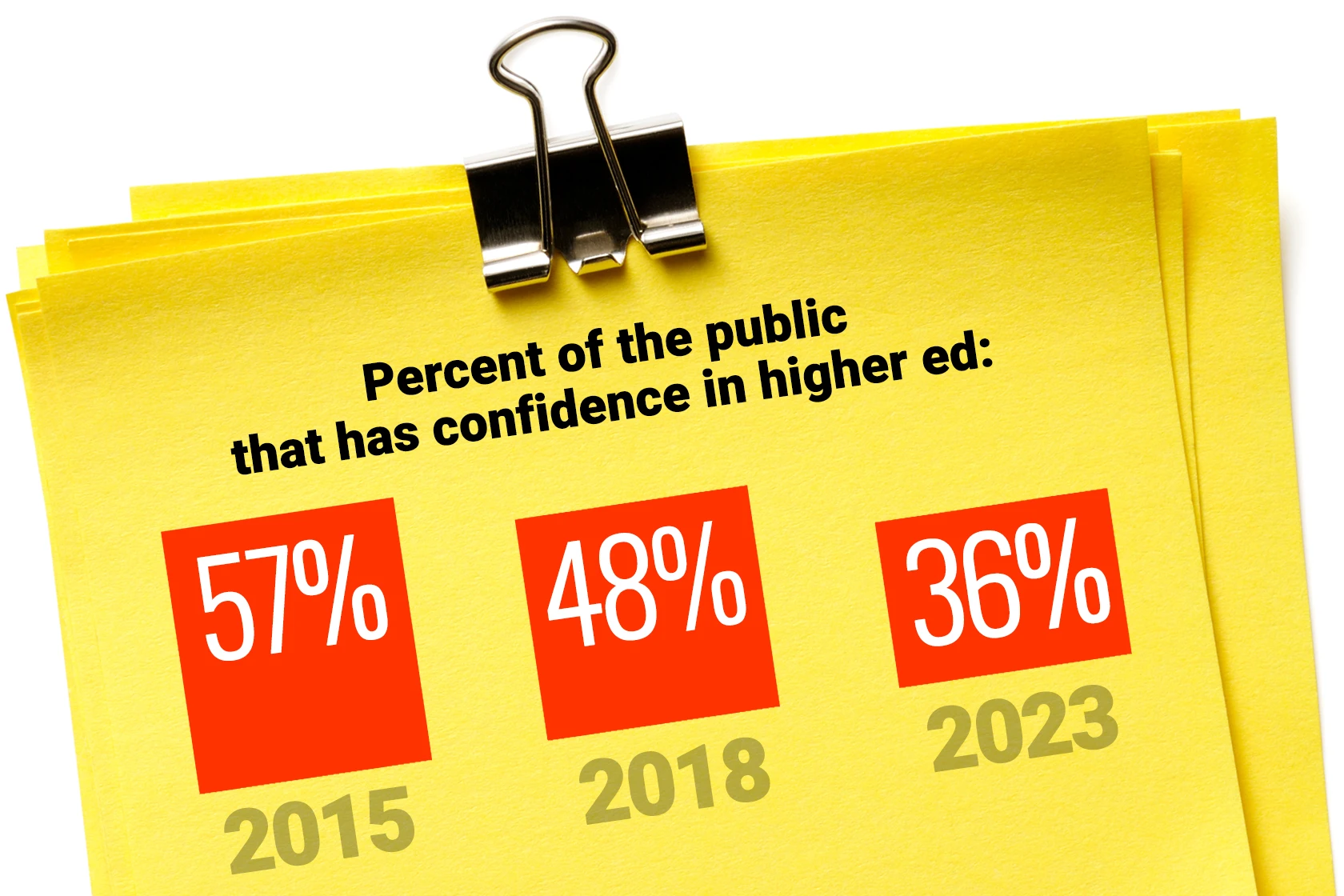
Only 36 percent of Americans say they have a great deal or quite a lot of confidence in higher education, according to a survey Gallup conducted in June. That’s down from 48 percent who said the same in 2018 and 57 percent in 2015.

It’s also broadly consistent with a March Wall Street Journal-NORC survey that found just 42 percent of respondents thought college was worth the cost because it improves career prospects.

Confidence waned among all major groups. Sharpest declines were among Republicans, those without a college degree, women, and the oldest respondents.

Rick links to Zachary’s article:

Public Trust in Higher Ed Has Plummeted. Yes, Again. — from chronicle.com by Zachary Schermele
Americans’ confidence in higher ed is continuing to shrivel — a troubling sign that could foreshadow further erosion of colleges’ enrollment, funding, and stature in the coming years.
.


Also relevant/see:


From DSC:
The Bible talks about listening quite frequently. The authors ask people to listen to what is being communicated.

Proverbs 16:20
Whoever gives heed to instruction prospers,
and blessed is the one who trusts in the Lord.

Unfortunately, it often involves people NOT listening to the LORD and/or to others and, instead, going their/our own way. In my own life, things don’t go so well when I do that. I think the same is true on a more general/corporate level as well.

For example, Israel in ancient days thought and behaved this way too. Read 1 Kings and 2 Kings to see what I mean. They didn’t listen to the LORD. They didn’t listen to instruction. They thought they knew it all. They didn’t give credit to Whom credit was due. They made up their own gods and worshipped the things that they created.

The LORD wanted to bless them — and us. But they didn’t — and we still don’t — want to listen and submit to His will at times (even though His will is meant to BLESS US).

I used to see the LORD looking down from heaven, with a stern or disappointed look on His face. He was tapping His foot, and had His arms folded. I imagined Him saying, “Daniel, get your stuff together!!!” I didn’t see Him as being on my team.

Through the years He has shown me that He IS on my team and that He is active in my heart, mind, and life. He is full of grace, truth, patience, forgiveness, vulnerable love, and wisdom. He’s awesome. I love Him and His ways — but that’s taken me decades to be able to say that.

He wants what is best for us. He gave us gifts and wants us to use those gifts to serve others.


Recording Arts as Reengagement, Social Justice and Pathway — from gettingsmart.com

Key Points

  • After a successful career as a recording artist, David “TC” Ellis created Studio 4 in St. Paul to spot budding music stars.
  • It became a hangout spot for creative young people, most of whom had “dropped out of school due to boredom and a sense that school wasn’t relevant to their lives and dreams.”
  • Ellis and colleagues then opened the High School for Recording Arts in 1998.

Young people learning how to perform and record music at the High School for Recording Arts


Peanuts Sing Roundabout — from theawesomer.com; I hadn’t seen this yet…so for those of my generation, you might like this as well! 🙂


How Schools Can Use Cultural Performing Arts to Reimagine Community-Engaged Learning — from edsurge.com by Christopher Sandoval

Excerpt:

My experience has taught me that if students do not believe their school is invested in activities and programs that reflect their community and culture, they will not feel a sense of belonging in the classroom, which will negatively impact student engagement and their ability to understand and appreciate cultural differences among one another.

Unfortunately, not every school believes the performing arts are worth the investment; if anything, the trend of school funding in the performing arts has been in sharp decline for some time. While student engagement continues to be a significant issue for classrooms across the country, I believe the performing arts can be an opportunity for schools to reimagine community engagement in schools and get students back on track.


Teaching With Music: 5 Tips for Using it With Any Subject — from by Erik Ofgang
Tips for teaching with music as a helpful learning tool regardless of the subject from school social worker Sherena Small

Excerpt:

Teaching with music can enhance learning in almost any subject area, says Sherena Small, a school social worker at Champaign Unit 4 School District in Illinois.

“It’s just such a good way to enhance what kids are learning,” says Small, who uses hip-hop and other music to teach social-emotional learning skills, including empathy and active listening. Earlier this year, Nearpod recognized Small as an Educator of the Year for her innovative efforts using Nearpod’s Flocabulary tool to incorporate music into class.


Speaking of multimedia, also see:

A DEEP DIVE INTO PEER LEARNING AND STUDENT VIDEO CREATION WITH KRISTEN BROOKS – EASY EDTECH PODCAST 218


And here’s another interesting item from Dr. Burns:

HOW MICROLEARNING IS RESHAPING PROFESSIONAL DEVELOPMENT – BONUS EPISODE WITH BRITANNICA EDUCATION


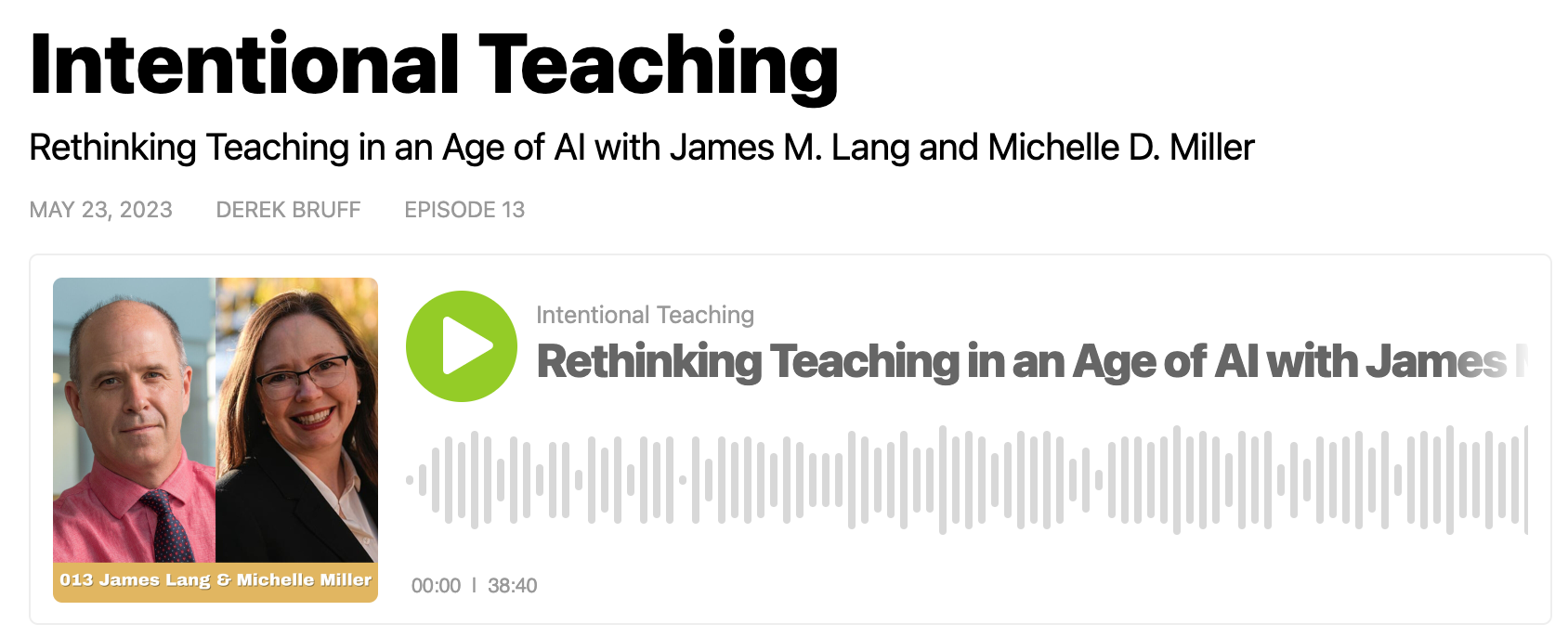
Intentional Teaching — from intentionalteaching.buzzsprout.com by Derek Bruff
Rethinking Teaching in an Age of AI with James M. Lang and Michelle D. Miller

Podcast from Derek Bruff -- Rethinking Teaching in an Age of AI with James M. Lang and Michelle D. Miller

Excerpt:

In her 2022 book Remembering and Forgetting in the Age of Technology, Michelle D. Miller writes about the “moral panics” that often happen in response to new technologies. In his 2013 book Cheating Lessons: Learning from Academic Dishonesty, James M. Lang argues that the best way to reduce cheating is through better course design. What do these authors have to say about teaching in an age of generative AI tools like ChatGPT? Lots!


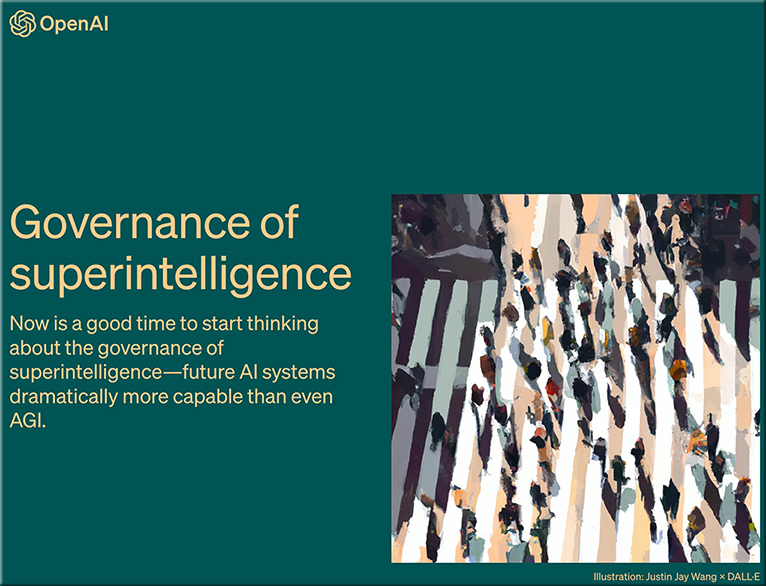
Governance of superintelligence — from openai.com
Now is a good time to start thinking about the governance of superintelligence—future AI systems dramatically more capable than even AGI.

Governance of superintelligence Now is a good time to start thinking about the governance of superintelligence—future AI systems dramatically more capable than even AGI.

OpenAI leaders propose international regulatory body for AI — from techcrunch.com by Devin Coldewey

Excerpt:

AI is developing rapidly enough and the dangers it may pose are clear enough that OpenAI’s leadership believes that the world needs an international regulatory body akin to that governing nuclear power — and fast. But not too fast. In a post to the company’s blog, OpenAI founder Sam Altman, President Greg Brockman and Chief Scientist Ilya Sutskever explain that the pace of innovation in artificial intelligence is so fast that we can’t expect existing authorities to adequately rein in the technology. While there’s a certain quality of patting themselves on the back here, it’s clear to any impartial observer that the tech, most visibly in OpenAI’s explosively popular ChatGPT conversational agent, represents a unique threat as well as an invaluable asset.

OpenAI-backed robot startup beats Elon Musk’s Tesla, deploys AI-enabled robots in real world — from firstpost.com by Mehul Reuben Das; via The Rundown
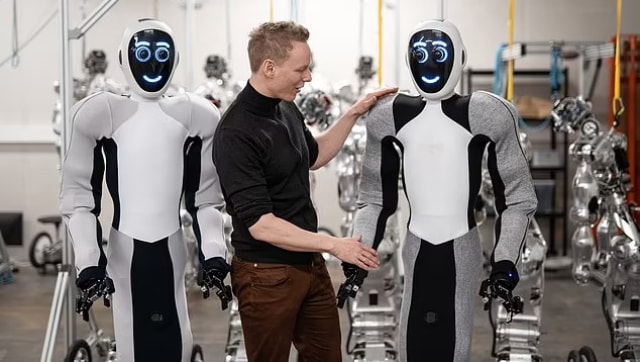
A robotics startup backed by OpenAI, the makers of ChatGPT has beaten Elon Musk’s Tesla in the humanoid robots race, and has successfully deployed humanoid robots as security guards. Next, they will be deploying the robots in hospices and assisted living facilities

A robotics startup backed by OpenAI, the makers of ChatGPT has beaten Elon Musk’s Tesla in the humanoid robots race, and has successfully deployed humanoid robots as security guards. Next, they will be deploying the robots in hospices and assisted living facilities.


From DSC:
Hmmm…given the crisis of loneliness in the United States, I’m not sure that this type of thing is a good thing. But I’m sure there are those who would argue the other side of this.


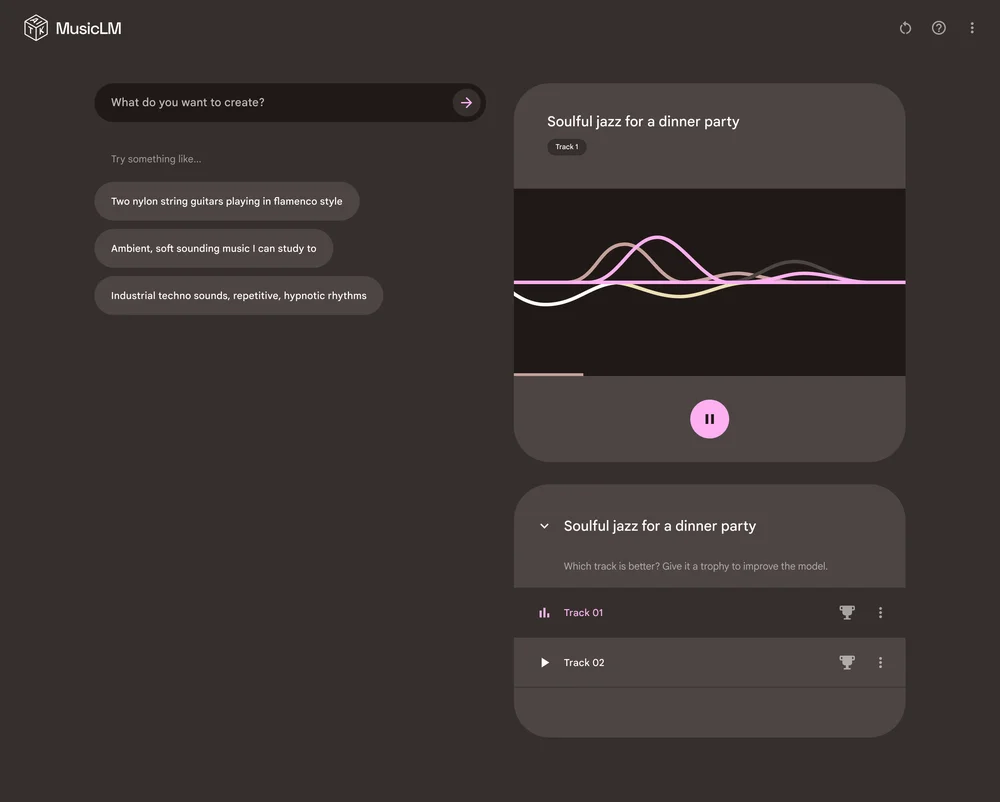
Turn ideas into music with MusicLM — from blog.google
Experiment today by describing a musical idea and hearing it come to life.

MusicLM is an experimental text-to-music model that can generate unique songs based on your ideas or descriptions.


Below comments/notes are from DSC (with thanks to Roberto Ferraro for this resource):
according to Dan Pink, intrinsic motivation is very powerful — much more powerful for many types of “messy/unclear” cognitive work (vs. clear, more mechanical types of work). What’s involved here according to Pink? Autonomy, mastery, and purpose. 

Dan Pink makes his case in the video below. My question is:

  • If this is true, how might this be applied to education/training/lifelong learning?

From DSC (cont’d):

As Dan mentions, we each know this to be true. For example, for each of our kids, my wife and I introduced them to a variety of things — music, sports, art, etc. We kept waiting for them to discover which thing(s) that THEY wanted to pursue. Perhaps we’ll find out that this was the wrong thing to do. but according to Pink, it’s aligned with the type of energy and productivity that gets released when we pursue something that we want to pursue. Plus creativity flows in this type of setting. 

Again, my thanks to Roberto Ferraro for resurfacing this item as his “One ‘must read’ for this week” item of his newsletter.


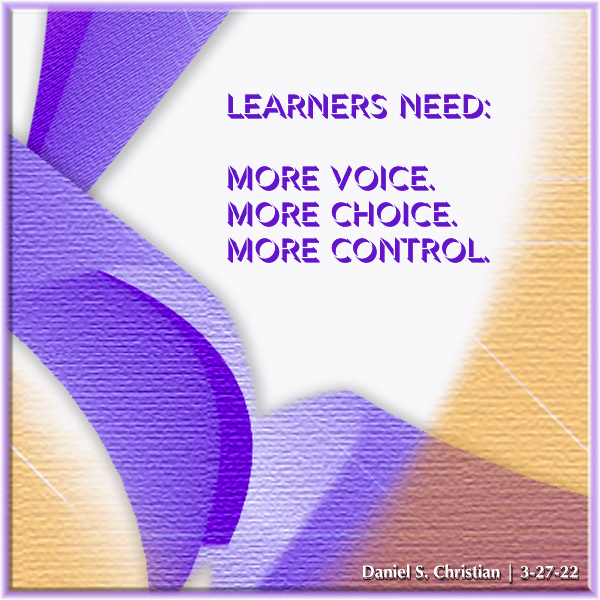
Learners need: More voice. More choice. More control. -- this image was created by Daniel Christian


How to Continue Learning after College Graduation — from ivypanda.com; with thanks to Yvonne McQuarrie for this resource.

First, a brief note from DSC:
I publish this piece because I’m a firm believer that all of us are now into lifelong learning. Each of us needs to be intentional on enhancing our personal learning ecosystems.

Excerpt:

College graduation often becomes a turning point in students’ lives. Fear, confusion, and self-doubt often affect you at this time. They are likely to impact your interest and motivation for further study. To overcome this, you will have to adopt a lifelong learning mindset.

Our team wants to help you preserve your natural curiosity and interest in studies long after your college years are over. Below you will find reasons why lifelong learning matters and how it can help you live a fulfilling life.

  1. Importance
  2. Reasons to Learn
  3. Keep Learning
  4. Find Motivation
  5. Final Thoughts
  6. References
 

Send in another victim of industrial disease — from jordanfurlong.substack.com
The legal profession is drowning in psychological and emotional distress. One change, right now, could help save the next generation of lawyers from the flood.

Excerpt:

But don’t make the mistake of thinking this is a problem just at Paul Hastings or in the AmLaw 100. It’s everywhere. Mental distress and emotional anguish are endemic throughout the legal profession, driven by pathologies inextricably intertwined with our malignant cultural impulses and exploitative business models. And it’s getting much worse, very fast.

Take a deep breath, and then work your way through this list of findings from seven separate reports into the legal profession’s state of mental and emotional sickness:

  • Massachusetts: 77% of lawyers reported burnout from their work; almost half thought about leaving their job. 40% considered leaving the profession entirely due to stress. 7% experienced suicide ideation in the weeks before the survey.
  • California and DC: Lawyers were twice as likely as the general population to experience thoughts of suicide, and those with high stress were 22 times more likely to have such thoughts.
  • Midsized law firms: Nearly 3/4 of lawyers, paralegals and administrative professionals at midsized law firms report feeling stress, burnout, or being overwhelmed in the past year.
  • Canada: 59% of legal professionals report psychological distress. 56% report burnout. 24% say they’ve experienced suicidal thoughts at least once since starting practice.
  • UK: 62% of lawyers have experienced burnout as a result of their work in the last year. 57% put “an unmanageable caseload” at the top of their list of stressors at work, followed by a lack of work/life balance (42%).
  • In-house counsel: Legal department lawyers face burnout and attrition internally, and supply chain issues and high inflation externally. “The environment legal departments are operating in now is an extremely challenging one.”
  • Law students: Over 75% reported increased anxiety because of law school-related issues; over 50% reported experiencing depression. A majority reported experiencing anxiety (77%), disrupted sleep (71%), and depression (51%).

Every one of the percentages laid out above is higher for new lawyers, higher for women, higher for visible minorities, and higher for members of the LGBTQ+ community. And all but one of these reports were released just in the first two months of 2023.


From DSC:
One of the enormous surprises that I learned about while working at a law school (from 2018-2021) is the state of mental health within the legal industry. It’s not good. Beware!

Students in college — or to anyone who is thinking about entering law school and then practicing some area of law — get educated on things. Talk to lawyers of all kinds — especially in the area(s) that you are thinking of going into.

Then go forward into your decision with your eyes wide open. Know that you will need to put up some serious boundaries; if you don’t do that, you too may suffer the consequences that many lawyers have had to deal with.

I caught up with an old college friend of mine a year or so ago. He was absolutely exhausted. He was emotionally at the end of his rope. He was the owner of his own law firm and was working non-stop. He didn’t want to disappoint his clients, so he kept saying yes to things…to almost everything in fact. He later got out of owning his own firm — thank God — and went to work for an insurance company.

Furlong: Law school curricula and bar admission programs in every jurisdiction should be upgraded, starting today, to include significant instruction to aspiring lawyers about the deadly serious threats to their lives and health posed by choosing a legal career.

I just want to pass this along because I don’t think many younger students realize the state of mental health and stress within the legal field. And while you’re reflecting on that, you should also pulse-check how AI is impacting the legal field. Along these lines — and also from Jordan Furlong — see:


Poetry writing about Flint murals allows for ‘creative freedom’ in this high school classroom — from mlive.com  by Dylan Goetz (behind paywall)

Excerpt:

It’s a new tradition in the curriculum of the senior-level English class, where teacher Carrie Mattern asks her students to seek out a mural in Flint and write poetry about it.

This year, there was a focus on writing around cultural grief and the process of healing.

It’s become a favorite assignment for the students who’ve worked on the project, who say it allows them to use “creative freedom” in a way that other classes don’t.
.


Also see:

 
© 2025 | Daniel Christian