K-12 schools around the world tackling social injustice — from thetechedvocate.org by Matthew Lynch

Excerpt:

Social justice is a broad term that includes the economic, social, political, and civic as well as the human rights aspects of society. The denial of these basic elements is what we call social injustice. Social injustice is the product of years of oppression and discrimination and often breeds resentment and anger towards certain groups in society. It is evident that social justice is a problem that is yet to be sufficiently addressed through the ever-increasing protests, boycotts, and even violence inflicted on certain groups.

Restorative Justice Solutions for Youth Are Growing Abroad, Can They Become Part of the Mix in the U.S. — from the74million.org by Elizabeth Thompson

Excerpt:

The underlying philosophy for Piedmont Mediation’s process is restorative justice, said Terri Masiello, Piedmont Mediation’s executive director and the coordinator of the Restoring Youth Coalition of North Carolina.

Restorative justice is the practice of bringing together affected parties of a crime to discuss what happened and what needs to happen to make things right.

Piedmont Mediation is a diversion program that serves as an alternative to juvenile court for some cases in the Piedmont area of North Carolina, serving Alexander, Iredell, Davie, Davidson and Randolph counties.


The top 5 benefits of art programs for children — from thetechedvocate.org by Matthew Lynch

Excerpt:

Schools across the country are removing art programs and classes. Some do so due to a lack of funding; others just don’t believe it’s an essential subject for children. Unfortunately, many schools and learning institutes don’t realize the dangers of removing art. You wouldn’t question Math or English as core subjects, but many question the importance of art.

Art nurture’s a child’s inner creativity. So, what benefits does art bring to a child?


45 Next Generation Learning Tools That Kids Will Love — from ireviews.com with thanks to Alex Ward for this resource

Excerpts:

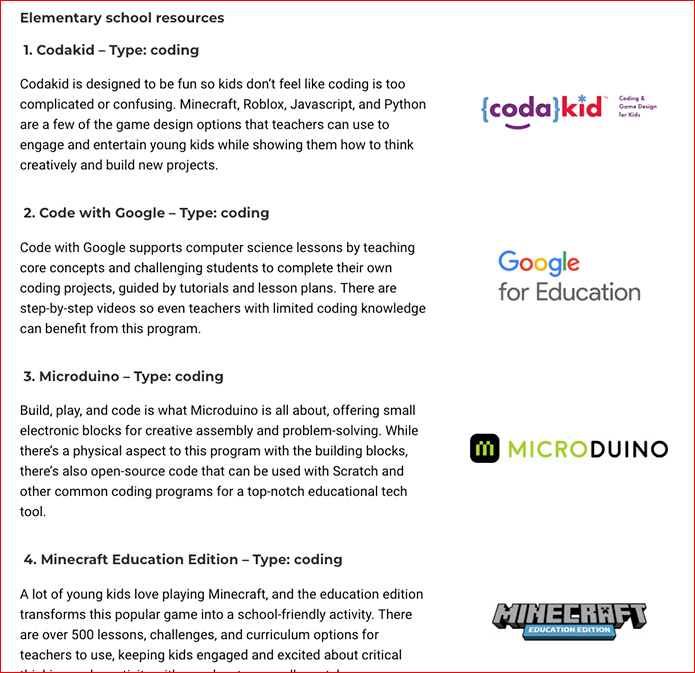
There’s a wide range of tools designed to support curriculum and help teachers and students achieve their goals. These are our top picks for school students of every age, due to their impressive functionality and simple integration into the classroom.


From DSC:
Below is a sample screenshot from the Elementary school resources section. They also have resources for middle schoolers and high schoolers.


45 Next Generation Learning Tools That Kids Will Love


Visions of the Internet in 2035 — from pewresearch.org

Excerpt:

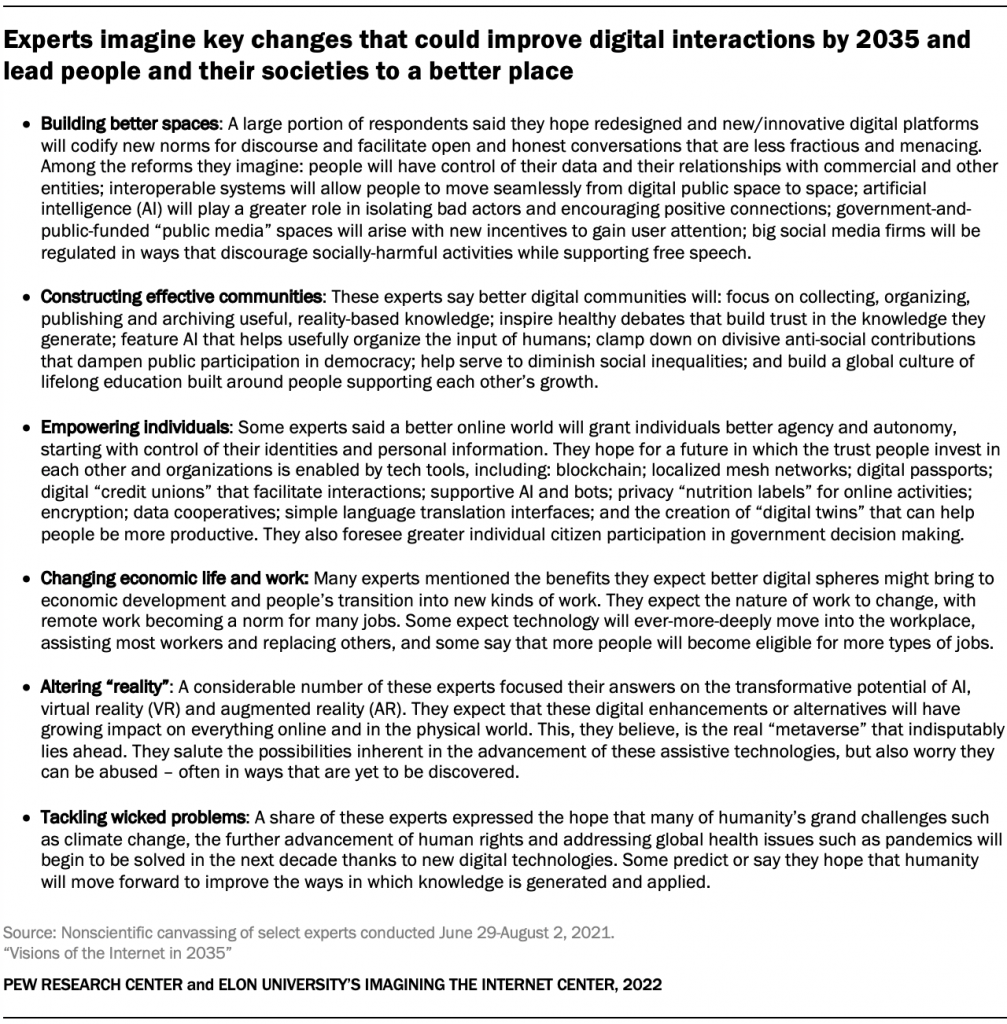
This report is the second of two analyzing the insights of hundreds of technology experts who responded in the summer of 2021 to a canvassing of their predictions about the evolution of online public spaces and their role in democracy in the coming years. In response to the primary research question, many said they expect that these forums will be significantly improved by 2035 if reformers, big technology firms, governments and activists tackle the problems created by misinformation, disinformation and toxic discourse. At the same time, they expressed ongoing concerns about the destructive forces in culture and technology that could continue to plague online life and disrupt beneficial change in the coming years.

Visions of the Internet in 2035


10 things you didn’t know you could do with Google Arts and Culture — from ditchthattextbook.com

Excerpt:

Google Arts and Culture is a massive collection of videos and images of cultural artifacts from over 2,000 museums around the world. But virtually visiting art exhibits is just one of the many things you can do with Google Arts and Culture. From virtually displaying life-sized art inside your house to playing in a blob opera, Google Arts and Culture runs an impressive gamut of ways to explore culture from your own home or classroom.


From DSC:
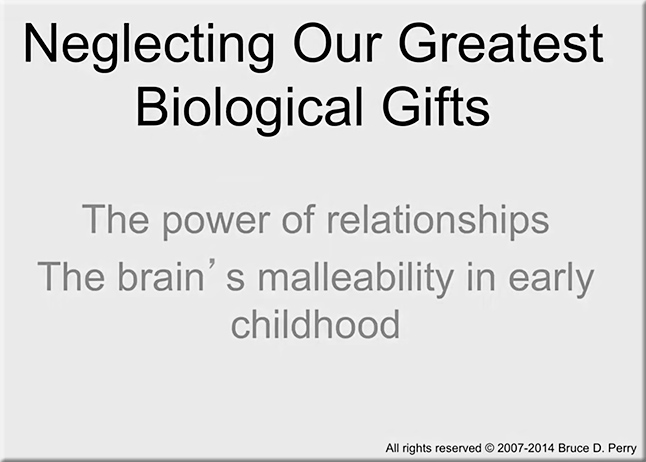
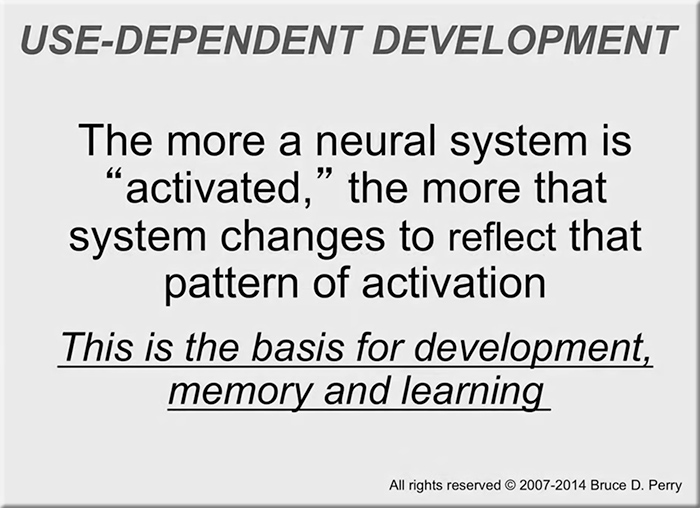
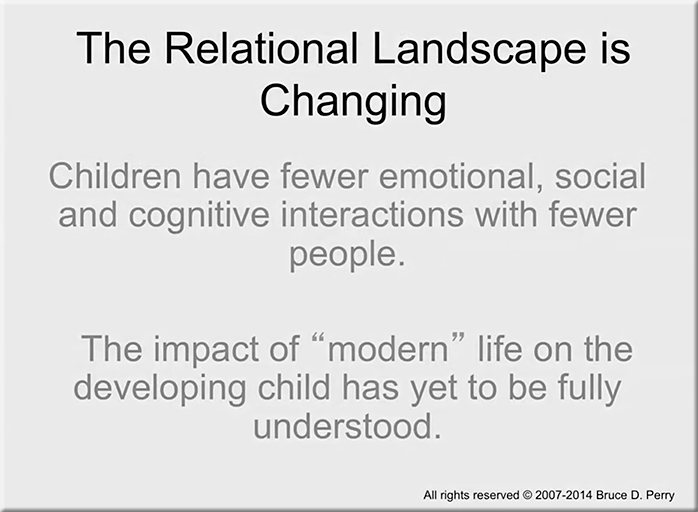
One of my sisters is a Professor of Psychology and she highly recommended that I check out the work of Dr. Bruce D. Perry. Below is an example video that was recorded on October 25, 2014 as part of the 25th Anniversary Chicago Humanities Festival, Journeys. I included some excerpted slides in this posting to give you a flavor of portions of this talk.

Description (emphasis DSC):

Each of us takes the same journey from birth to consciousness—but none of us recalls it. This early stage of life is crucial; Sigmund Freud famously obsessed over it, as do millions of parents every day. What goes on cognitively during that time, and what can parents—and other adults—do to further promote infant well-being? Join renowned psychiatrist Bruce D. Perry, recipient of the 2014 Dolores Kohl Education Prize, for this discussion of early-childhood brain development and its long-term importance.

Social & Emotional Development in Early Childhood [CC]


The Humanities May Be Declining at Universities — But They’re Thriving on Zoom — from edsurge.com by Rebecca Koenig

Excerpt:

Throughout the pandemic, versions of this close-reading conversation have taken place week after week. Organized through new nonprofits and small startups including the Catherine Project, Night School Bar and Premise, they bring together adults who want to spend their free time talking to strangers about literature and philosophy.

It sounds at first like an ambitious book club—except for the fact that many of these seminars are organized and led by college professors, some so eager to participate that they do it for free.

“Mostly it’s a way for them to do a kind of teaching they can’t do at their regular jobs,” explains Zena Hitz, founder of the Catherine Project and a tutor (faculty member) at St. John’s College in Annapolis, Maryland.

From DSC:
I’ve often thought that online-based learning may be the thing that saves the liberal arts (i.e., available throughout one’s lifetime and would be far less expensive). It would be ironic though, as many liberal arts institutions have not been proponents of online-based learning.


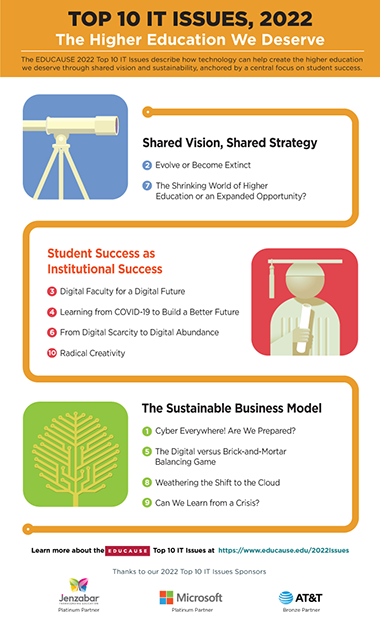
EDUCAUSE 2022 Top 10 IT Issues — from educause.edu
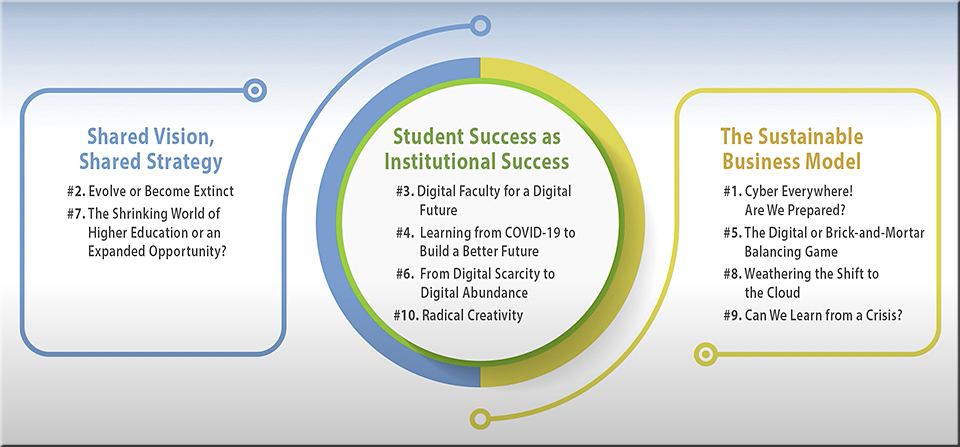
EDUCAUSE's 2022 Top 10 IT Issues


EDUCAUSE's 2022 Top 10 IT Issues

Excerpt (emphasis DSC):

The EDUCAUSE 2022 Top 10 IT Issues take an optimistic view of how technology can help create the higher education we deserve —through a shared transformational vision and strategy for the institution, a recognition of the need to place student success at the center, and a sustainable business model that redefines “the campus.”

See the 2022 Top 10 IT Issues

Almost two years into a global pandemic, it’s clear the higher education we knew will never return and now we can focus on getting the higher education we deserve.


From DSC:
I’m assuming that the we in the we deserve (as highlighted above) includes the students, as *the students* are the ones who most need for things to change.

That said, I’m doubtful such profound change will occur within higher education as it stands today. The existing cultures may prevent such significant and necessary change from occurring — and higher ed isn’t used to dealing with the current exponential pace of change that we’re experiencing. Plus, the downward spirals that many institutions are in don’t always allow for the new investments, programs, and/or experiments to occur. But who knows? When institutions of traditional higher education have their backs pressed up against the walls, perhaps such institutions and the people within them will be forced to change. There are innovative individuals and institutions out there. (I’m just not sure how much they’ve been listened to in many cases.)

To help students truly succeed means to change one’s core products/services — one’s story. But higher ed loves to play around the edges…rarely letting the core products/services get touched. 

To me, student success includes having students pay far less and, while still getting a solid liberal arts education/foundation, can get solid jobs immediately upon graduation. At least that’s my hope as we head into 2022. 

But what student success looks like may be different in the future.

Perhaps in 5 years, we will have moved much more towards a lifelong learning situation. Individuals may have joined a global, next-generation learning platform whereby one teaches for X minutes of the day, and learns for Y minutes of that same day. AI-based dashboards let people know which skills are in high demand, and then offer a menu of choices for how to acquire those skills.

A couple of lasts comments:

  • Being data-driven won’t save an institution. Vision might. But being data-driven has its limits.
  • The digital transformations being talked about within institutions of traditional higher education may be too little, too late. This conversation should have taken place a decade or more ago. (I think I just heard an “Amen!” from some folks who used to work at Blockbuster. They didn’t think a transformation was necessary either….but they learned their lesson the hard way. We should have learned from their situation…a long time ago. And I’m sure that you can think of other examples as well.)


Fastcase Unveils NextChapter Docs Form Preparation, Client Management Tools, and Workflow Tools for All Practice Areas — from legaltechmonitor.com by Jaime Houssami

Excerpt:

To that end, NextChapter is soon releasing a Forms Exchange, where seasoned attorneys can upload their form templates to the marketplace for other attorneys to purchase for their own use. “Providing access to pre-built forms designed by subject matter experts will be useful for many of the solo and small firm practitioners,” said NextChapter’s first Forms attorney author Carolyn Elefant.

TechReport 2021: Websites & Marketing — from lawtechnologytoday.org by Allison C. Johs

Excerpt:

The COVID-19 pandemic brought changes to the practice of law–many of which were overdue–including virtual meetings and client conferences, remote document signings, court appearances by Zoom and Microsoft Teams, and more. But according to the ABA Legal Technology Resource Center’s 2021 Legal Technology Survey Report results on the use of technology in the legal profession, there is still work to be done.

Linklaters launches virtual global business teams internship — from legaltechnology.com by Caroline Hill

Excerpt:

While most law firm internships are focussed exclusively on attracting future lawyers, magic circle law firm Linklaters has launched a virtual global business teams internship programme aimed at 16- to 18-year-old students. The new internship, which will be welcomed by many for shining a light on the key functions that enable a law firm to run and succeed, will help interns to become aware of the wide range of career options available at Linklaters.

Linklaters Internships For 16-18 Year Olds To Cover Legal Ops + Tech — from artificiallawyer.com


Native American Students Build STEM Skills While Exploring Their Cultural Stories with VR/AR Design Projects — from campustechnology.com by Mary Grush and Tilanka Chandrasekera

Excerpt:

Through a $1.5million, four-year NSF grant, Oklahoma State University researchers are leveraging their earlier work with proven, college-level design courses that incorporate VR, AR, and 3D printing technologies. But this time, they are helping underserved Native American middle school students develop STEM skills.

Here, Campus Technology talks with Principal Investigator Dr. Tilanka Chandrasekera, who is an endowed professor at OSU and director of the Mixed Reality Lab, to find out more about the grant that the NSF titled, “Engaging Native American Students in STEM Career Development Through a Culturally Responsive After School Program Using Virtual Environments and 3D Printing.”


2022 Top 10 IT Issues -- from Educause

2022 Top 10 IT Issues


From DSC:
Time will tell which institutions have the prerequisite culture of innovation that will help reinvent themselves, stay relevant, and survive. 

And for people (who have worked in higher education for years) who don’t like to see learners as customers…well…when those learners are often paying $100,000-$250,000 or more for a four-year degree, those folks don’t have much say or credibility any longer. The price increases that they never stepped in to stop from occurring have forever changed the learning ecosystems within higher education. The idea of supporting  the perspective that says:

Well, we’re proud (and content) that our institution will have the lowest price increase in X (where X is a city, state,  or geographic region)
or
We’re proud that our institution will have the lowest price increase within our group of similar/comparative institutions.

…well, that type of perspective hasn’t cut it for years now. But the danger of that status quo perspective is only becoming apparent to many now that one’s very survival is at stake.


Addendum/also see:


Three Steps to Building a Learning Culture That Delivers Innovation — from sloanreview.mit.edu by Ori Mor
To create technological solutions for grand challenges, companies must foster cultures that support continuous learning and team optimism.

Excerpt:

Now that we’re on the other side, with our system up and running in retail outlets, helping to reduce e-waste (such as cords and batteries), we’re able to look back and see what it took to get here. While the skills of our team were essential, the biggest reason we ultimately succeeded was our culture of continuous learning. Three steps in particular allowed that culture to thrive.

Also relevant — especially to those working in higher education — see:


© 2025 | Daniel Christian