


In ‘Flying High,’ Tyler D. Ballon’s Portraits Parallel Sports, History, Identity, and Patriotism — from thisiscolossal.com by Tyle Ballon and Kate Mothes

In ‘Flying High,’ Tyler D. Ballon’s Portraits Parallel Sports, History, Identity, and Patriotism — from thisiscolossal.com by Tyle Ballon and Kate Mothes
From DSC:
Look out Google, Amazon, and others! Nvidia is putting the pedal to the metal in terms of being innovative and visionary! They are leaving the likes of Apple in the dust.
The top talent out there is likely to go to Nvidia for a while. Engineers, programmers/software architects, network architects, product designers, data specialists, AI researchers, developers of robotics and autonomous vehicles, R&D specialists, computer vision specialists, natural language processing experts, and many more types of positions will be flocking to Nvidia to work for a company that has already changed the world and will likely continue to do so for years to come.
NVIDIA just shook the AI and Robotic world at NVIDIA GTC 2025.
CEO Jensen Huang announced jaw-dropping breakthroughs.
Here are the top 11 key highlights you can’t afford to miss: (wait till you see no 3) pic.twitter.com/domejuVdw5
— The AI Colony (@TheAIColony) March 19, 2025
NVIDIA’s AI Superbowl — from theneurondaily.com by Noah and Grant
PLUS: Prompt tips to make AI writing more natural
That’s despite a flood of new announcements (here’s a 16 min video recap), which included:
For enterprises, NVIDIA unveiled DGX Spark and DGX Station—Jensen’s vision of AI-era computing, bringing NVIDIA’s powerful Blackwell chip directly to your desk.
Nvidia Bets Big on Synthetic Data — from wired.com by Lauren Goode
Nvidia has acquired synthetic data startup Gretel to bolster the AI training data used by the chip maker’s customers and developers.
Nvidia, xAI to Join BlackRock and Microsoft’s $30 Billion AI Infrastructure Fund — from investopedia.com by Aaron McDade
Nvidia and xAI are joining BlackRock and Microsoft in an AI infrastructure group seeking $30 billion in funding. The group was first announced in September as BlackRock and Microsoft sought to fund new data centers to power AI products.
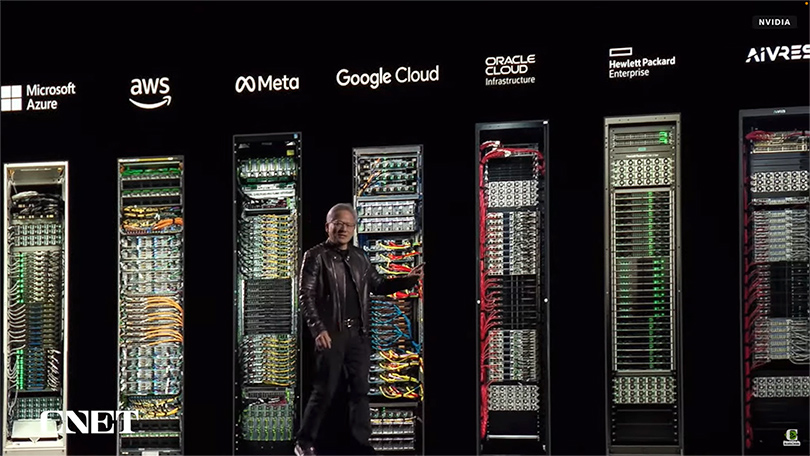
Nvidia CEO Jensen Huang says we’ll soon see 1 million GPU data centers visible from space — from finance.yahoo.com by Daniel Howley
Nvidia CEO Jensen Huang says the company is preparing for 1 million GPU data centers.
Nvidia stock stems losses as GTC leaves Wall Street analysts ‘comfortable with long term AI demand’ — from finance.yahoo.com by Laura Bratton
Nvidia stock reversed direction after a two-day slide that saw shares lose 5% as the AI chipmaker’s annual GTC event failed to excite investors amid a broader market downturn.
Microsoft, Google, and Oracle Deepen Nvidia Partnerships. This Stock Got the Biggest GTC Boost. — from barrons.com by Adam Clark and Elsa Ohlen
The 4 Big Surprises from Nvidia’s ‘Super Bowl of AI’ GTC Keynote — from barrons.com by Tae Kim; behind a paywall
AI Super Bowl. Hi everyone. This week, 20,000 engineers, scientists, industry executives, and yours truly descended upon San Jose, Calif. for Nvidia’s annual GTC developers’ conference, which has been dubbed the “Super Bowl of AI.”
Learning as a Learning Professional: Unlock Hidden Opportunities — from learningguild.com by Will Thalheimer
As learning professionals, we help others grow—but how well are we developing ourselves? And does it really matter? Absolutely! In this article, I’ll explore why mastering the art of learning is crucial for our success and share strategies that go beyond traditional professional development.
Why learning matters for us
We need to be strong learners because our work demands broad expertise. We must understand the learning sciences, instructional design, project management, technology, evaluation, organizational dynamics, and business strategy. We also need to navigate a sea of learning frameworks, approaches, and models.
Also from learningguild.com, see:
Microlearning: The Key to Capturing Modern Learners’ Attention — by Sergiy Movchan
This shift in how we consume and process information is challenging traditional learning methods, which are finding it increasingly difficult to keep learners’ attention.
Microlearning is a bridge to the attention of today’s learners, delivering complex topics in short, manageable pieces. Whether it’s a five-minute video, a quick quiz, or a short lesson, microlearning makes it easier for students to stay engaged. Microlearning often holds learners’ attention better and for longer compared to standard learning methods.
Typical low completion rates clearly show the need for innovative approaches to content delivery and student engagement. Microlearning offers the answer to this need.
Cultivating Creativity as an L&D Professional — by Katie Belle (Curry) Nelson
Instructional designers and learning professionals are creative by nature. We are called upon to be creative with technology like Articulate, Camtasia, or Captivate. More often than we would like, organizations, red tape, and clients require us to be creative with timelines and budgets. Being creative is a core qualification and requirement of our work. So, what do we do when we feel like the creative river has run to a trickle or dried up entirely?
From Dazzling Lights to Bursting Geysers, Jennifer Esseiva Captures Iceland’s Diverse Scenery — from thisiscolossal.com by Jennifer Esseiva and Jackie Andres

Uncanny Objects by Joyce Lin Blur Distinctions Between Reality and the Fantastical — from thisiscolossal.com by Kate Mothes and Joyce Lin

In London, an Enormous Exhibition of 500+ Works Roots Out the Creative Seeds of Flowers — from thisiscolossal.com by Grace Ebert and Co.

Mous Lamrabat’s Striking Portraits Put Unity, Love, and Compassion in Sharp Focus — from thisiscolossal.com by Kate Mothes and Mous Lamrabat

Escaped from the paper world
— Science girl (@gunsnrosesgirl3) January 11, 2025
The Best of AI 2024: Top Winners Across 9 Categories — from aiwithallie.beehiiv.com by Allie Miller
2025 will be our weirdest year in AI yet. Read this so you’re more prepared.

Top AI Tools of 2024 — from ai-supremacy.com by Michael Spencer (behind a paywall)
Which AI tools stood out for me in 2024? My list.
Memorable AI Tools of 2024
Catergories included:
New “best” AI tool? Really? — from theneurondaily.com by Noah and Grant
PLUS: A free workaround to the “best” new AI…
What is Google’s Deep Research tool, and is it really “the best” AI research tool out there?
…
Here’s how it works: Think of Deep Research as a research team that can simultaneously analyze 50+ websites, compile findings, and create comprehensive reports—complete with citations.
Unlike asking ChatGPT to research for you, Deep Research shows you its research plan before executing, letting you edit the approach to get exactly what you need.
…
It’s currently free for the first month (though it’ll eventually be $20/month) when bundled with Gemini Advanced. Then again, Perplexity is always free…just saying.
We couldn’t just take J-Cal’s word for it, so we rounded up some other takes:
Our take: We then compared Perplexity, ChatGPT Search, and Deep Research (which we’re calling DR, or “The Docta” for short) on robot capabilities from CES revealed:
An excerpt from today’s Morning Edition from Bloomberg
Global banks will cut as many as 200,000 jobs in the next three to five years—a net 3% of the workforce—as AI takes on more tasks, according to a Bloomberg Intelligence survey. Back, middle office and operations are most at risk. A reminder that Citi said last year that AI is likely to replace more jobs in banking than in any other sector. JPMorgan had a more optimistic view (from an employee perspective, at any rate), saying its AI rollout has augmented, not replaced, jobs so far.
This woman Is the new Bob Ross ?
?paintwithkatmuggpic.twitter.com/vT4Fiq2YBJ
— Interesting things (@awkwardgoogle) December 8, 2024
— Art world (@Artsworlld) December 13, 2024
Magic and Mystery Illuminate Hari & Deepti’s Paper-Cut Dioramas — from thisiscolossal.com by Grace Ebert and Hari & Deepti

Ethereal, Glowing Curtains Drape Over Lake Michigan in Reuben Wu’s Light Paintings — from thisiscolossal.com by Kate Mothes and Reuben Wu

Edge of origin. pic.twitter.com/sAfLQjAqKf
— Qyraxos (@qyraxos) December 7, 2024
Artist Spotlight: Jessica Vollrath — from booooooom.com by Staff and Jessica Vollrath

Colossal’s Top Articles of 2024 — from thisiscolossal.com

Where to start with AI agents: An introduction for COOs — from fortune.com by Ganesh Ayyar
Picture your enterprise as a living ecosystem, where surging market demand instantly informs staffing decisions, where a new vendor’s onboarding optimizes your emissions metrics, where rising customer engagement reveals product opportunities. Now imagine if your systems could see these connections too! This is the promise of AI agents — an intelligent network that thinks, learns, and works across your entire enterprise.
Today, organizations operate in artificial silos. Tomorrow, they could be fluid and responsive. The transformation has already begun. The question is: will your company lead it?
The journey to agent-enabled operations starts with clarity on business objectives. Leaders should begin by mapping their business’s critical processes. The most pressing opportunities often lie where cross-functional handoffs create friction or where high-value activities are slowed by system fragmentation. These pain points become the natural starting points for your agent deployment strategy.
Create podcasts in minutes — from elevenlabs.io by Eleven Labs
Now anyone can be a podcast producer

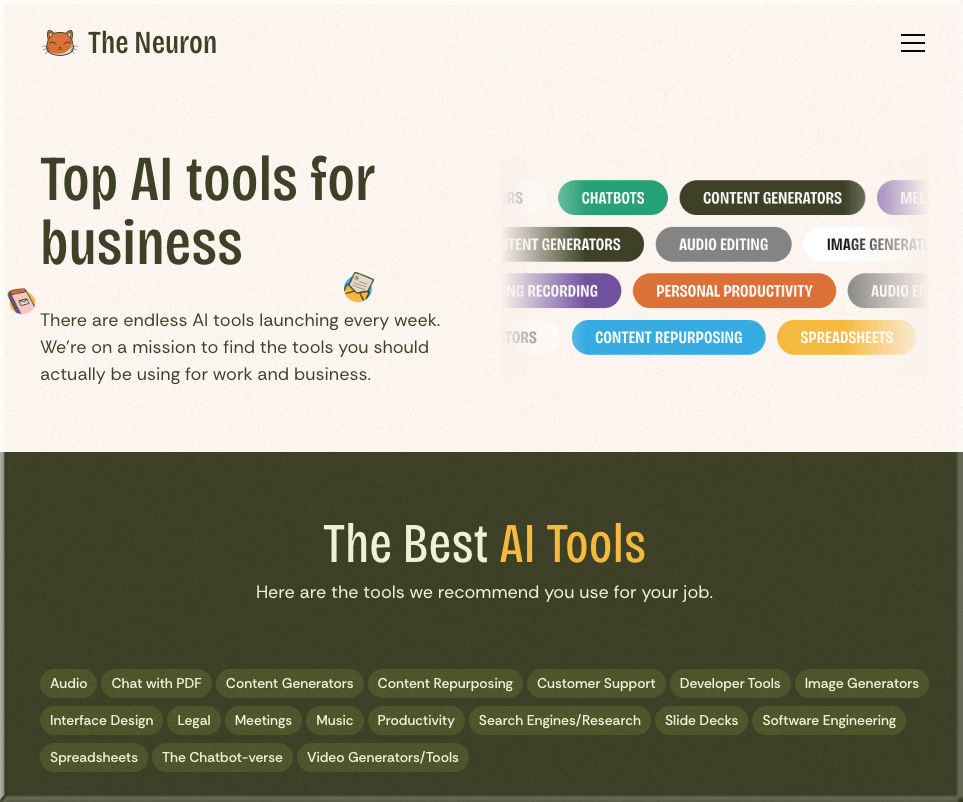
Top AI tools for business — from theneuron.ai
This week in AI: 3D from images, video tools, and more — from heatherbcooper.substack.com by Heather Cooper
From 3D worlds to consistent characters, explore this week’s AI trends
Another busy AI news week, so I organized it into categories:
Want to speak Italian? Microsoft AI can make it sound like you do. — this is a gifted article from The Washington Post;
A new AI-powered interpreter is expected to simulate speakers’ voices in different languages during Microsoft Teams meetings.

Artificial intelligence has already proved that it can sound like a human, impersonate individuals and even produce recordings of someone speaking different languages. Now, a new feature from Microsoft will allow video meeting attendees to hear speakers “talk” in a different language with help from AI.
What Is Agentic AI? — from blogs.nvidia.com by Erik Pounds
Agentic AI uses sophisticated reasoning and iterative planning to autonomously solve complex, multi-step problems.
The next frontier of artificial intelligence is agentic AI, which uses sophisticated reasoning and iterative planning to autonomously solve complex, multi-step problems. And it’s set to enhance productivity and operations across industries.
Agentic AI systems ingest vast amounts of data from multiple sources to independently analyze challenges, develop strategies and execute tasks like supply chain optimization, cybersecurity vulnerability analysis and helping doctors with time-consuming tasks.
Amazing Chalk Art ?pic.twitter.com/KpqTlJFFsM
— Interesting things (@awkwardgoogle) November 27, 2024
— Art world (@Artsworlld) November 27, 2024
Spray Artwork pic.twitter.com/HxBzOVqDke
— Art world (@Artsworlld) November 27, 2024
Wow.. pic.twitter.com/cc9ANywMcO
— Art world (@Artsworlld) November 28, 2024
Rate this Artwork pic.twitter.com/DpuKqYZqKq
— Art world (@Artsworlld) November 30, 2024
Masakatsu Sashie’s Mysterious Spheres Hover Over Post-Apocalyptic Landscapes — from thisiscolossal.com by Kathe Mothes and Masakatsu Sashie

