Experiences in self-determined learning — a free download/PDF file from uni-oldenburg.de by Lisa Blaschke, Chris Kenyon, & Stewart Hase (Eds.)

Excerpts (emphasis DSC):

An Introduction to Self-Determined Learning (Heutagogy)

Summary
There is a good deal that is provocative in the theory and principles surrounding self-determined learning or heutagogy. So, it seems appropriate to start off with a, hopefully, eyebrow-raising observation. One of the key ideas underpinning self-determined learning is that learning, and educational and training are quite different things. Humans are born to learn and are very good at it. Learning is a natural capability and it occurs across the human lifespan, from birth to last breath. In contrast, educational and training systems are concerned with the production of useful citizens, who can contribute to the collective economic good. Education and training is largely a conservative enterprise that is highly controlled, is product focused, where change is slow, and the status quo is revered. Learning, however, is a dynamic process intrinsic to the learner, uncontrolled except by the learner’s mental processes. Self-determined learning is concerned with understanding how people learn best and how the methods derived from this understanding can be applied to educational systems. This chapter provides a relatively brief introduction of the origins, the key principles, and the practice of self-determined learning. It also provides a number of resources to enable the interested reader to take learning about the approach further.

Contributors to this book come from around the world: they are everyday practitioners of self-determined learning who have embraced the approach. In doing so, they have chosen the path less taken and set off on a journey of exploration and discovery – a new frontier – as they implement heutagogy in their homes, schools, and workplaces. Each chapter was written with the intent of sharing the experiences of practical applications of heutagogy, while also encouraging those just starting out on the journey in using self-determined learning. The authors in this book are your guides as you move forward and share with you the lessons they have learned along the way. These shared experiences are meant to be read – or dabbled in – in any way that you want to read them. There is no fixed recipe or procedure for tackling the book contents.

…

At the heart of self-determined learning is that the learner is at the centre of the learning process. Learning is intrinsic to the learner, and the educator is but an agent, as are many of the resources so freely available these days. It is now so easy to access knowledge and skills (competencies), and in informal settings we do this all the time, and we do it well. Learning is complex and non-linear, despite what the curricula might try to dictate. In addition, every brain is different as a result of its experience (as brain research tells us). Each brain will also change as learning takes place with new hypotheses, new needs, and new questions forming, as new neuronal connections are created.

Heutagogy also doesn’t have anything directly to do with self-determination theory (SDT). SDT is a theory of motivation related to acting in healthy and effective ways (Ryan & Deci, 2000). However, heutagogy is related to the philosophical notion of self-determinism and shares a common belief in the role of human agency in behavior.

The idea of human agency is critical to self-determined learning, where learning is learner-directed. Human agency is the notion that humans have the capacity to make choices and decisions, and then act on them in the real world. However, how experiences and learning bring people to make the choices and decisions that they do make, and what actions they may then take is a very complex matter. What we are concerned with in self-determined learning is that people have agency with respect to how, what, and when they learn. It is something that is intrinsic to each individual person. Learning occurs in the learner’s brain, as the result of his or her past and present experiences.


The notion of placing the learner at the centre of the learning experience is a key principle of self-determined learning. This principle is the opposite of teacher-centric or, perhaps more accurately curriculum-centric, approaches to learning. This is not to say that the curriculum is not important, just that it needs to be geared to the learner – flexible, adaptable, and be a living document that is open to change.

Teacher-centric learning is an artifact of the industrial revolution when an education system was designed to meet the needs of the factories (Ackoff & Greenberg, 2008) and to “make the industrial wheel go around” (Hase & Kenyon, 2013b). It is time for a change to learner-centred learning and the time is right with easy access to knowledge and skills through the Internet, high-speed communication and ‘devices’. Education can now focus on more complex cognitive activities geared to the needs of the 21st century learner, rather than have its main focus on competence (Blaschke & Hase, 2014; Hase & Kenyon, 2013a).


What is a learning ecosystem? And how does it support corporate strategy? — from ej4.com by Ryan Eudy

Excerpt:

A learning ecosystem is a system of people, content, technology, culture, and strategy, existing both within and outside of an organization, all of which has an impact on both the formal and informal learning that goes on in that organization.

The word “ecosystem” is worth paying attention to here. It’s not just there to make the term sound fancy or scientific. A learning ecosystem is the L&D equivalent of an ecosystem out in the wild. Just as a living ecosystem has many interacting species, environments, and the complex relationships among them, a learning ecosystem has many people and pieces of content, in different roles and learning contexts, and complex relationships.

Just like a living ecosystem, a learning ecosystem can be healthy or sick, nurtured or threatened, self-sustaining or endangered. Achieving your development goals, then, requires an organization to be aware of its own ecosystem, including its parts and the internal and external forces that shape them.


From DSC:
Yes, to me, the concept/idea of a learning ecosystem IS important. Very important. So much so, I named this blog after it.

Each of us as individuals have a learning ecosystem, whether we officially recognize it or not. So do the organizations that we work for. And, like an ecosystem out in nature, a learning ecosystem is constantly morphing, constantly changing.

We each have people in our lives that help us learn and grow, and the people that were in our learning ecosystems 10 years ago may or may not still be in our current learning ecosystems. Many of us use technologies and tools to help us learn and grow. Then there are the spaces where we learn — both physical and virtual spaces. Then there are the processes and procedures we follow, formally and/or informally. Any content that helps us learn and grow is a part of that ecosystem. Where we get that content can change, but obtaining up-to-date content is a part of our learning ecosystems. I really appreciate streams of content in this regard — and tapping into blogs/websites, especially via RSS feeds and Feedly (an RSS aggregator that took off when Google Reader left the scene).

The article brings up a good point when it states that a learning ecosystem can be “healthy or sick, nurtured or threatened, self-sustaining or endangered.” That’s why I urge folks to be intentional about maintaining and, better yet, consistently enhancing their learning ecosystems. In this day and age where lifelong learning is now a requirement to remain in the workforce, each of us needs to be intentional in this regard.


How blockbuster MOOCs could shape the future of teaching — from edsurge.com by Jeff Young

Excerpt:

There isn’t a New York Times bestseller list for online courses, but perhaps there should be. After all, so-called MOOCs, or massive open online courses, were meant to open education to as many learners as possible, and in many ways they are more like books (digital ones, packed with videos and interactive quizzes) than courses.

The colleges and companies offering MOOCs can be pretty guarded these days about releasing specific numbers on how many people enroll or pay for a “verified certificate” or microcredential showing they took the course. But both Coursera and EdX, two of the largest providers, do release lists of their most popular courses. And those lists offer a telling snapshot of how MOOCs are evolving and what their impact is on the instructors and institutions offering them.

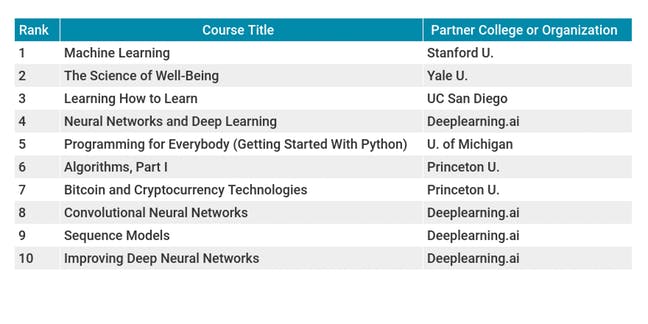
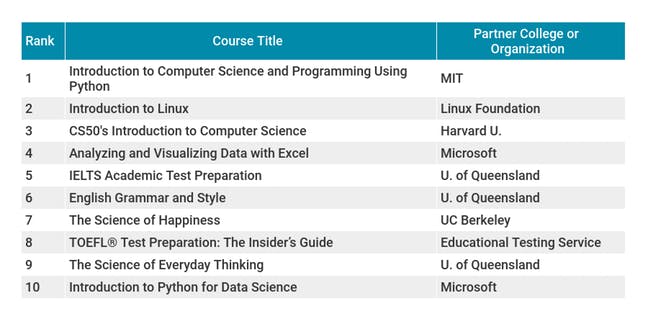
Here are the top 10 most popular courses for each provider:


Coursera Top 10 Most Popular Courses (over past 12 months)


edX Top 10 Most Popular Courses (all time)


So what are these blockbuster MOOCs, then? Experiential textbooks? Gateways to more rigorous college courses? A new kind of entertainment program?

Maybe the answer is: all of the above.


Reimagining the Higher Education Ecosystem — from edu2030.agorize.com
How might we empower people to design their own learning journeys so they can lead purposeful and economically stable lives?

Excerpts:

The problem
Technology is rapidly transforming the way we live, learn, and work. Entirely new jobs are emerging as others are lost to automation. People are living longer, yet switching jobs more often. These dramatic shifts call for a reimagining of the way we prepare for work and life—specifically, how we learn new skills and adapt to a changing economic landscape.

The changes ahead are likely to hurt most those who can least afford to manage them: low-income and first generation learners already ill-served by our existing postsecondary education system. Our current system stifles economic mobility and widens income and achievement gaps; we must act now to ensure that we have an educational ecosystem flexible and fair enough to help all people live purposeful and economically stable lives. And if we are to design solutions proportionate to this problem, new technologies must be called on to scale approaches that reach the millions of vulnerable people across the country.


The challenge
How might we empower people to design their own learning journeys so they can lead purposeful and economically stable lives?

The Challenge—Reimagining the Higher Education Ecosystem—seeks bold ideas for how our postsecondary education system could be reimagined to foster equity and encourage learner agency and resilience. We seek specific pilots to move us toward a future in which all learners can achieve economic stability and lead purposeful lives. This Challenge invites participants to articulate a vision and then design pilot projects for a future ecosystem that has the following characteristics:

Expands access: The educational system must ensure that all people—including low-income learners who are disproportionately underserved by the current higher education system—can leverage education to live meaningful and economically stable lives.

Draws on a broad postsecondary ecosystem: While college and universities play a vital role in educating students, there is a much larger ecosystem in which students learn. This ecosystem includes non-traditional “classes” or alternative learning providers, such as MOOCs, bootcamps, and online courses as well as on-the-job training and informal learning. Our future learning system must value the learning that happens in many different environments and enable seamless transitions between learning, work, and life.


From DSC:
This is where I could see a vision similar to Learning from the Living [Class] Room come into play. It would provide a highly affordable, accessible platform, that would offer more choice, and more control to learners of all ages. It would be available 24×7 and would be a platform that supports lifelong learning. It would combine a variety of AI-enabled functionalities with human expertise, teaching, training, motivation, and creativity.

It could be that what comes out of this challenge will lay the groundwork for a future, massive new learning platform.


The Living [Class] Room -- by Daniel Christian -- July 2012 -- a second device used in conjunction with a Smart/Connected TV


Also see:


From DSC regarding Virtual Reality-based apps:
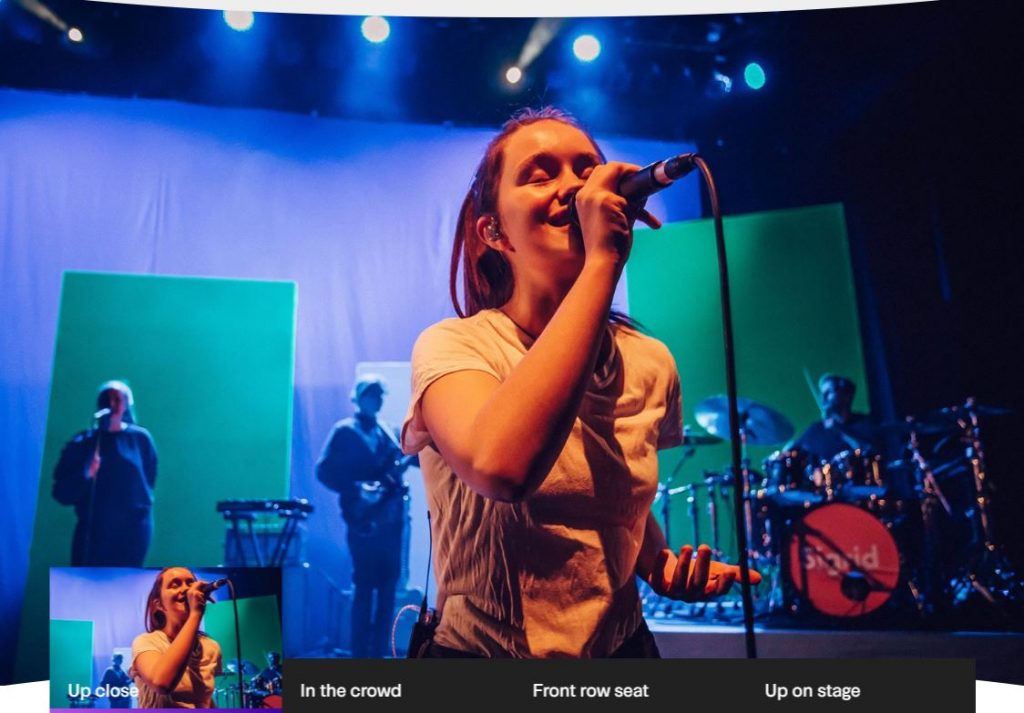
If one can remotely select/change their seat at a game or change seats/views at a concert…how soon before we can do this with learning-related spaces/scenes/lectures/seminars/Active Learning Classrooms (ALCs)/stage productions (drama) and more?

Talk about getting someone’s attention and engaging them!


Excerpt:

(MAY 2, 2018) MelodyVR, the world’s first dedicated virtual reality music platform that enables fans to experience music performances in a revolutionary new way, is now available.

The revolutionary MelodyVR app offers music fans an incredible selection of immersive performances from today’s biggest artists. Fans are transported all over the world to sold-out stadium shows, far-flung festivals and exclusive VIP sessions, and experience the music they love.

What MelodyVR delivers is a unique and world-class set of original experiences, created with multiple vantage points, to give fans complete control over what they see and where they stand at a performance. By selecting different Jump Spots, MelodyVR users can choose to be in the front row, deep in the crowd, or up-close-and-personal with the band on stage.


See their How it Works page.


With standalone VR headsets like the Oculus Go now available at an extremely accessible price point ($199), the already vibrant VR market is set to grow exponentially over the coming years. Current market forecasts suggest over 350 million users by 2021 and last year saw $3 billion invested in virtual and alternative reality.


Transforming the Postsecondary Professional Education Experience — from by Mary Grush & Thomas Finholt

Excerpt:

So, among other factors currently influencing change, those are the predominate ones. I’ll sum it up this way: The tried-and-true residential model has worked so far, but a number of factors are forcing transformation: emerging technologies, new expectations about when learning will occur in a student’s lifespan, and the introduction of a whole new population of students that had never been imagined before.
…
Grush: What are your latest efforts or experiments in new professional education offerings that you see as part of this transformation? When did you make a start and what impacts do you see so far?
Finholt: The biggest transformation for us to date has been our entry into the MOOC space. That movement began with a few small trials, but it’s now rapidly expanding and may include, ultimately, full degree offerings. I would describe our period of experimentation with MOOCs to have started in 2013, gaining especially significant momentum in the past two years. Over the next couple of years, our efforts will expand even more dramatically, if we elect to offer fully online degrees. As a measure of the magnitude of impact of MOOCs so far, one of our MOOC specializations in the Python programming language is among the most popular offerings on Coursera — I believe that it has reached more than a million learners at this point. A significant fraction of those learners have opted to sit for an exam to get a certificate in Python programming.


One is, as announced at the March 6th Coursera meeting, that we have joined in a partnership with Coursera and the University of Michigan’s Office of Academic Innovation to design and get approved, a brand-new online master’s degree in Applied Data Science. 


From DSC:
Mary and Thomas’ solid article reminds me of a graphic I put together a while back:


“The process of obtaining postgraduate credentials is becoming something that one works on over the entire span of one’s career… Working professionals will have an array of punctuated intervals, if you will — periods of time when they work intensively to update their credentials.” (source)


2018 Workplace Learning Report — from learning.linkedin.com

Excerpts:

The path to opportunity is changing
The short shelf life of skills and a tightening labor market are giving rise to a multitude of skill gaps. Businesses are fighting to stay ahead of the curve, trying to hold onto their best talent and struggling to fill key positions. Individuals are conscious of staying relevant in the age of automation.

Enter the talent development function.
These organizational leaders create learning opportunities to enable employee growth and achievement. They have the ability to guide their organizations to success in tomorrow’s labor market, but they can’t do it alone.
…
Our research answers the talent developer’s most pressing questions:
* How are savvy talent development leaders adapting to the pace of change in today’s dynamic world of work?
* Why do employees demand learning and development resources, but don’t make the time to learn?
* How do executives think about learning and development?
* Are managers the missing link to successful learning programs?


From DSC:
Even though this piece is a bit of a sales pitch for Lynda.com — a great service I might add — it’s still worth checking out. I say this because it brings up a very real trend that I’m trying to bring more awareness to — i.e., the pace of change has changed. Our society is not ready for this new, exponential pace of change. Technologies are impacting jobs and how we do our jobs, and will likely do so for the next several decades. Skills gaps are real and likely growing larger. Corporations need to do their part in helping higher education revise/develop curriculum and they need to offer funds to create new types of learning labs/environments. They need to offer more internships and opportunities to learn new skills.


A Microlearning Framework — from jvsp.io and Pablo Navarro
This infographic is based on the experience of different clients from different industries in different training programs.


From DSC:
I thought this was a solid infographic and should prove to be useful for Instructional Designers, Faculty Members, and/or for Corporate Trainers as well. 

I might also consider adding a “Gotcha!” piece first — even before the welcome piece — in order to get the learner’s attention and to immediately answer the WHY question. WHY is this topic important and relevant to me? When topics are relevant to people, they care and engage a whole lot more with the content that’s about to be presented to them. Ideally, such a piece would stir some curiosity as well.


From DSC:
Why aren’t we further along with lecture recording within K-12 classrooms?

That is, I as a parent — or much better yet, our kids themselves who are still in K-12 — should be able to go online and access whatever talks/lectures/presentations were given on a particular day. When our daughter is sick and misses several days, wouldn’t it be great for her to be able to go out and see what she missed? Even if we had the time and/or the energy to do so (which we don’t), my wife and I can’t present this content to her very well. We would likely explain things differently — and perhaps incorrectly — thus, potentially muddying the waters and causing more confusion for our daughter.

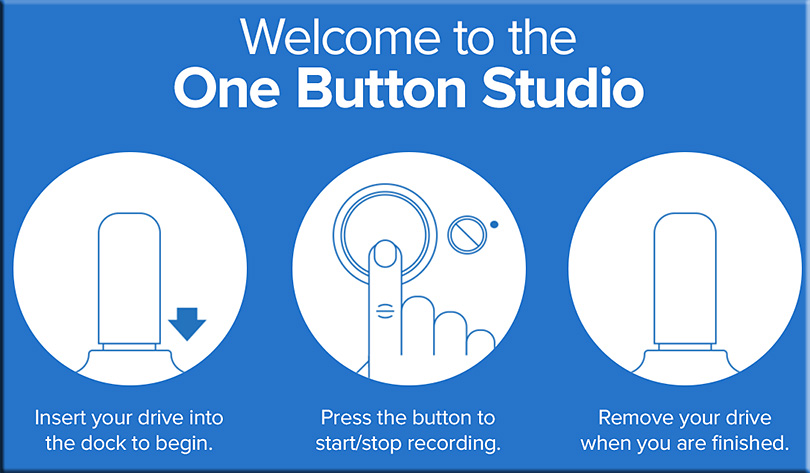
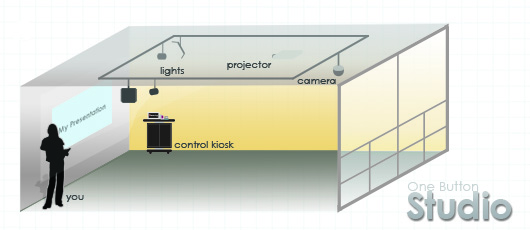
There should be entry level recording studios — such as the One Button Studio from Penn State University — in each K-12 school for teachers to record their presentations. At the end of each day, the teacher could put a checkbox next to what he/she was able to cover that day. (No rushing intended here — as education is enough of a run-away train often times!) That material would then be made visible/available on that day as links on an online-based calendar. Administrators should pay teachers extra money in the summer times to record these presentations.

Also, students could use these studios to practice their presentation and communication skills. The process is quick and easy:


I’d like to see an option — ideally via a brief voice-driven Q&A at the start of each session — that would ask the person where they wanted to put the recording when it was done: To a thumb drive, to a previously assigned storage area out on the cloud/Internet, or to both destinations?

Providing automatically generated close captioning would be a great feature here as well, especially for English as a Second Language (ESL) students.


From DSC:
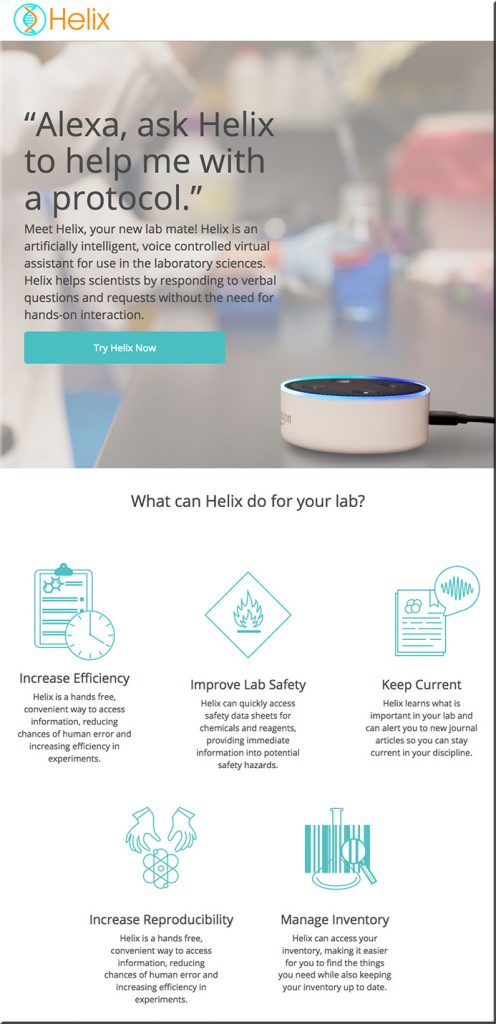
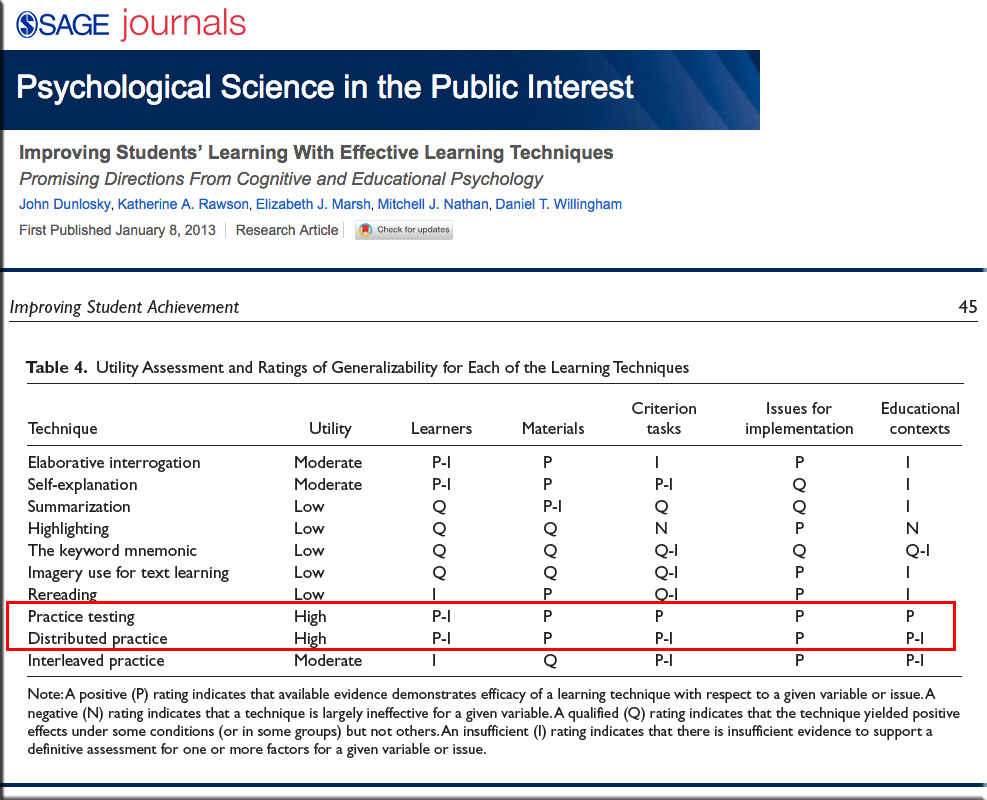
After seeing the article entitled, “Scientists Are Turning Alexa into an Automated Lab Helper,” I began to wonder…might Alexa be a tool to periodically schedule & provide practice tests & distributed practice on content? In the future, will there be “learning bots” that a learner can employ to do such self-testing and/or distributed practice?


From page 45 of the PDF available here:


Might Alexa be a tool to periodically schedule/provide practice tests & distributed practice on content?


Deeper Thinking about Active Learning — from facultyfocus.com by Maryellen Weimer

Excerpts (emphasis DSC):

I keep worrying that we’re missing the boat with active learning. Here’s why. First, active learning isn’t about activity for the sake of activity. I fear we’ve gotten too fixated on the activity and aren’t as focused as we should be on the learning. We’re still obsessed with collecting teaching techniques—all those strategies, gimmicks, approaches, and things we can do to get students engaged. But what kind of engagement does the activity promote? Does it pique student interest, make them think, result in learning, and cultivate a desire to know more? Or is it more about keeping basically bored students busy?
…
Teaching techniques are an essential part of any active learning endeavor. But they aren’t the center or the most important part of student learning experiences. Techniques provide the framework, the structure, the context. What really matters is what we put in the structure—what students are thinking about and sharing when they’re pairing.
…
Larry recommends selecting things that confront students with their ignorance—so they see clearly what they don’t know, can’t understand, don’t see the reason for, or can’t make work. When you’ve got an artifact in front of you, there’s motivation to deal with it. 


Think for a moment of what happens when you give most any of those millennial students a new electronic device. Usually, without the instructions and no attention to technique, they start playing with it to see how it works. Do they mess up and make mistakes? Do they give up or worry about looking stupid? Does active learning in our courses look anything like this?


From DSC:
This article reminds me of a great conversation that I had with an elderly gentleman a few months ago. He’s still involved with instructional design, after several decades of related work experiences. He said to me that learners need to truly ***engage*** with the content to make it meaningful to them.

And then I read a quote from Robert Greenleaf’s book, On Becoming a Servant Leader (p. 304), that said:

Nothing is meaningful to me until it is related to my own experience.


The Link to Content in 21st-Century Libraries — from er.educause.edu by Joan Lippincott

Excerpt (emphasis DSC):

At the 2017 Designing Libraries for the 21st Century annual conference, architect Craig Dykers asked the audience what he described as a rhetorical question: Are libraries places for information, with people in them, or are they places for people, with information in them? He concluded that ideally, today’s libraries, as they have always been, are places for the interaction of people, knowledge, and technologies. One reason that library renovations have brought record numbers of people into the physical building is that the notion of how people interact with content began to expand when available technologies were introduced to libraries in the 1990s. Two specific concepts motivated many of the changes in library spaces beginning at that time. First was the realization that libraries could become places for students and faculty to create content rather than places merely to access content. Second was an increased emphasis in higher education pedagogy on active, collaborative learning, in contrast to the traditional, passive lecture mode. These trends led to some pervasive changes in library space configurations, but sometimes the emphasis on information or content got lost along the way.


Architect Craig Dykers asked the audience what he described as a rhetorical question: Are libraries places for information, with people in them, or are they places for people, with information in them? He concluded that ideally, today’s libraries, as they have always been, are places for the interaction of people, knowledge, and technologies.


From DSC:
I agree with my friend and colleague, Mr. Eric Kunnen (Associate Director, eLearning and Emerging Technologies at GVSU), when he mentions on Twitter that it would have been good to highlight the beautifully done Mary Idema Pew Library Learning and Information Commons in this solid article.


TV is (finally) an app: The goods, the bads and the uglies for learning — from thejournal.com by Cathie Norris, Elliot Soloway

Excerpts:

Television. TV. There’s an app for that. Finally! TV — that is, live shows such as the news, specials, documentaries (and reality shows, if you must) — is now just like Candy Crunch and Facebook. TV apps (e.g., DirecTV Now) are available on all devices — smartphones, tablets, laptops, Chromebooks. Accessing streams upon streams of videos is, literally, now just a tap away.

…

Plain and simple: readily accessible video can be a really valuable resource for learners and learning.

…

Not everything that needs to be learned is on video. Instruction will need to balance the use of video with the use of printed materials. That balance, of course, needs to take in cost and accessibility.

…

Now for the 800 pound gorilla in the room: Of course, that TV app could be a huge distraction in the classroom. The TV app has just piled yet another classroom management challenge onto a teacher’s back.

…

That said, it is early days for TV as an app. For example, HD (High Definition) TV demands high bandwidth — and we can experience stuttering/skipping at times. But, when 5G comes around in 2020, just two years from now, POOF, that stuttering/skipping will disappear. “5G will be as much as 1,000 times faster than 4G.”  Yes, POOF!


From DSC:
Learning via apps is here to stay. “TV” as apps is here to stay. But what’s being described here is but one piece of the learning ecosystem that will be built over the next 5-15 years and will likely be revolutionary in its global impact on how people learn and grow. There will be opportunities for social-based learning, project-based learning, and more — with digital video being a component of the ecosystem, but is and will be insufficient to completely move someone through all of the levels of Bloom’s Taxonomy.

I will continue to track this developing learning ecosystem, but voice-driven personal assistants are already here. Algorithm-based recommendations are already here. Real-time language translation is already here.  The convergence of the telephone/computer/television continues to move forward.  AI-based bots will only get better in the future. Tapping into streams of up-to-date content will continue to move forward. Blockchain will likely bring us into the age of cloud-based learner profiles. And on and on it goes.

We’ll still need teachers, professors, and trainers. But this vision WILL occur. It IS where things are heading. It’s only a matter of time.


The Living [Class] Room -- by Daniel Christian -- July 2012 -- a second device used in conjunction with a Smart/Connected TV


The Section 508 Refresh and What It Means for Higher Education — from er.educause.edu by Martin LaGrow

Excerpts (emphasis DSC):

Higher education should now be on notice: Anyone with an Internet connection can now file a complaint or civil lawsuit, not just students with disabilities. And though Section 508 was previously unclear as to the expectations for accessibility, the updated requirements add specific web standards to adhere to — specifically, the Web Content Accessibility Guidelines (WCAG) 2.0 level AA developed by the World Wide Web Consortium (W3C).

…

Although WCAG 2.0 has been around since the early 2000s, it was developed by web content providers as a self-regulating tool to create uniformity for web standards around the globe. It was understood to be best practices but was not enforced by any regulating agency. The Section 508 refresh due in January 2018 changes this, as WCAG 2.0 level AA has been adopted as the standard of expected accessibility. Thus, all organizations subject to Section 508, including colleges and universities, that create and publish digital content — web pages, documents, images, videos, audio — must ensure that they know and understand these standards.

…

Reacting to the Section 508 Refresh
In a few months, the revised Section 508 standards become enforceable law. As stated, this should not be considered a threat or burden but rather an opportunity for institutions to check their present level of commitment and adherence to accessibility. In order to prepare for the update in standards, a number of proactive steps can easily be taken:

  • Contract a third-party expert partner to review institutional accessibility policies and practices and craft a long-term plan to ensure compliance.
  • Review all public-facing websites and electronic documents to ensure compliance with WCAG 2.0 Level AA standards.
  • Develop and publish a policy to state the level of commitment and adherence to Section 508 and WCAG 2.0 Level AA.
  • Create an accessibility training plan for all individuals responsible for creating and publishing electronic content.
  • Ensure all ICT contracts, ROIs, and purchases include provisions for accessibility.
  • Inform students of their rights related to accessibility, as well as where to address concerns internally. Then support the students with timely resolutions.

As always, remember that the pursuit of accessibility demonstrates a spirit of inclusiveness that benefits everyone. Embracing the challenge to meet the needs of all students is a noble pursuit, but it’s not just an adoption of policy. It’s a creation of awareness, an awareness that fosters a healthy shift in culture. When this is the approach, the motivation to support all students drives every conversation, and the fear of legal repercussions becomes secondary. This should be the goal of every institution of learning.


Als0 see:


How to Make Accessibility Part of the Landscape — from insidehighered.com by Mark Lieberman
A small institution in Vermont caters to students with disabilities by letting them choose the technology that suits their needs.

Excerpt:

Accessibility remains one of the key issues for digital learning professionals looking to catch up to the needs of the modern student. At last month’s Online Learning Consortium Accelerate conference, seemingly everyone in attendance hoped to come away with new insights into this thorny concern.

Landmark College in Vermont might offer some guidance. The private institution with approximately 450 students exclusively serves students with diagnosed learning disabilities, attention disorders or autism. Like all institutions, it’s still grappling with how best to serve students in the digital age, whether in the classroom or at a distance. Here’s a glimpse at the institution’s philosophy, courtesy of Manju Banerjee, Landmark’s vice president for educational research and innovation since 2011.


Udemy for Business Unveils Team Plan, a New Learning Product Designed Specifically for Small & Midsize Businesses — from globenewswire.com
Team Plan enables organizations of any size to invest in their employees’ skills development by providing quick, easy access to top-rated courses without the hassle of contracts

Excerpt:

SAN FRANCISCO, Dec. 07, 2017 (GLOBE NEWSWIRE) — Udemy, the global marketplace for learning and teaching online, today introduced Team Plan, a new corporate learning product from Udemy for Business designed specifically to help teams of 5-20 employees master new skills. With Team Plan, managers are able to easily purchase subscriptions to a curated selection of more than 2,000 top courses from the Udemy marketplace for their team and immediately gain access to learning content without a time-consuming contracting process.

Udemy is unveiling Team Plan at a time when more workers are feeling pressure to keep up with changing job requirements. A recent Udemy survey revealed that nearly 80% of Americans agree there is a skills gap, and more than a third (35%) say it affects them personally. More than a quarter of U.S. employees also believe that employers should take responsibility for reskilling the workforce. Team Plan is an easy-to-use and affordable subscription-based solution that lets internal departments and small businesses offer employees on-demand access to quality learning content that they can use to gain new skills and apply what they learn immediately.


© 2025 | Daniel Christian