


Also see:
Also see:
How Can a University Help Your Leadership Development Program? — from learningsolutionsmag.com by Gaylen Paulson
Excerpt:
For L&D or HR departments, executive education offers a solution for upskilling employees and improving the effectiveness of company leaders. Programs are highly flexible and can target the development needs of a few individuals, a large project team, or a pipeline of future leaders. With additional flexibility on duration, location, and competency areas, executive education can deliver a range of solutions customized to your organization’s specific needs.
4 questions to ask when considering a leadership development program:
Also from learningsolutionsmag.com see:
How to Get Started with Chunking & Sequencing eLearning Design — from learningsolutionsmag.com by Madeleine MacDonald, Shweta Shukla, Lisa A. Giacumo
Also for Training / L&D Departments, see:
Using VR to enhance your DEI training — from chieflearningofficer.com by Scott Stachiw
Excerpt:
VR provides a vehicle with which several specific DEI issues can be dealt in particularly enlightening ways, such as:
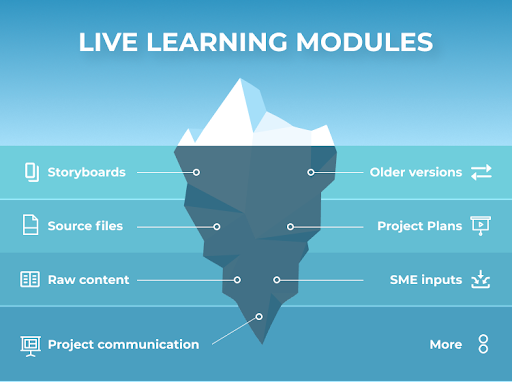
Five steps to getting higher ROI on your learning content — from chieflearningofficer.com by Anindita Gupta
Excerpt:
Both scenarios point toward the fact that organizations are investing a disproportionate amount of time and money on their star content while the supporting content assets are left languishing. In the long run, this skewed handling makes it extremely difficult for L&D teams to manage and maintain not just their content but also their budget. They could do better, be leaner, get more out of their investments, and experience smarter if they did just one thing differently.
.
Also relevant/see:
Addendum on 5/16/22:
100 Universities established an OPM, Bootcamp or Pathways partnership in Q1 2022 — from holoniq.com
Bootcamps are directing more resources B2B and B2G, OPMs are growing existing partnerships further and evolving their technology and healthcare programs.
Excerpt:
Higher Education, like the broader economy, is awkwardly emerging from an almost exclusively digital, isolated and stimulus fuelled environment into… well it’s not clear yet. University Partnerships continued to be established at pace through Q1 2022, albeit at a much slower rate than through 2021.

Also relevant/see:
College contracts with OPMs need better oversight, watchdog says — from highereddive.com by Natalie Schwartz
Excerpt from Dive Brief:
Addendum on 5/11/22:
Coursera launches skills training academy for colleges and companies — from highereddive.com by Natalie Schwartz
Experts say the move could help the company strengthen its focus on selling courses to colleges rather than consumers.
Excerpts:
Coursera, like other popular MOOC platforms, has made its name by bringing online classes to the masses. But lately, the company has been expanding efforts to provide these offerings to colleges and employers rather than solely to consumers.
The company doubled down on that strategy Wednesday, when it announced the launch of a career training academy that enables users to earn entry-level certificates from companies like Meta and IBM in fields such as data analytics, social media marketing and user experience design. Institutions — including colleges, businesses and government organizations — can sign up to make the platform available to their students or employees.
The move signals a shift in strategy for the company. While Coursera is still focused on delivering courses directly to consumers, it’s also been building out its offerings to colleges and employers. This business segment includes Coursera for Campus, which allows colleges to use the platform’s content in their classes.
From DSC:
For those who think MOOCs have come and gone:
Coursera has been using academic content created by universities for years to build its audience, amassing some 97 million users by the end of last year, according to its latest earnings report.
Addendum on 5/11/22:
From DSC:
After seeing the item below, I thought, “Hmmm…traditional institutions of higher education better look out if alternatives continue to gain momentum.” Perhaps it’s wise to double down on efforts to gather feedback from students, families, parents, businesses, and other stakeholders in the workplace regarding what they want and need — vs. what the faculty members of institution ABC want to teach.
A Third of U.S. College Students Consider Withdrawing — from news.gallup.com by Stephanie Marken
Excerpt:
Editor’s Note: The research below was conducted in partnership between the Lumina Foundation and Gallup.
About a third (32%) of currently enrolled students pursuing a bachelor’s degree report they have considered withdrawing from their program for a semester or more in the past six months. A slightly higher percentage of students pursuing their associate degree, 41%, report they have considered stopping out in the past six months. These are similar to 2020 levels when 33% of bachelor’s degree students reported they had considered stopping out and 38% of associate degree students said the same.
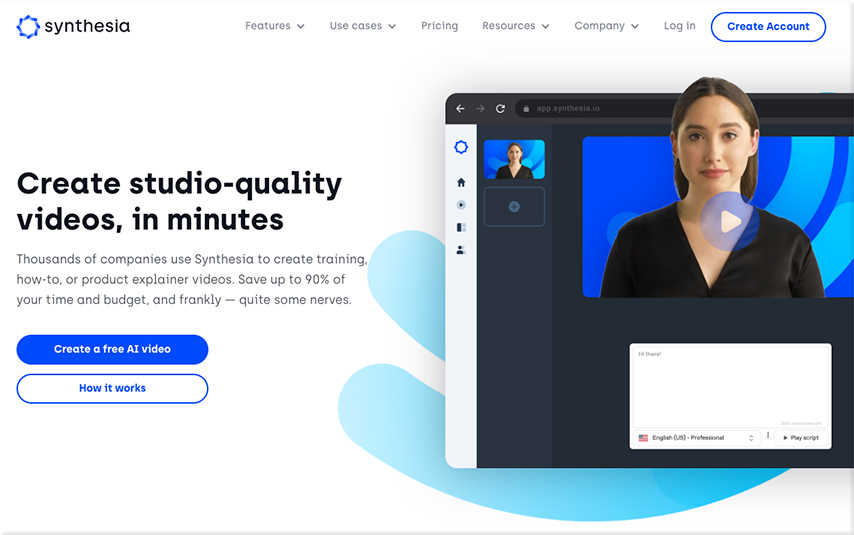
The Pros and Cons of Developing AI-Powered Corporate Training Videos with Synthesia — from blog.commlabindia.com by Saritha Esaboyuna
Synthesia is a game-changing invention that uses AI (Artificial Intelligence) to generate videos from text inputs. It enables designers to not only natively localise content but also to create and update existing films.
Excerpt:
You don’t need an editing studio, expensive equipment, or a high-end video editing program to design a video. All you need is Synthesia. Actors, cameras, and microphones are no longer required! You can produce high quality AI-enabled videos in over 50 languages just by adding text with Synthesia.
Also see:
From DSC:
Teachers and faculty members might want to try this out as well — especially if you have multiple languages being spoken in your classroom. And/or perhaps IT Departments and Help Desks could look at this as well.