From DSC:
A few items re: ChatGPT — with some items pro-chat and other items against the use of ChatGPT (or at least to limit its use).


How About We Put Learning at the Center? — from insidehighered.com by John Warner
The ongoing freak-out about ChatGPT sent me back to considering the fundamentals.

Excerpt:

So, when people express concern that students will use ChatGPT to complete their assignments, I understand the concern, but what I don’t understand is why this concern is so often channeled into discussions about how to police student behavior, rather than using this as an opportunity to exam the kind of work we actually ask students (and faculty) to do around learning.

If ChatGPT can do the things we ask students to do in order to demonstrate learning, it seems possible to me that those things should’ve been questioned a long time ago. It’s why I continue to believe this technology is an opportunity for reinvention, precisely because it is a threat to the status quo.

Top AI conference bans use of ChatGPT and AI language tools to write academic papers — from theverge.com by James Vincent; with thanks to Anna Mills for this resource
AI tools can be used to ‘edit’ and ‘polish’ authors’ work, say the conference organizers, but text ‘produced entirely’ by AI is not allowed. This raises the question: where do you draw the line between editing and writing?

Excerpt:

The International Conference on Machine Learning (ICML) announced the policy earlier this week, stating, “Papers that include text generated from a large-scale language model (LLM) such as ChatGPT are prohibited unless the produced text is presented as a part of the paper’s experimental analysis.” The news sparked widespread discussion on social media, with AI academics and researchers both defending and criticizing the policy. The conference’s organizers responded by publishing a longer statement explaining their thinking. (The ICML responded to requests from The Verge for comment by directing us to this same statement.)

How to… use AI to teach some of the hardest skills — from oneusefulthing.substack.com by Ethan Mollick
When errors, inaccuracies, and inconsistencies are actually very useful

Excerpt:

Instead, I want to discuss the opportunity provided by AI, because it can help us teach in new ways. The very things that make AI scary for educators — its tedency to make up facts, its lack of nuance, and its ability to make excellent student essays — can be used to make education better.

This isn’t for some future theoretical version of AI. You can create assignments, right now, using ChatGPT, that we will help stretch students in knew ways. We wrote a paper with the instructions. You can read it here, but I also want to summarize our suggestions. These are obviously not the only ways to use AI to educate, but they solve some of the hardest problems in education, and you can start experimenting with them right now.

NYC education department blocks ChatGPT on school devices, networks — from ny.chalkbeat.org by Michael Elsen-Rooney

Excerpt:

New York City students and teachers can no longer access ChatGPT — the new artificial intelligence-powered chatbot that generates stunningly cogent and lifelike writing — on education department devices or internet networks, agency officials confirmed Tuesday.

Teachers v ChatGPT: Schools face new challenge in fight against plagiarism — from straitstimes.com by Osmond Chia; with thanks to Stephen Downes for this resource

Excerpt:

SINGAPORE – Teachers in Singapore say they will likely have to move from assignments requiring regurgitation to those that require greater critical thinking, to stay ahead in the fight against plagiarism.

This comes on the back of the rise of ChatGPT, an intelligent chatbot that is able to spin essays and solve mathematical equations in seconds.

ChatGPT Is Not Ready to Teach Geometry (Yet) — from educationnext.org by Paul T. von Hippel
The viral chatbot is often wrong, but never in doubt. Educators need to tread carefully.

Excerpt:

Can ChatGPT provide feedback and answer questions about math in a more tailored and natural way? The answer, for the time being, is no. Although ChatGPT can talk about math superficially, it doesn’t “understand” math with real depth. It cannot correct mathematical misconceptions, it often introduces misconceptions of its own; and it sometimes makes inexplicable mathematical errors that a basic spreadsheet or hand calculator wouldn’t make.

Here, I’ll show you.


Addendum on 1/9/23:

9 ways ChatGPT saves me hours of work every day, and why you’ll never outcompete those who use AI effectively. — from .linkedin.com by Santiago Valdarrama

A list for those who write code:

  1. 1. Explaining code…
  2. Improve existing code…
  3. Rewriting code using the correct style…
  4. Rewriting code using idiomatic constructs…
  5. Simplifying code…
  6. Writing test cases…
  7. Exploring alternatives…
  8. Writing documentation…
  9. Tracking down bugs…
 

37 predictions about edtech’s impact in 2023 — from eschoolnews.com by Laura Ascione
What edtech trends will take top billing in schools and districts in the new year?

Excerpts:

School districts will begin to offer microschool options. With 65% of K-12 parents backing school choice, school districts will realize that in order to stay competitive and meet the needs of students and parents, adopting and offering innovative learning models is key. One of the shifts the industry can expect to see in the coming years is school districts offering mircoschool options within the district itself. While historically independent learning institutions, microschools will be adopted within school districts that are responsive to this need for choice and evolving learning needs of students.
—Carlos Bortoni, Principal, Industry Advisor, K-12 Education, Qualtrics
…
In 2023, educators nationwide will benefit from the most recent wave of edtech consolidation. The various services and products acquired by consolidators over the last year or two will be integrated into increasingly comprehensive platforms offering instructional content, assessments, and classroom tools all in one place.  As this occurs, the power and effectiveness of those edtech resources will grow as they begin to work in concert with each other seamlessly. The combination of these resources will empower administrators, teachers, families, and students to better leverage edtech’s ability to improve learning.
–Kelli Campbell, President, Discovery Education

From DSC:
Vision is key here…not just data. If data provided all of the answers, being an effective, impactful leader/administrator would be far easier.


Also from Laura Ascione, see:


From DSC:
Check out the items below. As with most technologies, there are likely going to be plusses & minuses regarding the use of AI in digital video, communications, arts, and music.


Also see:


Also somewhat relevant, see:


Adult learners can help solve higher education’s enrollment crisis. But here’s what colleges will need to know. — from by Terah Crews
A slowing economy could push employees back to college, but institutions still have work to do to serve adult students, the CEO of ReUp Education writes.

Excerpts:

If the U.S. economy contracts over the next year or two, as a majority of experts anticipate, there will be an enormous need for education and training. Workers will want to reskill and retrain for a reshaped world of work. Colleges and universities will have a critical role to play in getting Americans back to work and on a path toward more stable careers.

The 39 million Americans with some college but no credential will be the key to recovery, and colleges and universities must redouble their efforts to get these learners back in school and on a path toward new careers.

From DSC:
Given the above is true/occurs, my question is this: Has higher ed kept up curriculum- and content-wise?


ChatGPT and The Professional’s Guide to Using AI — from linkedin.com by Allie K. Miller

Excerpt:

Real Ways Professionals Can Use ChatGPT to Improve Job Performance
Let’s dive into some real examples of how professionals across sales, marketing, product management, project management, recruiting, and teaching can take advantage of this new tool and leverage it for even more impact in their careers.

Teachers and ChatGPT

  1. Help with grading and feedback on student work.
    Example prompt: “Tell me every grammar rule that’s been violated in this student’s essay: [paste in essay]”
  2. Create personalized learning materials.
    Example prompt: “Help me explain photosynthesis to a 10th grade student in a way similar to sports.”
  3. Generate lesson plans and activities.
    Example prompt: “Create an activity for 50 students that revolves around how to learn the different colors of the rainbow.” or “Generate a lesson plan for a high school English class on the theme of identity and self-discovery, suitable for a 45-minute class period.”
  4. Write fake essays several reading levels below your class, then print them out, and have your students review and edit the AI’s work to make it better.
    Example prompt: “Generate a 5th grade level short essay about Maya Angelou and her work.”
  5. Providing one-on-one support to students.
    Example prompt: “How can I best empower an introverted student in my classroom during reading time?”

From DSC:
I haven’t tried these prompts. Rather I post this because I’m excited about the potential of Artificial Intelligence (AI) to help people teach and to help people to learn.


The talent needed to adopt mobile AR in industry — from chieflearningofficer.com by Yao Huang Ph.D.

Excerpt:

Therefore, when adopting mobile AR to improve job performance, L&D professionals need to shift their mindset from offering training with AR alone to offering performance support with AR in the middle of the workflow.

The learning director from a supply chain industry pointed out that “70 percent of the information needed to build performance support systems already exists. The problem is it is all over the place and is available on different systems.”

It is the learning and development professional’s job to design a solution with the capability of the technology and present it in a way that most benefits the end users.

All participants revealed that mobile AR adoption in L&D is still new, but growing rapidly. L&D professionals face many opportunities and challenges. Understanding the benefits, challenges and opportunities of mobile AR used in the workplace is imperative.

A brief insert from DSC:
Augmented Reality (AR) is about to hit the mainstream in the next 1-3 years. It will connect the physical world with the digital world in powerful, helpful ways (and likely in negative ways as well). I think it will be far bigger and more commonly used than Virtual Reality (VR). (By the way, I’m also including Mixed Reality (MR) within the greater AR domain.) With Artificial Intelligence (AI) making strides in object recognition, AR could be huge.

Learning & Development groups should ask for funding soon — or develop proposals for future funding as the new hardware and software products mature — in order to upskill at least some members of their groups in the near future.

As within Teaching & Learning Centers within higher education, L&D groups need to practice what they preach — and be sure to train their own people as well.


AI bot ChatGPT stuns academics with essay-writing skills and usability — from theguardian.com by Alex Hern
Latest chatbot from Elon Musk-founded OpenAI can identify incorrect premises and refuse to answer inappropriate requests

Excerpt:

Professors, programmers and journalists could all be out of a job in just a few years, after the latest chatbot from the Elon Musk-founded OpenAI foundation stunned onlookers with its writing ability, proficiency at complex tasks, and ease of use.

The system, called ChatGPT, is the latest evolution of the GPT family of text-generating AIs. Two years ago, the team’s previous AI, GPT3, was able to generate an opinion piece for the Guardian, and ChatGPT has significant further capabilities.

In the days since it was released, academics have generated responses to exam queries that they say would result in full marks if submitted by an undergraduate, and programmers have used the tool to solve coding challenges in obscure programming languages in a matter of seconds – before writing limericks explaining the functionality.


Also related/see:


AI and the future of undergraduate writing — from chronicle.com by Beth McMurtrie

Excerpts:

Is the college essay dead? Are hordes of students going to use artificial intelligence to cheat on their writing assignments? Has machine learning reached the point where auto-generated text looks like what a typical first-year student might produce?

And what does it mean for professors if the answer to those questions is “yes”?
…
Scholars of teaching, writing, and digital literacy say there’s no doubt that tools like ChatGPT will, in some shape or form, become part of everyday writing, the way calculators and computers have become integral to math and science. It is critical, they say, to begin conversations with students and colleagues about how to shape and harness these AI tools as an aide, rather than a substitute, for learning.

“Academia really has to look at itself in the mirror and decide what it’s going to be,” said Josh Eyler, director of the Center for Excellence in Teaching and Learning at the University of Mississippi, who has criticized the “moral panic” he has seen in response to ChatGPT. “Is it going to be more concerned with compliance and policing behaviors and trying to get out in front of cheating, without any evidence to support whether or not that’s actually going to happen? Or does it want to think about trust in students as its first reaction and building that trust into its response and its pedagogy?”


ChatGPT Could Be AI’s iPhone Moment — from bloomberg.com by Vlad Savov; with thanks to Dany DeGrave for his Tweet on this

Excerpt:

The thing is, a good toy has a huge advantage: People love to play with it, and the more they do, the quicker its designers can make it into something more. People are documenting their experiences with ChatGPT on Twitter, looking like giddy kids experimenting with something they’re not even sure they should be allowed to have. There’s humor, discovery and a game of figuring out the limitations of the system.


And on the legal side of things:


Radar Trends to Watch: December 2022 — from oreilly.com by Mike Loukides
Developments in Security, Cryptocurrency, Web, and More

Excerpt:

This month’s news has been overshadowed by the implosion of SBF’s TFX and the possible implosion of Elon Musk’s Twitter. All the noise doesn’t mean that important things aren’t happening. Many companies, organizations, and individuals are wrestling with the copyright implications of generative AI. Google is playing a long game: they believe that the goal isn’t to imitate art works, but to build better user interfaces for humans to collaborate with AI so they can create something new. Facebook’s AI for playing Diplomacy is an exciting new development. Diplomacy requires players to negotiate with other players, assess their mental state, and decide whether or not to honor their commitments. None of these are easy tasks for an AI. And IBM now has a 433 Qubit quantum chip–an important step towards making a useful quantum processor.


From DSC:
I was watching a sermon the other day, and I’m always amazed when the pastor doesn’t need to read their notes (or hardly ever refers to them). And they can still do this in a much longer sermon too. Not me man.

It got me wondering about the idea of having a teleprompter on our future Augmented Reality (AR) glasses and/or on our Virtual Reality (VR) headsets.  Or perhaps such functionality will be provided on our mobile devices as well (i.e., our smartphones, tablets, laptops, other) via cloud-based applications.

One could see one’s presentation, sermon, main points for the meeting, what charges are being brought against the defendant, etc. and the system would know to scroll down as you said the words (via Natural Language Processing (NLP)).  If you went off script, the system would stop scrolling and you might need to scroll down manually or just begin where you left off.

For that matter, I suppose a faculty member could turn on and off a feed for an AI-based stream of content on where a topic is in the textbook. Or a CEO or University President could get prompted to refer to a particular section of the Strategic Plan. Hmmm…I don’t know…it might be too much cognitive load/overload…I’d have to try it out.

And/or perhaps this is a feature in our future videoconferencing applications.

But I just wanted to throw these ideas out there in case someone wanted to run with one or more of them.

Along these lines, see:

.

Is a teleprompter a feature in our future Augmented Reality (AR) glasses?

Is a teleprompter a feature in our future Augmented Reality (AR) glasses?


From DSC:
With a shout out to Beth McMurtrie’s Teaching Newsletter for pointing this Tweet out from Robert Talbert. Nice work Robert and Beth!


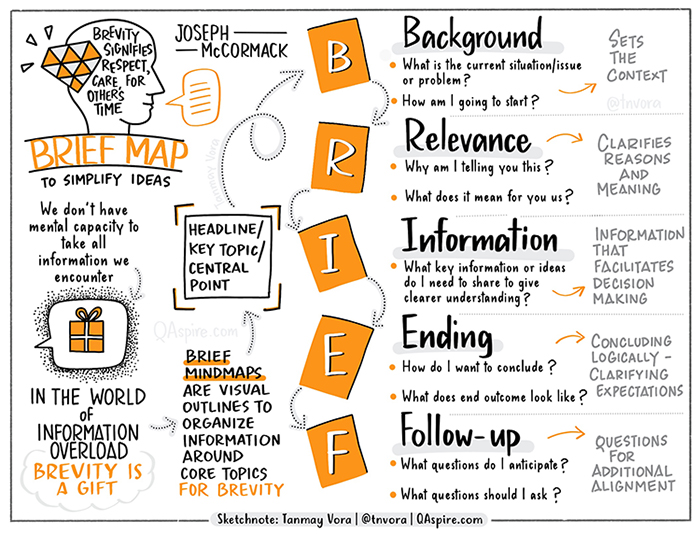
How to Communicate with Brevity — from qaspire.com by Tanmay Vora; with thanks to Roberto Ferraro for this resource
We live in a world of information overload. In such a world, communicating with brevity is a gift to others.
 

The Job: Online Certifications #85? DEC 1, 2022 — from getrevue.co by Paul Fain
Growing interest in online training for medical certifications and a private university that’s offering credit for MedCerts and other microcredentials.

Excerpt:

‘Train and Hire’ in Healthcare
The nation’s healthcare system continues to strain amid a severe staffing crisis. And the mounting desperation is prodding some employers to get more creative about how they hire, train, and retain healthcare workers.

MedCerts has seen growing demand for its online certification training, with strong interest in the 28-week medical assistant and 12-week phlebotomy technician programs.

The company has enrolled 55K students and roughly doubled its offerings during the last two years. Its fastest-growing segment is the train-and-hire model, where employers cover the full tuition and training costs for students.

“We are now helping several hundred people every month move from education to high-demand careers, and our pace and scale are still growing,” says Rafael Castaneda, MedCerts’ vice president of workforce development.

Stride Inc., a large online K-12 education provider, acquired MedCerts in 2020 for roughly $80M. The company’s 50+ self-paced career training programs in healthcare, IT, and professional development typically cost $4K in tuition and other fees. Most can be completed in six months, and the company offers on-demand support to all students for a year regardless of their program’s length.

 
© 2025 | Daniel Christian