Can colleges still deliver in the age of AI? One Ivy League school is investing $30 million to improve career outcomes — from cnbc.com by Jessica Dickler

Key Points

  • College students are increasingly worried about what an AI-driven jobs apocalypse could mean for their employment prospects.
  • To that end, many colleges and universities are racing to recalibrate.
  • Even at nation’s most elite schools, the focus is shifting to career readiness.
 

Why universities must become flexible lifelong partners, not one-time providers — from timeshighereducation.com by Sankar Sivarajah
As careers become increasingly non-linear and shaped by rapid change, universities must evolve beyond traditional degree provision, says Sankar Sivarajah. Here, he outlines strategies

From programmes to learning ecosystems
These pressures point towards a broader redefinition of higher education. Rather than viewing education as a one-time experience culminating in a degree, universities increasingly need to see themselves as partners in professional development across an entire career.

This means moving from a model centred on programmes to one focused on learning ecosystems that allow individuals to enter, leave and re-engage with higher education as their needs evolve.

Business schools may be particularly well placed to lead this shift because of their close engagement with employers and their long tradition of educating professionals at different stages of their careers.

But success will depend on more than introducing new modules or certificates. Universities must confront a fundamental question. Are the systems, structures and cultures that define higher education capable of supporting genuinely flexible learning?

The sector has already embraced the language of lifelong learning – the next step is ensuring that universities themselves are built to deliver it.


From DSC:
Long-time readers of this blog have seen this graphic of mine posted over the last 12+ years:
.

.


Also relevant/see:

What if the undergraduate journey were a four-year internship? — from timeshighereducation.com by Michelle Seref
Treating work placements and co-curricular programmes as optional or supplementary misses deeper questions about whether traditional degrees prepare students for careers. Michelle Seref explains

Attending workshops or polishing a résumé in their final semester does not make students career-ready. They need to practise how to work – how to collaborate, navigate ambiguity, manage projects and apply knowledge in context – throughout their academic experience. The reality is that career readiness is not a co-curricular programme; it is an essential part of an integrated curriculum.

To be clear, employers do not expect classrooms to become training centres. What they are asking for – implicitly and explicitly – is graduates who can function in complex environments from day one. That means graduates who can work in teams, communicate professionally with stakeholders, adapt when plans change, apply theory to real constraints and learn continuously on the job.

These capabilities do not develop through passive learning. But experiential learning is often misunderstood as a single, high-impact activity: an internship, a capstone project or study abroad. In reality, its power comes from repetition and progression. One experience introduces exposure. A sequence of experiences builds competence.

We are proposing a paradigm shift: repositioning the undergraduate journey as a four-year professional internship rather than a continuation of the K-12 classroom environment. 

.
From DSC:

The problem with this innovative idea is that faculty often are not out in the “real world.” The best chance higher ed has to deliver on this idea is via the adjunct faculty members out there. Often, they are the ones practicing what they are teaching. They are constantly pulse-checking — and actively involved with — their industries and have more up-to-date, practical knowledge.

But this is a problem for traditional institutions of higher education, which have treated their adjunct faculty members poorly through the years. Adjunct faculty members hardly make minimum wage, have no benefits, no retirement plans, etc. — plus they have little to no say in faculty senates. 

Organizational change would be a requirement.


Words are easy to say. Examples:

  • We are the leading ____ in the Midwest/Southwest/Northwest/etc. (says who? Prove it.)
  • Our patients’ care is important to us (no, it’s not…you only care if your customers’ accounts are paid in full. If patients’ care were actually important, you would fix what’s broken.)
  • Your call is important to us (no, it’s actually not. If it were actually important to you, you would have more customer service reps working so that the wait times were either non-existent or much shorter. The truth is that you would rather cut costs/headcount and have your customers wait. Be truthful about it. Stop the B.S.)

A vast number of American corporations don’t actually care about their customers — their concern focuses solely on obtaining their customers’ money.
One of the ways this plays out is that they hide behind the labyrinths that are designed into the call pathways in their Voice Response Units (VRUs). VRUs have been abused. Corporations hide behind them. It’s hard to actually reach a person or hold a person accountable for something.

And now, with executives getting rid of entry-level jobs in customer service, they seek to cut costs further as they implement AI-based systems…which rarely give us what we’re looking for.

But even in written communications, times seem to be changing…and not for the better. I had a customer service rep write me a letter recently (regarding an incident with our daughter’s experience at a blood lab). But in the letter, she didn’t even provide her last name or a direct phone # in her correspondence. This would NEVER have happened in business letters back in the day — her last name would have been present, for sure — and likely a direct phone #. This isn’t her fault. It’s her leadership’s fault. BTW, the issue was passed along to the lab’s leadership…and she closed her ticket out. But there was no mention of an actual fix or resolution. Nice hand washing job, don’t you think?

Another case in point. This time, involving Apple. (BTW, I’ve been a long-time Apple fan…until the last several years. They have lost some of their focus on customer service.) I wanted to ask a question about a purchase that showed up on our Visa bill from apple.com/bill. Do you think I could find an 800# to talk with someone at Apple? Nope. You can try to find things via their online-based support systems, but often their documentation doesn’t match up with one’s devices. I couldn’t even use their chat feature — their systems told me that their chat feature wasn’t available (and it was 11:30am EST). 

I’m sure if you thought about it, you could come up with your own recent examples of poor customer service experiences — or examples of companies that you did business with who didn’t deliver what they said they would deliver.

The issue runs deeper than we think. It actually has to do with whether people actually care about each other or not. And here in America, actually caring about others seems to be in short supply.


I Was a University AI Czar. I’m Not Equipped to Teach in the Age of AI. — from jgellers.substack.com by Josh Gellers, PhD

The reason that I claim I am not well-suited to thrive as an instructor in the age of AI is because both AI Enthusiasts and AI Resisters put a lot of thought and energy into completely redesigning their classes in response to AI. This is the one takeaway that I don’t think the Exhausted Majority has fully accepted yet—to excel as a teacher in this AI era, you need to totally revise how you teach and how you assess what students learn in your classes.

I can say this much—whatever solution our industry comes up with, it’s likely to emerge from teaching and learning centers. Contrary to what Paul Schofield  wrote in the Chronicle of Higher Education, pedagogy experts are the best hope we have to equip today’s faculty with the tools required to succeed in this uncertain educational environment. As I always tell my students, “I was trained for 7 years to become a researcher and 2 days to become a teacher.” The idea that only disciplinary experts know how to teach and have nothing to learn from so-called “nonscholars” is so laughable that one has to wonder whether an AI agent jokingly wrote that sad opinion piece to troll the whole academe.

Also from Dr. Gellers, see:

The Worst AI Policy in Higher Ed
How Berkeley Law Boalt-ed From Expertise in Favor of Abstinence

Last week, one of the top law schools in the United States, the University of California, Berkeley School of Law, released its final policy on artificial intelligence, effective summer 2026. In the span of a breezy 1.5 pages, the school outlined the challenge AI poses to legal education and how it plans to address this problem. Despite these intentions, this AI policy is, in my estimation, the worst AI policy in higher education I have seen.


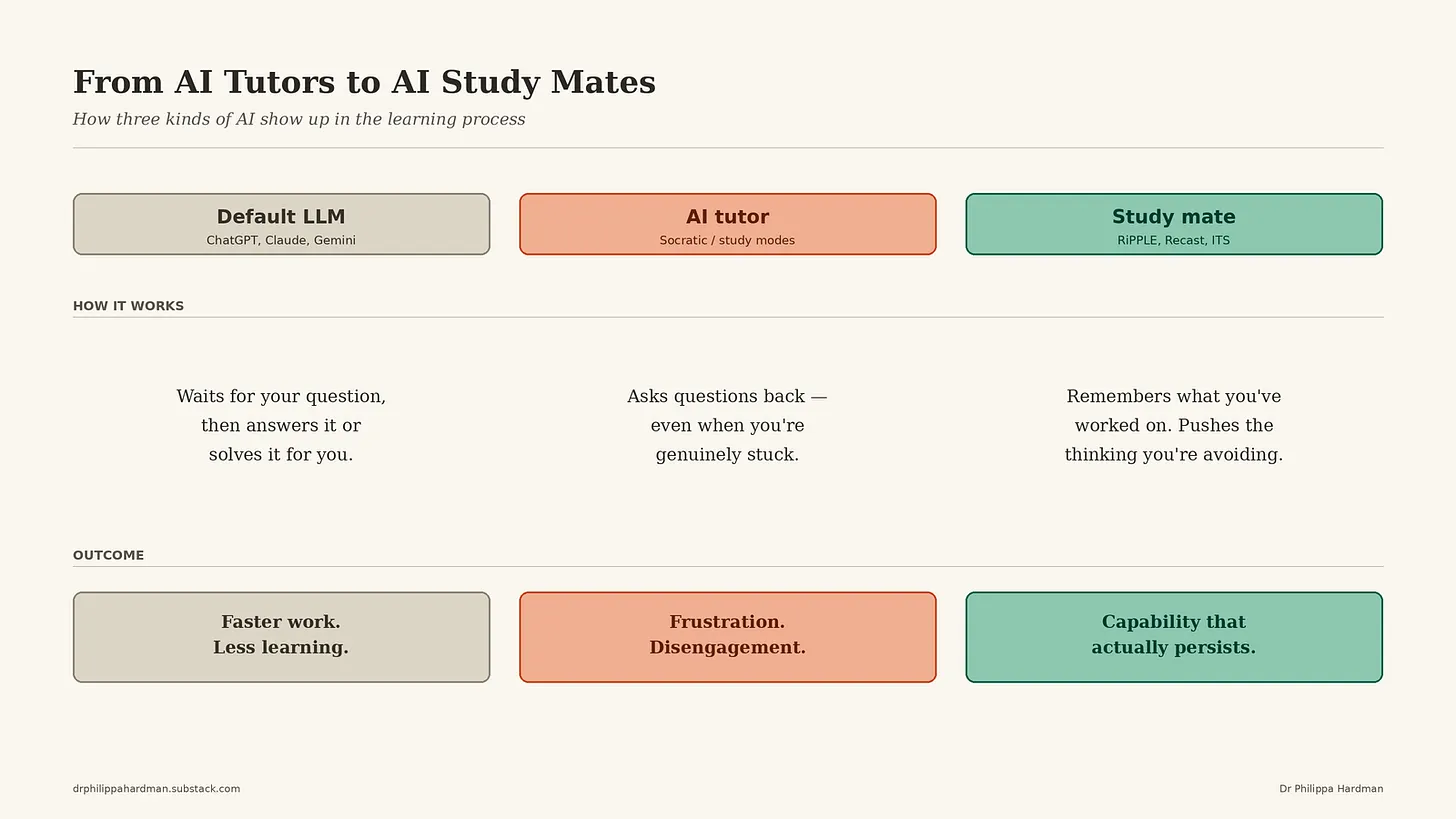
From AI Tutors to AI Study Mates— from drphilippahardman.substack.com by Dr Philippa Hardman
New research reveals how AI can enable real learning — not just productivity gains


.

The point isn’t that AI is inherently bad for learning — it’s that the meta-analyses showing that LLMs improve assignment and performance scores are measuring the wrong thing. They’re measuring performance with the AI present, not learning that persists once it’s gone.

.
From DSC:
Notice that when an AI-based learning system can remember what you’ve worked on and how you are doing — where you are struggling or doing well — it can have a positive impact on your longer-term learning. That, to me, is where long-term based learner profiles come in.

Later in the article, Dr. Hardman points out that “if we want to deliver AI tooling which supports substantive learning, we need to intentionally create a new category of AI tool for ‘learning at work’ which prioritises learning and development over productivity.” While I agree with that, I do wonder if businesses will care, so long as the work gets done and gets done well. But this calls into mind the word “experience” — something that traditionally has been hard fought to get in the corporate world. But the corporate realm often doesn’t like to pay for experience (beyond key AI-based jobs) when they perceive it’s getting too expensive. Ask all those 50 and over who had or have a target on their backs.

.


“The sad fact is that we don’t teach learners how to be good at learning. Whether K12, higher ed, or organizations, it’s just not there.”


from Clark Quinn’s posting entitled, Thoughts on meta-coaching!


From DSC:
I agree. We could do a much better job at this.


A New Era of Security: Frontier AI Defense — from paloaltonetworks.com by Sam Rubin

For the last several months, we have had early, unbounded access to the latest frontier AI models. What we’ve seen from that vantage point has made it clear that the window for organizations to get ahead of what’s coming is shorter than most leaders realize.

We have moved past the era of incremental AI improvements into a threat landscape shift. Our testing has revealed a step-change in capability that demonstrates an intuitive understanding of software vulnerabilities. This is more than faster code generation, it is a shift from AI as an assistant to AI as an autonomous agent capable of discovering and chaining flaws at a scale that most defenders aren’t prepared for.

These capabilities will not stay confined to controlled environments for long. When Mythos first launched, we predicted a six-month window before attackers gained access. We now believe that timeline has accelerated significantly.


When anyone can build a course, the real job is deciding which ones shouldn’t exist — from drphilippahardman.substack.com by Dr. Philippa Hardman
Why deciding is the only L&D skill AI can’t replace.

The biggest AI risk that L&D faces isn’t that it gets left behind: it’s that we build more — and flood the organisation with meh-quality content nobody needed in the first place.

In this post, I’ll make the case that:

  • The L&D job has just split in two — and most of us are still working on the wrong half.
  • There’s a new operating model coming for the role, and it’s already running inside a lot of the companies you’ve heard of.
  • The smartest critique of everything I’m about to argue comes from Ethan Mollick — and I think he’s half right.

The question we’ve been asking for the last two years — “how do I get faster at building?” — was the wrong one.

The real question is: can I look at fifteen AI-generated learning assets and decide which three are worth scaling — and put my name to that decision?


The TalentLMS 2026 Annual L&D Benchmark Report — from talentlms.com
From year-over-year training benchmarks to learner–leader gaps, see the data that defines the new era of learning. To turn insight into action, the report lays out 10 evidence-backed interventions to hardwire development. Plus, lift the lid on Learning Debt: What it is and how to spot it.

Executive summary
The skills economy is being rewritten in real time. AI is reshaping what people need to know, do, and deliver, faster than organizational structures can adapt. The result is a workplace caught between acceleration and inertia. Companies are racing to reskill for an AI-driven future while relying on structures built for yesterday’s world.

This TalentLMS 2026 L&D Benchmark Report captures that inflection point. Based on data collected through 2025, and compared with earlier findings from 2022 to 2024, it explores how learning is evolving and what’s holding it back.

Our research integrates two vantage points: HR leaders overseeing learning initiatives and employees receiving formal training. Together, they offer a dual perspective on how learning is managed and how it’s experienced.

The analysis also draws on insights from external research and leading L&D practitioners, anchoring the report in both evidence and practice.

Combined, the findings point to a structural fault line: Learning is expanding in scope but contracting in space. Organizations are multiplying programs, tools, and ambitions, yet the conditions for learning — time, focus, and cognitive bandwidth — keep shrinking.

The data from this report underscores this critical conflict: According to half of the surveyed employees and learning leaders, high workloads leave little room for training, even when it’s needed.

Employees work inside a permanent sprint, where attention is fragmented and reflection is sidelined. The space for learning is collapsing under the weight of doing. Sixty-five percent of employees say performance expectations have risen this year, yet lack of time remains the biggest barrier to learning.

The numbers confirm what employees and learning leaders both feel: Technology can advance overnight. But people and cultures can’t.


Which Jobs Are Most at Risk From AI? New Anthropic Data Offers Clues. — from builtin.com by Matthew Urwin
Anthropic set out in its latest study to predict how artificial intelligence could impact the labor market. Instead, its findings raise more questions than answers for tech workers as the U.S. government refuses to regulate the AI industry.

Summary:
In its latest labor market study, Anthropic found that artificial intelligence poses the greatest threat to software jobs, women and younger professionals. As the Trump administration takes a hands-off approach to AI, tech workers may be left to grapple with these findings on their own.


Matthew links to:

Labor market impacts of AI: A new measure and early evidence — from anthropic.com

Key findings

  • We introduce a new measure of AI displacement risk, observed exposure, that combines theoretical LLM capability and real-world usage data, weighting automated (rather than augmentative) and work-related uses more heavily
  • AI is far from reaching its theoretical capability: actual coverage remains a fraction of what’s feasible
  • Occupations with higher observed exposure are projected by the BLS to grow less through 2034
  • Workers in the most exposed professions are more likely to be older, female, more educated, and higher-paid
  • We find no systematic increase in unemployment for highly exposed workers since late 2022, though we find suggestive evidence that hiring of younger workers has slowed in exposed occupations


The Most Obvious Fix in Education — from michelleweise.substack.com by Michelle Weise
The No-Brainer Nobody’s Doing 

We know what better learning looks like. We have known for a while.

Real problems. Real roles. Built-in conflict. Conditions that simulate the messiness of actual work. Reflection that asks not just what did you do but who are you becoming? These are not radical ideas. They are not untested theories. The research is clear, employers are asking for exactly this, and students consistently report that the closest they got to real work was the most valuable part of their education.

So why aren’t universities doing more of it?

That is the question worth sitting with — because the gap between what we know and what we do is not a knowledge problem. It is a design problem, an incentive problem, and if we’re being candid, a courage problem.

Because in the meantime, learners are paying the price. They graduate credentialed but untested. They enter labor markets that want proof of performance and experience, not transcripts. They lack the networks, the exposure, and the scar tissue that comes from navigating real work.


Also relevant, see:

The Apprenticeship (R)Evolution — from insidehighered.com by Sara Weissman and Colleen Flaherty
Once synonymous with hard hats and tool belts, apprenticeships are branching into health care, artificial intelligence, business services, advanced manufacturing and more.

Such programs also challenge stereotypes about apprenticeships—namely that they’re only in construction, an earn-and-learn catchall for traditionally apprenticeable occupations such as bricklayer, plumber, carpenter and electrician. In integrating robotics, automation, machining and logistics, the manufacturing development program is a bridge to understanding how apprenticeships are evolving to support some of the nation’s fastest-growing industries. These include advanced manufacturing, but also health care, information technology and other business services.


From DSC:
I have been proposing that the AI-based learning platform of the future will be constantly doing this — every single day. It will know what the in-demand skills are — at any given moment in time. It will then be able to direct you to resources that will help you gain those skills. Though in my vision, the system is querying actual/open job descriptions, not analyzing learning data from enterprise learners. Perhaps I should add that to the vision.


Coursera’s Job Skills Report 2026: Top skills for your students — from coursera.org

The Job Skills Report 2026 analyzes learning data from more than 6 million enterprise learners to identify the future job skills organizations need most. It’s designed for HR and L&D leaders; data, IT, and software & product development leaders; higher education administrators; and government agencies seeking actionable insights on workforce skills trends and AI-driven transformation.

Drawing on data from 6 million enterprise learners across nearly 7,000 organizations, the Job Skills Report 2026 guides you through the skills reshaping the global economy. This year’s analysis spans Data, IT, and Software & Product Development—and the Generative AI skills becoming essential for every role.


From DSC:
The types of postings/articles (such as the one below) make me ask, are we not shooting ourselves in the foot with AI and recent college graduates? If the bottom rungs continue to disappear, internships and apprenticeships can only go so far. There aren’t enough of them — especially valuable ones. So as this article points out, there will be threats to the long-term health of our talent pipelines unless we can take steps to thwart those impacts — and to do so fairly soon.

To me…vocational training and jobs are looking better all the time — i.e., plumbers, carpenters, electricians, mechanics, and more.


Can New Graduates Compete With AI? — from builtin.combyRichard Johnson
The increasing adoption of AI automation is compressing early-career jobs. How should new graduates get a foothold in the economy now?

Summary: AI is hollowing out entry-level roles by automating routine tasks, eliminating a rung on the career ladder. New graduates face intense competition and a rising skill floor. While firms gain short-term productivity, they risk a long-term talent shortage by eliminating junior training grounds.

Conversations about AI have covered all grounds: hype, fear and slop. But while some roll their eyes at yet another automation headline, soon?to?be graduates are watching the labor market with a very different level of urgency. They’re entering a world where the old paradox of needing experience to get experience is colliding with a new reality: AI is absorbing the standardized, routine tasks that once defined entry?level work. The result isn’t just a shift in job descriptions or skill-requirements, but rather a structural reshaping of the career pipeline.

Entry-level workers face an outsized disruption to their long-term career trajectories. They have the least buffer to adapt given their lack of relevant job market experience and heightened financial pressure to secure a job quickly with the student-debt repayment periods for recent graduates looming.

Momentum early in one’s career matters, and the first job on a resume shapes future compensation bands and opportunities. It also serves as a signal for perceived specialization or, at minimum, interest. Losing that foothold has compounding effects to one’s career ladder.


Also relevant/see:

New Anthropic Institute to Study Risks and Economic Effects of Advanced AI — from campustechnology.com by John K. Waters

Key Takeaways

  • Anthropic has launched the Anthropic Institute, a new research effort focused on the biggest societal challenges posed by more powerful AI systems.
  • The institute will study how advanced AI could affect the economy, the legal system, public safety, and broader social outcomes.
  • Anthropic co-founder Jack Clark will lead the institute in a new role as the company’s head of public benefit.
  • The new unit brings together Anthropic’s existing red-teaming, societal impacts, and economic research work, while adding new hires and new research areas.
 
© 2025 | Daniel Christian