New hybrid PhD program at MSU — from Michigan State University
From Dr. Patrick Dickson of MSU College of Education:

I would like to let you know of  the new hybrid avenue to earning the Michigan State University Ph.D. in Educational Psychology and Educational Technology with an emphasis in educational technology and online learning.

The faculty decided to offer this substantially online pathway to our PhD in response to the interest among professionals who wish to continue in their current positions while earning their doctorate.

The hybrid program is designed for the bright, established professionals currently serving in K-12 schools, universities, policy centers, and research institutions, who understand how new technologies, including online learning, continue to transform education.
Getting Face to Face with Distance Learning — from CampusTechnology.com by Bridget McCrea

New York Institute of Technology’s videoconferencing capabilities have brought the school closer to its overseas learning partners.

RENCI pioneering the visualization industry with innovative interfaces — from InnovativeInteractivity.com by Tracy Boyer

“Today I flew through a digitally enhanced simulation of an ear canal, looked at 3D manipulations of static 2D images, and watched a seamless video projected simultaneously on four surrounding walls. The Renaissance Computing Institute (RENCI) is based in North Carolina and oddly enough it was my first visit to this extremely innovative and eye-opening interactive institute. Not only did it get me excited about information visualization, it gave me tons of inspiration for the future of immersive and interactive multimedia. Here is a great overview video of a similar tour group that went through RENCI. I experienced the first two visualizations that are shown here…”

“This is from Lynn Schofield Clark’s Innovation in Mass Communications class at the University of Denver. If you are a fan of The Office, and you follow the discussions about technology use in the classroom, you will love this. They really nail the opening, and they have some great moments.”

From DSC:
Please take this in a spirit of humor. I love “The Office” and I thought this clip was a riot.

With that said, I realize that change is not easy; and again, for me, it gets back to the need for using teams to develop and deliver content. One person just can’t do it all anymore. Using the various technologies that can/will exist in a “smart classroom”  is but one of many pieces involved here.

From DSC:
Which question is dead? This one:

Where is the return on investment in all of this technology?

Through the last several decades, as we’ve invested in PCs, Macs, cabling/telecommunications infrastructure, wireless access points, LANs, servers, routers, etc…the question kept being asked, “Where’s the return on investment with all of this technology?”

To me, that question is being put to rest once and for all (at least in terms of those sets of technologies.) Why? Because that infrastructure is the foundation of an ever-growing, sprawling, network of connections that people are using more and more to communicate, socialize, learn, and grow. Sure, there are downsides to the Internet, but there are many upsides as well:

  • You want a lesson plan? It’s out there.
  • You want to hear a lecture on topic A, B, or C? It’s out there and able to start playing on your PC, Mac, iPhone, etc. in seconds
  • You need to find directions to place XYZ? As you know, a huge timesaver can be found in services like Mapquest or with GPS-enabled services.
  • You want to take a break and watch a show? It’s on your PC or Mac in a short period of time.
  • You want to quickly orchestrate an event to catch up with a group of your friends? No problem.
  • …
  • …

I could go on and on, but you get my point: We are at the embryonic stages of an explosion in innovation that is now possible due to the Internet and the blazingly-fast exchanges of information. Surely, there has been an excellent ROI here!

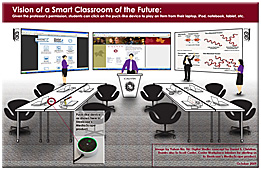
Here’s my vision of what a Smart Classroom should look like in the near future (please click on the image  below to see an enlarged image and to get some further details of my thoughts here):

My vision for what a Smart Classroom should look like -- 2009

Click image to see larger image w/ details

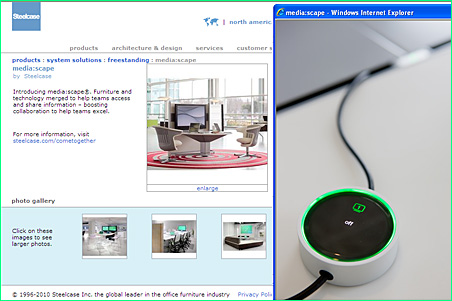
My thanks to Mr. Yohan Na for help with this graphic. The vision leverages the same idea as Steelcase’s Media:Scape product line:

"Pucks" on each table to "plug and play" various types of media

Interest in hybrid courses on the rise — from eSchoolNews.com
Students say they like being able to realize the benefits of both face-to-face and online instruction

Tagged with: • •  

Original resource from:
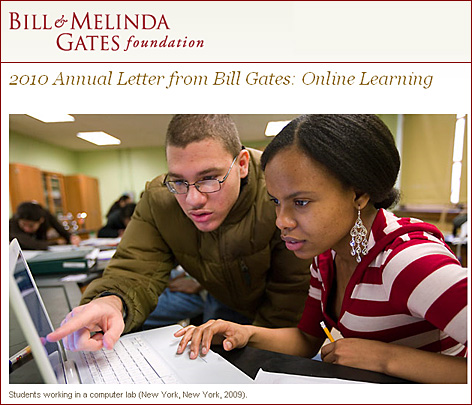
Grant Writers, Get Ready. Bill Gates Is Fired Up About Online Learning. — from The Chronicle, by Marc Parry


Gates Foundation Supporting Online Learning

The quote below is from the Gates Foundation’s 2010 Annual Letter:

“The foundation has made a few grants to drive online learning, but we are just at the start of this work. So far technology has hardly changed formal education at all. But a lot of people, including me, think this is the next place where the Internet will surprise people in how it can improve things—especially in combination with face-to-face learning. With the escalating costs of education, an advance here would be very timely (emphasis DSC).“

Paul Simbeck-Hampson has some good thoughts on the term “learning ecosystem” — check them out.

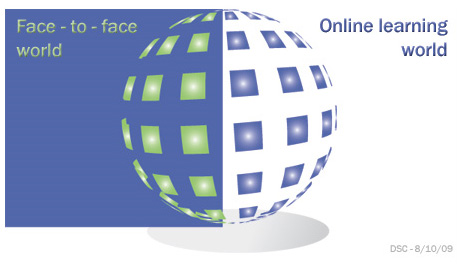
I think, as this blog progresses, blended learning will definitely be a very important element of a learning ecosystem, as it combines the best of both worlds:

Blended learning -- the best of both worlds


I am working on a graphic for “The House of Instruction“. Given all of the building blocks out there, how do we best build such a house? Which materials get used? Can we use them all and let students select which “blocks” work for them?

© 2025 | Daniel Christian