This month’s news has been overshadowed by the implosion of SBF’s TFX and the possible implosion of Elon Musk’s Twitter. All the noise doesn’t mean that important things aren’t happening. Many companies, organizations, and individuals are wrestling with the copyright implications of generative AI. Google is playing a long game: they believe that the goal isn’t to imitate art works, but to build better user interfaces for humans to collaborate with AI so they can create something new. Facebook’s AI for playing Diplomacy is an exciting new development. Diplomacy requires players to negotiate with other players, assess their mental state, and decide whether or not to honor their commitments. None of these are easy tasks for an AI. And IBM now has a 433 Qubit quantum chip–an important step towards making a useful quantum processor.
As we near the end of 2022, we’re taking a look back at the year, starting with the books we found most compelling, impressive, and inspirational. We’ve published dozens of articles on artist monographs and compendiums of broader topics across art and design and science and history over the last 12 months, and these are the 10 titles that impacted us most.
OpenAI has built the best Minecraft-playing bot yet by making it watch 70,000 hours of video of people playing the popular computer game. It showcases a powerful new technique that could be used to train machines to carry out a wide range of tasks by binging on sites like YouTube, a vast and untapped source of training data.
The Minecraft AI learned to perform complicated sequences of keyboard and mouse clicks to complete tasks in the game, such as chopping down trees and crafting tools. It’s the first bot that can craft so-called diamond tools, a task that typically takes good human players 20 minutes of high-speed clicking—or around 24,000 actions.
The result is a breakthrough for a technique known as imitation learning, in which neural networks are trained to perform tasks by watching humans do them.
…
The team’s approach, called Video Pre-Training (VPT), gets around the bottleneck in imitation learning by training another neural network to label videos automatically.
“Most language learning software can help with the beginning part of learning basic vocabulary and grammar, but gaining any degree of fluency requires speaking out loud in an interactive environment,” Zwick told TechCrunch in an email interview. “To date, the only way people can get that sort of practice is through human tutors, which can also be expensive, difficult and intimidating.”
Speak’s solution is a collection of interactive speaking experiences that allow learners to practice conversing in English. Through the platform, users can hold open-ended conversations with an “AI tutor” on a range of topics while receiving feedback on their pronunciation, grammar and vocabulary.
It’s one of the top education apps in Korea on the iOS App Store, with over 15 million lessons started annually, 100,000 active subscribers and “double-digit million” annual recurring revenue.
If you last checked in on AI image makers a month ago & thought “that is a fun toy, but is far from useful…” Well, in just the last week or so two of the major AI systems updated.
You can now generate a solid image in one try. For example, “otter on a plane using wifi” 1st try: pic.twitter.com/DhiYeVMEEV
So, is this a cool development that will become a fun tool for many of us to play around with in the future? Sure. Will people use this in their work? Possibly. Will it disrupt artists across the board? Unlikely. There might be a few places where really generic artwork is the norm and the people that were paid very little to crank them out will be paid very little to input prompts. Look, PhotoShop and asset libraries made creating company logos very, very easy a long time ago. But people still don’t want to take the 30 minutes it takes to put one together, because thinking through all the options is not their thing. You still have to think through those options to enter an AI prompt. And people just want to leave that part to the artists. The same thing was true about the printing press. Hundreds of years of innovation has taught us that the hard part of the creation of art is the human coming up with the ideas, not the tools that create the art.
A quick comment from DSC: Possibly, at least in some cases. But I’ve seen enough home-grown, poorly-designed graphics and logos to make me wonder if that will be the case.
How to Teach With Deep Fake Technology — from techlearning.com by Erik Ofgang Despite the scary headlines, deep fake technology can be a powerful teaching tool
Excerpt:
The very concept of teaching with deep fake technology may be unsettling to some. After all, deep fake technology, which utilizes AI and machine learning and can alter videos and animate photographs in a manner that appears realistic, has frequently been covered in a negative light. The technology can be used to violate privacy and create fake videos of real people.
However, while these potential abuses of the technology are real and concerning that doesn’t mean we should turn a blind eye to the technology’s potential when using it responsibly, says Jaime Donally, a well-known immersive learning expert.
From DSC: I’m still not sure about this one…but I’ll try to be open to the possibilities here.
Recently, we spoke with three more participants of the AI Explorations program to learn about its ongoing impact in K-12 classrooms. Here, they share how the program is helping their districts implement AI curriculum with an eye toward equity in the classroom.
A hitherto stealth legal AI startup emerged from the shadows today with news via TechCrunch that it has raised $5 million in funding led by the startup fund of OpenAI, the company that developed advanced neural network AI systems such as GPT-3 and DALL-E 2.
The startup, called Harvey, will build on the GPT-3 technology to enable lawyers to create legal documents or perform legal research by providing simple instructions using natural language.
The company was founded by Winston Weinberg, formerly an associate at law firm O’Melveny & Myers, and Gabriel Pereyra, formerly a research scientist at DeepMind and most recently a machine learning engineer at Meta AI.
A class-action lawsuit filed in a federal court in California this month takes aim at GitHub Copilot, a powerful tool that automatically writes working code when a programmer starts typing. The coder behind the suit argues that GitHub is infringing copyright because it does not provide attribution when Copilot reproduces open-source code covered by a license requiring it.
…
Programmers have, of course, always studied, learned from, and copied each other’s code. But not everyone is sure it is fair for AI to do the same, especially if AI can then churn out tons of valuable code itself, without respecting the source material’s license requirements. “As a technologist, I’m a huge fan of AI ,” Butterick says. “I’m looking forward to all the possibilities of these tools. But they have to be fair to everybody.”
Whatever the outcome of the Copilot case, Villa says it could shape the destiny of other areas of generative AI. If the outcome of the Copilot case hinges on how similar AI-generated code is to its training material, there could be implications for systems that reproduce images or music that matches the style of material in their training data.
Also related to AI and art/creativity from Wired.com, see:
Picture Limitless Creativity at Your Fingertips— by Kevin Kelly Artificial intelligence can now make better art than most humans. Soon, these engines of wow will transform how we design just about everything.
Who Will Own the Art of the Future? — by Jessica Rizzo OpenAI has announced that it’s granting Dall-E users the right to commercialize their art. For now.
The Impact of Storytelling on Learning— from campustechnology.com by Ruth Reynard The benefits of storytelling in teaching and learning are well established — and digital tools can help make stories more interactive, boost engagement, and convey ideas more effectively. Here’s how to make the most of technology and sidestep common mistakes in the use of storytelling for learning.
Excerpts:
Research.com provides a lot of helpful information on digital storytelling, including a breakdown of the tools and media used to tell stories or present ideas: audio capture devices (e.g. microphones and voice recorders), image capture devices (such as digital cameras and scanners), computers (with multimedia capabilities and ample storage), and digital media software (for creating and editing image, video, and audio).
…
While digital tools evolve rapidly, there are several useful tools listed for teachers and students by Med Kharbach (2022). These include:
StoryboardThat – this storyboard design tool helps to support good design and planning for effective storytelling.
Canva – this provides already developed templates to use in any story design and development.
Adobe Spark – useful if you are already familiar with Adobe products.
SAN DIEGO (AP) — California voters on Tuesday approved a ballot measure backed by a celebrity lineup that included Barbra Streisand and Los Angeles-born rappers will.i.am and Dr. Dre that could pump as much as $1 billion a year from the state’s general fund into arts education.
Supporters said it would benefit public school programs that go beyond the traditional art, theater, dance and music classes to include graphic design, computer coding, animation, music composition and script writing.
Also from Goldie Blumenstyk:
@CeciliaOrphan and I have a new article out in @ChangeHigher on expanding our understanding of "value" in higher education to better capture the full contributions of regional public universities as broadly accessible anchor institutions. https://t.co/iY5eIP5uzb
As the founder of a technology investment firm, I’ve seen firsthand just how much AI has advanced in such a short period of time. The underlying building blocks of the technology are getting astonishingly better at an exponential rate, far outpacing our expectations. Techniques like deep learning allow us to run complex AI models to solve the most difficult problems. But while those who work in technology-centric careers are aware of AI’s explosive capabilities, the public at large is still largely unaware of the depth of AI’s potential.
Enterprise functions such as marketing, sales, finance and HR are all areas that can utilize new AI-enabled applications; these applications include providing customers with 24/7 financial guidance, predicting and assessing loan risks and collecting and analyzing client data.
Let’s explore some real-life artificial intelligence applications.
Using Artificial Intelligence for Navigation
Marketers Use Artificial Intelligence to Increase Their Efficiency
The use of Artificial Intelligence in robotics
Gaming and Artificial Intelligence
Incorporating Artificial Intelligence into Lifestyles
Artificial intelligence (AI): 7 roles to prioritize now — from enterprisersproject.com by Marc Lewis; with thanks to Mr. Stephen Downes for this resource Which artificial intelligence (AI) jobs are hottest now? Consider these seven AI/ML roles to prioritize in your organization
While these seven AI roles are critical, finding talent to fill them is difficult. AI, machine learning, and data analytics are new fields, and few people have relevant experience.
This leads us back to the fact: We are dealing with a Great Reallocation of the labor force to an AI/Machine learning, data-driven world.
3 ways AI is scaling helpful technologies worldwide — from blog.google by Jeff Dean Decades of research have led to today’s rapid progress in AI. Today, we’re announcing three new ways people are poised to benefit.
Excerpts:
Supporting 1,000 languages with AI
Empowering creators and artists with AI
Addressing climate change and health challenges with AI
You’ve likely been reading for the last few minutes my arguments for why AI is going to change education. You may agree with some points, disagree with others…
Only, those were not my words.
An AI has written every single word in this essay up until here.
The only thing I wrote myself was the first sentence: Artificial Intelligence is going to revolutionize education. The images too, everything was generated by AI.
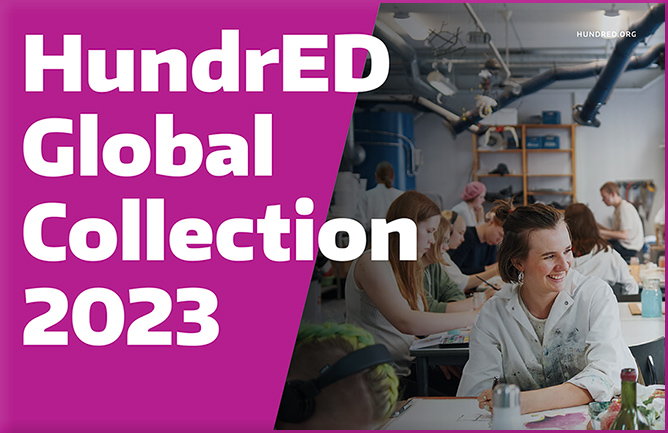
HundrED Global Collection 2023 — from hundred.org Meet the 100 most impactful innovations that are changing the face of education in a post-COVID world.
Excerpt:
The year 2022 has been a year to look to the future, as the global education conversation moves again toward themes of education transformation and the futures of education. The 100 innovations selected for this year’s global collection are impacting the lives of over 95 million students worldwide. The collection highlights the important role of teachers in education innovation; the continued need for students to develop 21st century skills, including social and emotional learning; an increasing focus on student wellbeing and mental health; and equity in education.
For more information, download the full Global Collection 2023 report.
You can also browse the innovation pages of the selected innovators here. .
From DSC: Here’s an excerpt of the email I received today from EducationHQ out of Australia — though I think it applies here in the United States as well:
Not much entices a second grader to skip out on recess to get back to schoolwork. But excitement around a classroom-run business can do just that, especially when it means creating candles out of crayons and selling them in the local community.
Promotion: fifty-two students presented digital designs and architectural models of their ideal home as part of Hong Kong-based education institute My ArchiSchool’s latest exhibition. As part of the exhibition, My ArchiSchool students were asked to design their ideal home within an urban environment. The exhibition, which took place on 2 October 2022 at the Sky100 on the 100th floor of the International Commerce Centre in Hong Kong, showcased photomontages of digital designs presented alongside physical models.
We need to create opportunities for students to become more digitally aware and literate, and to be responsible when using technology. There are many ways to do this, depending on our content area and grade level. We can model best practices for our students, bring in a specific digital citizenship curriculum to guide them through their learning, or use digital tools and resources available to have students explore and create.
Helping students learn to safely navigate what has become a highly digital world is something that we are all responsible for. Students need to be aware of the impact of their posts online, how to create and manage social accounts and protect their information, and how to properly access and use resources they obtain through technology.
School and district leaders can—and should—be using social media in their work.
That’s the message shared by Stephanie McConnell, a superintendent in the Hawkins Independent School District in Texas, and Salome Thomas-El, a K-8 principal in Delaware, during an Education Week K-12 Essentials forum on Oct. 13.
At the event, McConnell and Thomas-El provided insights and advice for school leaders who are hesitant to post on certain social platforms or unsure how to use them.