Another ‘shock’ is coming for American jobs — from washingtonpost.com by Heather Long. DSC: This is a gifted article
Millions of workers will need to shift careers. Our country is unprepared.

The United States is on the cusp of a massive economic shift due to AI, and it’s likely to cause greater change than anything President Donald Trump does in his second term. Much good can come from AI, but the country is unprepared to grapple with the need for millions — or perhaps tens of millions — of workers to shift jobs and entire careers.

“There’s a massive risk that entry-level, white-collar work could get automated. What does that do to career ladders?” asked Molly Kinder, a fellow at the Brookings Institution. Her research has found the jobs of marketing analysts are five times as likely to be replaced as those of marketing managers, and sales representative jobs are three times as likely to be replaced as those of sales managers.

Young people working in these jobs will need to be retrained, but it will be hard for them to invest in new career paths. Consider that many college graduates already carry a lot of debt (an average of about $30,000 for those who took student loans).What’s more, the U.S. unemployment insurance system covers only about 57 percent of unemployed workers and replaces only a modest amount of someone’s pay.

From DSC:
This is another reason why I think this vision here is at least a part of our future. We need shorter, less expensive credentials.

  • People don’t have the time to get degrees that take 2+ years to complete (after they have already gone through college once).
  • They don’t want to come out with more debt on their backs.
  • With inflation going back up, they won’t have as much money anyway.
  • Also, they may already have enough debt on their backs.
 

Outdated Microschool Laws Turn Parents into Criminals — from educationnext.org by Erica Smith Ewing
By over-regulating the pandemic-era schooling alternative, states ignore families’ constitutional rights

Public schools do not work for everyone. But options have increased since 1922, when Oregon tried to ban private education. The Supreme Court shut down that scheme fast. But now, after more than 100 years, political insiders are rallying again to stop a new source of choice.

The target this time is microschooling, a Covid-era alternative that has outlasted the pandemic. Key players in the movement will gather May 8–9, 2025, at the International Microschools Conference in Washington, D.C. I will join them.

Most likely, I will meet educators running all kinds of programs in all kinds of community spaces. Microschools blur the lines between home, public, and private schooling—combining elements from all three models.

The result is a fourth category of schooling that hinges on flexibility. Some parents pool their resources and hire outside instructors. Other groups rotate teaching duties among themselves, gathering daily or perhaps only once or twice per week. These are the do-it-yourselfers. Professionals also get involved with standalone enterprises and national networks.


.

2025 EDUCAUSE Students and Technology Report: Shaping the Future of Higher Education Through Technology, Flexibility, and Well-Being — from library.educause.edu

The student experience in higher education is continually evolving, influenced by technological advancements, shifting student needs and expectations, evolving workforce demands, and broadening sociocultural forces. In this year’s report, we examine six critical aspects of student experiences in higher education, providing insights into how institutions can adapt to meet student needs and enhance their learning experience and preparation for the workforce:

  • Satisfaction with Technology-Related Services and Supports
  • Modality Preferences
  • Hybrid Learning Experiences
  • Generative AI in the Classroom
  • Workforce Preparation
  • Accessibility and Mental Health

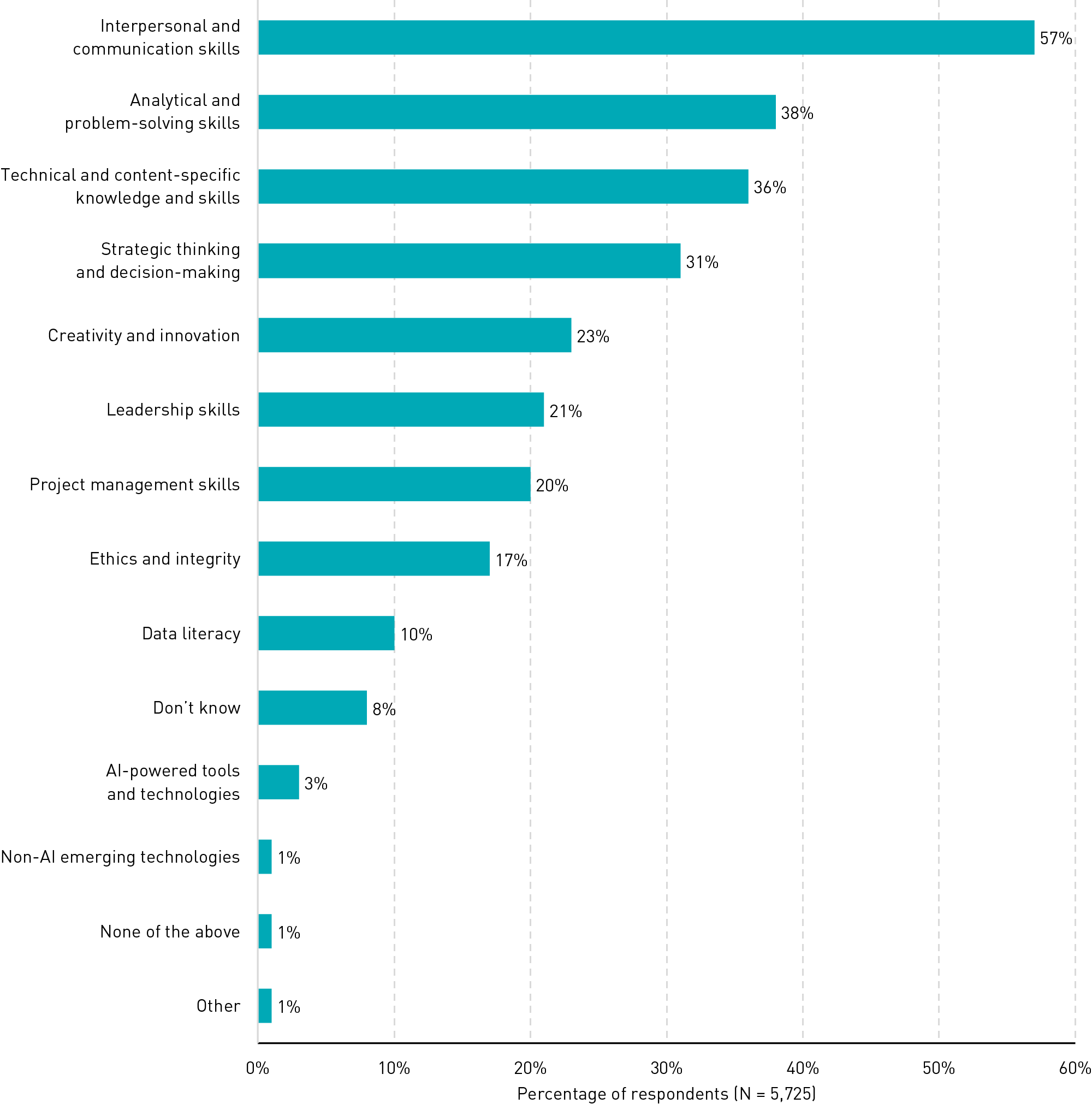
DSC: Shame on higher ed for not preparing students for the workplace (see below). You’re doing your students wrong…again. Not only do you continue to heap a load of debt on their backs, but you’re also continuing to not get them ready for the workplace. So don’t be surprised if eventually you’re replaced by a variety of alternatives that students will flock towards.
.


DSC: And students don’t have a clue as to what awaits them in the workplace — they see AI-powered tools and technologies at an incredibly low score of only 3%. Yeh, right. You’ll find out. Here’s but one example from one discipline/field of work –> Thomson Reuters Survey: Over 95% of Legal Professionals Expect Gen AI to Become Central to Workflow Within Five Years

.

Figure 15. Competency Areas Expected to Be Important for Career


Who does need college anymore? About that book title … — from Education Design Lab

As you may know, Lab founder Kathleen deLaski just published a book with a provocative title: Who Needs College Anymore? Imagining a Future Where Degrees Won’t Matter.

Kathleen is asked about the title in every media interview, before and since the Feb. 25 book release. “It has generated a lot of questions,” she said in our recent book chat. “I tell people to focus on the word, ‘who.’ Who needs college anymore? That’s in keeping with the design thinking frame, where you look at the needs of individuals and what needs are not being met.”

In the same conversation, Kathleen reminded us that only 38% of American adults have a four-year degree. “We never talk about the path to the American dream for the rest of folks,” she said. “We currently are not supporting the other really interesting pathways to financial sustainability — apprenticeships, short-term credentials. And that’s really why I wrote the book, to push the conversation around the 62% of who we call New Majority Learners at the Lab, the people for whom college was not designed.” Watch the full clip

She distills the point into one sentence in this SmartBrief essay:  “The new paradigm is a ‘yes and’ paradigm that embraces college and/or other pathways instead of college or bust.”

What can colleges do moving forward?
In this excellent Q&A with Inside Higher Ed, Kathleen shares her No. 1 suggestion: “College needs to be designed as a stepladder approach, where people can come in and out of it as they need, and at the very least, they can build earnings power along the way to help afford a degree program.”

In her Hechinger Report essay, Kathleen lists four more steps colleges can take to meet the demand for more choices, including “affordability must rule.”

From white-collar apprenticeships and micro-credential programs at local community colleges to online bootcamps, self-instruction using YouTube, and more—students are forging alternative paths to GREAT high-paying jobs. (source)


Market scan: What’s possible in the current skills validation ecosystem? — from eddesignlab.org
Education Design Lab provides an overview of emerging practices + tools in this 2025 Skills Validation Market Scan.

Employers and opportunity seekers are excited about the possibilities of a skills-based ecosystem, but this new process for codifying a person’s experiences and abilities into skills requires one significant, and missing, piece: Trust. Employers need to trust that the credentials they receive from opportunity seekers are valid representations of their skills. Jobseekers need to trust that their digital credentials are safe, accurate, and will lead to employment and advancement.

Our hypothesis
We posit that the trust needed for the validation of skills to be brought into a meaningful reality is established through a network of skills validation methods and opportunities. We also recognize that the routes through which an individual can demonstrate skills are as varied as the individuals themselves. Therefore, in order to equitably create a skills-based employment ecosystem, the routes by which skills are validated must be held together with common standards and language, but flexible enough to accommodate a multitude of validation practices.


The Real Deal — from workshift.org
A series exploring what we know about the quality of nondegree credentials.

The above link/page includes the posting:

Understanding Influencers in the World of Nondegree Credentials — by Michelle Van Noy and Tom Hilliard
There’s no single arbiter of nondegree quality, but rather a host of “quality influencers” who seek to shape the market.

They respond to needs that the degree-credit system has not efficiently met: quick start-up, shorter sequences, relationships with third-party credential issuers, real-time employer engagement, and so on. The complexity of the needs of the market and of learners has led to a proliferation of diverse credentials, and a landscape that continues to evolve in surprising directions.

Amid this complexity, there’s no one single arbiter of quality but rather a host of “quality influencers” who seek to shape the market in different ways. Exploring who those influencers are, how they approach their work, and what they seek to accomplish is essential to understanding what quality means for noncredit credentials—and what could happen in years to come.


A Three-Phase, Rational System of Education — from petergray.substack.com by Peter Gray; with thanks to Dr. Kate Christian for this resource
What will replace k-12 and college?

A Three-Phase, Rational System of Education
I don’t know just how or how fast the change will happen, but I think the days of K-12 and four years of college are numbered and sanity will begin to prevail in the educational world. I envision a future with something like the following three-phase approach to education:

Phase I. Discovery: Learning about your world, your self, and how the two fit together.
Phase II. Exploring a career path.
Phase III. Becoming credentialed for specialized work.


Average Student Loan Debt — from educationdata.org by Melanie Hanson; last updated August 16, 2024

Report Highlights. 

  • The total average student loan debt (including private loan debt) may be as high as $40,681.
  • The average federal student loan debt is $37,853 per borrower.
  • Outstanding private student loan debt totals $128.8 billion.
  • The average student borrows over $30,000 to pursue a bachelor’s degree.
  • A total of 42.8 million borrowers have federal student loan debt.
  • It may take borrowers close to 20 years to pay off their student loans.

From DSC:
In other words, we are approaching the end of the line in terms of following the status quo within higher education. Institutions of traditional higher education can no longer increase their cost of tuition by significantly more than the rate of inflation. Increasingly, K-12 students (and families) are looking for other pathways and alternatives. Higher ed better stop trying to change around the edges…they need new, more cost-effective business models as well as being able to be much more responsive in terms of their curricula.


Teens are losing interest in school, and say they hear about college ‘a lot’ — from npr.org by Cory Turner

This is not your standard back-to-school story, about school supplies or first-day butterflies.

It’s about how school-aged members of Gen Z — that’s 12- to 18-year-olds — are feeling about school and the future. And according to a new national survey, those feelings are a little worrying.

School engagement is down. The middle- and high-schoolers surveyed find school less interesting than they did just last year, and only about half believe they’re being challenged “in a good way.” The problem is especially acute for teens who say they don’t want to go to college right out of high school.

“The conversations that [K-12 schools are] having with middle-schoolers and high-schoolers are predominantly about college,” says Zach Hrynowski, a senior education researcher at Gallup. “Even the kids who are like, ‘I don’t want to go to college,’ what are they hearing the most about? College. We’re not talking to them about apprenticeships, internships, starting a business, entrepreneurial aspirations or jobs that don’t require a college degree.”


New Microschools for a New School Year — from the74million.org by Kerry McDonald
As parent demand for more individualized education options grows, everyday entrepreneurs are stepping up to meet that demand by launching microschools

Microschools and similarly creative schooling options gained increased popularity in the wake of the pandemic, and they continue to gain momentum. Not only are new schools and spaces opening across the U.S. but existing ones are expanding.

New data from VELA, a philanthropic nonprofit organization and entrepreneur community, reveals that over 90 percent of the unconventional learning environments it surveyed had more learners last fall than they did at their launch date, and the median compound rate of growth for these programs was 25 percent a year.


How to use accommodations and modifications in the classroom — from understood.org by Amanda Morin

In a busy classroom, it can be daunting to meet the varied learning needs of all your students. Knowing you’re also responsible for implementing instructional accommodations and modifications in students’ IEPs and 504 plans can make it feel even more challenging. But with the right information, you can provide these important supports to help all students thrive.

Here are key concepts to keep in mind and steps you can take to implement accommodations and modifications for your students.


Unschooling: A way of learning outside of school and it requires no lessons, tests or grades — from cbsnews.com by  Janay Reece

BALTIMORE — What if your child didn’t go to school?

Believe it or not, some parents don’t send their children to school five days a week, and it’s called unschooling.

It is a growing and sometimes controversial approach to homeschooling.

Rather than using a defined curriculum, unschooling parents trust their kids to learn organically. Unschoolers are focused more on the experimental process of learning and becoming educated, rather than with “doing or going to school.”


People Are Hunting for Education ‘Fads.’ What Does That Say About Schools? — from edsurge.com by Daniel Mollenkamp

Public schools are particularly vulnerable to pressure, Cuban said on a call with EdSurge. That’s because national problems tend to become school ones, Cuban says. Schools have to walk a “tightrope,” striking a balance that is both stable for students and able to adapt to changes in the broader society, he says.

Pressure on schools to respond to new issues often ends up altering curricula or introducing new courses, because that’s the easiest part of the public education system to change, Cuban argues. But classrooms are isolated from the superintendent’s office, the school board and other “policy elites” who push change, he says.


Many kids can’t read, even in high school. Is the solution teaching reading in every class? — from hechingerreport.org by Julian Roberts-Grmela
Some high schools and states are experimenting with ways to integrate literacy instruction across all classes

Every teacher at her school, the Health Sciences High and Middle College, in San Diego, shares in the responsibility of teaching students literacy skills, regardless of the subject they teach. That’s because so many students, even incoming ninth graders, arrive at the school without basic reading skills, according to Douglas Fisher, an administrator at the school. While some students also receive one-on-one remediation, Fisher said that research shows those interventions aren’t enough to close the gap.

“We have kids that on our benchmark knowledge assessments are scoring what is the equivalent of second grade, first grade, fourth grade,” said Fisher, who is also a professor and chair of educational leadership at San Diego State University. Yet, by the time students graduate, he said, the goal at the secondary school is that they have “reading levels ready for college.”


What to know about homeschooling — from parents.com by Wendy Wisner
Get a closer look at why families choose homeschooling, how common homeschooling is, and what homeschooling really looks like for kids and parents.

There are so many reasons why families become interested in homeschooling their children, and these days the choice has become much more mainstream and accepted.1 You may be interested in homeschooling starting from preschool or kindergarten, or it may be something you are considering for your older child.

While there are a lot of factors to weigh as you consider the option of homeschooling, the good news is that now, more than ever, there are many resources out there to help you. Let’s take a look at why families choose to homeschool, what homeschooling really looks like, and what the options for style and instruction.


Data: Microschool Leaders Wear Lots of Hats — from microschoolingcenter.org by Don Soifer and Ashley Soifer

In our 2024 Sector Analysis the Center analyzed data received for 400 microschools representing 41 states. 

We asked “How many staff, other than yourself and cofounder if applicable, do you have?” and here is what we learned:

  • The most common staffing arrangement, for one in four microschools, is for founders to be supported by two or three staff members, who may be but are not always full-time personnel.
  • One-third of microschools are run by the founders with no more than one other full- or part-time staff member, while 15% of microschools have no other staff than the founders themselves. We often talk about the many hats that microschool founders wear, and for these in seven, they truly are doing it all and all on their own.
  • One in seven microschools reported having more than ten full- or part-time staff members supporting founders regularly.
 

More colleges are breaching their debt requirements: S&P — from highereddive.com by Ben Unglesbee
Amid operating pressures, some institutions are struggling to meet financial metrics stipulated in their bond and loan covenants.

Dive Brief:

  • A growing number of colleges are breaching bond and loan stipulations, known as covenants, that require them to stay within certain financial health parameters, according to a new report from S&P Global Ratings.
  • The agency cited 12 colleges it rates that have breached covenants since last June. In most cases, bondholders waived the violation. Some covenants could allow debtholders to accelerate repayment, which could add to an institution’s liquidity and ratings risks.
  • S&P downgraded ratings for about half the institutions with violations, typically because of underlying financial issues. “We see continued credit quality divergence in the U.S. higher education sector, with weaker-positioned institutions experiencing budgetary pressure and covenant violations,” the analysts said.

Student Loan Borrowers Owe $1.6 Trillion. Nearly Half Aren’t Paying. — from nytimes.com by Stacy Cowley (behind a paywall)
Millions of people are overdue on their federal loans or still have them paused — and court rulings keep upending collection efforts.

After an unprecedented three-year timeout on federal student loan payments because of the pandemic, millions of borrowers began repaying their debt when billing resumed late last year. But nearly as many have not.

That reality, along with court decisions that regularly upend the rules, has complicated the government’s efforts to restart its system for collecting the $1.6 trillion it is owed.


Universities Investing in Microcredential Leadership — from insidehighered.com by Lauren Coffey
As microcredential programs slowly gain traction, more universities are looking for leaders to coordinate the efforts.

Microcredentials—also known as digital badges, credentials, certificate, or alternative credentials—grew in popularity during the COVID-19 pandemic. Now they are attracting renewed interest as institutions look to widen their nets for nontraditional students as an enrollment cliff looms.

In addition to backing these programs, some universities are going further by hiring staff solely to oversee microcredential efforts.


A Plan to Save Small Colleges — from insidehighered.com by Michael Alexander
Small colleges could join forces through a supporting-organization model, Michael Alexander writes.

The challenges are significant. But there is a way to increase the probability of survival for many small colleges or spare them from a spartan existence. It involves groups of colleges affiliating under a particular structure that would facilitate both (1) a significant reduction in operating costs for each college and (2) a rationalization of each college’s academic offerings to concentrate on its strongest programs.

 
© 2025 | Daniel Christian