InstructureCon 23 Conference Notes — from onedtech.beehiiv.com by Phil Hill

The company is increasingly emphasizing its portfolio of products built around the Canvas LMS, what they call the Instructure Unified Learning Platform. Perhaps the strongest change in message is the increased emphasis on the EdTech Collective, Instructure’s partner ecosystem. In fact, two of the three conference press releases were on the ecosystem – describing the 850 partners as “a larger partner community than any other LMS provider” and announcing a partnership with Khan Academy with its Khanmigo AI-based tutoring and teaching assistant tool (more on generative AI approach below).

Anthology Together 23 Conference Notes — from philhillaa.com by Glenda Morgan

The Anthology conference, held from July 17-19, marked the second gathering since Blackboard ceased operating as a standalone company and transformed into a brand for a product line.

What stood out was not just the number of added features but the extent to which these enhancements were driven by customer input. There has been a noticeable shift in how Anthology listens to clients, which had been a historical weakness for Blackboard. This positive change was emphasized not only by Anthology executives, but more importantly by customers themselves, even during unscripted side conversations.

D2L Fusion 23 Conference Notes — from onedtech.beehiiv.com

D2L is a slow burn company, and in the past eight years in a good way. The company started working on its move to the cloud, tied to its user experience redesign as Brightspace, in 2014. Five years later, the company’s LMS was essentially all cloud (with one or two client exceptions). More importantly, D2L Brightspace in this time period became fully competitive with Instructure Canvas, winning head-to-head competitions not just due to specialized features but more broadly in terms of general system usability and intuitive design. That multi-year transformation is significant, particularly for a founder-led company.


From DSC:
Time will tell.

Per Jeff Maggioncalda, Coursera CEO: “This system-wide industry micro-credential program sets an innovative blueprint for the future of higher education.”

***

University Of Texas, Coursera Launch Historic Micro-credential Partnership — from forbes.com by Michael T. Nietzel

The University of Texas and Coursera, the online learning platform and a pioneer of Massive Open Online Courses (MOOCS), are launching a large-scale, industry-recognized micro-credential program. The collaboration was announced today in a blogpost by Coursera.

Through the new partnership, every student, faculty, and staff (and even alumni) across all nine universities in the University of Texas (UT) System will gain access to Courser’s Career Academy for no additional cost to them.


Skilled Trades School — from uei.edu with thanks to Noah Adam for this resource

Excerpt:

UEI College provides students with a wide range of career training opportunities for those who enjoy hands-on work and are interested in building, fixing, or designing things. UEI College’s programs range from HVAC Training to Automotive Technician Training. Our skilled trades programs are designed to equip you with the knowledge and skills needed to succeed in your chosen trade. With experienced instructors, hands-on training, and suitable facilities, we are able to provide you with a comprehensive education that prepares you for a successful career in the skilled trades.


Related topics from DSC:

  • Getting someone’s attention
  • Having the information sink in and mean something to someone
  • Inspiration
  • Goal setting
  • Motivation
  • Metacognition?
  • Getting psyched to try something new out!

From DSC: Engaged students do not just absorb content, they try to make meaning of what they study. Engaged learners ***care about*** the subject, ***feel motivated or excited*** to learn, and take ownership of their learning.


Start Lifelong Learning Now! Tips for Students & Inspiring Examples — from custom-writing.org; with thanks to Julia Reed for this resource

Excerpts:

  • Develop a growth mindset
  • Set effective learning goals
  • Work on your time management
  • Develop self-motivation
  • Reflect on your progress
  • Make learning a habit
  • …and several more items

From DSC:
I would add a few more:

  • Have fun!
  • Select something that you want to learn about and enjoy the experience!
  • In the process, take some time to enjoy the gifts of others as well as the gifts that you’ve been given.
  • Use what you’ve learned to help/serve others.
 

We Might Finally Get AI That “Remembers” Us — from theneurondaily.com by Noah Edelman & Pete Huang

Excerpt:

Why it matters: The best AI assistants will be the ones that require the least prompting. They’ll get to know who you are, what you need, and your modus operandi. Profiles are a good starting point, but we believe the game-changer will be larger context windows (that’s nerd-speak for the amount of context ChatGPT can handle).
.

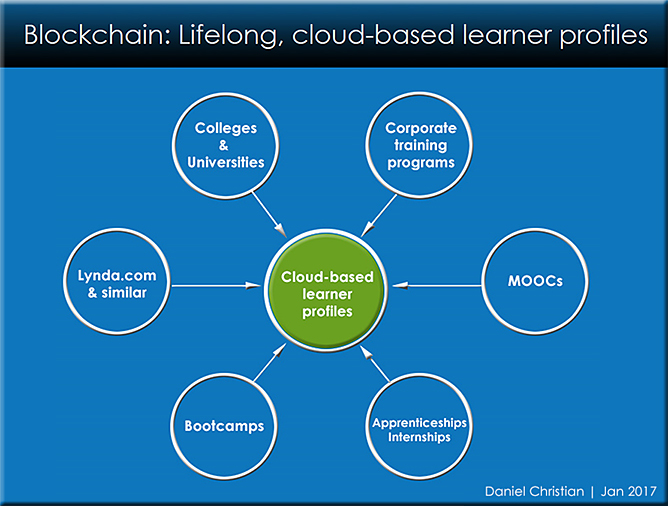
Will ChatGPT remember us in the future via our own profiles? How about taking this a step further Daniel Christian offers -- to access our own web-based learning profiles?

From DSC:
And how about taking this a step further and remembering — or being able to access — our constantly updated Cloud-Based Learning Profiles?

How about taking this a step further Daniel Christian offers -- to access our own web-based learning profiles?


Trend No. 3: The business model faces a full-scale transformation — from www2.deloitte.com by Cole Clark, Megan Cluver, and Jeffrey J. Selingo
The traditional business model of higher education is broken as institutions can no longer rely on rising tuition among traditional students as the primary driver of revenue.

Excerpt:

Yet the opportunities for colleges and universities that shift their business model to a more student-centric one, serving the needs of a wider diversity of learners at different stages of their lives and careers, are immense. Politicians and policymakers are looking for solutions to the demographic cliff facing the workforce and the need to upskill and reskill generations of workers in an economy where the half-life of skills is shrinking. This intersection of needs—higher education needs students; the economy needs skilled workers—means that colleges and universities, if they execute on the right set of strategies, could play a critical role in developing the workforce of the future. For many colleges, this shift will require a significant rethinking of mission and structure as many institutions weren’t designed for workforce development and many faculty don’t believe it’s their job to get students a job. But if a set of institutions prove successful on this front, they could in the process improve the public perception of higher education, potentially leading to more political and financial support for growing this evolving business model in the future.

Also see:

Trend No. 2: The value of the degree undergoes further questioning — from www2.deloitte.com by Cole Clark, Megan Cluver, and Jeffrey J. Selingo
The perceived value of higher education has fallen as the skills needed to keep up in a job constantly change and learners have better consumer information on outcomes.

Excerpt:

Higher education has yet to come to grips with the trade-offs that students and their families are increasingly weighing with regard to obtaining a four-year degree.
…
But the problem facing the vast majority of colleges and universities is that they are no longer perceived to be the best source for the skills employers are seeking. This is especially the case as traditional degrees are increasingly competing with a rising tide of microcredentials, industry-based certificates, and well-paying jobs that don’t require a four-year degree.

Trend No. 1: College enrollment reaches its peak — from www2.deloitte.com by Cole Clark, Megan Cluver, and Jeffrey J. Selingo
Enrollment rates in higher education have been declining in the United States over the years as other countries catch up.

Excerpt:

Higher education in the United States has only known growth for generations. But enrollment of traditional students has been falling for more than a decade, especially among men, putting pressure both on the enrollment pipeline and on the work ecosystem it feeds. Now the sector faces increased headwinds as other countries catch up with the aggregate number of college-educated adults, with China and India expected to surpass the United States as the front runners in educated populations within the next decade or so.

Plus the other trends listed here >>


Also related to higher education, see the following items:


Number of Colleges in Distress Is Up 70% From 2012 — from bloomberg.com by Nic Querolo (behind firewall)
More schools see falling enrollement and tuition revenue | Small private, public colleges most at risk, report show

About 75% of students want to attend college — but far fewer expect to actually go — from highereddive.com by Jeremy Bauer-Wolf

There Is No Going Back: College Students Want a Live, Remote Option for In-Person Classes — from campustechnology.com by Eric Paljug

Excerpt:

Based on a survey of college students over the last three semesters, students understand that remotely attending a lecture via remote synchronous technology is less effective for them than attending in person, but they highly value the flexibility of this option of attending when they need it.

Future Prospects and Considerations for AR and VR in Higher Education Academic Technology — from er.educause.edu by Owen McGrath, Chris Hoffman and Shawna Dark
Imagining how the future might unfold, especially for emerging technologies like AR and VR, can help prepare for what does end up happening.

Black Community College Enrollment is Plummeting. How to Get Those Students Back — from the74million.org by Karen A. Stout & Francesca I. Carpenter
Stout & Carpenter: Schools need a new strategy to bolster access for learners of color who no longer see higher education as a viable pathway

As the Level Up coalition reports ,“the vast majority — 80% — of Black Americans believe that college is unaffordable.” This is not surprising given that Black families have fewer assets to pay for college and, as a result, incur significantly more student loan debt than their white or Latino peers. This is true even at the community college level. Only one-third of Black students are able to earn an associate degree without incurring debt. 

Repairing Gen Ed | Colleges struggle to help students answer the question, ‘Why am I taking this class?’ — from chronicle.com by Beth McMurtrie
Students Are Disoriented by Gen Ed. So Colleges Are Trying to Fix It.

Excerpts:

Less than 30 percent of college graduates are working in a career closely related to their major, and the average worker has 12 jobs in their lifetime. That means, he says, that undergraduates must learn to be nimble and must build transferable skills. Why can’t those skills and ways of thinking be built into general education?
…
“Anyone paying attention to the nonacademic job market,” he writes, “will know that skills, rather than specific majors, are the predominant currency.”

Micro-credentials Survey. 2023 Trends and Insights. — from holoniq.com
HolonIQ’s 2023 global survey on micro-credentials

3 Keys to Making Microcredentials Valid for Learners, Schools, and Employers — from campustechnology.com by Dave McCool
To give credentials value in the workplace, the learning behind them must be sticky, visible, and scalable.

Positive Partnership: Creating Equity in Gateway Course Success — from insidehighered.com by Ashley Mowreader
The Gardner Institute’s Courses and Curricula in Urban Ecosystems initiative works alongside institutions to improve success in general education courses.

American faith in higher education is declining: one poll — from bryanalexander.org by Bryan Alexander

Excerpt:

The main takeaway is that our view of higher education’s value is souring.  Fewer of us see post-secondary learning as worth the cost, and now a majority think college and university degrees are no longer worth it: “56% of Americans think earning a four-year degree is a bad bet compared with 42% who retain faith in the credential.”
…
Again, this is all about one question in one poll with a small n. But it points to directions higher ed and its national setting are headed in, and we should think hard about how to respond.



Upskilling the top priority for L&D leaders, LinkedIn report finds — from hcamag.com by Ksenia Stepanova; with thanks to GSV for this resource
L&D is becoming critical to business strategy – but are leaders keeping up? LinkedIn reveals its latest insights

Excerpt:

Learning and development (L&D) has taken centre stage in recent years, and has become vital to business strategy across the globe. In Singapore, upskilling employees has become the number one priority for L&D professionals in 2023, according to LinkedIn’s 2023 Workplace Learning Report.


2023 EDUCAUSE Horizon Report | Teaching and Learning Edition

2023 EDUCAUSE Horizon Report | Teaching and Learning Edition — from library.educause.edu

Excerpt:

The Future of Teaching and Learning
Artificial intelligence (AI) has taken the world by storm, with new AI-powered tools such as ChatGPT opening up new opportunities in higher education for content creation, communication, and learning, while also raising new concerns about the misuses and overreach of technology. Our shared humanity has also become a key focal point within higher education, as faculty and leaders continue to wrestle with understanding and meeting the diverse needs of students and to find ways of cultivating institutional communities that support student well-being and belonging.

For this year’s teaching and learning Horizon Report, then, our panelists’ discussions oscillated between these seemingly polar ideas: the supplanting of human activity with powerful new technological capabilities, and the need for more humanity at the center of everything we do. This report summarizes the results of those discussions and serves as one vantage point on where our future may be headed.


The 2023 Global Sentiment Survey — from donaldhtaylor.co.uk by Don Taylor

Excerpt:

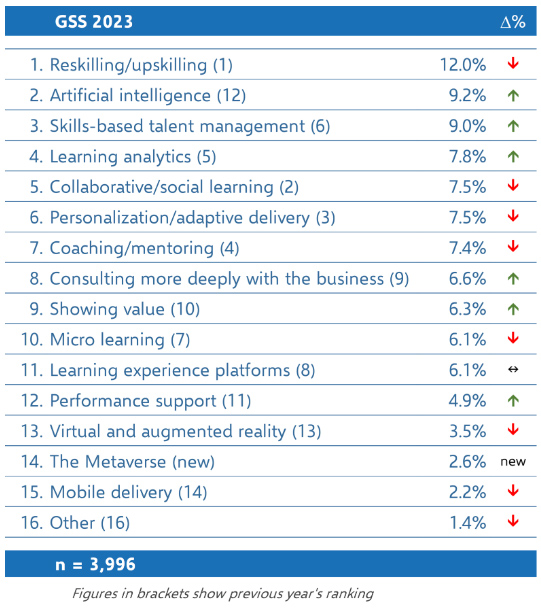
This year’s Global Sentiment Survey – the tenth – paints a picture that is both familiar and unusual. In our 2020 survey report, we noted that ‘Data dominates this year’s survey’. It does so again this year, with the near 4,000 respondents showing a strong interest in AI, Skills-based talent management and Learning analytics (in positions #2, #3 and #4), all of which rely on data. The table is topped by Reskilling/upskilling, in the #1 spot for the third year running.
.

Donald Taylor's GSS 2023

.

Also see Don’s report here >>


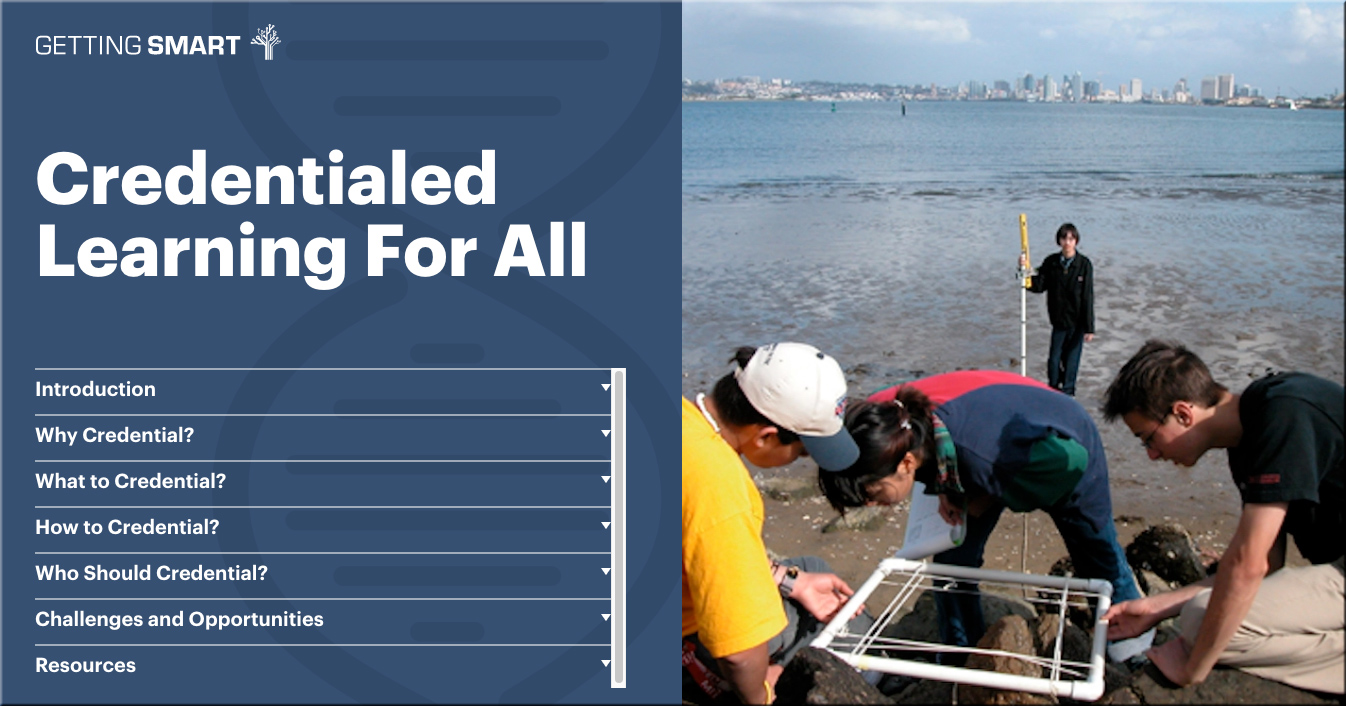
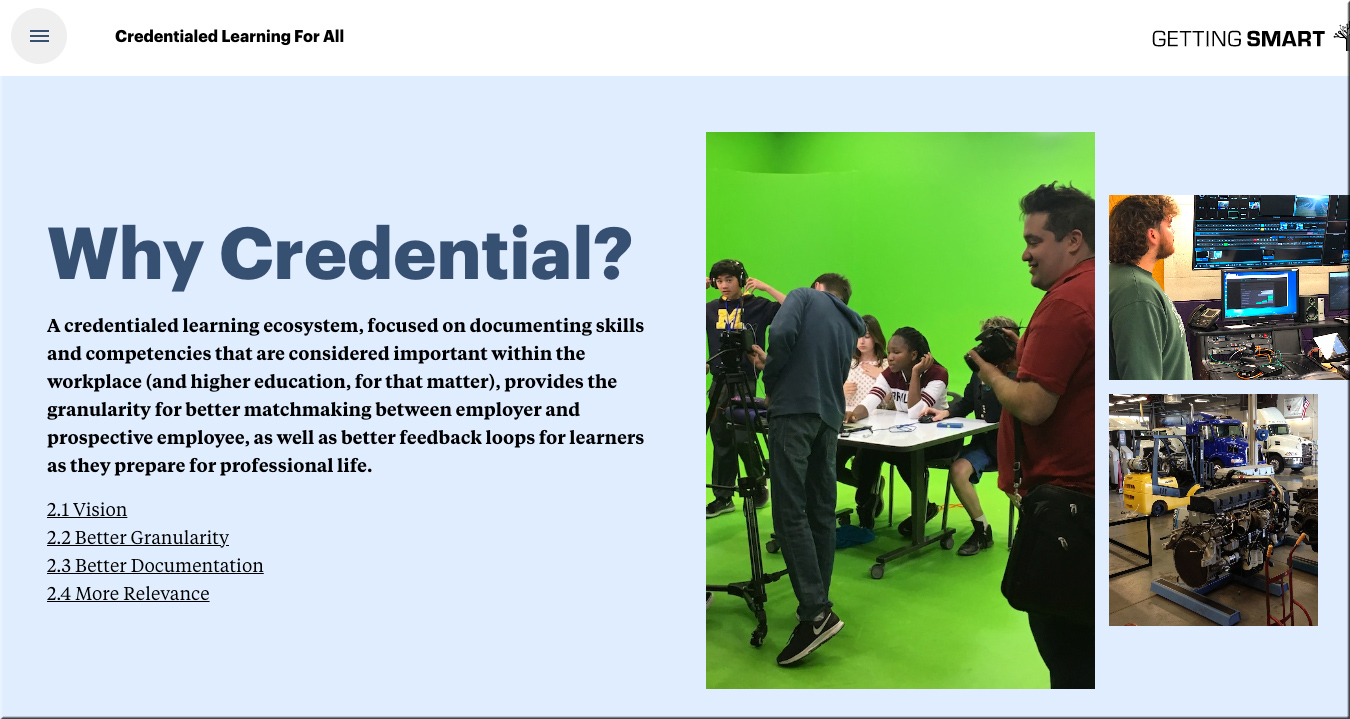
Credentialed learning for all -- from Getting Smart


Why credential section -- from Getting Smart's Credentialed Learning for All

Credentialed Learning For All — from gettingsmart.com

Vision

Learning happens throughout life and is not isolated to the K-12 or higher education sectors. Yet, often, validations of learning only happen in these specific areas. The system of evaluation based on courses, grades, and credit serves as a poor proxy for communicating skills given the variation in course content, grade inflation, and inclusion of participation and extra credit within course grades.

Credentialed learning provides a way to accurately document human capability for all learners throughout their life. A lifetime credentialed learning ecosystem provides better granularity around learning, better documentation of the learning, and more relevance for both the credential recipient and reviewer. This improves the match between higher education and/or employment with the individual, while also providing a more clear and accurate lifetime learning pathway.

With a fully-credentialed system, individuals can own well-documented evidence of a lifetime of learning and choose what and when to share this data. This technology enables every learner to have more opportunities for finding the best career match without today’s existing barriers around cost, access, and proxies.


Addendum on 4/28/23 — speaking of credentials:

First Rung — from the-job.beehiiv.com by Paul Fain
New research shows stacking credentials pays off for low-income learners.

Stacking credentials pays off for many low-income students, new research finds, but only if learners move up the education ladder. Also, Kansas is hoping a new grant program will attract more companies to participate in microinternships.


60% of Higher Education Leaders Say Continuing Education is Not Well-Integrated into Institutional Portfolio Offerings — from finance.yahoo.com
Despite Belief that CE Programming Positively Affects Enrollments in Traditional Programming, CE Units Remain Under-Resourced

Excerpt:

TORONTO, March 22, 2023 /PRNewswire-PRWeb/ — While 71% of senior leaders within higher education institutions support scale and growth of continuing education (CE), more than half (57%) feel that their CE units are understaffed to execute on institutional goals. This is according to the 2023 State of Continuing Education report. Published by higher education engagement platform leader Modern Campus, in partnership with the Canadian Association for University Continuing Education (CAUCE), The EvoLLLution, and the University Professional and Continuing Education Association (UPCEA), the study explores professional, continuing, and online (PCO) unit program offerings, institutional support and capabilities, perceptions of the competitive landscape, and continuing education collaboration and integration within the larger institution.

“The future higher education institution is rooted in CE, but delivering on that promise requires both strategic and operational support from the institution,” said Amrit Ahluwalia, senior director of content and strategic insights at Modern Campus and editor-in-chief of The EvoLLLution. “It is our sincere belief that the findings of this study will enable CE professionals to advocate for greater resources and allow them to be seen for the critical functions that their portfolio plays for institutions and learners alike.”


Houses of worship to move streaming from social media to dedicated platforms — from inavateonthenet.net

Houses of worship to move streaming from social media to dedicated platforms

Excerpt:

A report by Pushpay, with data from over 1,700 organisations has found that while 91% of churches currently livestream worship services on social media, only 47% plan to do the same in the upcoming year.

The report, entitled ‘State of Church Tech 2023 is available to download here.

The reason cited for this shift is organisations’ lack of control on social media platforms to maintain engagement, as users are bombarded with pop-up windows, notifications, status updates, and more.

This is driving a rise in custom video players, website embeds, mobile app streaming, and other platforms that are better suited to maintain engagement.


Designing Virtual Edtech Faculty Development Workshops That Stick: 10 Guiding Principles — from er.educause.edu by Tolulope (Tolu) Noah
These ten principles offer guidance on ways to design and facilitate effective and engaging virtual workshops that leave faculty feeling better equipped to implement new edtech tools.

Excerpt:

I share here ten guiding principles that have shaped my design and facilitation of virtual synchronous edtech workshops. These guiding principles are based on lessons learned in both my previous role as a professional learning specialist at a major technology company and my current role as a faculty developer at a university. In the spirit of James M. Lang’s book Small Teaching, my hope is that the principles shared here may prompt reflection on the small yet impactful moves academic technology specialists, instructional designers, and educational developers can make to create virtual learning experiences whereby faculty leave feeling better equipped to implement the edtech tools they have learned.


Somewhat relevant/see:

Evidence-Based Learning Design 101 — by Dr. Philippa Hardman
A practical guide on how to bake the science of learning into the art of course design

Excerpt:

As I reflect on the experience and what I’ve learned so far, I thought I’d share a response to the question I probably get asked most: what process do you use to go from an idea to a designed learning experience?

So, let’s do a rapid review of the four step process I and my bootcamp alumni use – aka the DOMS™? process – to go from zero to a designed learning experience.


Donald Clark’s recent thoughts regarding how ChatGPT is and will impact the Learning & Development world — from linkedin.com by Donald Clark

Excerpts:

Fascinating chat with three people heading up L&D in a major international company. AI has led them to completely re-evaluate their strategy. Key concepts were performance, process and data. What I liked was their focus on that oft-quoted issue of aligning L&D with the business goals – unlike most, they really meant it.

The technology that puts that in the hands of learners has arrived. Performance support will be a teacher or trainer at your fingertips.

We also talked about prompting, the need to see it as ‘CHAT’gpt, an iterative process, where you need to understand how to speak to the tech. It’s a bit like speaking to an alien from space, as it has no comprehension or consciousness but it is still competent and smart. We have put together 100 prompt tips for learning professionals and taking it out on the road soon. All good in the hood.

Also from Donald Clark, see:

OpenAI releases massive wave of innovation — from donaldclarkplanb.blogspot.com

Excerpt:

With LLMs, OpenAI’s ChatGPT, based on GPT 3.5, started a race where:

  • AI is integrated into mainstream tools like Teams
  • Larger LLMs are being built
  • LLMs are changing ‘search’
  • LLMs are being used on a global scale in real businesses
  • Real businesses are being built on the back of LLMs
  • LLMs as part of ensembes of other tools are being researched to solve accuracy, updatability & provenance issues
  • Open, transparent LLMs (Bloom) are being built
 
© 2025 | Daniel Christian