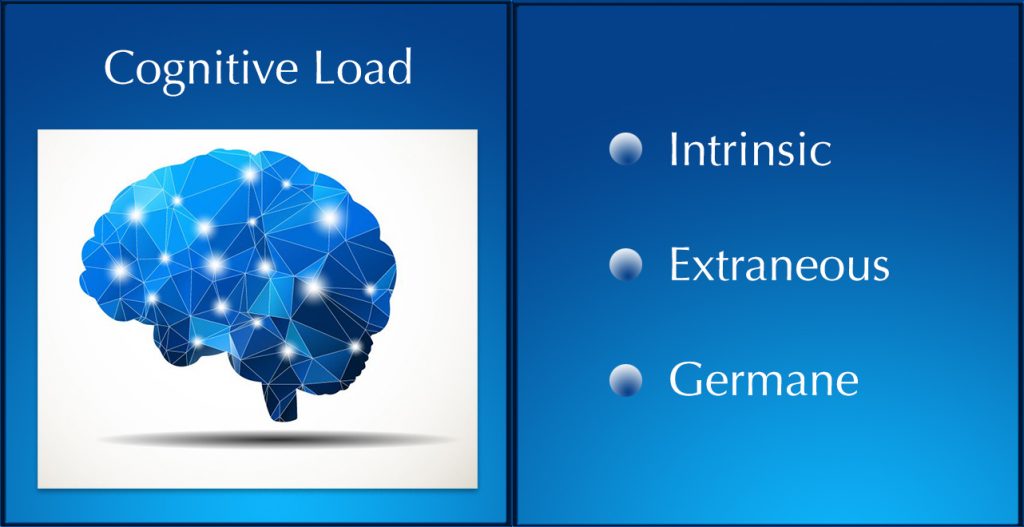
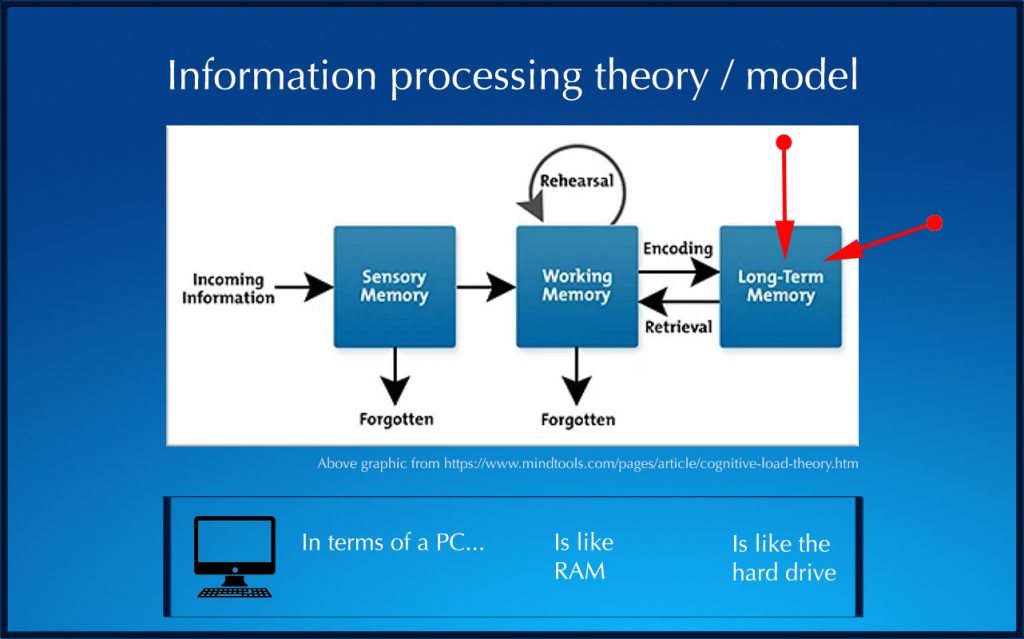
Cognitive Load Theory is an influential theory from educational psychology that describes how various factors affect our ability to use our working memory resources. We’ve done a digest about cognitive load theory here and talked about it here and here, but haven’t provided an overview of the theory so I want to give an overview here.
…
Cognitive load theory provides useful and dynamic model for how many different factors affect working memory and learning. Hopefully this post provides a useful overview of some of the main components of cognitive load!
Simplify the explanations of what you’re presenting as much as possible and break down complex tasks into smaller parts
Don’t place a large amount of text on a slide and then talk about it at the same time — doing so requires much more processing than most people can deal with.
Consider creating two versions of your PowerPoint files:
A text-light version that can be used for presenting that content to students
A text-heavy version — which can be posted to your LMS for the learners to go through at their own pace — and without trying to process so much information (voice and text, for example) at one time.
Design-wise:
Don’t use decorative graphics — everything on a slide should be there for a reason
Don’t use too many fonts or colors — this can be distracting
Don’t use background music when you are trying to explain something
YouTube is experimenting with AI-generated quizzes on its mobile app for iOS and Android devices, which are designed to help viewers learn more about a subject featured in an educational video. The feature will also help the video-sharing platform get a better understanding of how well each video covers a certain topic.
Since January 2023, I’ve talked with hundreds of instructors at dozens of institutions about how they might incorporate AI into their teaching. Through these conversations, I’ve noticed a few common issues:
Faculty and staff are overwhelmed and burned out. Even those on the cutting edge often feel they’re behind the curve.
It’s hard to know where to begin.
It can be difficult to find practical examples of AI use that are applicable across a variety of disciplines.
To help address these challenges, I’ve been working on a list of AI-infused learning activities that encourage experimentation in (relatively) small, manageable ways.
September 2023: The Secret Intelligent Beings on Campus— from stefanbauschard.substack.com by Stefan Bauschard Many of your students this fall will be enhanced by artificial intelligence, even if they don’t look like actual cyborgs. Do you want all of them to be enhanced, or just the highest SES students?
In the past few months we have been deluged with headlines about new AI tools and how much they are going to change society.
Some reporters have done amazing work holding the companies developing AI accountable, but many struggle to report on this new technology in a fair and accurate way.
We—an investigative reporter, a data journalist, and a computer scientist—have firsthand experience investigating AI. We’ve seen the tremendous potential these tools can have—but also their tremendous risks.
As their adoption grows, we believe that, soon enough, many reporters will encounter AI tools on their beat, so we wanted to put together a short guide to what we have learned.
.
DSC:
Something I created via Adobe Firefly (Beta version)
Does this mean it will do away with the L&D job? Not at all — these tools give you superhuman powers to find content faster, put it in front of employees in a more useful way and more creatively craft character simulations, assessments, learning in the flow of work and more.
And it’s about time. We really haven’t had a massive innovation in L&D since the early days of the learning experience platform market, so we may be entering the most exciting era in a long time.
Let me give you the five most significant use cases I see. And more will come.
As I read online, I bookmark resources I find interesting and useful. I share these links periodically here on my blog. This post includes links on using tech with scenarios: AI, xAPI, and VR. I’ll also share some other AI tools and links on usability, resume tips for teachers, visual language, and a scenario sample.
Microsoft co-founder Bill Gates saying generative AI chatbots can teach kids to read in 18 months rather than years.
Artificial intelligence is beginning to prove that it can accelerate the impact teachers have on students and help solve a stubborn teacher shortage.
Chatbots backed by large language models can help students, from primary education to certification programs, self-guide through voluminous materials and tailor their education to specific learning styles [preferences].
Unfortunately, too often attention is focused on the problems of AI—that it allows students to cheat and can undermine the value of what teachers bring to the learning equation. This viewpoint ignores the immense possibilities that AI can bring to education and across every industry.
The fact is that students have already embraced this new technology, which is neither a new story nor a surprising one in education. Leaders should accept this and understand that people, not robots, must ultimately create the path forward. It is only by deploying resources, training and policies at every level of our institutions that we can begin to realize the vast potential of what AI can offer.
SAIL: State of Research: AI & Education — from buttondown.email by George Siemens Information re: current AI and Learning Labs, education updates, and technology
In this post I’d like to explore that apocalyptic model. For reasons of space, I’ll leave off analyzing student cheating motivations or questioning the entire edifice of grade-based assessment. I’ll save potential solutions for another post.
Let’s dive into the practical aspects of teaching to see why Mollick and Bogost foresee such a dire semester ahead.
I put together an initial prompt to set up Code Interpreter to create useful data visualizations. It gives it some basic principles of good chart design & also reminds it that it can output many kinds of files.
Code Interpreter continues OpenAI’s long tradition of giving terrible names to things, because it might be most useful for those who do not code at all. It essentially allows the most advanced AI available, GPT-4, to upload and download information, and to write and execute programs for you in a persistent workspace. That allows the AI to do all sorts of things it couldn’t do before, and be useful in ways that were impossible with ChatGPT.
.
BREAKING: Code Interpreter is FINALLY rolling out to all ChatGPT Plus users.
It’s the most powerful feature OpenAI has released since GPT-4. It makes everyone a data analyst.
The Homework Apocalypse — from oneusefulthing.org by Ethan Mollick Fall is going to be very different this year. Educators need to be ready.
Excerpt:
Students will cheat with AI. But they also will begin to integrate AI into everything they do, raising new questions for educators. Students will want to understand why they are doing assignments that seem obsolete thanks to AI. They will want to use AI as a learning companion, a co-author, or a teammate. They will want to accomplish more than they did before, and also want answers about what AI means for their future learning paths. Schools will need to decide how to respond to this flood of questions.
The challenge of AI in education can feel abstract, so to understand a bit more about what is going to happen, I wanted to examine some common assignment types.
Post-AI Assessment Design — from drphilippahardman.substack.com by Dr. Philippa Hardman A simple, three-step guide on how to design assessments in a post-AI world
Excerpt:
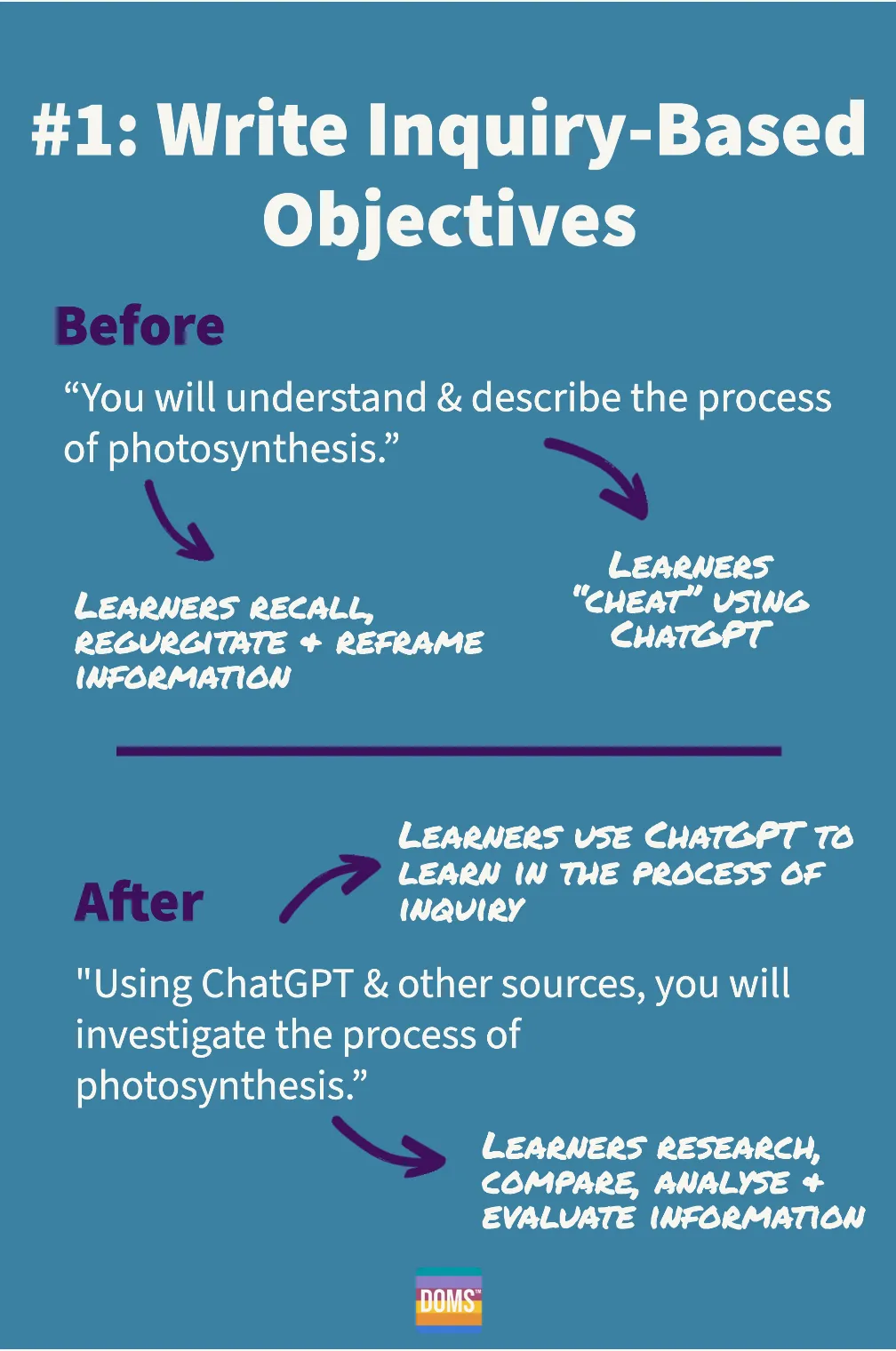
Step 1: Write Inquiry-Based Objectives
Inquiry-based objectives focus not just on the acquisition of knowledge but also on the development of skills and behaviours, like critical thinking, problem-solving, collaboration and research skills.
They do this by requiring learners not just to recall or “describe back” concepts that are delivered via text, lecture or video. Instead, inquiry-based objectives require learners to construct their own understanding through the process of investigation, analysis and questioning.
Just for a minute, consider how education would change if the following were true –
AIs “hallucinated” less than humans
AIs could write in our own voices
AIs could accurately do math
AIs understood the unique academic (and eventually developmental) needs of each student and adapt instruction to that student
AIs could teach anything any student wanted or need to know any time of day or night
AIs could do this at a fraction of the cost of a human teacher or professor
Fall 2026 is three years away. Do you have a three year plan? Perhaps you should scrap it and write a new one (or at least realize that your current one cannot survive). If you run an academic institution in 2026 the same way you ran it in 2022, you might as well run it like you would have in 1920. If you run an academic institution in 2030 (or any year when AI surpasses human intelligence) the same way you ran it in 2022, you might as well run it like you would have in 1820. AIs will become more intelligent than us, perhaps in 10-20 years (LeCun), though there could be unanticipated breakthroughs that lower the time frame to a few years or less (Benjio); it’s just a question of when, not “if.”
On one creative use of AI — from aiandacademia.substack.com by Bryan Alexander A new practice with pedagogical possibilities
Excerpt:
Look at those material items again. The voiceover? Written by an AI and turned into audio by software. The images? Created by human prompts in Midjourney. The music is, I think, human created. And the idea came from a discussion between a human and an AI?
…
How might this play out in a college or university class?
Imagine assignments which require students to craft such a video. Start from film, media studies, or computer science classes. Students work through a process:
I continue to try to imagine ways generative AI can impact teaching and learning, including learning materials like textbooks. Earlier this week I started wondering – what if, in the future, educators didn’t write textbooks at all? What if, instead, we only wrote structured collections of highly crafted prompts? Instead of reading a static textbook in a linear fashion, the learner would use the prompts to interact with a large language model.These prompts could help learners ask for things like:
overviews and in-depth explanations of specific topics in a specific sequence,
examples that the learner finds personally relevant and interesting,
interactive practice – including open-ended exercises – with immediate, corrective feedback,
the structure of the relationships between ideas and concepts,
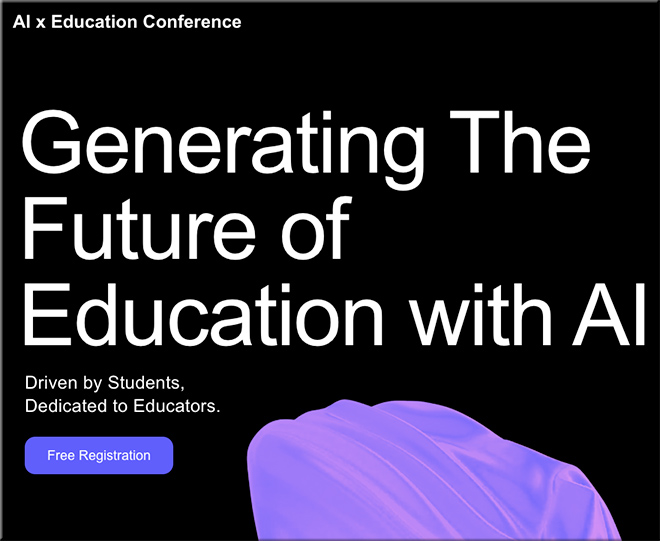
Designed for K12 and Higher-Ed Educators & Administrators, this conference aims to provide a platform for educators, administrators, AI experts, students, parents, and EdTech leaders to discuss the impact of AI on education, address current challenges and potentials, share their perspectives and experiences, and explore innovative solutions. A special emphasis will be placed on including students’ voices in the conversation, highlighting their unique experiences and insights as the primary beneficiaries of these educational transformations.
The use of generative AI in K-12 settings is complex and still in its infancy. We need to consider how these tools can enhance student creativity, improve writing skills, and be transparent with students about how generative AI works so they can better understand its limitations. As with any new tech, our students will be exposed to it, and it is our task as educators to help them navigate this new territory as well-informed, curious explorers.
The education ministry has emphasized the need for students to understand artificial intelligence in new guidelines released Tuesday, setting out how generative AI can be integrated into schools and the precautions needed to address associated risks.
Students should comprehend the characteristics of AI, including its advantages and disadvantages, with the latter including personal information leakages and copyright infringement, before they use it, according to the guidelines. They explicitly state that passing off reports, essays or any other works produced by AI as one’s own is inappropriate.
Thanks to the rapid development of artificial intelligence tools like Dall-E and ChatGPT, my brother-in-law has been wrestling with low-level anxiety: Is it a good idea to steer his son down this path when AI threatens to devalue the work of creatives? Will there be a job for someone with that skill set in 10 years? He’s unsure. But instead of burying his head in the sand, he’s doing what any tech-savvy parent would do: He’s teaching his son how to use AI.
In recent months the family has picked up subscriptions to AI services. Now, in addition to drawing and sculpting and making movies and video games, my nephew is creating the monsters of his dreams with Midjourney, a generative AI tool that uses language prompts to produce images.
To bridge this knowledge gap, I decided to make a quick little dictionary of AI terms specifically tailored for educators worldwide. Initially created for my own benefit, I’ve reworked my own AI Dictionary for Educators and expanded it to help my fellow teachers embrace the advancements AI brings to education.
According to Accessibility.com, at least 2,387 web accessibility lawsuits were filed in 2022. Those lawsuits were either filed under the Americans with Disabilities Act (ADA) or California’s Unruh Act; any violation of the ADA is considered a violation of the Unruh Act.
While the plaintiffs cited a variety of issues, multimedia accessibility is a common point of concern. In 2015, the National Association of the Deaf (NAD) and other plaintiffs settled a lawsuit with Netflix, which cited a lack of captions for certain featured movies and TV shows.
That prompts an interesting question: Does the ADA require captions for internet videos — and if so, how can businesses make sure that they’re compliant?
Rachel Kapp, M.Ed., BCET, and Stephanie Pitts, M.Ed., BCET welcome back College Learning Disability Specialist Elizabeth Hamblet to discuss her new book 7 Steps to College Success: A Pathway for Students with Disabilities. She discusses the origin story of the book and the disconnect between what college disability services can do for learners and what learners and parents expect. She talks about reading this book when the learner is in 8th grade because of the specific impact it can have on parent and learner decisions on course selection. Elizabeth discusses how parents and learners can get surprised in the college disability process. Elizabeth talks about the critical importance of non-academic skills and how the drive for success in high school can stand in the way of independence necessary for college success.
If you’re interested in accessible digital design, pay attention to Apple. The company seems to approach accessibility from the perspective of users with disabilities.
Apple’s messaging treats accessibility as a fundamental design principle: Accessibility must be built into digital systems from the start, not tacked on as an afterthought. In other words, they take an accessibility-first mindset, and their commitment seems consistent.
The company’s track record continued in May 2023, when Apple announced its latest suite of accessibility features to launch later that year. One of these features, Assistive Access for iPhone and iPad, holds valuable lessons that web designers can apply to their own work.
Here’s what Apple accomplished with Assistive Access, plus a few ways web designers can achieve similar goals.
But a recent survey of contingent faculty reveals the more uncertain situation most adjuncts find themselves in. A third of respondents earn less than $25,000 a year, falling below federal poverty guidelines for a family of four. Fewer than half receive university-provided health insurance, with nearly 20 percent on Medicaid.
In a stinging irony, many tenured faculty teach courses on equity and social justice, where students learn about oppression engendered by privilege. Yet just down the hall, someone else with the same level of education is teaching a similar course for vastly less pay and with little or no benefits.
Generative AI has taken the world by storm since OpenAI launched ChatGPT-3 in November 2022. Generative AI is characterized by its capacity to generate human-like content based on deep learning models in response to prompts. There is a wealth of opinions about how this will impact higher education spanning from the need to limit the use in the protection of higher education to embracing the tool as a means to improve higher education. In this webinar session, speakers from different regions shared their views and perspectives and discuss how Generative AI will transform higher education. What are the challenges to be addressed and which opportunities can be pursued to improve the quality of higher education? Watch the webinar and learn about the uncertainties, tensions, and opportunities triggered by Generative AI.
Trust and Transparency Are Key Factors When Using AI in Academia — from by Dr. Andrew Lang Much can be learned from embracing artificial intelligence in the teaching and learning process. Here, two professors share their experiences using ChatGPT freely in the classroom.
The AI-Education Divide— from drphilippahardman.substack.com by Philippa Hardman How the rise of AI has reinforced inequity in education (and what we need to do to reverse it) .
Their most recognisable role is to partner with faculty and provide them with inspiration, expertise and support in their teaching. But a broader role is emerging at institutional level- helping create a culture where people value talking about teaching and more generally, fostering a culture of continuous learning. In this respect, CTLs act as agents of change, aiming to influence the organizational (learning) environment.
…
CTLs are part of an ecosystem, internally and externally, and they have the potential to play a very important role, that of a network node. Internally, this can mean connecting various silos within the university, a much needed task, while externally it implies establishing collaboration flows with other CTLs that can in turn lead to broader inter-university collaboration. Making use of the full potential of this role can make a big difference for the success of a CTL.
Speaking of Teaching & Learning Centers, also see:
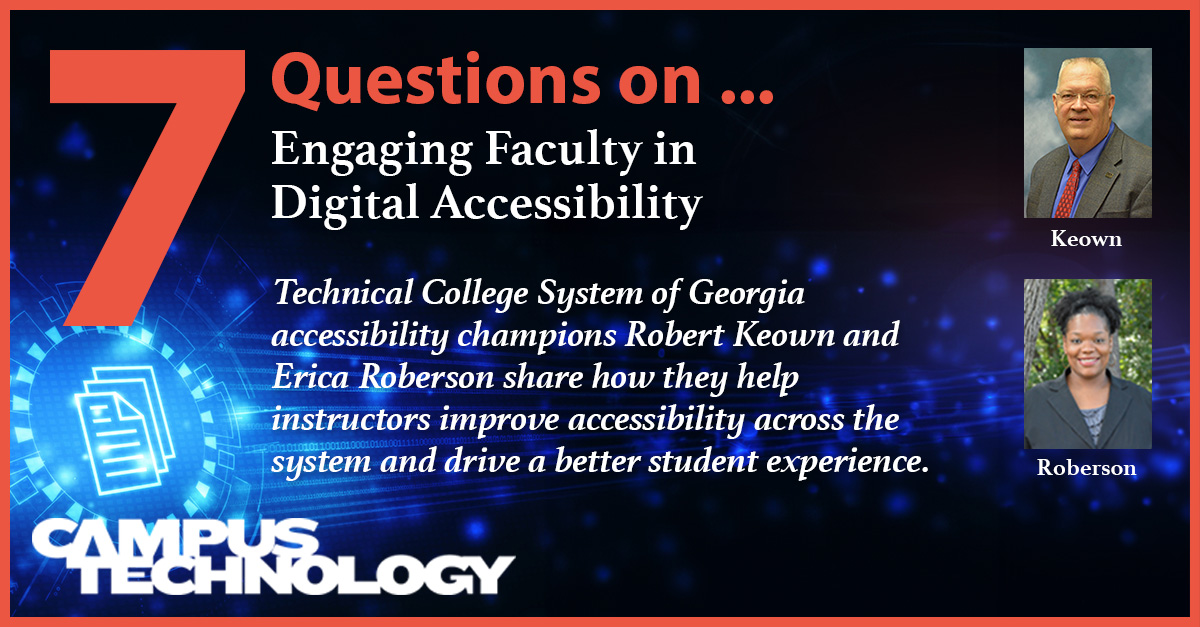
7 Questions on Engaging Faculty in Digital Accessibility — from campustechnology.com by Rhea Kelly We asked the Technical College System of Georgia’s accessibility champions how they help instructors create a more inclusive learning experience for all students.
— Daniel Christian (he/him/his) (@dchristian5) June 23, 2023
.
On giving AI eyes and ears— from oneusefulthing.org by Ethan Mollick AI can listen and see, with bigger implications than we might realize.
Excerpt:
But even this is just the beginning, and new modes of using AI are appearing, which further increases their capabilities. I want to show you some examples of this emerging world, which I think will soon introduce a new wave of AI use cases, and accompanying disruption.
We need to recognize that these capabilities will continue to grow, and AI will be able to play a more active role in the real world by observing and listening. The implications are likely to be profound, and we should start thinking through both the huge benefits and major concerns today.
Even though generative AI is a new thing, it doesn’t change why students cheat. They’ve always cheated for the same reason: They don’t find the work meaningful, and they don’t think they can achieve it to their satisfaction. So we need to design assessments that students find meaning in.
Tricia Bertram Gallant
Caught off guard by AI— from chonicle.com by Beth McMurtrie and Beckie Supiano Professor scrambled to react to ChatGPT this spring — and started planning for the fall
Excerpt:
Is it cheating to use AI to brainstorm, or should that distinction be reserved for writing that you pretend is yours? Should AI be banned from the classroom, or is that irresponsible, given how quickly it is seeping into everyday life? Should a student caught cheating with AI be punished because they passed work off as their own, or given a second chance, especially if different professors have different rules and students aren’t always sure what use is appropriate?
…OpenAI built tool use right into the GPT API with an update called function calling. It’s a little like a child’s ability to ask their parents to help them with a task that they know they can’t do on their own. Except in this case, instead of parents, GPT can call out to external code, databases, or other APIs when it needs to.
Each function in function calling represents a tool that a GPT model can use when necessary, and GPT gets to decide which ones it wants to use and when. This instantly upgrades GPT capabilities—not because it can now do every task perfectly—but because it now knows how to ask for what it wants and get it. .
.
How ChatGPT can help disrupt assessment overload— from timeshighereducation.com by David Carless Advances in AI are not necessarily the enemy – in fact, they should prompt long overdue consideration of assessment types and frequency, says David Carless
Excerpt:
Reducing the assessment burden could support trust in students as individuals wanting to produce worthwhile, original work. Indeed, students can be co-opted as partners in designing their own assessment tasks, so they can produce something meaningful to them.
A strategic reduction in quantity of assessment would also facilitate a refocusing of assessment priorities on deep understanding more than just performance and carries potential to enhance feedback processes.
If we were to tackle assessment overload in these ways, it opens up various possibilities. Most significantly there is potential to revitalise feedback so that it becomes a core part of a learning cycle rather than an adjunct at its end. End-of-semester, product-oriented feedback, which comes after grades have already been awarded, fails to encourage the iterative loops and spirals typical of productive learning. .
Since AI in education has been moving at the speed of light, we built this AI Tools in Education database to keep track of the most recent AI tools in education and the changes that are happening every day.This database is intended to be a community resource for educators, researchers, students, and other edtech specialists looking to stay up to date. This is a living document, so be sure to come back for regular updates.
These claims conjure up the rosiest of images: human resource departments and their robot buddies solving discrimination in workplace hiring. It seems plausible, in theory, that AI could root out unconscious bias, but a growing body of research shows the opposite may be more likely.
…
Companies’ use of AI didn’t come out of nowhere: For example, automated applicant tracking systems have been used in hiring for decades. That means if you’ve applied for a job, your resume and cover letter were likely scanned by an automated system. You probably heard from a chatbot at some point in the process. Your interview might have been automatically scheduled and later even assessed by AI.
From DSC:
Here was my reflection on this:
DC: Along these lines, I wonder if Applicant Tracking Systems cause us to become like typecast actors and actresses — only thought of for certain roles. Pigeonholed.
— Daniel Christian (he/him/his) (@dchristian5) June 23, 2023
In June, ResumeBuilder.com surveyed more than 1,000 employees who are involved in hiring processes at their workplaces to find out about their companies’ use of AI interviews.
The results:
43% of companies already have or plan to adopt AI interviews by 2024
Two-thirds of this group believe AI interviews will increase hiring efficiency
15% say that AI will be used to make decisions on candidates without any human input
More than half believe AI will eventually replace human hiring managers
Watch OpenAI CEO Sam Altman on the Future of AI — from bloomberg.com Sam Altman, CEO & Co-Founder, OpenAI discusses the explosive rise of OpenAI and its products and what an AI-laced future can look like with Bloomberg’s Emily Chang at the Bloomberg Technology Summit.
The implementation of generative AI within these products will dramatically improve educators’ ability to deliver personalized learning to students at scale by enabling the application of personalized assessments and learning pathways based on individual student needs and learning goals. K-12 educators will also benefit from access to OpenAI technology…
Since 2012, 65 private colleges and universities with enrollment of 500 students or more, that I know of, have reduced their tuition, and commensurately reduced their discount rate. Several more schools are planning price resets for fall 2024. Schools use this strategy to increase the number of students who will consider them, and this approach has been successful for more than 80 percent of the schools which have reduced their published price.
From DSC: What I learned of economics in college would agree with this last bit. As the price goes down, demand goes up. And conversely, as the price goes up, demand goes down. As Lucie points out, many people don’t know about the heavily discounted prices within higher education. I’ve been fighting for price decreases for over 15 years…clearly, I haven’t had much success in that area.
AI-assisted cheating isn’t a temptation if students have a reason to care about their own learning.
Yesterday I happened to listen to two different podcasts that ended up resonating with one another and with an idea that’s been rattling around inside my head with all of this moral uproar about generative AI:
** If we trust students – and earn their trust in return – then they will be far less motivated to cheat with AI or in any other way. **
First, the question of motivation. On the Intentional Teaching podcast, while interviewing James Lang and Michelle Miller on the impact of generative AI, Derek Bruff points out (drawing on Lang’s Cheating Lessons book) that if students have “real motivation to get some meaning out of [an] activity, then there’s far less motivation to just have ChatGPT write it for them.” Real motivation and real meaning FOR THE STUDENT translates into an investment in doing the work themselves.
…
Then I hopped over to one of my favorite podcasts – Teaching in Higher Ed – where Bonni Stachowiak was interviewing Cate Denial about a “pedagogy of kindness,” which is predicated on trusting students and not seeing them as adversaries in the work we’re doing.
So the second key element: being kind and trusting students, which builds a culture of mutual respect and care that again diminishes the likelihood that they will cheat.
…
Again, human-centered learning design seems to address so many of the concerns and challenges of the current moment in higher ed. Maybe it’s time to actually practice it more consistently. #aiineducation #higheredteaching #inclusiveteaching
How liberal arts colleges can make career services a priority — from highereddive.com by John Boyer Creating internships and focusing on short-term experiences has a big impact, the longtime undergraduate dean at the University of Chicago says.
TI-ADDIE: A Trauma-Informed Model of Instructional Design — from er.educause.edu by Ali Carr-Chellman and Treavor Bogard Adjusting the ADDIE model of instructional design specifically to accommodate trauma offers an opportunity to address the collective challenges that designers, instructors, and learners have faced during the current learning moment.
Ernst and Young dug a little deeper. “Today’s disruptive working landscape requires organisations to largely restructure the way they are doing work,” they noted in a bulletin in March this year. “Time now spent on tasks will be equally divided between people and machines. For these reasons, workforce roles will change and so do the skills needed to perform them.”
The World Economic Forum has pointed to this global skills gap and estimates that, while 85 million jobs will be displaced, 50% of all employees will need reskilling and/or upskilling by 2025. This, it almost goes without saying, will require Learning and Development departments to do the heavy-lifting in this initial transformational phase but also in an on-going capacity.
“And that’s the big problem,” says Hardman. “2025 is only two and half years away and the three pillars of L&D – knowledge transference, knowledge reinforcement and knowledge assessment – are crumbling. They have been unchanged for decades and are now, faced by revolutionary change, no longer fit for purpose.”
ChatGPT is the shakeup education needs— from eschoolnews.com by Joshua Sine As technology evolves, industries must evolve alongside it, and education is no exception–especially when students heavily and regularly rely on edtech
Key points:
Education must evolve along with technology–students will expect it
Embracing new technologies helps education leverage adaptive technology that engage student interest
Changed by Our Journey: Engaging Students through Simulive Learning — from er.educause.edu by Lisa Lenze and Megan Costello In this article, an instructor explains how she took an alternative approach to teaching—simulive learning—and discusses the benefits that have extended to her in-person classrooms.
Excerpts:
Mustering courage, Costello devised a novel way to (1) share the course at times other than when it was regularly scheduled and (2) fully engage with her students in the chat channel during the scheduled class meeting time. Her solution, which she calls simulive learning, required her to record her lectures and watch them with her students. (Courageous, indeed!)
Below, Costello and I discuss what simulive learning looks like, how it works, and how Costello has taken her version of remote synchronous teaching forward into current semesters.
Megan Costello: I took a different approach to remote synchronous online learning at the start of the pandemic. Instead of using traditional videoconferencing software to hold class, I prerecorded, edited, and uploaded videos of my lectures to a streaming website. This website allowed me to specify a time and date to broadcast my lectures to my students. Because the lectures were already prepared, I could watch and participate in the chat with my students as we encountered the materials together during the scheduled class time. I drove conversations in chat, asked questions, and got students engaged as we covered materials for the day. The students had my full attention.
Professors Plan Summer AI Upskilling, With or Without Support — from insidehighered.com by Susan D’Agostino Academics seeking respite from the fire hose of AI information and hot takes launch summer workshops. But many of the grass-roots efforts fall short of meeting demand.
Excerpt:
In these summer faculty AI workshops, some plan to take their first tentative steps in redesigning assignments to recognize the AI-infused landscape. Others expect to evolve their in-progress teaching-with-AI practices. At some colleges, full-time staff will deliver the workshops or pay participants for professional development time. But some offerings are grassroots efforts delivered by faculty volunteers attended by participants on their own time. Even so, many worry that the efforts will fall short of meeting demand.
From DSC: We aren’t used to this pace of change. It will take time for faculty members — as well as Instructional Designers, Instructional Technologists, Faculty Developers, Learning Experience Designers, Librarians, and others — to learn more about AI and its implications for teaching and learning. Faculty are learning. Staff are learning. Students are learning. Grace is needed. And faculty/staff modeling what it is to learn themselves is a good thing for students to see as well.
This can be done first and foremost through collaboration, bringing more people at the table, in a meaningful workflow, whereby they can make the best use of their expertise. Moreover, we need to take a step back and keep the big picture in mind, if we want to provide our students with a valuable experience.
…
This is all about creating and nurturing partnerships. Thinking in an inclusive way about who is at the table when we design our courses and our programmes and who we are currently missing. Generally speaking, the main actors involved should be: teaching staff, learning design professionals (under all their various names) and students. Yes, students. Although we are designing for their learning, they are all too often not part of the process.
In order to yield results, collaborative practice needs to be embedded in the institutional fabric, and this takes time. Building silos happens fast, breaking them is a long term process. Creating a culture of dialogue, with clear and replicable processes is key to making collaborative learning design work.
From DSC: To me, Alexandra is addressing the topic of using teams to design, develop, and teach/offer courses. This is where a variety of skills and specialties can come together to produce an excellent learning experience. No one individual has all of the necessary skills — nor the necessary time. No way.
For the purpose of this article I want to look at learning design in a more holistic way, as a practice that takes place at institutional level. Because we are actually not designing the learning, we are designing for learning. It’s all about an ecosystem with many variable components, including people, institutions, pedagogy, disciplinary content, technology. Some of them more controllable or predictable, some of them less so. So learning design is (should be!) all about being adaptive, iterative, empathic, but also efficient, sustainable (from different points of view, I will come back to that later), scalable.





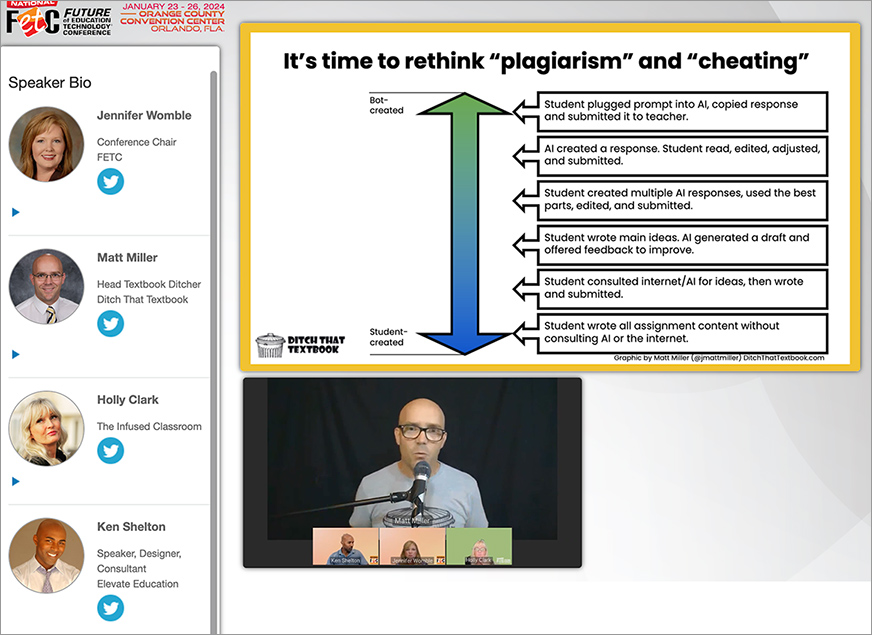


AI-assisted cheating isn’t a temptation if students have a reason to care about their own learning.
Yesterday I happened to listen to two different podcasts that ended up resonating with one another and with an idea that’s been rattling around inside my head with all of this moral uproar about generative AI:
** If we trust students – and earn their trust in return – then they will be far less motivated to cheat with AI or in any other way. **
First, the question of motivation. On the Intentional Teaching podcast, while interviewing James Lang and Michelle Miller on the impact of generative AI, Derek Bruff points out (drawing on Lang’s Cheating Lessons book) that if students have “real motivation to get some meaning out of [an] activity, then there’s far less motivation to just have ChatGPT write it for them.” Real motivation and real meaning FOR THE STUDENT translates into an investment in doing the work themselves.
…
Then I hopped over to one of my favorite podcasts – Teaching in Higher Ed – where Bonni Stachowiak was interviewing Cate Denial about a “pedagogy of kindness,” which is predicated on trusting students and not seeing them as adversaries in the work we’re doing.
So the second key element: being kind and trusting students, which builds a culture of mutual respect and care that again diminishes the likelihood that they will cheat.
…
Again, human-centered learning design seems to address so many of the concerns and challenges of the current moment in higher ed. Maybe it’s time to actually practice it more consistently. #aiineducation #higheredteaching #inclusiveteaching