Workday Acquires Sana To Transform Its Learning Platform And Much More— from joshbersin.com by Josh Bersin

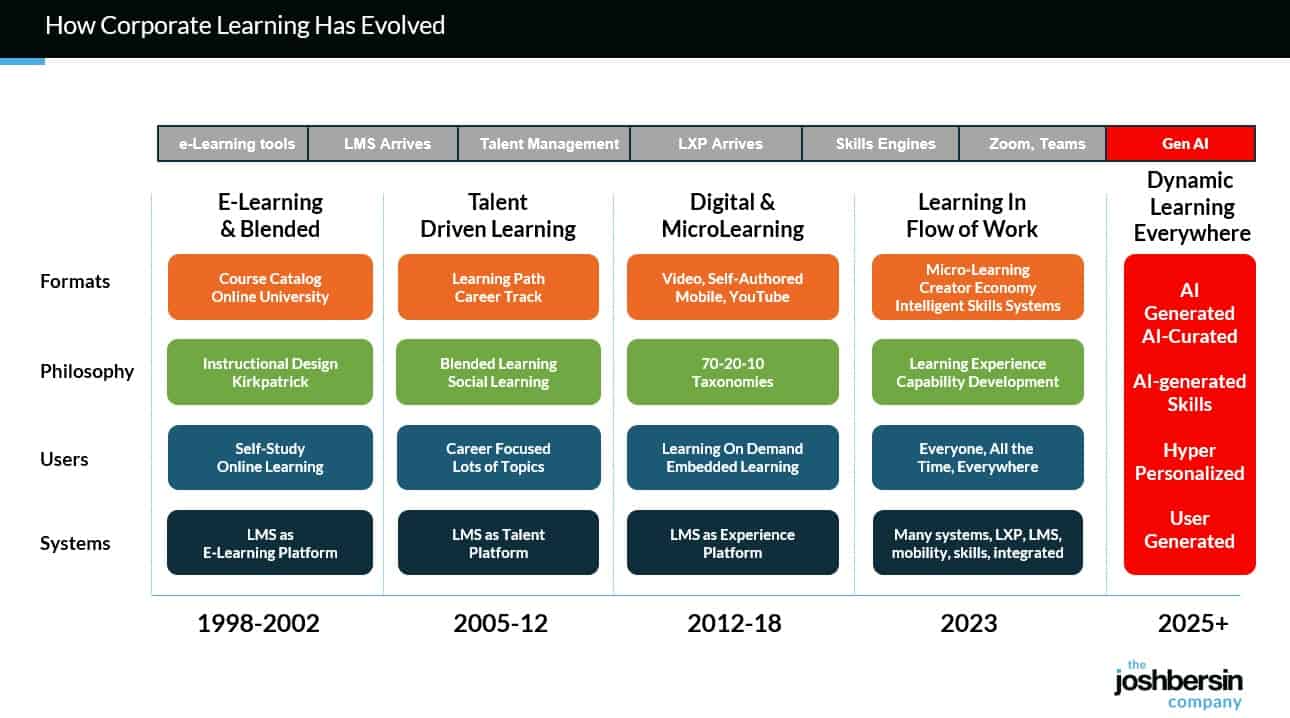
Well now, as the corporate learning market shifts to AI, (read the details in our study “The Revolution in Corporate Learning” ), Workday can jump ahead. This is because the $400 billion corporate training market is moving quickly to an AI-Native dynamic content approach (witness OpenAI’s launch of in-line learning in its chatbot). We’re just finishing a year-long study of this space and our detailed report and maturity model will be out in Q4.
.

.
With Sana, and a few other AI-native vendors (Uplimit, Arist, Disperz, Docebo), companies can upload audios, videos, documents, and even interviews with experts and the system build learning programs in minutes. We use Sana for Galileo Learn (our AI-powered learning academy for Leadership and HR), and we now have 750+ courses and can build new programs in days instead of months.

And there’s more; this type of system gives every employee a personalized, chat-based experience to learn. 


Via Kim “Chubby” Isenberg


ChatGPT: the world’s most influential teacher — from drphilippahardman.substack.com by Dr. Philippa Hardman; emphasis DSC
New research shows that millions of us are “learning with AI” every week: what does this mean for how (and how well) humans learn?

This week, an important piece of research landed that confirms the gravity of AI’s role in the learning process. The TLDR is that learning is now a mainstream use case for ChatGPT; around 10.2% of all ChatGPT messages (that’s ~2BN messages sent by over 7 million users per week) are requests for help with learning.

The research shows that about 10.2% of all messages are tutoring/teaching, and within the “Practical Guidance” category, tutoring is 36%. “Asking” interactions are growing faster than “Doing” and are rated higher quality by users. Younger people contribute a huge share of messages, and growth is fastest in low- and middle-income countries (How People Use ChatGPT, 2025).

If AI is already acting as a global tutor, the question isn’t “will people learn with AI?”—they already are. The real question we need to ask is: what does great learning actually look like, and how should AI evolve to support it? That’s where decades of learning science help us separate “feels like learning” from “actually gaining new knowledge and skills”.

Let’s dive in.


Stanford Law Unveils liftlab, a Groundbreaking AI Initiative Focused on the Legal Profession’s Future — from law.stanford.edu

September 15, 2025 — Stanford, CA — Stanford Law School today announced the launch of the Legal Innovation through Frontier Technology Lab, or liftlab, to explore how artificial intelligence can reshape legal services—not just to make them faster and cheaper, but better and more widely accessible.

Led by Professor Julian Nyarko and Executive Director Megan Ma, liftlab is among the first academic efforts in legal AI to unite research, prototyping, and real-time collaboration with industry. While much of AI innovation in law has so far focused on streamlining routine tasks, liftlab is taking a broader and more ambitious approach. The goal is to tap AI’s potential to fundamentally change the way legal work serves society.


The divergence of law firms from lawyers — from jordanfurlong.substack.com by Jordan Furlong
LLMs’ absorption of legal task performance will drive law firms towards commoditized service hubs while raising lawyers to unique callings as trustworthy legal guides — so long as we do this right.

Generative AI is going to weaken and potentially dissolve that relationship. Law firms will become capable of generating output that can be sold to clients with no lawyer involvement at all.

Right now, it’s possible for an ordinary person to obtain from an LLM like ChatGPT-5 the performance of a legal task — the provision of legal analysis, the production of a legal instrument, the delivery of legal advice — that previously could only be acquired from a human lawyer.

I’m not saying a person should do that. The LLM’s output might be effective and reliable, or it might prove disastrously off-base. But many people are already using LLMs in this way, and in the absence of other accessible options for legal assistance, they will continue to do so.


Why legal professionals need purpose-built agentic AI — from legal.thomsonreuters.com by Frank Schilder with Thomson Reuters Labs

Highlights

  • Professional-grade agentic AI systems are architecturally distinct from consumer chatbots, utilizing domain-specific data and robust verification mechanisms to deliver the high accuracy and reliability essential for legal work, whereas consumer tools prioritize conversational flow using unvetted web data.
  • True agentic AI for legal professionals offers transparent, multi-agent workflows, integrates with authoritative legal databases for verification, and applies domain-specific reasoning to understand legal nuances, unlike traditional chatbots that lack this complexity and autonomy.
  • When evaluating legal AI, professionals should avoid solutions that lack workflow transparency, offer no human checkpoints for oversight, and cannot integrate with professional databases, ensuring the chosen tool enhances, rather than replaces, expert judgment.

How I Left Corporate Law to Become a Legal Tech Entrepreneur — from news.bloomberglaw.com by Adam Nguyen; behind a paywall

If you’re a lawyer wondering whether to take the leap into entrepreneurship, I understand the apprehension that comes with leaving a predictable path. Embracing the fear, uncertainty, challenges, and constant evolution integral to an entrepreneur’s journey has been worth it for me.


Lawyering In The Age Of AI: Why Artificial Intelligence Might Make Lawyers More Human — from abovethelaw.com by Lisa Lang and Joshua Horenstein
AI could rehumanize the legal profession.

AI is already adept at doing what law school trained us to do — identifying risks, spotting issues, and referencing precedent. What it’s not good at is nuance, trust, or judgment — skills that define great lawyering.

When AI handles some of the drudgery — like contract clause spotting and formatting — it gives us something precious back: time. That time forces lawyers to stop hiding behind legalese and impractical analysis. It allows — and even demands — that we communicate like leaders.

Imagine walking into a business meeting and, instead of delivering a 20-page memo, offering a single slide with a recommendation tied directly to company goals. That’s not just good lawyering; that’s leadership. And AI may be the catalyst that gets us there.

AI changes the game. When generative tools can translate clauses into plain English, the old value proposition of complexity begins to crumble. The playing field shifts — from who can analyze the most thoroughly to who can communicate the most clearly.

That’s not a threat. It’s an opportunity — one for lawyers to become better partners to the business by focusing on what matters most: sound judgment delivered in plain language.


3 Work Trends – Issue 87 — from the World Economic Forum

1. #AI adoption is delivering real results for early movers
Three years into the generative AI revolution, a small but growing group of global companies is demonstrating the tangible potential of AI. Among firms with revenues of $1 billion or more:

  • 17% report cost savings or revenue growth of at least 10% from AI.
  • Almost 80% say their AI investments have met or exceeded expectations.
  • Half worry they are not moving fast enough and could fall behind competitors.

The world’s first AI cabinet member — from therundown.ai by Zach Mink, Rowan Cheung, Shubham Sharma, Joey Liu & Jennifer Mossalgue
PLUS: Startup produces 3,000 AI podcast episodes weekly

The details:

  • Prime Minister Edi Rama unveiled Diella during a cabinet announcement this week, calling her the first member “virtually created by artificial intelligence”.
  • The AI avatar will evaluate and award all public tenders where the government contracts private firms.
  • Diella already serves citizens through Albania’s digital services portal, processing bureaucratic requests via voice commands.
  • Rama claims the AI will eliminate bribes and threats from decision-making, though the government hasn’t detailed what human oversight will exist.

The Rundown AI’s article links to:


Anthropic Economic Index report: Uneven geographic and enterprise AI adoption — from anthropic.com

In other words, a hallmark of early technological adoption is that it is concentrated—in both a small number of geographic regions and a small number of tasks in firms. As we document in this report, AI adoption appears to be following a similar pattern in the 21st century, albeit on shorter timelines and with greater intensity than the diffusion of technologies in the 20th century.

To study such patterns of early AI adoption, we extend the Anthropic Economic Index along two important dimensions, introducing a geographic analysis of Claude.ai conversations and a first-of-its-kind examination of enterprise API use. We show how Claude usage has evolved over time, how adoption patterns differ across regions, and—for the first time—how firms are deploying frontier AI to solve business problems.


How human-centric AI can shape the future of work — from weforum.org by Sapthagiri Chapalapalli

  • Last year, use of AI in the workplace increased by 5.5% in Europe alone.
  • AI adoption is accelerating, but success depends on empowering people, not just deploying technology.
  • Redesigning roles and workflows to combine human creativity and critical thinking with AI-driven insights is key.

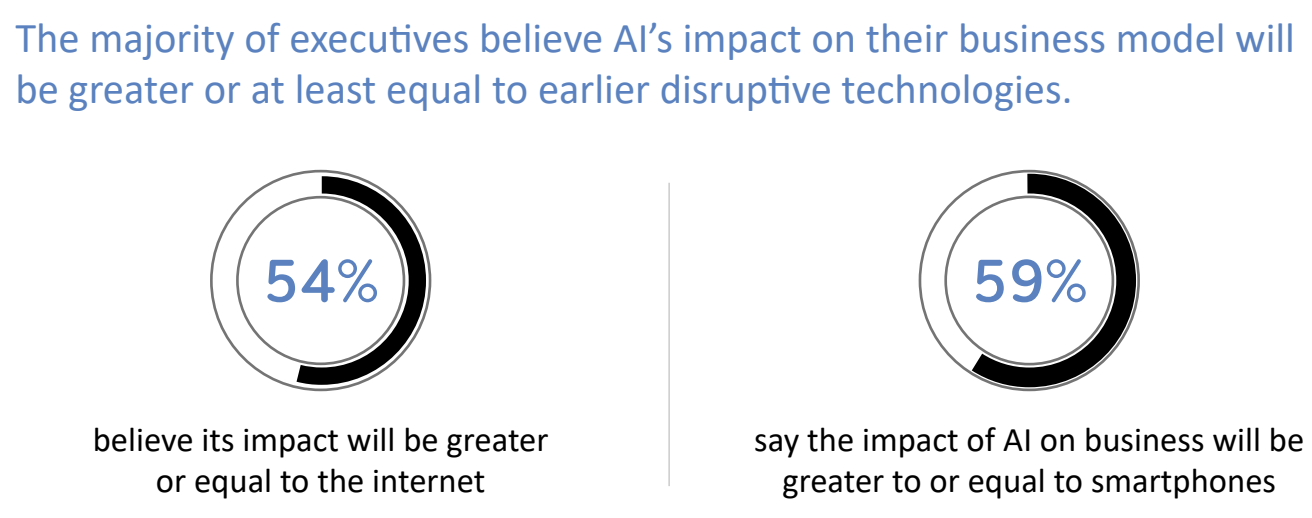
The transformative potential of AI on business

Organizations are having to rapidly adapt their business models. Image: TCS


Using ChatGPT to get a job — from linkedin.com by Ishika Rawat


From EdTech to TechEd: The next chapter in learning’s evolution — from linkedin.com by Lev Gonick

A day in the life: The next 25 years
A learner wakes up. Their AI-powered learning coach welcomes them, drawing their attention to their progress and helping them structure their approach to the day.  A notification reminds them of an upcoming interview and suggests reflections to add to their learning portfolio.

Rather than a static gradebook, their portfolio is a dynamic, living record, curated by the student, validated by mentors in both industry and education, and enriched through co-creation with maturing modes of AI. It tells a story through essays, code, music, prototypes, journal reflections, and team collaborations. These artifacts are not “submitted”, they are published, shared, and linked to verifiable learning outcomes.

And when it’s time to move, to a new institution, a new job, or a new goal, their data goes with them, immutable, portable, verifiable, and meaningful.

From DSC:
And I would add to that last solid sentence that the learner/student/employee will be able to control who can access this information. Anyway, some solid reflections here from Lev.


AI Could Surpass Schools for Academic Learning in 5-10 Years — from downes.ca with commentary from Stephen Downes

I know a lot of readers will disagree with this, and the timeline feels aggressive (the future always arrives more slowly than pundits expect) but I think the overall premise is sound: “The concept of a tipping point in education – where AI surpasses traditional schools as the dominant learning medium – is increasingly plausible based on current trends, technological advancements, and expert analyses.”


The world’s first AI cabinet member — from therundown.ai by Zach Mink, Rowan Cheung, Shubham Sharma, Joey Liu & Jennifer Mossalgue

The Rundown: In this tutorial, you will learn how to combine NotebookLM with ChatGPT to master any subject faster, turning dense PDFs into interactive study materials with summaries, quizzes, and video explanations.

Step-by-step:

  1. Go to notebooklm.google.com, click the “+” button, and upload your PDF study material (works best with textbooks or technical documents)
  2. Choose your output mode: Summary for a quick overview, Mind Map for visual connections, or Video Overview for a podcast-style explainer with visuals
  3. Generate a Study Guide under Reports — get Q&A sets, short-answer questions, essay prompts, and glossaries of key terms automatically
  4. Take your PDF to ChatGPT and prompt: “Read this chapter by chapter and highlight confusing parts” or “Quiz me on the most important concepts”
  5. Combine both tools: Use NotebookLM for quick context and interactive guides, then ChatGPT to clarify tricky parts and go deeperPro Tip: If your source is in EPUB or audiobook, convert it to PDF before uploading. Both NotebookLM and ChatGPT handle PDFs best.

Claude can now create and edit files — from anthropic.com

Claude can now create and edit Excel spreadsheets, documents, PowerPoint slide decks, and PDFs directly in Claude.ai and the desktop app. This transforms how you work with Claude—instead of only receiving text responses or in-app artifacts, you can describe what you need, upload relevant data, and get ready-to-use files in return.

Also see:

  • Microsoft to lessen reliance on OpenAI by buying AI from rival Anthropic — from techcrunch.com byRebecca Bellan
    Microsoft will pay to use Anthropic’s AI in Office 365 apps, The Information reports, citing two sources. The move means that Anthropic’s tech will help power new features in Word, Excel, Outlook, and PowerPoint alongside OpenAI’s, marking the end of Microsoft’s previous reliance solely on the ChatGPT maker for its productivity suite. Microsoft’s move to diversify its AI partnerships comes amid a growing rift with OpenAI, which has pursued its own infrastructure projects as well as a potential LinkedIn competitor.

Ep. 11 AGI and the Future of Higher Ed: Talking with Ray Schroeder

In this episode of Unfixed, we talk with Ray Schroeder—Senior Fellow at UPCEA and Professor Emeritus at the University of Illinois Springfield—about Artificial General Intelligence (AGI) and what it means for the future of higher education. While most of academia is still grappling with ChatGPT and basic AI tools, Schroeder is thinking ahead to AI agents, human displacement, and AGI’s existential implications for teaching, learning, and the university itself. We explore why AGI is so controversial, what institutions should be doing now to prepare, and how we can respond responsibly—even while we’re already overwhelmed.


Best AI Tools for Instructional Designers — from blog.cathy-moore.com by Cathy Moore

Data from the State of AI and Instructional Design Report revealed that 95.3% of the instructional designers interviewed use AI in their daily work [1]. And over 85% of this AI use occurs during the design and development process.

These figures showcase the immense impact AI is already having on the instructional design world.

If you’re an L&D professional still on the fence about adding AI to your workflow or an AI convert looking for the next best tools, keep reading.

This guide breaks down 5 of the top AI tools for instructional designers in 2025, so you can streamline your development processes and build better training faster.

But before we dive into the tools of the trade, let’s address the elephant in the room:


3 Human Skills That Make You Irreplaceable in an AI World — from gettingsmart.com/ by Tom Vander Ark and Mason Pashia

Key Points

  • Update learner profiles to emphasize curiosity, curation, and connectivity, ensuring students develop irreplaceable human skills.
  • Integrate real-world learning experiences and mastery-based assessments to foster agency, purpose, and motivation in students.
 

From Content To Capability: How AI Agents Are Redefining Workplace Learning — from forbes.com by Nelson Sivalingam

Real, capability-building learning requires three key elements: content, context and conversation. 

The Rise Of AI Agents: Teaching At Scale
The generative AI revolution is often framed in terms of efficiency: faster content creation, automated processes and streamlined workflows. But in the world of L&D, its most transformative potential lies elsewhere: the ability to scale great teaching.

AI gives us the means to replicate the role of an effective teacher across an entire organization. Specifically, AI agents—purpose-built systems that understand, adapt and interact in meaningful, context-aware ways—can make this possible. These tools understand a learner’s role, skill level and goals, then tailor guidance to their specific challenges and adapt dynamically over time. They also reinforce learning continuously, nudging progress and supporting application in the flow of work.

More than simply sharing knowledge, an AI agent can help learners apply it and improve with every interaction. For example, a sales manager can use a learning agent to simulate tough customer scenarios, receive instant feedback based on company best practices and reinforce key techniques. A new hire in the product department could get guidance on the features and on how to communicate value clearly in a roadmap meeting.

In short, AI agents bring together the three essential elements of capability building, not in a one-size-fits-all curriculum but on demand and personalized for every learner. While, obviously, this technology shouldn’t replace human expertise, it can be an effective tool for removing bottlenecks and unlocking effective learning at scale.


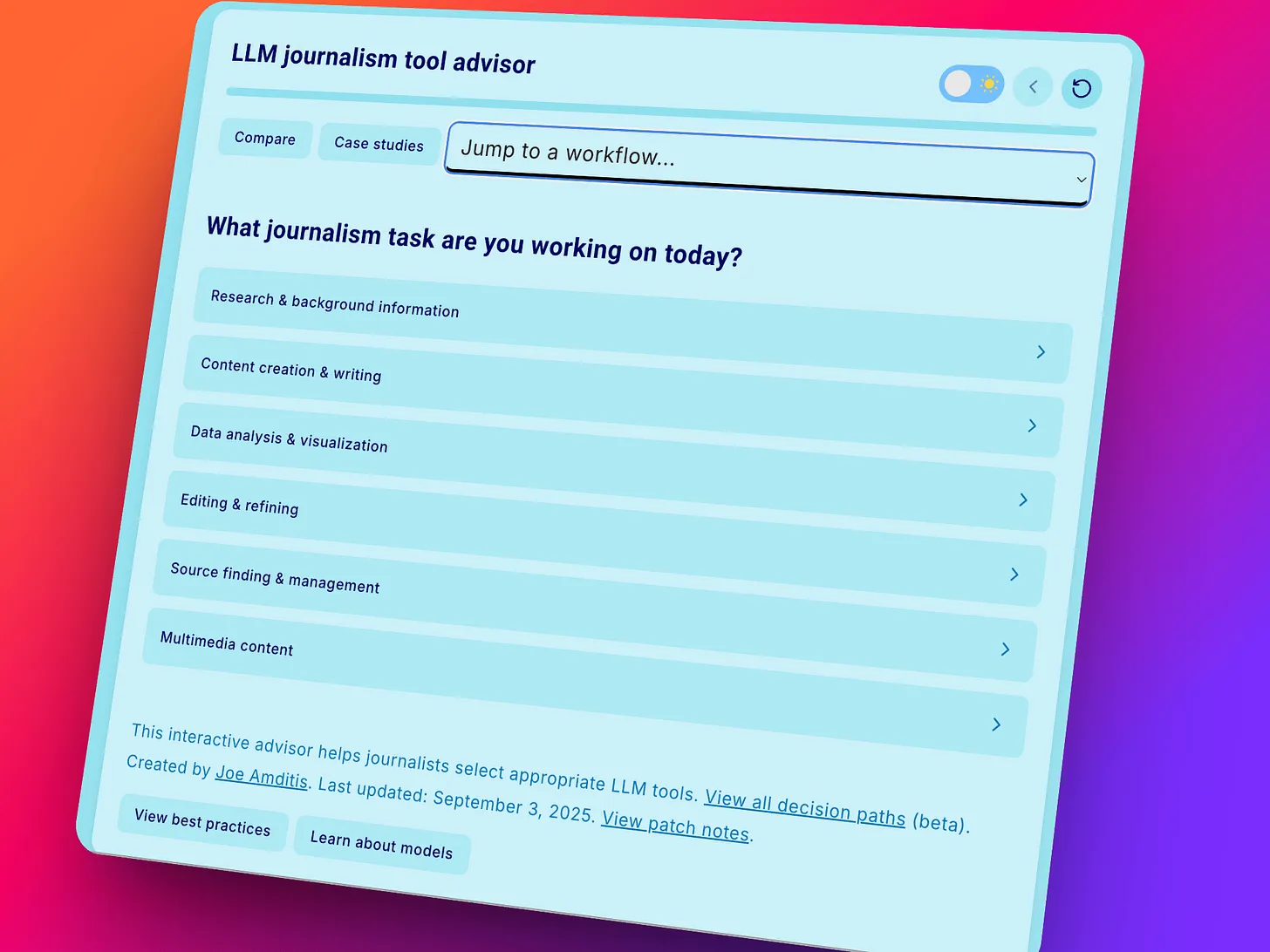
A Journalist’s Toolkit for the AI Era — from wondertools.substack.com by Jeremy Caplan and Joe Amditis
A guest expert shares his practical tools

As news organizations scramble to update their digital toolkits, I invited one of the most tech savvy journalism advisors I know to share his guidance.

In the guest post below, Joe Amditis shares a bunch of useful resources. A former CUNY student of mine, Joe now serves as associate director of operations at the Center for Cooperative Media at Montclair State University.


PODCAST: The AI that’s making lawyers 100x better (and it’s not ChatGPT) — from theneurondaily.com by Matthew Robinson
How Thomson Reuters solved AI hallucinations in legal work

Bottom line: The best engineers became 100x better with AI coding tools. Now the same transformation is hitting law. Joel [the CTO at Thomson Reuters] predicts the best attorneys who master these tools will become 100x more powerful than before.


Legal Tech at a Turning Point: What 2025 Has Shown Us So Far — from community.nasscom.in by Elint AI

4. Legal Startups Reshape the Market for Judges and Practitioners
Legal services are no longer dominated by traditional providers. Business Insider reports on a new wave of nimble “Law Firm 2.0” entities—AI-enabled startups offering fixed cost services for specific tasks such as contract reviews or drafting. The LegalTech Lab is helping launch such disruptors with funding and guidance.

At the same time, alternative legal service providers or ALSPs are integrating generative AI, moving beyond cost-efficient support to providing legal advice and enhanced services—often on subscription models.

In 2025 so far, legal technology has moved from incremental adoption to integral transformation. Generative AI, investments, startups, and regulatory readiness are reshaping the practice of law—for lawyers, judges, and the rule of law.


Insights On AI And Its Impact On Legal, Part One — from abovethelaw.com by Stephen Embry
AI will have lasting impact on the legal profession.

I recently finished reading Ethan Mollick‘s excellent book on artificial intelligence, entitled Co-Intelligence: Living and Working with AI. He does a great job of explaining what it is, how it works, how it best can be used, and where it may be headed.
…
The first point that resonated with me is that artificial intelligence tools can take those with poor skills in certain areas and significantly elevate their output. For example, Mollick cited a study that demonstrated that the performance of law students at the bottom of their class got closer to that of the top students with the use of AI.

Lawyers and law firms need to begin thinking and planning for how the coming skill equalization will impact competition and potentially profitability. They need to consider how the value of what they provide to their clients will be greater than their competition. They need to start thinking about what skill will set them apart in the new AI driven world. 


267 | AI First Drafts: What Your Clients Aren’t Telling You (and Why It Matters) — from thebrainyacts.beehiiv.com by Brainyacts

Welcome to the new normal: the AI First Draft.
Clients—from everyday citizens to solo entrepreneurs to sophisticated in-house counsel—are increasingly using AI to create the first draft of legal documents before outside counsel even enters the conversation. Contracts, memos, emails, issue spotters, litigation narratives: AI can now do it all.

This means outside counsel is now navigating a very different kind of document review and client relationship. One that comes with hidden risks, awkward conversations, and new economic pressures.

Here are the three things every lawyer needs to start thinking about when reviewing client-generated work product.

1. The Prompt Problem: What Was Shared, and With Whom?…
2. The Confidence Barrier: When AI Sounds Right, But Isn’t…
3. The Economic Shift: Why AI Work Can Cost More, Not Less…


There Is Now Clearer Evidence AI Is Wrecking Young Americans’ Job Prospects — from wsj.com by Justin Lahart; this article is behind a paywall
Young workers face rising AI competition in fields like software development, but some also benefit from AI as a helper, new research shows

Young workers are getting hit in fields where generative-AI tools such as ChatGPT can most easily automate tasks done by humans, such as software development, according to a paper released Tuesday by three Stanford University economists. They crunched anonymized data on millions of employees at tens of thousands of firms, including detailed information on workers’ ages and jobs, making this one of clearest indicators yet of AI’s disruptive impact.

Young workers in jobs where AI could act as a helper, rather than a replacement, actually saw employment growth, economists found.


Bringing the best of AI to college students for free — from blog.google by Sundar Pichai

Millions of college students around the world are getting ready to start classes. To help make the school year even better, we’re making our most advanced AI tools available to them for free, including our new Guided Learning mode. We’re also providing $1 billion to support AI education and job training programs and research in the U.S. This includes making our AI and career training free for every college student in America through our AI for Education Accelerator — over 100 colleges and universities have already signed up.
…
Guided Learning: from answers to understanding
AI can broaden knowledge and expand access to it in powerful ways, helping anyone, anywhere learn anything in the way that works best for them. It’s not about just getting an answer, but deepening understanding and building critical thinking skills along the way. That opportunity is why we built Guided Learning, a new mode in Gemini that acts as a learning companion guiding you with questions and step-by-step support instead of just giving you the answer. We worked closely with students, educators, researchers and learning experts to make sure it’s helpful for understanding new concepts and is backed by learning science.


From DSC:
You and I both know that numerous militaries across the globe are working on killer robots equipped with AI. This is nothing new. But I don’t find this topic to be entertaining in the least. Because it could be part of how wars are fought in the near future. And most of us wouldn’t have a clue how to stop one of these things.


21 Ways People Are Using A.I. at Work — from nytimes.com by Larry Buchanan and Francesca Paris; this is a gifted article

  1. Select wines for restaurant menus
  2. Digitize a herbarium
  3. Make everything look better
  4. Create lesson plans that meet educational standards
  5. Make a bibliography
  6. Write up therapy plans
  7. …and many more

The GPT-5 fallout, explained… — from theneurondaily.com by Grant Harvey
PLUS: Who knew ppl loved 4o so much!?

The GPT-5 Backlash, Explained: OpenAI users revolted against GPT-5… then things got weird.
What a vibe shift a day or two makes, huh? As you all know by now, GPT-5 dropped last Thursday, and at first, it seemed like a pretty successful launch.

Early testers loved it. Sam Altman called it “the most powerful AI model ever made.”

Then the floodgates opened to 700 million users.. and all hell broke loose.

Here’s what happened: Within hours, Reddit and Twitter turned into digital pitchforks. The crime? OpenAI had quietly sunset GPT-4o—the model everyone apparently loved more than their morning coffee—without warning. Users weren’t just mad. They were devastated.


ChatGPT Changes — from getsuperintel.com by Kim “Chubby” Isenberg
4o is back, and Plus users get 3000 reasoning requests per week with GPT-5!

Who would have thought that the “smartest model ever” would trigger one of the loudest user revolts in AI history? The return of GPT-4o after only 24 hours shows how attached people are to the personality of their AI—and how quickly trust crumbles when expectations are not met. In this issue, we not only look at OpenAI’s response, but also at how the balance of power between developers and the community is shifting.


GPT-5 doesn’t dislike you—it might just need a benchmark for emotional intelligence — from link.wired.com by
Welcome to another AI Lab!

The backlash over the more emotionally neutral GPT-5 shows that the smartest AI models might have striking reasoning, coding, and math skills, but advancing their psychological intelligence safely remains very much unsolved.
…
Since the all-new ChatGPT launched on Thursday, some users have mourned the disappearance of a peppy and encouraging personality in favor of a colder, more businesslike one (a move seemingly designed to reduce unhealthy user behavior.) The backlash shows the challenge of building artificial intelligence systems that exhibit anything like real emotional intelligence.

Researchers at MIT have proposed a new kind of AI benchmark to measure how AI systems can manipulate and influence their users—in both positive and negative ways—in a move that could perhaps help AI builders avoid similar backlashes in the future while also keeping vulnerable users safe.


ChatGPT is bringing back 4o as an option because people missed it — from theverge.com by Emma Roth
Many ChatGPT users were frustrated by OpenAI’s decision to make GPT-5 the default model.

OpenAI is bringing back GPT-4o in ChatGPT just one day after replacing it with GPT-5. In a post on X, OpenAI CEO Sam Altman confirmed that the company will let paid users switch to GPT-4o after ChatGPT users mourned its replacement.

“We will let Plus users choose to continue to use 4o,” Altman says. “We will watch usage as we think about how long to offer legacy models for.”

For months, ChatGPT fans have been waiting for the launch of GPT-5, which OpenAI says comes with major improvements to writing and coding capabilities over its predecessors. But shortly after the flagship AI model launched, many users wanted to go back.


AI Agent Trends of 2025: A Transformative Landscape — from marktechpost.com by Asif Razzaq

This articles focuses on five core AI agent trends for 2025: Agentic Retrieval-Augmented Generation (RAG), Voice Agents, AI Agent Protocols, DeepResearch Agents, Coding Agents, and Computer Using Agents (CUA).


BREAKING: Google introduces Guided Learning — from aieducation.substack.com by Claire Zau
Some thoughts on what could make Google’s AI tutor stand out

Another major AI lab just launched “education mode.”

Google introduced Guided Learning in Gemini, transforming it into a personalized learning companion designed to help you move from quick answers to real understanding.

Instead of immediately spitting out solutions, it:

  • Asks probing, open-ended questions
  • Walks learners through step-by-step reasoning
  • Adapts explanations to the learner’s level
  • Uses visuals, videos, diagrams, and quizzes to reinforce concepts

This Socratic style tutor rollout follows closely behind similar announcements like OpenAI’s Study Mode (last week) and Anthropic’s Claude for Education (April 2025).


How Sci-Fi Taught Me to Embrace AI in My Classroom — from edsurge.com by Dan Clark

I’m not too naive to understand that, no matter how we present it, some students will always be tempted by “the dark side” of AI. What I also believe is that the future of AI in education is not decided. It will be decided by how we, as educators, embrace or demonize it in our classrooms.

My argument is that setting guidelines and talking to our students honestly about the pitfalls and amazing benefits that AI offers us as researchers and learners will define it for the coming generations.

Can AI be the next calculator? Something that, yes, changes the way we teach and learn, but not necessarily for the worse? If we want it to be, yes.

How it is used, and more importantly, how AI is perceived by our students, can be influenced by educators. We have to first learn how AI can be used as a force for good. If we continue to let the dominant voice be that AI is the Terminator of education and critical thinking, then that will be the fate we have made for ourselves.


AI Tools for Strategy and Research – GT #32 — from goodtools.substack.com by Robin Good
Getting expert advice, how to do deep research with AI, prompt strategy, comparing different AIs side-by-side, creating mini-apps and an AI Agent that can critically analyze any social media channel

In this issue, discover AI tools for:

  • Getting Expert Advice
  • Doing Deep Research with AI
  • Improving Your AI Prompt Strategy
  • Comparing Results from Different AIs
  • Creating an AI Agent for Social Media Analysis
  • Summarizing YouTube Videos
  • Creating Mini-Apps with AI
  • Tasting an Award-Winning AI Short Film

GPT-Building, Agentic Workflow Design & Intelligent Content Curation — from drphilippahardman.substack.com by Dr. Philippa Hardman
What 3 recent job ads reveal about the changing nature of Instructional Design

In this week’s blog post, I’ll share my take on how the instructional design role is evolving and discuss what this means for our day-to-day work and the key skills it requires.
…
With this in mind, I’ve been keeping a close eye on open instructional design roles and, in the last 3 months, have noticed the emergence of a new flavour of instructional designer: the so-called “Generative AI Instructional Designer.”

Let’s deep dive into three explicitly AI-focused instructional design positions that have popped up in the last quarter. Each one illuminates a different aspect of how the role is changing—and together, they paint a picture of where our profession is likely heading.

Designers who evolve into prompt engineers, agent builders, and strategic AI advisors will capture the new premium. Those who cling to traditional tool-centric roles may find themselves increasingly sidelined—or automated out of relevance.


Google to Spend $1B on AI Training in Higher Ed — from insidehighered.com by Katherine Knott

Google’s parent company announced Wednesday (8/6/25) that it’s planning to spend $1 billion over the next three years to help colleges teach and train students about artificial intelligence.

Google is joining other AI companies, including OpenAI and Anthropic, in investing in AI training in higher education. All three companies have rolled out new tools aimed at supporting “deeper learning” among students and made their AI platforms available to certain students for free.


5 Predictions for How AI Will Impact Community Colleges — from pistis4edu.substack.com by Feng Hou

Based on current technology capabilities, adoption patterns, and the mission of community colleges, here are five well-supported predictions for AI’s impact in the coming years.

  1. Universal AI Tutor Access
  2. AI as Active Teacher
  3. Personalized Learning Pathways
  4. Interactive Multimodal Learning
  5. Value-Centric Education in an AI-Abundant World

 
© 2025 | Daniel Christian