


October is National Disability Employment Awareness Month — from nationaldisabilityinstitute.org
Every October, we pause to honor something that should be obvious all year long: people with disabilities are part of the American workforce, and they always have been.
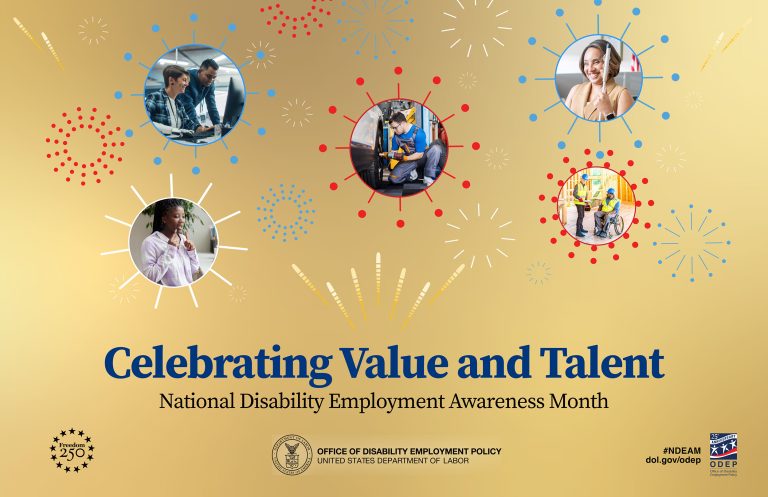
This is National Disability Employment Awareness Month, or NDEAM. The 2026 theme, set by the U.S. Department of Labor’s Office of Disability Employment Policy, is “Celebrating Value and Talent.” It’s the same theme as last year, carried forward as the country marks its 250th birthday.
We love that choice. It doesn’t ask anyone to prove their worth. It starts from the truth that the value and talent are already here.
A month with a long history
NDEAM began in 1945 as a single week. Congress expanded it to a full month in 1988, and today it’s observed by employers, schools, community groups and advocates across the country.
Eighty years in, the work is far from done.
Also relevant/see:
National Disability Institute (NDI) has launched a new podcast series. — from nationaldisabilityinstitute.org
“Moving the Needle” explores the ideas, innovations and partnerships that shape NDI’s work and are defining what comes next.
Episode 1 chronicles the gaps that existed prior to NDI’s formation, the organization’s humble beginnings and how far NDI has moved the needle toward building a better financial future for people with disabilities.
From vinyl records and paper checks to QR codes and smartphone apps, the first episode takes listeners on a then-and-now journey through NDI’s history, told through personal and professional reflections from members of its leadership team.
From DSC:
The topic of disability hits close to our home. One of our daughters was born with Mosaic Down Syndrome. She is different, but wonderfully so. Literally, from day one, the LORD said that He was going to teach me through her, and He has absolutely done so. I won’t get into all the ways that that has occurred, but valuing differences is not a cliché for me. For one thing, I don’t use the word “normal” much anymore…as there is no “normal.” I might use the word typical, but not normal.
Our daughter flavors the world in wonderful ways. For example:
- Even as a little girl, she would go up and give hugs to people — surprising them in wonderfully positive ways.
- She thrived in preschool all the way up through 5th grade, but then struggled mightily in 6th grade and 7th grade; she then went into homeschooling in 8th-12th grade. She also went to a Christian High School and a Career Technical Center.
- Within the last several years, she’s really hit her stride in school. Her note-taking and skills have jumped to a completely new level. She learns, but she learns at her own pace.
- She loves to dance and to draw things. She loves to write fantastical stories.
- She has successfully worked two jobs already.
- She’s in a special program for college and is learning a lot — but not without challenges.
- She has an imagination that is off the charts. She can see movies in her head and hear songs without issue. We’re hoping that this special program will give her access to creative writing classes, art, criminology, and other topics that she’s interested in.
The LORD has made good on His word — again. I’ve learned a lot through her. I’ve changed because of her — no doubt about it. But I’ve also learned the incredible challenges that people with disabilities face. If their unique physical and/or cognitive situations weren’t enough, the way policies are created puts them at huge disabilities that the rest of society would balk at in an instant (and our Senators and Representatives would not stand for it if this were them or someone in their families). This involves budgetary items, big time. But also, people with disabilities are often pigeonholed into certain jobs/industries. This needs to stop.
So I’m posting the above items to give more visibility to this subculture within our society, and the challenges that they face. Let’s help straighten this situation out.