An artificial-intelligence first: Voice-mimicking software reportedly used in a major theft — from washingtonpost.com by Drew Harwell

Excerpt:

Thieves used voice-mimicking software to imitate a company executive’s speech and dupe his subordinate into sending hundreds of thousands of dollars to a secret account, the company’s insurer said, in a remarkable case that some researchers are calling one of the world’s first publicly reported artificial-intelligence heists.

The managing director of a British energy company, believing his boss was on the phone, followed orders one Friday afternoon in March to wire more than $240,000 to an account in Hungary, said representatives from the French insurance giant Euler Hermes, which declined to name the company.


From DSC:
Needless to say, this is very scary stuff here! Now what…? Who in our society should get involved to thwart this kind of thing?

  • Programmers?
  • Digital audio specialists?
  • Legislators?
  • Lawyers?
  • The FBI?
  • Police?
  • Other?


Addendum on 9/12/19:


Podcast: Susan Patrick on Transforming Education Systems for Equitable High-Quality Learning — from gettingsmart.com by Tom Vander Ark & Susan Patrick

Excerpts:

5 Global Trends

  1. Ensuring education systems are fit for purpose.
  2. Modernizing educator workforce and professional learning.
  3. Innovating education for equity, prioritizing diversity, equity and inclusion.
  4. Aligning pathways from early childhood, K-12, college and workforce.
  5. Redesigning schools based on the learning sciences.
    In Fit for Purpose, Patrick and colleagues said, “A school redesign informed by learning sciences puts student success at its center. It incorporates youth development theory, culturally responsive teaching, and evidence-based approaches.” She added, “We must ensure we are designing for equity using research on how students learn best, youth development theory and evidence-based approaches.”


From DSC:

Below are the comments that I relayed back to Tom and Susan on Twitter:

“We need to keep asking– how do we design a system fit for the world we live in?” I thought that this was a great point from Susan. I would just add that not only do we need to look around at the current landscapes, but also what’s coming down the pike (i.e. the world that we will be living in). With the new pace of exponential change, our graduates will need to be able to pivot/adapt frequently and quickly.

Also, watching my wife’s experiences over the last few years, only one of the three school systems offered solid training and development. The other two school systems needed to pay much more attention to their onboarding and training programs. They needed to be far more supportive — working to establish a more team-oriented teaching and learning environment. While the corporate world can learn from the K-12 world often times, this is where the K-12 world could learn a lot to learn from the corporate world.


Lessons in learning — from news.harvard.edu by Peter Reuell; with thanks to Jason Findley for this resource out on Twitter
Study shows students in ‘active learning’ classrooms learn more than they think

Excerpts:

The question of whether students’ perceptions of their learning matches with how well they’re actually learning is particularly important, Deslauriers said, because while students eventually see the value of active learning, initially it can feel frustrating.

“Deep learning is hard work. The effort involved in active learning can be misinterpreted as a sign of poor learning,” he said. “On the other hand, a superstar lecturer can explain things in such a way as to make students feel like they are learning more than they actually are.”

When the results were tallied, the authors found that students felt as if they learned more from the lectures, but in fact scored higher on tests following the active learning sessions. “Actual learning and feeling of learning were strongly anticorrelated,” Deslauriers said, “as shown through the robust statistical analysis by co-author Kelly Miller, who is an expert in educational statistics and active learning.”


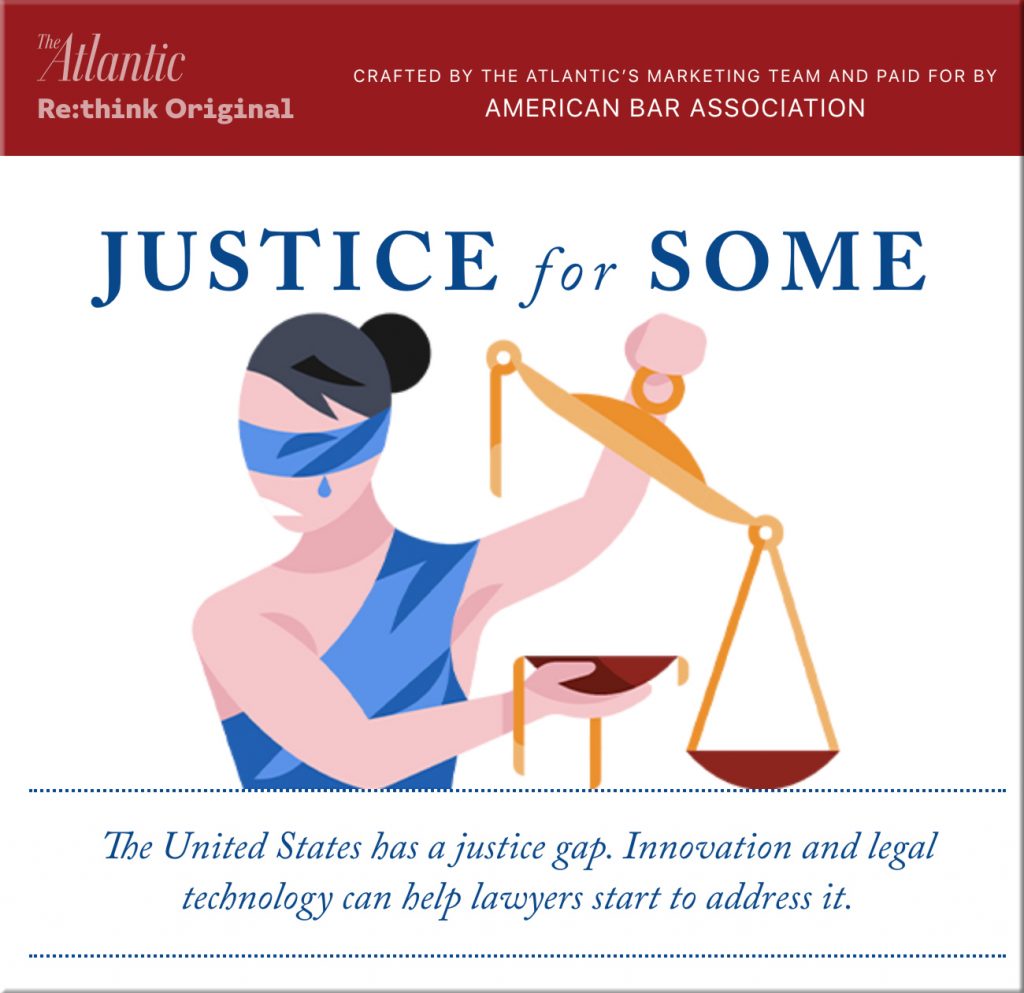
Justice for Some — from theatlantic.com and the American Bar Association (ABA)

Excerpts:

Today in the United States, millions of people like Carol lack access to basic legal resources for a variety of reasons. They forgo legal action because they find the system too overwhelming, for example, or because they perceive it to be too expensive. Many simply do not know when they qualify for legal services in the first place. And it isn’t an issue that affects only the elderly. Middle-class Americans, recent college graduates, first-generation immigrants, and new parents can all experience barriers to accessing the legal resources they need.

This issue affects lawyers, too.

DEFENDANTS FACING JAIL TIME in criminal cases have a constitutional right to be provided an attorney, but many people are surprised to learn there is no equivalent guarantee for individuals in civil cases. Typically, defendants in such cases—including divorces, domestic violence orders, home foreclosures, evictions, wills, and immigration applications—are responsible for attaining their own legal representation. And therein lies the gap.

By one estimate from the Legal Services Corporation1, 86 percent of low-income people with civil legal problems received inadequate or no legal help in the past year. Between 2015 and 2018, roughly 80 percent to 90 percent of domestic relations cases in Philadelphia involved at least one self-represented party. In 2016, 75 percent of low-income rural households experienced a civil legal problem, but only 22 percent sought professional legal help. And in 2017, 90 percent of evicted tenants in New York City never made an appearance in court.


“Search results have a huge influence on what people trust,” Hagan says. “If Google tells someone that an answer to their legal question is the number-one hit, people assume that it’s correct, unaware that it may be based on laws in another state. We have seen people click on Australian legal advice even if they’re in California.”


“We know the most successful technological solutions to the access-to-justice gap involve collaboration with lawyers, with technologists, with entrepreneurs and, hopefully to an increasing extent, with consumers,” Rodriguez says. “The object of what we’re doing is to improve the ability of lawyers to provide representation, not to supplant their businesses.”


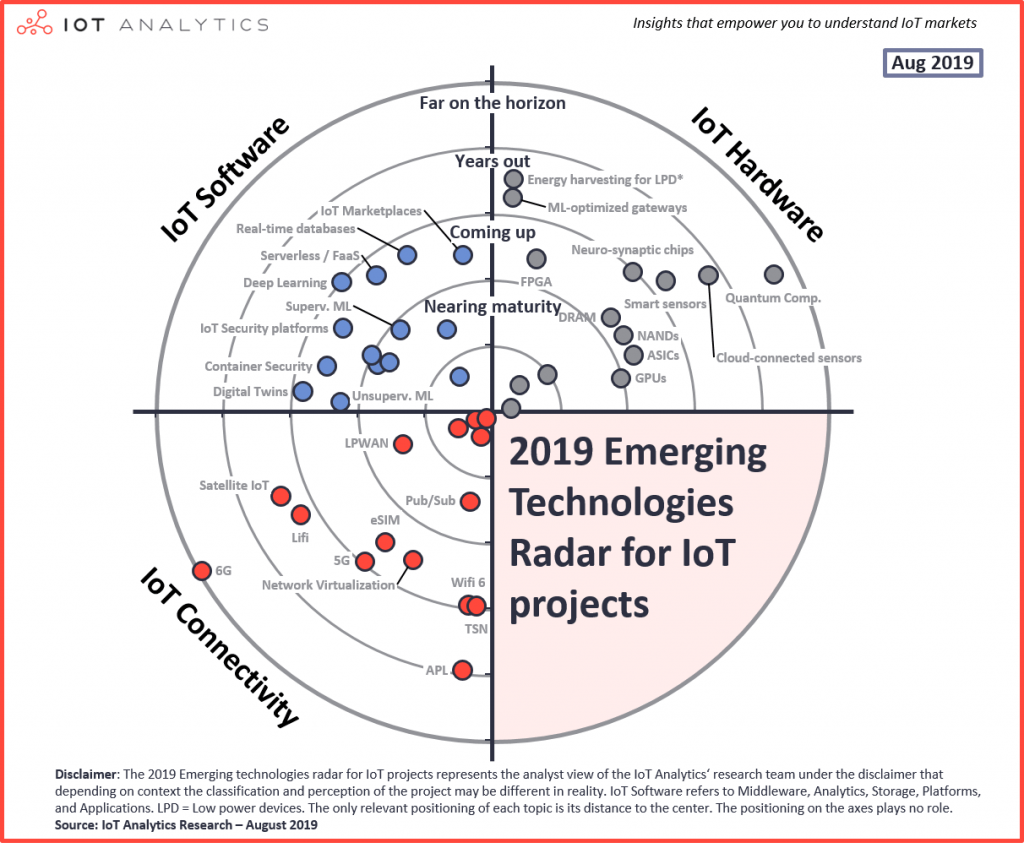
40+ Emerging IoT Technologies you should have on your radar — from iot-analytics.com by Knud Lasse Lueth

Excerpt:

As part of the “State of the IoT – Summer 2019 Update”, the analyst team at IoT Analytics handpicked 43 of the most promising technologies that are relevant to IoT projects around the globe. The team ranked the IoT technologies according to their perceived maturity (based on expert interviews, vendor briefings, secondary research, and conference attendances).


The Age of AI: How Will In-house Law Departments Run in 10 Years? — from accdocket.com by Elizabeth Colombo

Excerpt:

2029 may feel far away right now, but all of this makes me wonder what in-house law might look like in 10 years. What will in-house law be like in an age of artificial intelligence (AI)? This article will look at how in-house law may be different in 10 years, focusing largely on anticipated changes to contract review and negotiation, and the workplace.


Also see:
A Primer on Using Artificial Intelligence in the Legal Profession — from jolt.law.harvard.edu by Lauri Donahue (2018)

Excerpt (emphasis DSC):

How Are Lawyers Using AI?
Lawyers are already using AI to do things like reviewing documents during litigation and due diligence, analyzing contracts to determine whether they meet pre-determined criteria, performing legal research, and predicting case outcomes.


Document Review

Analyzing Contracts

Legal Research

Predicting Results
Lawyers are often called upon to predict the future: If I bring this case, how likely is it that I’ll win — and how much will it cost me? Should I settle this case (or take a plea), or take my chances at trial? More experienced lawyers are often better at making accurate predictions, because they have more years of data to work with.

However, no lawyer has complete knowledge of all the relevant data.

Because AI can access more of the relevant data, it can be better than lawyers at predicting the outcomes of legal disputes and proceedings, and thus helping clients make decisions. For example, a London law firm used data on the outcomes of 600 cases over 12 months to create a model for the viability of personal injury cases. Indeed, trained on 200 years of Supreme Court records, an AI is already better than many human experts at predicting SCOTUS decisions.


Digital workplaces are the future for the legal industry — from abovethelaw.com by James Lo
The speed of business is accelerating, and digital workplaces are answering the demand for a better way to work, by providing a single platform to manage content, people, and applications. 

Excerpt:

The consumerisation of enterprise technology has led to an increasing expectation from lawyers, clients, and business users alike that the legal technology they are using in the workplace for collaboration, knowledge management, transaction management, and more should be as useful, intuitive, and user-friendly as what they are already using at home on a day-to-day basis.

Digital workplaces are answering the demand for a better way to work, by providing a single platform to manage content, people, and applications. As law firms review their technology strategy for the next three to five years, there is an opportunity to create digital workplaces that will match how lawyers will want to work in the future. Within a digital workplace, a lawyer will have access to relevant data and content, collaborate with both clients and colleagues, share knowledge, and solve problems, all in real-time, from anywhere.

At the same time, clients are expecting firms to be using data, artificial intelligence and other technologies to predict outcomes, reduce costs, improve transparency and ultimately add value. 


The Adaptable Organization Series: Part 5: The Ecosystem — from capitalhblog.deloitte.com; posted by Don Miller and Tiffany McDowell

Excerpt:

In an Adaptable Organization, understanding the external environment becomes a continuous activity that fuels constant efforts to evolve the business.

Encouraging people to constantly sense the external environment helps people inside the organization to be open about what they are seeing and how they believe it will impact the organization.

It is a stark contrast to the “set it and forget it” strategy and organizational design that traditionally occurred every three to five years.

Yet this expansive system can easily become misaligned and requires a greater purpose to remain connected.

A shared purpose connects the ecosystem; defines success through the eyes of customers, stakeholders and society; and helps motivate people to succeed. Not only are Adaptable Organizations able to respond quickly to changes, but they also take their role as a social enterprise seriously, moving away from being solely a “business enterprise.” These organizations aim to engage and connect with the hearts and minds of their workers, customers, communities, and societies-at-large. Adaptable Organizations are grounded in social purpose and bring teams on a journey while responding to changes with agility, speed, and ease.

A shared purpose holds the ecosystem together. Direction is given from the shared purpose and not from an organizational hierarchy. By bringing a purpose statement to life and connecting the dots for workers through storytelling and meaningful narratives, workers are more likely to commit to the organization’s strategy and execution.


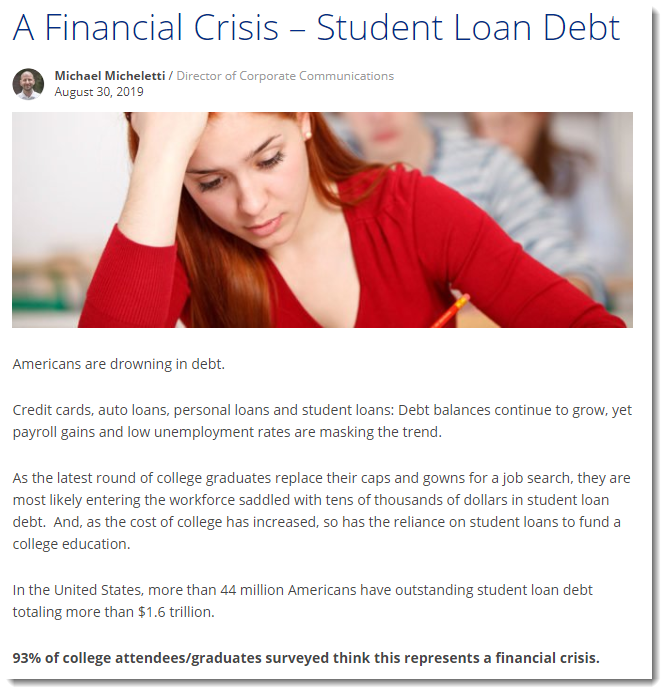
A Financial Crisis — Student Loan Debt — from freedomdebtrelief.com by Micahel Micheletti; with thanks to Aimée Bennett (APR, Principal, Fagan Business Communications, Inc.) for this resource

Key findings

1)  Impact of student loan debt on stress, day-to-day life (college attendees/grads)

  • 67% of respondents said the cost of their college education has caused them to feel overwhelmed.
  • 47% said their college education cost has contributed to mental or emotional health issues (e.g., anxiety, depression).
  • 38% said the cost has caused them to lose sleep at night.
  • 49% said the cost of their college education has impacted their choice of where to live.
  • 42% said it impacted their choice of careers or jobs.

2)  Impact of student loan debt on finances (college attendees/grads)

  • 59% respondents said they can’t save any money because of the cost of their college education.
  • 45% said they can’t go on vacation because of college costs.
  • 32% said they are carrying credit card debt because of college costs.
  • 48% said they have been unable to pay off (or down), or have delayed paying off (or down), other types of debt because of the cost of college.
  • 47% have been unable to, or have delayed contributing to, saving for emergencies.
  • 43% believe their college education cost has impacted their retirement age.

3) Willing to make sacrifices to eliminate student loan debt (college attendees/grads)

  • 52% of respondents said they would take a job with a salary less than what they expected if the company paid off their student debt.
  • 27% said they would be willing to commit a maximum of five years to a company if they paid off their student loans; 28% said they would be willing to commit more than five years.

4) Impact of child’s student loan debt on parents

  • 20% of parents said their child’s college education cost has contributed to mental or emotional health issues (e.g., anxiety, depression) of their own.
  • 20% of parents said their child’s college education cost has caused them to lose sleep at night.
  • 40% of parents believe their child’s college education cost has impacted their retirement age; 41% said the cost has impacted their overall retirement plan.
  • 42% said they had given up saving for retirement; 42% gave up going on vacation.


Additional survey findings

1) Student loan debt reforms

  • 54% of students said they feel that student loan debt should be forgiven by the federal government.
  • 63% of students, and 52% of parents, said they would support expanding student loan forgiveness for those in public service (e.g., teachers, government employees, first responders, military service).
  • 54% of students, and 42% of parents, said they would support free or subsidized tuition for low-income households.
  • 53% of students, and 50% of parents, said they would support tax breaks for companies that offer student-loan repayment programs.

2) Expected length of time to pay off student loan debt

3) Lack of knowledge of loan terms, types – among both college attendees/grads and parents


Also see:


From DSC:
This type of thing makes me wonder about the future of the legal profession as well. For example, here’s a relevant quote from The Uberization of Legal Technology by Felix Shipkevich:

In an age when there’s an app for everything, whether it’s to book air travel, rent a car, sell products or start a business, there wasn’t an app that could simply and easily connect you with legal counsel. Giving consumers a tool to book free consultations is the future of law, and the heart of attorney business development. 

Consumers have historically had little access to attorneys for a variety of reasons. First, unlike for doctors and mechanics, there is no annual legal checkup (though perhaps there should be). Consumers may be intimidated by not knowing costs upfront or even knowing if they have a case worth discussing. Assuming that every American will have at least three legal questions annually, there’s an untapped market of over a billion potential legal inquiries every year.


And by the way, as legal-related matters aren’t taught much in K-16, that’s an interesting idea:

First, unlike for doctors and mechanics, there is no annual legal checkup (though perhaps there should be).


A quick tip from RetrievalPractice.org’s e-newsletter today:

#1: Remember your lesson plan with a 1-minute reflection
Can’t remember how a lesson from last semester or last year went? On the bottom or back of a lesson plan, include two questions:
What went well? What should I do differently next time? 
As soon as you’re done with the lesson, take just one minute to write down a note to your future self. Stuff all your lesson plans/reflections into a folder. The next time you teach the lesson, future-you will be glad that past-you retrieved!


After 40 Years of Constant Change, What’s Next for the Legal Industry?  — from law.com by Dan Packel
Few could have anticipated the dramatic shift in scope and scale the industry has undergone since The American Lawyer’s founding 40 years ago. We asked some of the law’s brightest thinkers what we can expect over the next 10.

Excerpts (emphasis DSC):

Technology and Upheaval
While it’s easy to conclude that the technological revolution that’s already been unleashed will continue to drive transformation over the next 10 years, it’s harder to pinpoint how.

Expect more and more tasks to become subject to automation—not just contracts and e-discovery but also areas like trademarks and due diligence for mergers, for starters.

Technology and artificial intelligence on their own are noteworthy, but what’s more compelling is the impact they will have on how firms are structured.

“Everything that can be taken out of the hands of subject-matter experts and handed over to the process experts and technologists will be,” says Orrick, Herrington & Sutcliffe Chairman and CEO Mitch Zuklie. “There will be far fewer associates sitting in rooms with documents and more strategic partnerships among law firms and legal tech providers.”

This transition could help chip away at the supremacy of the billable hour.

Not only will technology move up the value chain for litigation, it will also emerge as a greater player on the deal side. Jae Um, director of pricing strategy at Baker McKenzie, expects to see a much greater focus on compliance and regulatory technology in the next five years.

As AI solutions, which depend upon machine learning, are slowly deployed in the marketplace, their efficacy will inevitably grow.


How about a little wild speculation to wrap this up?  With more nonlawyer specialists finding professional homes in law firms, it’s a short leap to hybrids between law firms and professional services operations. Imagine consultants and accountants working together with lawyers and technologists to solve clients’ increasingly complex problems. And what about a high-profile merger between a Big Four firm and a global law firm? I wouldn’t rule it out.


Four Big Themes Of Legal Tech + Innovation in 2019 — from artificiallawyer.com

Excerpt:

Many people are now heading off on holiday after what has been a frenetic period of change in the realm of legal tech and law firm innovation. In this article Artificial Lawyer identifies four key themes that help to make sense of what is happening.

These four themes are:

  1. Consolidation and Platformization;
  2. Continued Proliferation of Legal Tech Companies;
  3. Incubator/Accelerator Growth;
  4. More Than Law – Law Firms as Tech Producers.
 

What to expect at IFA 2019, Europe’s colossal tech show — from digitaltrends.com by Josh Levenson

Excerpt:

This week, the world’s leading manufacturers will take to the stage at IFA 2019 in Berlin, Germany, to showcase their latest innovations. Here’s what you need to know about this year’s show, including when it’s set to start, how long it will run for, where it’s held, the schedule, and all the devices we’re expecting to see unveiled by the likes of LG, Sony, Samsung, and more.


Samsung’s take on the world of 2069 — from newatlas.com by David Szondy

Excerpt:

Samsung is looking forward to what life might be like in the year 2069. The new report, called Samsung KX50: The Future in Focus, draws on the opinions of six of Britain’s leading academics and futurists to look at a range of new technologies that will affect people’s everyday lives.


© 2025 | Daniel Christian