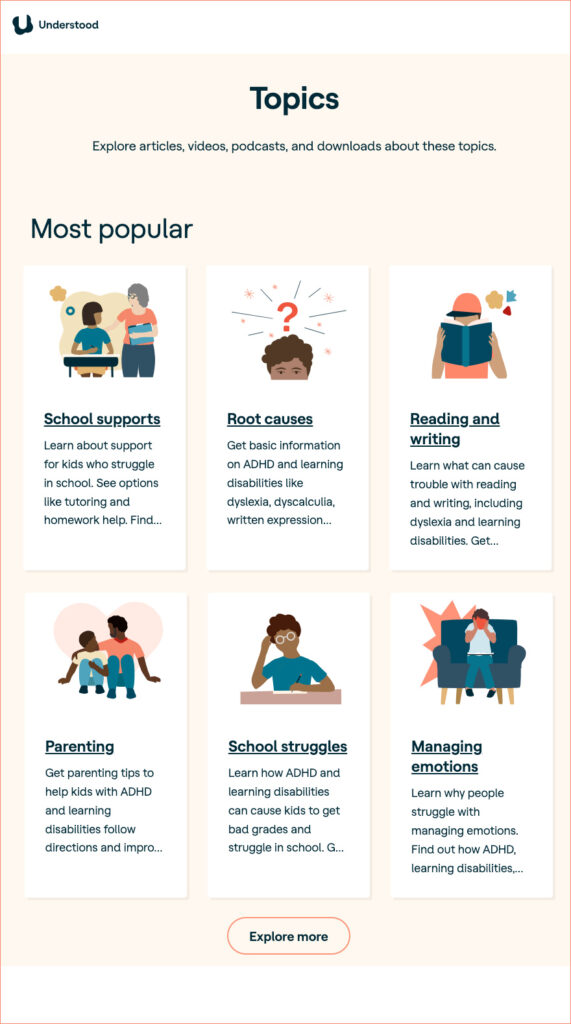
The start of the school year can be stressful, but parents of neurodivergent children are more likely to report feeling overwhelmed, unprepared and scared than other parents, according to a new survey shared with The Hechinger Report.
About 2,100 parents answered the survey this summer from Understood.org, a nonprofit that publishes resources for people with dyslexia, attention deficit disorder and other learning differences. Those with neurodivergent children say they were stressed about their child’s social life, whether the school would meet their child’s needs and whether their child would have access to adequate resources to succeed in school. About 82 percent of those parents said neurodivergent students are often misunderstood by their peers, and 76 percent said they are often misunderstood by teachers.
Lou Gerstner, writing about his legendary turnaround at IBM, said, “Culture isn’t just one aspect of the game, it is the game. In the end, an organization is nothing more than the collective capacity of its people to create value… What does the culture reward and punish – individual achievement or team play, risk taking or consensus building?”
Most business gurus would readily agree with that, but if you’d ask them what culture actually is they would be hard pressed to give a coherent answer. Anthropologists, on the other hand, are much more rigorous in their approach and most would agree that three essential elements of a culture are norms, rituals and behaviors.
In a positive organizational culture, norms and rituals support behaviors that honor the mission of the enterprise. Negative cultures undermine that mission. A common problem with many transformation initiatives is that they focus on designing incentives to alter behaviors. Unfortunately, unless you can shift norms and rituals, nothing is likely to change.
Over 500 private, nonprofit four-year institutions have closed in the last 10 years, according to the State Higher Education Executive Officers Association. That is three times what it was in the decade prior. Rachel Burns, a senior policy analyst at SHEEO, estimates at least 1.25 million students were affected by these closures. (Many more for-profit institutions have closed in this period as well.)
Around two-thirds of incoming college seniors said college has significantly contributed to their ability to land a well–paying job, according to a new survey from job platform Handshake.
A slightly higher share, 72%, said higher education has appreciably improved their ability to secure a meaningful job. And 85% of surveyed seniors said college significantly helped them understand their own career goals.
College seniors also indicated that higher education has helped them beyond their career development. According to the survey, 88% said college significantly contributed to their personal growth.
We are excited to announce the publication of the 2024 US Instructor Survey. This survey, adapted from our longstanding US Faculty Survey, provides a detailed snapshot of over 5,200 faculty members from different disciplines, institution types, ages, and titles across the US at four-year institutions. This new report offers a comprehensive overview of how college instructors across the country are navigating and shaping the current educational landscape.
Overall, we heard that instructors are increasingly adopting innovative, technology-driven teaching methods, while recognizing the critical role libraries play in supporting student success. The growing use of open educational resources (OERs) reflects a commitment to affordable education, though fewer instructors create their own. Additionally, strong institutional support remains essential for effective teaching, particularly IT and with pedagogical practices. Below we share several key findings:
But starting with the 2013-14 academic year, a whopping 726 degree-granting institutions closed through the 2022-23 school year, according to the National Center for Education Statistics. That means in just nine years, 15 percent of the-then 4,724 degree-granting colleges or universities closed. … Ultimately, after all, the prediction is a result of business model failure, in which rising expenses outpace revenue, as the students cease to enroll or have the capacity to pay enough.
But non-profit institutions are in their own world of hurt as well. According to Higher Ed Dive, 18 have announced their closure this year so far. But 141 closed between 2013-14 and 2022-23—or roughly 8.4 percent.
Survey: Over Half of Rising Seniors Feel Pessimistic About Starting Their Careers — from insidehighered.com by Ahsley Mowreader New data from Handshake finds 57 percent of the Class of 2025 have low expectations for their future after graduation, largely tied to a competitive job market, student loan debt and current political climate.
Entering senior year can be a stressful time for college students as they prepare for their next step after graduation. Inside Higher Ed’s 2024 Student Voice survey found 68 percent of fourth-year students (n=703) are at least somewhat stressed when they think about their life postgraduation, with 25 percent feeling “extremely stressed.”
This year’s graduating class is feeling less hopeful than their peers before them, with almost three in five students sharing that they feel pessimistic about their immediate future, according to new data from Handshake.
The results highlight a challenging job market for new graduates, the role of affordability in higher education and how institutions are supporting students as they launch into careers.
Today the workforce is getting older, and the number of younger workers in positions of senior management is growing. These two developments might appear to spell trouble, in that they seem to set the generations against one another, but the author of this article argues that in fact they represent an important opportunity: If companies can figure out how to enable the intergenerational transfer of the wisdom that comes with age and experience, they can strengthen themselves — and the workplace as a whole.
It also allowed us to develop a list of the character qualities that most commonly defined our best informal mentors, among them: less ego and more collaboration skills, a knack at asking generative questions, and an ability to offer unvarnished insight that feels like a gift as opposed to judgment.
…
It’s time that we invest as much energy in helping older workers distill their wisdom as we do in helping younger workers accumulate their knowledge.
From DSC: I think Chip hits on many important and valuable insights in this article. His messages apply to all kinds of organizations. Still, they are especially relevant to the Magnificent Seven (i.e., Google parent Alphabet, Meta Platforms, Amazon.com, Tesla, Apple, Microsoft, and Nvidia) and other tech-related companies who often move forward with designing and producing things without ever thinking about whether they SHOULD be producing those things. What are the positive and negative ramifications of this technology on society? THAT’s a wise question.
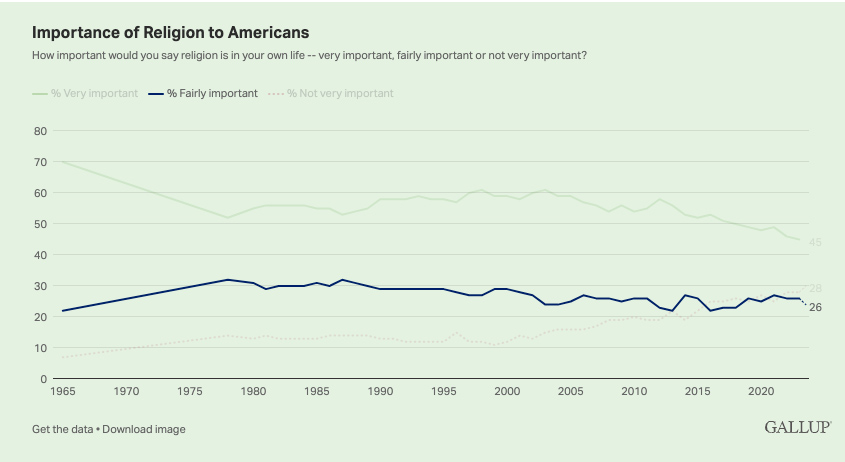
The long-term decline in church attendance is linked to a drop in religious identification in general — particularly for Protestant religions — but also to decreasing weekly attendance among U.S. Catholics.
Steep Decline in U.S. Church Membership
Additionally, less than half of Americans, 45%, belong to a formal house of worship. Church membership has been below the majority level each of the past four years. When Gallup first asked the question in 1937, 73% were members of a church, and as recently as 1999, 70% were. The decline in formal church membership has largely been driven by younger generations of Americans. Slightly more than one-third of U.S. young adults have no religious affiliation. Further, many young adults who do identify with a religion do not belong to a church. But even older adults who have a religious preference are less likely to belong to a church today than in the past.
What is powerfully revealing — and deeply concerning — is that when younger Americans are asked about the importance of community service and volunteer work (not if they have done the work), real differences between those with and without faith emerge.
.
I’ve known about this decline for years now, but Rex’ posting and graphs were disheartening nonetheless. And Samuel Abrams’ article contains many reflections that I’ve had as well.
The Christian journey is about transformation — our hearts and minds are changed so that we become more like Jesus Christ (the pioneer and perfecter of [our] faith, per Hebrews 12:2). This transformation involves how we see and experience the world as well as how we are supposed to treat others. We receive new “glasses” if you will — new lenses on the world. In fact, Jesus said inMatthew 22:37-40:
37 Jesus replied: “‘Love the Lord your God with all your heart and with all your soul and with all your mind.’ 38 This is the first and greatest commandment. 39 And the second is like it: ‘Love your neighbor as yourself.’ 40 All the Law and the Prophets hang on these two commandments.”
So Christians are taught to love our neighbors. I/we mess up on this constantly, but many of us are trying to get better at it.
But what happens when we don’t love — or even care for/about — our neighbor? Do you know that if you are living in the United States right now, you are already feeling and experiencing the impact of this in an enormous way?
Here are a few ways that you can see this playing out — even from a secular/business standpoint:
Numerous businesses don’t care at all if their products harm you, your family, or your future. For example, food companies don’t care if their products aren’t good for you — they just want your repeat business. They are concerned FAR more about Wall Street and their shareholders than about your health. With knowing that I am a chief sinner, I could also point to those businesses pushing marijuana/cannabis (especially right next to universities and colleges), cigarettes, gambling, and others. There are some dubious folks within the healthcare and pharmaceutical industries as well.
Many businesses lie to you when you call into their 800 #’s and they tell you that they care about you and your business. Again we see that they greatly appreciate your money, but they really don’t care about you or your time. They often put you in a long queue. The worst voice response units are programmed to make it extremely difficult — if not impossible — to let you talk to a live person.
Many businesses have embarked on the shrinkification of their products: offering smaller amounts but charging the same.
Many businesses don’t care if our youth are being negatively impacted (social media companies may come to some peoples’ minds. Disclaimer: I use Twitter/X and LinkedIn frequently).
Many businesses don’t care if their technologies are beneficial to society. They don’t stop to think about whether they should design and produce their products…just whether or not they can. Little to no wisdom is being displayed here.
…and I — and you — could list many more here.
So you and I are already being impacted when we push God out of our lives and out of our institutions. When we Americans look around these days..how’s that going for us? In my own life, the further I get away from God, the worse things get.
Also, we could talk about mental health*, shootings in our schools and on our streets, and several other things.
Do we care? I do. I think about this kind of thing more and more these days. LORD, forgive us. We need your help.
* I realize that Christians can struggle with mental health too
AI is welcomed by those with dyslexia, and other learning issues, helping to mitigate some of the challenges associated with reading, writing, and processing information. Those who want to ban AI want to destroy the very thing that has helped most on accessibility. Here are 10 ways dyslexics, and others with issues around text-based learning, can use AI to support their daily activities and learning.
Are U.S. public schools lagging behind other countries like Singapore and South Korea in preparing teachers and students for the boom of generative artificial intelligence? Or are our educators bumbling into AI half-blind, putting students’ learning at risk?
Or is it, perhaps, both?
Two new reports, coincidentally released on the same day last week, offer markedly different visions of the emerging field: One argues that schools need forward-thinking policies for equitable distribution of AI across urban, suburban and rural communities. The other suggests they need something more basic: a bracing primer on what AI is and isn’t, what it’s good for and how it can all go horribly wrong.
Bite-Size AI Content for Faculty and Staff— from aiedusimplified.substack.com by Lance Eaton Another two 5-tips videos for faculty and my latest use case: creating FAQs!
Despite possible drawbacks, an exciting wondering has been—What if AI was a tipping point helping us finally move away from a standardized, grade-locked, ranking-forced, batched-processing learning model based on the make believe idea of “the average man” to a learning model that meets every child where they are at and helps them grow from there?
I get that change is indescribably hard and there are risks. But the integration of AI in education isn’t a trend. It’s a paradigm shift that requires careful consideration, ongoing reflection, and a commitment to one’s core values. AI presents us with an opportunity—possibly an unprecedented one—to transform teaching and learning, making it more personalized, efficient, and impactful. How might we seize the opportunity boldly?
California and NVIDIA Partner to Bring AI to Schools, Workplaces — from govtech.com by Abby Sourwine The latest step in Gov. Gavin Newsom’s plans to integrate AI into public operations across California is a partnership with NVIDIA intended to tailor college courses and professional development to industry needs.
California Gov. Gavin Newsom and tech company NVIDIA joined forces last week to bring generative AI (GenAI) to community colleges and public agencies across the state. The California Community Colleges Chancellor’s Office (CCCCO), NVIDIA and the governor all signed a memorandum of understanding (MOU) outlining how each partner can contribute to education and workforce development, with the goal of driving innovation across industries and boosting their economic growth.
Listen to anything on the go with the highest-quality voices — from elevenlabs.io; via The Neuron
The ElevenLabs Reader App narrates articles, PDFs, ePubs, newsletters, or any other text content. Simply choose a voice from our expansive library, upload your content, and listen on the go.
Per The Neuron
Some cool use cases:
Judy Garland can teach you biology while walking to class.
James Dean can narrate your steamy romance novel.
Sir Laurence Olivier can read you today’s newsletter—just paste the web link and enjoy!
Why it’s important: ElevenLabs shared how major Youtubers are using its dubbing services to expand their content into new regions with voices that actually sound like them (thanks to ElevenLabs’ ability to clone voices).
Oh, and BTW, it’s estimated that up to 20% of the population may have dyslexia. So providing people an option to listen to (instead of read) content, in their own language, wherever they go online can only help increase engagement and communication.
How Generative AI Improves Parent Engagement in K–12 Schools — from edtechmagazine.com by Alexadner Slagg With its ability to automate and personalize communication, generative artificial intelligence is the ideal technological fix for strengthening parent involvement in students’ education.
As generative AI tools populate the education marketplace, the technology’s ability to automate complex, labor-intensive tasks and efficiently personalize communication may finally offer overwhelmed teachers a way to effectively improve parent engagement.
… These personalized engagement activities for students and their families can include local events, certification classes and recommendations for books and videos. “Family Feed might suggest courses, such as an Adobe certification,” explains Jackson. “We have over 14,000 courses that we have vetted and can recommend. And we have books and video recommendations for students as well.”
Including personalized student information and an engagement opportunity makes it much easier for parents to directly participate in their children’s education.
Will AI Shrink Disparities in Schools, or Widen Them? — edsurge.com by Daniel Mollenkamp Experts predict new tools could boost teaching efficiency — or create an “underclass of students” taught largely through screens.
If you’re looking for apps and games that not only keep young kids occupied but also encourage them to explore, learn, and express themselves, we have some great suggestions.
The apps we cover in this guide are good learning apps not because they’re designed to make kids smarter, to drill facts, or to replace in-school learning, but because they each offer something fun, unique, and interesting for kids and adults.
As with our guides to STEM and learning toys, we didn’t test scores of apps to try to find the “best” ones. Rather, most of our favorite apps have been chosen by teachers for their students in classrooms, used by Wirecutter parents and their kids, or recommended by the experts and educators we spoke with.
SATs Have Never Been About Equity — from insidehighered.com by Pepper Stetler The history of the SAT raises questions about how we value and measure intelligence, Pepper Stetler writes.
Excerpts (emphasis DSC):
Even though the overwhelming majority (about 80 percent) of the country’s colleges and universities will remain test optional for the Class of 2029, our national conversation about the role of standardized admissions tests in higher education focuses almost exclusively on elite colleges, whose enrollments represent only 1 percent of students. Such a myopic perspective will do little to increase access to higher education. Real change would require us to reckon with the history of standardized tests and how they have persistently disadvantaged large numbers of students, particularly students of color and students with disabilities.
One hundred years later, academic success is defined as the capacity to do well on a standardized test. It does not just predict a person’s academic ability. It defines academic ability. And those who have the most time and resources to devote to the test are the ones who will succeed.
Trend #1: Schools Are Using Career Technical Education to Increase Student Engagement
Trend #2: Districts Are Looking to Scale Up Tutoring
Trend #3: Virtual Learning Solutions Can Help Address Teacher Shortages
Understood.com | Everyone deserves to be understood Understood is the leading nonprofit empowering the 70 million people with learning and thinking differences in the United States.
The University of California, Berkeley School of Law has announced that it will offer what it’s calling “the first-ever law degree with a focus on artificial intelligence (AI).” The new AI-focused Master of Laws (LL.M.) program is scheduled to launch in summer 2025.
The program, which will award an AI Law and Regulation certificate for students enrolled in UC Berkeley Law’s LL.M. executive track, is designed for working professionals and can be completed over two summers or through remote study combined with one summer on campus.
This week on The Geek in Review, we discuss the future of legal technology with Dr. Megan Ma, a distinguished research fellow and Associate Director of the Stanford Program in Law, Science, and Technology at the Stanford Center for Legal Informatics, also known as Codex. Dr. Ma’s groundbreaking work in integrating generative AI into legal applications takes center stage as she shares her insights on translating legal knowledge into code and the implications of human-machine collaboration in the legal field.
But what is crucial is that this is not a public, humiliating struggle which dehumanises the person, it is the private conversations we have with ourselves about what is working and what isn’t.
The second strand is that the circumstances are always low threat. No-one else can see our struggling to get the solution.
No-one is pointing the finger.
It is when we feel safe at this deep level that we are prepared to risk things and have a go.
If we are serious about providing pupils with an ambitious curriculum, we need to consider how the ‘high challenge’ is balanced by ‘low threat’.
But as generative AI tools like ChatGPT sweep into mainstream business tools, promising to draft properly-formatted text from simple prompts and the click of a button, new questions are rising about what role writing centers should play — or whether they will be needed in the future.
…
Writing centers need to find a balance between introducing AI into the writing process and keeping the human support that every writer needs, argues Anna Mills, an English instructor at the College of Marin.
AI can serve as a supplement to a human tutor, Mills says. She encourages her students to use MyEssayFeedback, an AI tool that critiques the organization of an essay, the quality of evidence a student has included to support their thesis or the tone of the writing. Such tools can also evaluate research questions or review a student’s writing based on the rubric for the assignment, she says.
Psalm 8 For the director of music. According to gittith.[b] A psalm of David.
1 Lord, our Lord, how majestic is your name in all the earth!
You have set your glory in the heavens. 2 Through the praise of children and infants you have established a stronghold against your enemies, to silence the foe and the avenger. 3 When I consider your heavens, the work of your fingers, the moon and the stars, which you have set in place, 4 what is mankind that you are mindful of them, human beings that you care for them?[c]
5 You have made them[d] a little lower than the angels[e] and crowned them[f] with glory and honor. 6 You made them rulers over the works of your hands; you put everything under their[g] feet: 7 all flocks and herds, and the animals of the wild, 8 the birds in the sky, and the fish in the sea, all that swim the paths of the seas.
9 Lord, our Lord, how majestic is your name in all the earth!
9 The Lord is a refuge for the oppressed, a stronghold in times of trouble. 10 Those who know your name trust in you, for you, Lord, have never forsaken those who seek you.
The Burden of Misunderstanding — from onedtech.philhillaa.com by Phil Hill How ED’s outdated consumer-protection view of online education could lead to bureaucratic burden on every online course in US higher ed
Time to Comment There are plenty of other points to be made on this proposed rule:
the lack of evidence supporting the treatment of online ed differently than f2f or hybrid;
the redefinition of regular and substantive interaction;
the impact of this simplification rule actually complicating matters for compliance; and
the risk of auto-withdrawal for 14-day inactivity periods, etc.
For now, I wanted to be more precise on what I believe is a misunderstood compliance burden of ED’s proposed rule, and ED’s inability to listen to feedback from colleges and universities and associations representing them. And that while the details of this proposed rule might seem arcane, it will have a major impact across higher ed.
It is very important to note that we are in the middle of the public comment period for these proposed rules, and that ED should hear directly from colleges and universities about the impact of the proposed rules. You can comment here through next Friday (August 23rd).
From DSC: Phil brings up numerous excellent points in the above posting. If the Department of Education’s (ED’s) proposed rules on online attendance taking get finalized, the impacts could be huge — and negative/costly in several areas. Faculty members, directors and staff of teaching and learning centers, directors of online programs, provosts and other members of administrations, plus other relevant staff should comment– NOW — before the comment period ends next Friday (August 23rd).
Thanks for dropping by my Learning Ecosystems blog!
My name is Daniel Christian and this blog seeks to cover the teaching and learning environments within the K-12 (including homeschooling, learning pods/micro-schools), collegiate, and corporate training spaces -- whether those environments be face-to-face, blended, hyflex, or 100% online.
Just as the organizations that we work for have their own learning ecosystems, each of us has our own learning ecosystem. We need to be very intentional about enhancing those learning ecosystems -- as we all need to be lifelong learners in order to remain marketable and employed. It's no longer about running sprints (i.e., getting a 4-year degree or going to a vocational school and then calling it quits), but rather, we are all running marathons now (i.e., we are into lifelong learning these days).