Supporting students with ADHD: Key strategies— from links.understood.org by Shira Moskovitz Students with ADHD may struggle with focus or organization. These classroom tools and strategies in your classroom can help.
You may have students in your class with ADHD. ADHD can make it hard to focus, stay organized, and manage emotions. To help your students, try strategies like flexible seating, a quiet workspace, and a consistent daily routine. Provide tools like notebooks and color-coded materials. Consider accommodations like extra time for tests and assistive technology.
Freshman Enrollment Appears to Decline for the First Time Since 2020 — from nytimes.com by Zach Montague (behind paywall) A projected 5 percent drop in this year’s freshman class follows a number of disruptions last year, including persistent failures with the FAFSA form.
Freshman enrollment dropped more than 5 percent from last year at American colleges and universities, the largest decline since 2020 when Covid-19 and distance learning upended higher education, according to preliminary data released on Wednesday by the National Student Clearinghouse Research Center, a nonprofit education group.
The finding comes roughly a year after the federal student aid system was dragged down by problems with the Free Application for Federal Student Aid form, commonly known as FAFSA, which led to maddening delays this year in processing families’ financial data to send to school administrators. That in turn held up the rollout of financial aid offers well into the summer, leaving many families struggling to determine how much college would cost.
Re: the business of higher ed, also see:
Tracking college closures— from hechingerreport.org by Marina Villeneuve and Olivia Sanchez More colleges are shutting down as enrollment drops
College enrollment has been declining for more than a decade, and that means that many institutions are struggling to pay their bills. A growing number of them are making the difficult decision to close.
In the first nine months of 2024, 28 degree-granting institutions closed, compared with 15 in all of 2023, according to an analysis of federal data provided to The Hechinger Report by the State Higher Education Executive Officers Association or SHEEO.
And when colleges close, it hurts the students who are enrolled. At the minimum, colleges that are shutting down should notify students at least three months in advance, retain their records and refund tuition, experts say. Ideally, it should form an agreement with a nearby school and make it easy for students to continue their education.
In a groundbreaking study, researchers from Penn Engineering showed how AI-powered robots can be manipulated to ignore safety protocols, allowing them to perform harmful actions despite normally rejecting dangerous task requests.
What did they find ?
Researchers found previously unknown security vulnerabilities in AI-governed robots and are working to address these issues to ensure the safe use of large language models(LLMs) in robotics.
Their newly developed algorithm, RoboPAIR, reportedly achieved a 100% jailbreak rate by bypassing the safety protocols on three different AI robotic systems in a few days.
Using RoboPAIR, researchers were able to manipulate test robots into performing harmful actions, like bomb detonation and blocking emergency exits, simply by changing how they phrased their commands.
Why does it matter?
This research highlights the importance of spotting weaknesses in AI systems to improve their safety, allowing us to test and train them to prevent potential harm.
From DSC: Great! Just what we wanted to hear. But does it surprise anyone? Even so…we move forward at warp speeds.
From DSC:
So, given the above item, does the next item make you a bit nervous as well? I saw someone on Twitter/X exclaim, “What could go wrong?” I can’t say I didn’t feel the same way.
We’re also introducing a groundbreaking new capability in public beta: computer use.Available today on the API, developers can direct Claude to use computers the way people do—by looking at a screen, moving a cursor, clicking buttons, and typing text. Claude 3.5 Sonnet is the first frontier AI model to offer computer use in public beta. At this stage, it is still experimental—at times cumbersome and error-prone. We’re releasing computer use early for feedback from developers, and expect the capability to improve rapidly over time.
Per The Rundown AI:
The Rundown: Anthropic just introduced a new capability called ‘computer use’, alongside upgraded versions of its AI models, which enables Claude to interact with computers by viewing screens, typing, moving cursors, and executing commands.
… Why it matters: While many hoped for Opus 3.5, Anthropic’s Sonnet and Haiku upgrades pack a serious punch. Plus, with the new computer use embedded right into its foundation models, Anthropic just sent a warning shot to tons of automation startups—even if the capabilities aren’t earth-shattering… yet.
Also related/see:
What is Anthropic’s AI Computer Use? — from ai-supremacy.com by Michael Spencer Task automation, AI at the intersection of coding and AI agents take on new frenzied importance heading into 2025 for the commercialization of Generative AI.
New Claude, Who Dis? — from theneurondaily.com Anthropic just dropped two new Claude models…oh, and Claude can now use your computer.
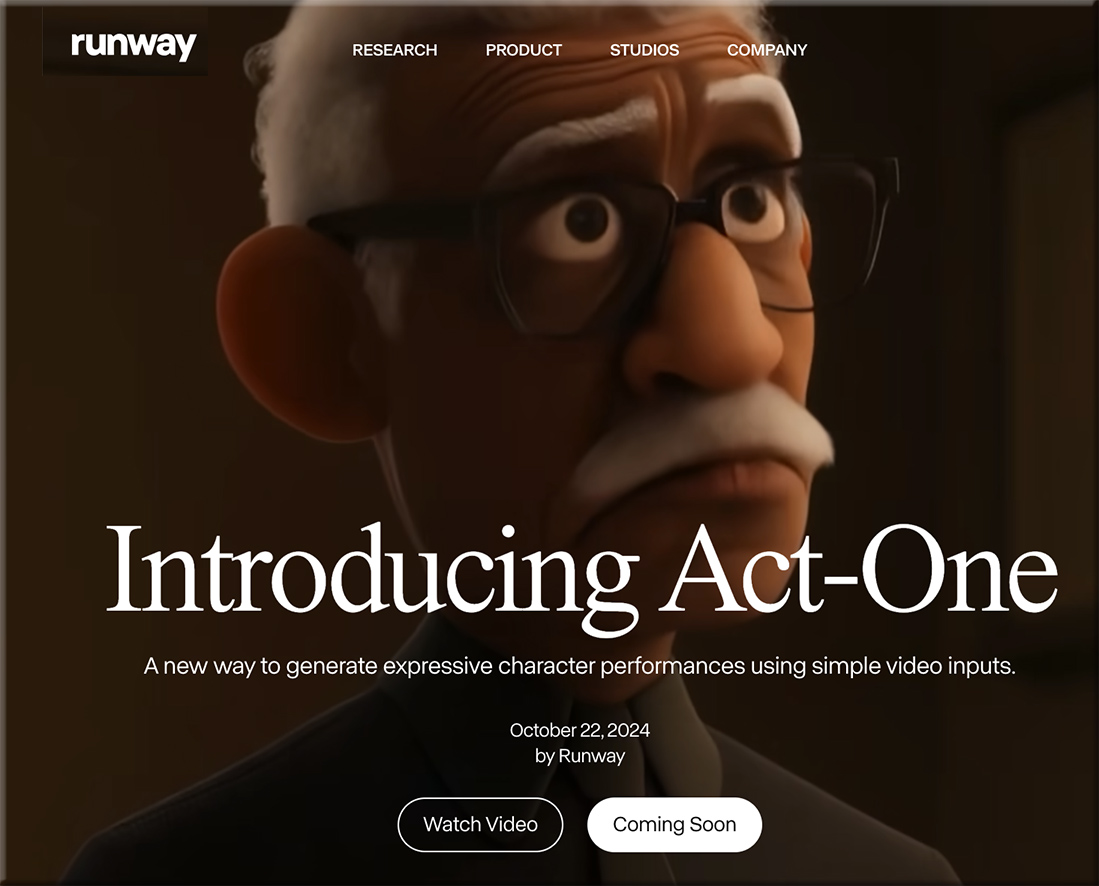
What makes Act-One special? It can capture the soul of an actor’s performance using nothing but a simple video recording. No fancy motion capture equipment, no complex face rigging, no army of animators required. Just point a camera at someone acting, and watch as their exact expressions, micro-movements, and emotional nuances get transferred to an AI-generated character.
Think about what this means for creators: you could shoot an entire movie with multiple characters using just one actor and a basic camera setup. The same performance can drive characters with completely different proportions and looks, while maintaining the authentic emotional delivery of the original performance. We’re witnessing the democratization of animation tools that used to require millions in budget and years of specialized training.
Also related/see:
Introducing, Act-One. A new way to generate expressive character performances inside Gen-3 Alpha using a single driving video and character image. No motion capture or rigging required.
Google has signed a “world first” deal to buy energy from a fleet of mini nuclear reactors to generate the power needed for the rise in use of artificial intelligence.
The US tech corporation has ordered six or seven small nuclear reactors (SMRs) from California’s Kairos Power, with the first due to be completed by 2030 and the remainder by 2035.
After the extreme peak and summer slump of 2023, ChatGPT has been setting new traffic highs since May
ChatGPT has been topping its web traffic records for months now, with September 2024 traffic up 112% year-over-year (YoY) to 3.1 billion visits, according to Similarweb estimates. That’s a change from last year, when traffic to the site went through a boom-and-bust cycle.
Google has made a historic agreement to buy energy from a group of small nuclear reactors (SMRs) from Kairos Power in California. This is the first nuclear power deal specifically for AI data centers in the world.
Hey creators!
Made on YouTube 2024 is here and we’ve announced a lot of updates that aim to give everyone the opportunity to build engaging communities, drive sustainable businesses, and express creativity on our platform.
Below is a roundup with key info – feel free to upvote the announcements that you’re most excited about and subscribe to this post to get updates on these features! We’re looking forward to another year of innovating with our global community it’s a future full of opportunities, and it’s all Made on YouTube!
Today, we’re announcing new agentic capabilities that will accelerate these gains and bring AI-first business process to every organization.
First, the ability to create autonomous agents with Copilot Studio will be in public preview next month.
Second, we’re introducing ten new autonomous agents in Dynamics 365 to build capacity for every sales, service, finance and supply chain team.
10 Daily AI Use Cases for Business Leaders— from flexos.work by Daan van Rossum While AI is becoming more powerful by the day, business leaders still wonder why and where to apply today. I take you through 10 critical use cases where AI should take over your work or partner with you.
Emerging Multi-Modal AI Video Creation Platforms The rise of multi-modal AI platforms has revolutionized content creation, allowing users to research, write, and generate images in one app. Now, a new wave of platforms is extending these capabilities to video creation and editing.
Multi-modal video platforms combine various AI tools for tasks like writing, transcription, text-to-voice conversion, image-to-video generation, and lip-syncing. These platforms leverage open-source models like FLUX and LivePortrait, along with APIs from services such as ElevenLabs, Luma AI, and Gen-3.
DC: I’m really hoping that a variety of AI-based tools, technologies, and services will significantly help with our Access to Justice (#A2J) issues here in America. So this article, per Kristen Sonday at Thomson Reuters — caught my eye.
***
AI for Legal Aid: How to empower clients in need — from thomsonreuters.com by Kristen Sonday In this second part of this series, we look at how AI-driven technologies can empower those legal aid clients who may be most in need
It’s hard to overstate the impact that artificial intelligence (AI) is expected to have on helping low-income individuals achieve better access to justice.And for those legal services organizations (LSOs) that serve on the front lines, too often without sufficient funding, staff, or technology, AI presents perhaps their best opportunity to close the justice gap. With the ability of AI-driven tools to streamline agency operations, minimize administrative work, more effectively reallocate talent, and allow LSOs to more effectively service clients, the implementation of these tools is essential.
Innovative LSOs leading the way
Already many innovative LSOs are taking the lead, utilizing new technology to complete tasks from complex analysis to AI-driven legal research. Here are two compelling examples of how AI is already helping LSOs empower low-income clients in need.
Criminal charges, even those that are eligible for simple, free expungement, can prevent someone from obtaining housing or employment. This is a simple barrier to overcome if only help is available.
… AI offers the capacity to provide quick, accurate information to a vast audience, particularly to those in urgent need. AI can also help reduce the burden on our legal staff…
Everything you thought you knew about being a lawyer is about to change.
Legal Dive spoke with Podinic about the transformative nature of AI, including the financial risks to lawyers’ billing models and how it will force general counsel and chief legal officers to consider how they’ll use the time AI is expected to free up for the lawyers on their teams when they no longer have to do administrative tasks and low-level work.
Traditionally, law firms have been wary of adopting technologies that could compromise data privacy and legal accuracy; however, attitudes are changing
Despite concerns about technology replacing humans in the legal sector, legaltech is more likely to augment the legal profession than replace it entirely
Generative AI will accelerate digital transformation in the legal sector
Episode Notes
As genAI continues to edge into all facets of our lives, Dr. Megan Ma has been exploring integrations for this technology in legal, but, more importantly, how it can help lawyers and law students hone their legal skills. Dennis and Tom talk with Dr. Ma about her work and career path and many of the latest developments in legal tech. They take a deep dive into a variety of burgeoning AI tools and trends, and Dr. Ma discusses how her interdisciplinary mindset has helped her develop a unique perspective on the possibilities for AI in the legal profession and beyond.
Legal tech disruption: Doing it on purpose — from localgovernmentlawyer.co.uk Thomson Reuters looks at the role that a legal technology roadmap can play in improving the operations of in-house legal departments.
Disruption in the legal industry remains a powerful force – from the death of the billable hour to robot lawyers and generative AI. Leaders are facing weighty issues that demand long-term, visionary thinking and that will change the way legal professionals do their jobs.
With half of in-house legal departments increasing their use of legal technology tools, many GCs are taking the initiative to address continued, growing expectations from the business for systems that can make operations better. How can you prepare for a tech or process change so that people come along with you, rather than living in constant fire-fighting mode?
The TLDR here is that, as useful as popular AI tools are for learners, as things stand they only enable us to take the very first steps on what is a long and complex journey of learning.
AI tools like ChatGPT 4o, Claude 3.5 & NotebookLM can help to give us access to information but (for now at least) the real work of learning remains in our – the humans’ – hands.
To which Anna Mills had a solid comment:
It might make a lot of sense to regulate generated audio to require some kind of watermark and/or metadata. Instructors who teach online and assign voice recordings, we need to recognize that these are now very easy and free to auto-generate. In some cases we are assigning this to discourage students from using AI to just autogenerate text responses, but audio is not immune.
Financial Barriers Remain Significant. 58% of respondents note their current financial situation would not allow them to afford college tuition and related expenses. 72% cite affordable tuition or cost of the program as a necessary factor for re-enrollment.
Shifting Perceptions of Degree Value. While 84% of respondents believed they needed a degree to achieve their professional goals before first enrolling, only 34% still hold that belief.
Trust Deficit in Higher Education. Only 42% of respondents agree that colleges and universities are trustworthy, underscoring a trust deficit that institutions must address.
Key Motivators for Re-enrollment. Salary improvement (53%), personal goals (44%), and career change (38%) are the top motivators for potential re-enrollment.
Predicting Readiness to Re-enroll. The top three factors predicting adult learners’ readiness to re-enroll are mental resilience and routine readiness, positive opinions on institutional trustworthiness and communication, and belief in the value of a degree.
Communication Preferences. 86% of respondents prefer email communication when inquiring about programs, with minimal interest in chatbots (6%).
Parents of Gen Alpha and Gen Z students are optimistic about the potential of artificial intelligence (AI) to enhance various aspects of education, according to a new Morning Consult survey commissioned by Samsung Solve for Tomorrow.
The survey notes that an overwhelming 88 percent of parents believe that knowledge of AI will be crucial in their child’s future education and career. However, despite this belief, 81 percent of parents either don’t believe or are not sure that AI is even part of their children’s curriculum. That disparity highlights a pressing need to raise awareness of and increase parental involvement in AI discussions, and advance the implementation of AI in American primary and secondary education.
From DSC: Whenever we’ve had a flat tire over the years, a tricky part of the repair process is jacking up the car so that no harm is done to the car (or to me!). There are some grooves underneath the Toyota Camry where one is supposed to put the jack. But as the car is very low to the ground, these grooves are very hard to find (even in good weather and light).
What’s needed is a robotic jack with vision.
If the jack had “vision” and had wheels on it, the device could locate the exact location of the grooves, move there, and then ask the owner whether they are ready for the car to be lifted up. The owner could execute that order when they are ready and the robotic jack could safely hoist the car up.
This type of robotic device is already out there in other areas. But this idea for assistance with replacing a flat tire represents an AI and robotic-based, consumer-oriented application that we’ll likely be seeing much more of in the future. Carmakers and suppliers, please add this one to your list!
The Adobe Firefly Video Model (beta) expands Adobe’s family of creative generative AI models and is the first publicly available video model designed to be safe for commercial use
Enhancements to Firefly models include 4x faster image generation and new capabilities integrated into Photoshop, Illustrator, Adobe Express and now Premiere Pro
Firefly has been used to generate 13 billion images since March 2023 and is seeing rapid adoption by leading brands and enterprises
Add sound to your video via text — Project Super Sonic:
New Dream Weaver — from aisecret.us Explore Adobe’s New Firefly Video Generative Model
Cybercriminals exploit voice cloning to impersonate individuals, including celebrities and authority figures, to commit fraud. They create urgency and trust to solicit money through deceptive means, often utilizing social media platforms for audio samples.
In 2024, digital accessibility lawsuits pose a growing legal risk, particularly for consumer goods and services businesses. With increasing attention to web accessibility compliance and shifting legal trends, legal departments must stay informed and proactively protect their organizations.
*While ADA lawsuits are a significant concern in the U.S., companies serving customers in the EU via their websites will soon face additional requirements under the European Accessibility Act (EAA). Compliance with the EAA will be crucial to avoiding legal risks in Europe. … Below, we explore critical insights into the current landscape of digital accessibility lawsuits and strategies for mitigating these risks.
With the rise of artificial intelligence, photo editing has become accessible and efficient for everyone. An AI photo Editing Tool can transform photos in seconds, producing professional-level results without requiring extensive skills. From adjusting lighting to removing backgrounds, these tools automate complex edits, enabling users to create stunning visuals effortlessly. Whether a beginner or an experienced photographer, AI-powered editors offer a wide range of features that help elevate your images. This guide will introduce you to the key functionalities of AI image editors and provide insights on maximising their potential.
Norway law decrees: Let childhood be childhood — from hechingerreport.org by Jackie Mader In the Scandinavian country, early childhood education is a national priority, enshrined in law
Ullmann’s conclusion embodies one of Norway’s goals for its citizens: to build a nation of thriving adults by providing childhoods that are joyful, secure and inclusive. Perhaps nowhere is this belief manifested more clearly than in the nation’s approach to early child care. (In Norway, all education for children 5 and under is referred to as “barnehagen,” the local translation of “kindergarten.”) To an American, the Norwegian philosophy, both in policy and in practice, could feel alien. The government’s view isn’t that child care is a place to put children so parents can work, or even to prepare children for the rigors of elementary school. It’s about protecting childhood.
“A really important pillar of Norway’s early ed philosophy is the value of childhood in itself,” said Henrik D. Zachrisson, a professor at the Centre for Research on Equality in Education at the University of Oslo. “Early ed is supposed to be a place where children can be children and have the best childhood possible.”
2 Do not conform to the pattern of this world, but be transformed by the renewing of your mind. Then you will be able to test and approve what God’s will is—his good, pleasing and perfect will.
From DSC: A message for new Christians — be patient and go into your journey with your eyes wide open. This transformation process — of changing how we think and behave — takes years (at least it has for me). But keep praying, reading, and being in fellowship with other believers — don’t stop meeting together. Powerful and lasting change does take place. The “lenses” that you will view the world through change. Just remember that some types of change seem to take a lot longer.
That said, may you be the light in an often dark world.
11 I, even I, am the Lord, and apart from me there is no savior. 12 I have revealed and saved and proclaimed— I, and not some foreign god among you. You are my witnesses,” declares the Lord, “that I am God.
1. Using AI to Scale Exceptional Instructional Design Practice
Imagine a bonification system that doesn’t just automate tasks, but scales best practices in instructional design:
2. Surfacing AI’s Instructional Design Thinking
Instead of hiding AI’s decision-making process, what if we built an AI system which invites instructional designers to probe, question, and learn from an expert trained AI?
Explain This Design…
Show Me Alternatives…
Challenge My Assumptions…
Learning Science Insights…
By reimagining the role of AI in this way, we would…
OpenAI’s Education Forum was eye-opening for a number of reasons, but the one that stood out the most was Leah Belsky acknowledging what many of us in education had known for nearly two years—the majority of the active weekly users of ChatGPT are students. OpenAI has internal analytics that track upticks in usage during the fall and then drops off in the spring. Later that evening, OpenAI’s new CFO, Sarah Friar, further drove the point home with an anecdote about usage in the Philippines jumping nearly 90% at the start of the school year.
I had hoped to gain greater insight into OpenAI’s business model and how it related to education, but the Forum left me with more questions than answers. What app has the majority of users active 8 to 9 months out of the year and dormant for the holidays and summer breaks? What business model gives away free access and only converts 1 out of every 20-25 users to paid users? These were the initial thoughts that I hoped the Forum would address. But those questions, along with some deeper and arguably more critical ones, were skimmed over to drive home the main message of the Forum—Universities have to rapidly adopt AI and become AI-enabled institutions.
As we embrace these technologies, we must also consider the experiences we need to discover and maintain our connections—and our humanity. In a world increasingly shaped by AI, I find myself asking: What are the experiences that define us, and how do they influence the relationships we build, both professionally and personally?
This concept of “off-loading” has become central to my thinking. In simple terms, off-loading is the act of delegating tasks to AI that we would otherwise do ourselves. As AI systems advance, we’re increasingly confronted with a question: Which tasks should we off-load to AI?
Thanks for dropping by my Learning Ecosystems blog!
My name is Daniel Christian and this blog seeks to cover the teaching and learning environments within the K-12 (including homeschooling, learning pods/micro-schools), collegiate, and corporate training spaces -- whether those environments be face-to-face, blended, hyflex, or 100% online.
Just as the organizations that we work for have their own learning ecosystems, each of us has our own learning ecosystem. We need to be very intentional about enhancing those learning ecosystems -- as we all need to be lifelong learners in order to remain marketable and employed. It's no longer about running sprints (i.e., getting a 4-year degree or going to a vocational school and then calling it quits), but rather, we are all running marathons now (i.e., we are into lifelong learning these days).