


Global AI Diffusion Q1 2026 Trends and Insights — from Microsoft

.

Deans for Impact Releases New Edition of The Science of Learning — from deansforimpact.org
Second edition of seminal report reflects new research amidst growing momentum for evidence-based instruction in teacher preparation and PK-12.
AUSTIN, Texas (May 19, 2026) – Deans for Impact (DFI) today released the second edition of The Science of Learning, a report translating cognitive-science research into practical implications for teaching. The updated edition includes new research on memory, attention, motivation, and learning misconceptions, offering educators a research-based foundation for understanding how to support durable student learning.
First released in 2015, The Science of Learning is DFI’s most widely-used and cited resource, with more than one million downloads. Since its publication, DFI has supported nearly 300 teacher-preparation programs to make instructional quality a priority in the way teachers are prepared, directly impacting more than 110,000 teachers over the last decade.
The second edition arrives at a moment when more than 40 states have made meaningful investments in strengthening evidence-based instruction, particularly in early literacy, mathematics, and the use of high-quality instructional materials. The science of learning supports future teachers to build a comprehensive foundation for instructional decision-making that cuts across content areas and grade levels.
…
The report has been endorsed by more than 100 field experts and leading organizations across the United States and internationally.
Download the report at deansforimpact.org/thescienceoflearning.
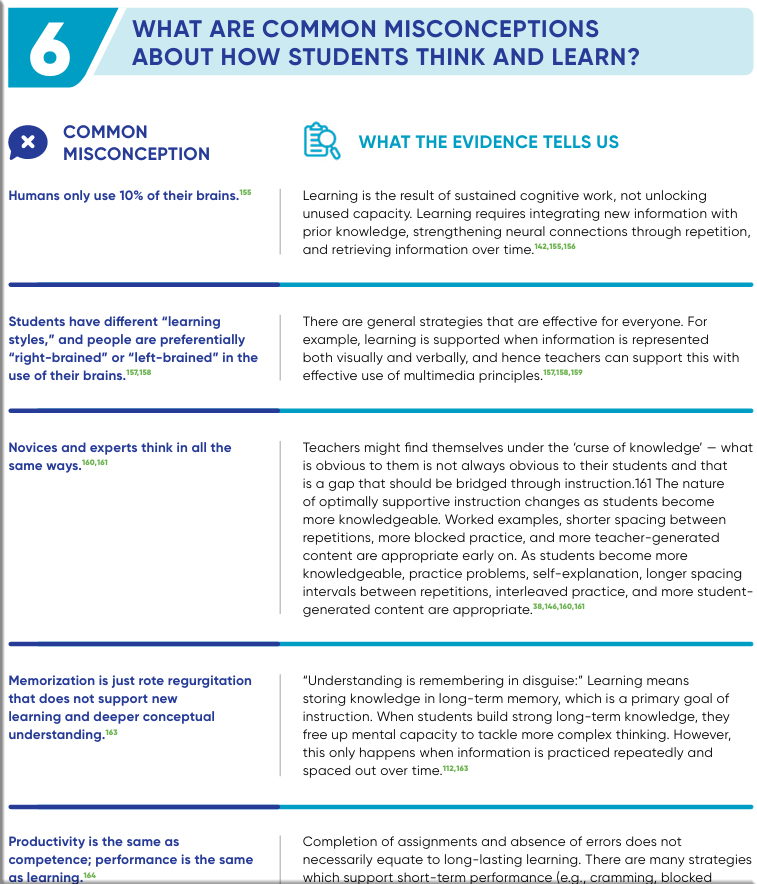
An example excerpt:
Putting college on the fast track — from hechingerreport.org by Jon Marcus
As students grow impatient, colleges try three-year bachelor’s degrees
Some colleges and the accreditors and states that oversee them are adding and approving three-year bachelor’s degrees that require fewer credits than the traditional four-year kind.
Institutions facing enrollment declines hope the new three-year degrees will attract students unwilling to spend the usual amount of time and money that it takes to graduate. States need those graduates to fill jobs.
Nearly 60 universities and colleges are planning, considering or have already launched reduced-credit, three-year bachelor’s degrees in some disciplines. They’re calling them “applied” or “career-focused” bachelor’s degrees.
While earning bachelor’s degrees with fewer credits may appeal to some students, the idea is so new that there’s a key unanswered question: whether employers, graduate schools and licensing agencies will accept them.
From DSC:
Given the often high price of obtaining a degree these days…whether it’s a 4-year program or a 3-year program, the key is whether a student can get a good job coming out of that program. I think the required time doesn’t help as much as making the necessary changes to offer more responsive curricula, relevant programs, and real-world learning experiences (including apprenticeships and internships). I appreciate the experiment to lower the overall costs, but like so many other “innovations,” it’s playing at the fringes. It’s really the same old, same old — just on a shorter time frame.
At current prices, families are FORCED to consider employment prospects. They are demanding a ROI, because they have to.
I was at a meeting earlier this year with other parents and family members who were interested in a particular program at a Michigan-based university. One set of parents really wanted to know if their student would be getting a good job coming out of the program. They didn’t want to take a second mortgage out if the investment wasn’t going to pay off.
Also see:
This see-through smart ring translates sign language and almost works like magic — from digitaltrends.com by Rachit Agarwal
For people who are hard of hearing, sign language isn’t just a communication tool; it’s their primary language. The problem is that sign language is not taught to people with regular hearing, thus creating a barrier that’s hard to bridge. Now, a team of researchers in South Korea may have just found a surprisingly elegant solution to this age-old problem.
According to a new study published in Science Advances, the system, called WRSLT (wirelessly connected, ring-type sign language translator), can recognize and translate both American Sign Language and International Sign Language words with around 88% accuracy. And yes, it works in real time.
.

Several items re: Anthropic’s recent announcement

[On May 12, 2026, we introduced] 20+ new MCP connectors that link Claude to the software the legal industry already relies on, and 12 new plugins tailored to specific legal work and practice areas. And finally, we’re partnering with the Free Law Project, the Justice Technology Association, and others working to put legal help within reach of people who can’t currently access it.
.
Link to Nicola’s posting on LinkedIn
Claude For Legal Launches, May Reshape the Legal Tech World — from Artificial Lawyer’s interview with Mark Pike, Anthropic Associate General Counsel
We have been building toward this moment, and now it’s finally arrived. Anthropic has formally launched ‘Claude For Legal’, a comprehensive offering that could reshape the legal tech world and places the LLM-maker at the heart of the market. (See below Artificial Lawyer interview with Mark Pike, Anthropic Associate General Counsel.)
Legal tech companies from Thomson Reuters and LexisNexis, to Harvey and Legora, are all participants in one way or another, in what is a bold strategic move that changes the legal tech market in ways that would have been unimaginable just a few years ago. (Plus, see comments from Harvey and TR below.) And of course, Freshfields has already gone all-in with Claude, while other major firms are also deeply exploring what it can do.
Claude for Legal will manifest itself across four main paths and builds on work that has already been developed:
Justice Technology Association Named Access to Justice Partner in Anthropic’s Legal AI Launch — from lawnext.com by Bob Ambrogi
The Justice Technology Association (JTA), a nonprofit trade group representing mission-driven companies focused on the access to justice crisis, announced today that it has joined Anthropic as a launch partner in what Anthropic is calling its first comprehensive legal vertical initiative.
The announcement comes as part of a much-broader announcement by Anthropic of its push into the legal industry, as it just released more than 20 MCP connectors to legal tech products and 12 practice-area plugins for Claude.
“Legal services are out of reach for many people and small businesses, and the gap is widening,” Anthropic said in its announcement. “We’re working with the Free Law Project, Justice Technology Association and other legal aid and public service organizations to help make legal services more affordable and available.”
That makes this the first time that a leading AI company is explicitly naming access to justice as a foundational pillar, JTA says, with Anthropic positioning the initiative as “investing in the premise that AI should expand access to justice — making legal services more affordable and available.”
Anthropic Goes All-In on Legal, Releasing More Than 20 Connectors and 12 Practice-Area Plugins for Claude — from lawnext.com by Bob Ambrogi
Anthropic today took its biggest step yet into the legal market, releasing more than 20 new MCP connectors linking Claude to the software that law firms and legal departments run on, along with 12 new plugins tailored to specific legal practice areas.
Today’s announcement builds on the legal plugin Anthropic released in early February for Claude Cowork — the agentic desktop tool the company introduced in January as “Claude Code for the rest of your work.”
In the months since that initial release, Anthropic says legal professionals have become the most engaged Cowork users of any knowledge-work function, a statistic that likely accelerated this deeper push.
ANTHROPIC JUST OPEN-SOURCED A COMPLETE AI LEGAL SYSTEM COVERING 10 PRACTICE AREAS. 100% FREE.
80+ NAMED AGENTS handling
– contracts
– employment
– litigation
– privacy, IP
– corporate work. All of itIt is called Claude for Legal.
Here is what is going on.
Legal work is… pic.twitter.com/LjGi1VRSgK
— Kanika (@KanikaBK) May 13, 2026
— Zack Shapiro (@zackbshapiro) February 27, 2026
The AI Pilot is Over: Legal’s Moment to Move Beyond Experiments and Avoid the Innovator’s Dilemma — by Sabastian Niles, President & CLO Salesforce

We welcome back Sabastian Niles, President and Chief Legal Officer at Salesforce, to discuss his recent “Open Letter to Law Firms.” As the legal industry hits a critical inflection point, Sabastian argues that the era of “AI theater” and small-scale pilots is over.
The conversation dives deep into the Innovator’s Dilemma facing law firms, the shift toward agentic AI, and how firms must reimagine their business models to remain competitive. Sabastian highlights that legal professionals are uniquely positioned to lead the charge in trusted AI transformation, provided they embrace transparency, data integration, and shared efficiency gains with their clients.
How Law Firms Can Lead the Agentic AI Era — And What Clients Now Expect — from salesforce.com by Sabastian Niles
Three Realities for the Modern Legal Firm
To lead in this landscape, there are three realities every firm leader must understand:
Are AI First Firms a Threat To Biglaw? — from legallydisrupted.com by Zach Abramowitz and Logan Brown
Episode 49 features AI first law firm founder Logan Brown
Is Big Law about to become the Yellow Pages? Hey, I didn’t say it, but ex-Cooley lawyer turned AI first law firm Logan Brown did. The question is do I agree?
.
Instead of the traditional billable hour, they charge flat fees like $100 for a contract review or $50 to ask a lawyer a quick question via chat. She’s already got over 40 attorneys on the platform. And in a departure from the traditional partnership track, she actually chose to raise venture capital so she could scale the firm like a tech company and tackle the access-to-justice gap.
From DSC:
LOVE to hear anything and everything regarding efforts to address the access-to-justice gap here in the United States!!! Along these lines, also see:
“Legal services are out of reach for many people and small businesses, and the gap is widening,” Anthropic said in its announcement. “We’re working with the Free Law Project, Justice Technology Association and other legal aid and public service organizations to help make legal services more affordable and available.”
That makes this the first time that a leading AI company is explicitly naming access to justice as a foundational pillar, JTA says, with Anthropic positioning the initiative as “investing in the premise that AI should expand access to justice — making legal services more affordable and available.”
AI Hallucinations in Legal Filings: How to Avoid Them and What to Do When You Find Them — from legaltechdaily.com by Ed Walters
What AI hallucinations in law actually are
In a legal context, AI hallucinations are one of two things. They’re either citations to cases or statutes that don’t exist, or citations to real authorities for propositions those authorities don’t actually support.
The first kind is the one making headlines. A lawyer or pro se litigant uses a general-purpose chatbot like ChatGPT, Claude, Gemini, Copilot, or Grok to help draft a brief. The model, predicting the statistically likely next word, decides a citation belongs in a particular spot, and produces one. The reporter might be real. The volume number might fall within the right range. The Bluebook formatting is often better than what most associates produce. The case itself just doesn’t exist.
The second kind is older than AI. Lawyers have always occasionally cited a case for a proposition that the case doesn’t stand for. AI has made this kind of error easier to commit and easier to catch.
A dangerous mind — from by Jordan Furlong
Generative AI is a tireless genius with no boundaries. Use it carelessly, and it can usurp your voice, overwrite your ideas, and steal your originality. Make sure you safeguard your capacity to think.
Don’t let the genius do the hard work for you. The more incisive and unique your own thinking — the more you battle and struggle and eventually succeed in getting your ideas and insights out — the more you can benefit from the AI’s complementary improvements. The great irony of Gen AI is that it actually makes your own cognitive processes your most valuable asset.
So safeguard your mind. Defend your right to think as only you can. And if you don’t want AI to replace you, then don’t send it a written invitation.
Ten AI Predictions for 2026: What Leading Analysts Say Legal Teams Should Expect — from natlawreview.com by Andrew R. Lee, Jason M. Loring, Graham H. Ryan
The pilot phase is over. After two years of experimentation for legal departments, 2026 will be the year AI moves from “interesting tool” to “operational infrastructure,” whether they’re ready or not. We surveyed predictions from Gartner, Forrester, McKinsey, and other leading legal tech analysts to identify where expert consensus is forming. The implications for AI governance, outside counsel relationships, and regulatory compliance are significant.
LinkedIn Grad’s Guide 2026: Starting your career in the AI era — from linkedin.com by Gianna Prudente
To help you head off in the right direction, we’ve identified where those starting their careers are finding opportunity, based on data from millions of LinkedIn member profiles.
While all of this is happening, colleges are still catching up. Many students are graduating without having spent much time learning how AI actually fits into day-to-day work — even as employers seek out those exact skills.
“Colleges are moving into an era of, we’ll let the faculty decide, which leads to a very uneven experience for students because some faculty are really into AI and other faculty are not,” says Jeff Selingo, a higher education strategist. “Employers are the same; they don’t really know how to act around early careers.”
Taken together, new grads are entering a uniquely challenging environment: fewer traditional entry points, slower turnover and a workplace that’s evolving faster than the systems preparing people for it.
.
I knew my writing students were using AI. Their confessions led to a powerful teaching moment — from theguardian.com by Micah Nathan
The problem wasn’t just the perfectly polished, yet mediocre prose. It’s what’s lost when we surrender the struggle to translate thought into words
For a few moments, all was quiet except the classroom’s ticking radiators. Then, a teary-eyed confession: one of the ostensible authors said she only used AI because she was scared of looking stupid, of being criticized for bad writing. She said she loved writing stories and hated having used AI. But she couldn’t stop herself, recounting a sequence similar to an addict’s descent: at first she fed her story into AI for a grammar check, it suggested line edits and she accepted, then it asked if she wanted structural edits, then it offered to rewrite the entire piece.
The other would-be author admitted he had never written a short story before and he had an idea but didn’t know where to start. I asked him why he didn’t reach out to me for help. He shrugged.
One of the other students raised her hand, saying she didn’t understand why it was bad for AI to write stories as long as the stories are based on their ideas. More students spoke: one wanted to know how using AI was any different from using a human editor. Another wanted me to answer why, at a university that launched one of the world’s first AI research programs in 1959, were we even having this debate? Isn’t AI meant to make everyone’s life easier? Less stressful? Isn’t the point of AI to free humans from the tedium of rote tasks?
The conversation that followed their confessions was one of the most productive teaching moments of my eight years at MIT. Writing, I told them, isn’t supposed to be easy, and of course it can be tedious but that doesn’t make it rote. Writing isn’t just the production of sentences – it’s the training of endurance by way of sustained attention. It’s a way of learning what one thinks by attempting to say it.
This $10K AI School Promises to Future-Proof Your Career — from builtin.com by Matthew Urwin
Khan Academy, TED and ETS are starting a new program to equip students and professionals with the skills to thrive in an increasingly AI-driven economy. Here’s what you need to know.
Summary: The Khan TED Institute is a higher-education program that will teach students and workers how to use AI through interactive learning. The program’s AI-centric curriculum is an unproven approach, though, casting doubt on whether it will actually improve learning outcomes and career prospects.
No one has ever seen God, but the one and only Son, who is himself God and[a] is in closest relationship with the Father, has made him known.
Psalm 16:1-2
A miktam of David.
1 Keep me safe, my God,
for in you I take refuge.
2 I say to the Lord, “You are my Lord;
apart from you I have no good thing.”
.

Hilary Pecis Paints Saturated Snapshots of West Coast Life — from thisiscolossal.com by Hilary Pecis and Grace Ebert

.
Ornamental Carpets Release Wild Animals in Debbie Lawson’s Provocative Sculptures — from thisiscolossal.com by Debbie Lawson and Kate Mothes

Want Students to Build a Healthier Relationship With Technology? Start With The Arts — from techlearning.com by Adrianna Marshall
Arts classrooms demonstrate what technology integration at its best can look like

But at a moment defined by rapid AI adoption and ongoing debates about screen time, the argument for protecting and investing in arts education needs to take on a new tone. The arts continue to be one of the most effective places in school for students to build healthier, more intentional relationships with technology.
In short, in the age of AI, we need the arts more than ever.
…
Digital composition software, notation tools, and recording platforms allow students to experiment, revise, and refine their ideas in ways that would have been far more time-consuming a decade ago. Students can layer tracks, hear immediate playback, annotate their own scores, and collaborate across devices. The same is true in other contexts besides music; in visual arts, for instance, a variety of digital drawing and painting platforms enable students to practice with new mediums, styles, and techniques without having to worry about supplies or messes. But in either case, the core intellectual work of looking and listening critically, understanding structure, and making aesthetic choices remains entirely human and part of the learning.
From DSC:
I agree. At one of my previous positions, I spent 10 years supervising a digital studio — helping professors and students use a variety of applications to create things. The applications were from Adobe, Apple, and a variety of smaller vendors. The deliverables could be graphics, edited soundtracks, music, videos, flyers, posters, collages, edited photographs, presentations, websites, and more. I longed for people to discover the power of multimedia to communicate their messages, tell stories, stir emotion, powerfully engage themselves (and others), and unleash their creativity.
There were several obstacles to our digital studio being more impactful at that institution. It was under the IT department, not the academic side of the house. It was in the basement of the library, where few students and faculty traveled. During those years, it was highly uncommon for faculty members to require multimedia-based assignments — so many students had to WANT to develop these skills on their own time. The majority of students didn’t see the value in developing the types of digital skills that we were trying to build…or they didn’t have the time.
Also relevant/see:
This $10K AI School Promises to Future-Proof Your Career — from builtin.com by Matthew Urwin
Khan Academy, TED and ETS are starting a new program to equip students and professionals with the skills to thrive in an increasingly AI-driven economy. Here’s what you need to know.
Summary: The Khan TED Institute is a higher-education program that will teach students and workers how to use AI through interactive learning. The program’s AI-centric curriculum is an unproven approach, though, casting doubt on whether it will actually improve learning outcomes and career prospects.
Higher education might be on the verge of a radical overhaul to bring it up to speed in the age of artificial intelligence. At the TED2026 conference, Khan Academy, TED and ETS announced that they’re partnering to establish the Khan TED Institute — a new program that reorients the college curriculum around AI. By joining forces, the education technology trio aims to develop an alternative to traditional universities that better tracks student progress, teaches more relevant skills and provides a more personalized learning experience.
Accessibility is another major tenet of the Khan TED Institute. Its virtual nature allows anyone with an internet connection to participate in the program and makes it easier for students to move at their preferred pace. And because its curriculum prioritizes competency over course credits, advanced learners can complete the program in a shorter period. Time isn’t the only thing students can save on, either: The Institute promises a bachelor’s degree for less than $10,000, offering a much more affordable alternative to the typical four-year degree.

From DSC:
Faculty senates don’t do well with this pace of change. But to their credit, few organizations can begin to deal with this pace of change.

