


McKinsey Technology Trends Outlook 2022
Excerpt:
Which technology trends matter most for companies in 2022? New analysis by the McKinsey Technology Council highlights the development, possible uses, and industry effects of advanced technologies.
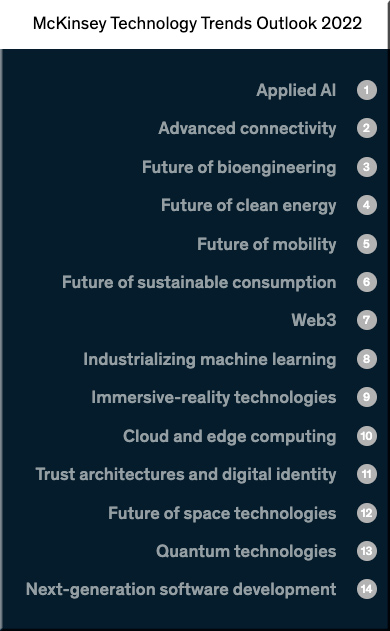
McKinsey Technology Trends Outlook 2022
Excerpt:
Which technology trends matter most for companies in 2022? New analysis by the McKinsey Technology Council highlights the development, possible uses, and industry effects of advanced technologies.
#ILTACON22 Day One Roundup: News from DISCO, Docket Alarm, LexFusion, Relativity and Reveal — from legaltechmonitor.com by Bob Ambrogi

Excerpt:
[8/22/22] kicks off the first full day of ILTACON22, the annual conference of the International Legal Technology Association. Already, the day has brought a slew of news announcements from legal technology companies.
Here is a roundup of news announced this morning.
2022 CHLOE 7 Report (Changing Landscape of Online Education) — from qualitymatters.org
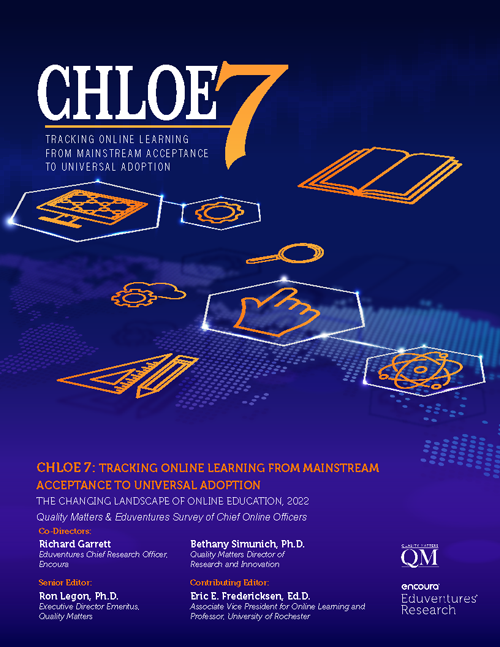
The seventh installment of the Changing Landscape of Online Education (CHLOE) report, produced by Quality MattersTM and Eduventures®, offers an overview of the current state of online learning in higher education as well as insights into its future development. The report was compiled by surveying chief online officers (COOs) at two- and four-year colleges and universities — the professionals best situated to assess the current state of this ever-developing field.
Also relevant/see:
Online Education Is Booming, but Colleges Risk Lapses in Quality, Report Says — from chronicle.com by Taylor Swaak
Excerpt:
A survey of more than 300 officials at American colleges shows many are planning for long-term growth in online education, but few are consistently evaluating the quality of their mushrooming course lists.
According to a newly released report on the survey’s findings — by the nonprofit group Quality Matters and Encoura’s Eduventures, a higher-education-market research firm — more than 90 percent of the “chief online officers” surveyed said they expect the typical traditional-age undergraduates on their campus would be taking courses in some kind of hybrid format by 2025. That’s a stark departure from just three years ago, before the pandemic, when 20 percent of such undergrads took hybrid courses.
Is Higher Ed Really Ready to Embrace Hybrid Learning? — from edsurge.com by Rebecca Koenig
New study shows colleges may need to hire more digital experts and better prepare students to learn online.
Excerpt:
The future of higher education will bring more hybrid learning models—but colleges may not yet have the staff and systems they need to scale up high-quality programs that blend in-person and online experiences.
So believe chief online officers at U.S. colleges, according to a new survey of more than 300 such leaders published today by Quality Matters and Encoura Eduventures Research. It’s the seventh edition of the Changing Landscape of Online Education (CHLOE) report.
How will the Metaverse Influence Business and Legal Processes? — from jdsupra.com
Excerpt:
While some will be hesitant to use the metaverse and adoption is difficult to predict, it is not going away and will undoubtedly affect internal processes, business dealings, case strategy, and more. Organizations should start thinking about the possibilities now to be better prepared for future challenges. Below are some predictions on how the metaverse will influence operations, strategy, and investments across different areas of the enterprise.
Lawyers & the Metaverse — from joetechnologist.com by Elizabeth Beattie and Joseph Raczynski
Excerpt:
In a new Q&A interview, Thomson Reuters’ technologist and futurist Joseph Raczynski offers his insight about the Metaverse and how it will impact the legal industry.
I have likely spoken to thousands of lawyers over the last several years. They are extraordinarily bright, but with one limiting factor — their dedication to their craft. This means that they do not have the time to lift their heads to see what is coming. All these emerging technologies will impact their practices in some way, as well as the business of law. At a minimum, lawyers need the opportunity to focus on the big four: AI, blockchain, workflow, and the grab bag of general emerging technology. There are a multitude of places to learn about these things, but I would include some of the classics such as Google Alerts, Twitter threads on these topics, and magazines like Wired, which should be a staple for everyone.
These legal issues should be on college business officers’ radars — from highereddive.com by Rick Seltzer
A panel at the National Association of College and University Business Officers’ annual meeting covered legal questions spanning many offices on campus.
Let’s not presume that virtual hearings are the best solution in family law — from canadianlawyermag.com by John Silvester
Excerpts:
Proponents argue that virtual hearings are less expensive for clients, leading to enhanced access to justice for those who cannot afford to pay for their lawyers to travel to a courthouse and then sit and wait for hearings to commence. Sounds reasonable, right?
Not so fast.
…
Virtual hearings are advantageous in some scenarios, but there are at least three reasons why moving to an almost entirely virtual legal world may prove problematic.
LawNext Podcast: CALI Executive Director John Mayer on Using Tech to Advance Legal Education and Access to Justice — from lawnext.com by Bob Ambrogi and John Mayer
Excerpt:
In this episode of LawNext, Mayer joins host Bob Ambrogi to discuss the history and mission of CALI and to share his thoughts on the use of technology to enhance legal education. They also talk about how and why A2J Author was developed and how it is used by courts and legal services organizations to help those who are without legal representation. Mayer also shares his thoughts on the future of innovation in law and on the future of CALI.
Louisiana Approves Virtual Custody Services and Proposes Virtual Currency Business Licensing Rules — from natlawreview.com by Moorari Shah and A.J. S. Dhaliwal
Excerpt:
Recently, the Louisiana lawmakers and regulators have taken steps to legalize operations in the state involving virtual currencies. On June 15, the Louisiana governor signed a bill that, effective August 1, 2022, will allow financial institutions and trust companies to provide virtual currency custody services to their customers as long as they satisfy certain requirements on risk-management and compliance. On June 20, the Louisiana Office of Financial Institutions (OFI) published proposed rules on licensing and regulation of virtual currency businesses in the state pursuant to the Louisiana Virtual Currency Business Act, which went into effect on August 1, 2020.
7 Amazing Ways Technology Is Changing Higher Education for the Better — from innotechtoday.com by Emily Newton
Excerpt:
As society has stepped decidedly into the digital age, there’s been a lot of debate about how technology is changing higher education. Some people believe there are benefits of technology in education, while others are concerned about tech’s impact on learning and motivation. Technology in higher education can be a major distraction or an incredibly helpful resource.
Technology is only as good or as bad as what you do with it. In education, AI, coding, and media creation are tools that teachers can use to motivate their students and help them grasp new ideas. Keeping pace with everyday tech is important for modern students. Here are seven amazing ways technology is changing higher education for the better.
Matthew Ball on the metaverse: We’ve never seen a shift this enormous — protocol.com by Janko Roettgers
The leading metaverse theorist shares his thoughts on the sudden rise of the concept, its utility for the enterprise and what we still get wrong about the metaverse.
Excerpts:
What are the biggest misconceptions about the metaverse?
First, the idea that the metaverse is immersive virtual reality, such as an Oculus or Meta Quest. That’s an access device. It would be akin to saying the mobile internet is a smartphone.
We should think of the metaverse as perhaps changing the devices we use, the experiences, business models, protocols and behaviors that we enjoy online. But we’ll keep using smartphones, keyboards. We don’t need to do all video conferences or all calls in 3D. It’s supplements and complements, doesn’t replace everything.
Also relevant/see:
A former Amazon exec thinks Disney will win the metaverse — from protocol.com by
Excerpt:
This month, Ball is publishing his book, “The Metaverse: And How It Will Revolutionize Everything.” The work explains in detail what the metaverse is all about and which shifts in tech, business and culture need to fall into place for it to come into existence.
How will the metaverse change Hollywood? In his book, Ball argues that people tend to underestimate the changes new technologies will have on media and entertainment.
Addendum on 7/24/22:
Neurodiversity, Inclusion And The Metaverse — from workdesign.com by Derek McCallum
Excerpt:
Innovation in virtual and augmented reality platforms and the vast opportunities connected to the metaverse are driving innovation in nearly every industry. In the workplace, future-focused companies are increasingly exploring ways to use this nascent technology to offer workers more choices and better support for neurodiverse employees.
It would be nearly impossible to list all the challenges and opportunities associated with this technology in a single article, so I’ll keep things focused on an area that is top-of-mind right now as many of us start to make our way back into the office—the workplace. The truth is, while we can use our expertise and experience to anticipate outcomes, no one truly knows what the metaverse will become and what the wide-ranging effects will be. At the moment, the possibilities are exciting and bring to mind more questions than answers. As a principal and hands-on designer in a large, diverse practice, my hope is that we will be able to collectively harness the inherent opportunities of the metaverse to support richer, more accessible human experiences across all aspects of the built environment, and that includes the workplace.
If I were you I’d be following what @LXStudio_Legal is up to. Knowing the smart folks involved, the initiatives to come are likely to be exciting and much needed for the legal ecosystem. #legaltech #business
— Colin S. Levy (@Clevy_Law) July 16, 2022
Also relevant/see:
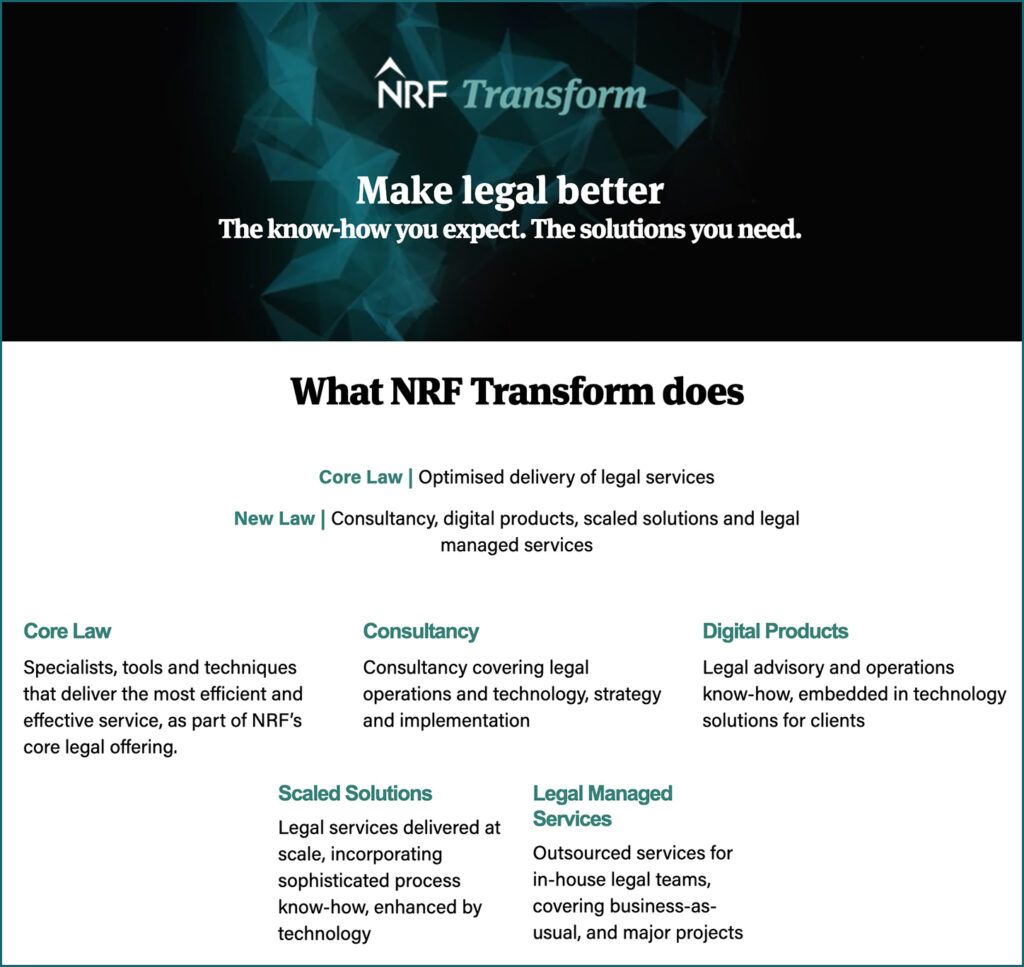
What is Norton Rose Fulbright’s LX Studio? — from artificiallawyer.com
Excerpts:
‘From tiny acorns, mighty oak trees grow’ so the saying goes, and it’s fair to say that US-based LX Studio, the new innovation project of global firm Norton Rose Fulbright (NRF), is very much still an acorn – but it has plenty of potential.
Artificial Lawyer spoke to Jeff Cody, Managing Partner for the US side of 3,700-lawyer NRF, which was formed by the merger of the UK’s Norton Rose and America’s Fulbright & Jaworski in 2013, to find out some more.
But, with a more optimistic outlook one might say that this is a beginning; and that although the US is home to many pioneering legal tech companies and ALSPs, the reality is that few law firms in the US have dedicated innovation groups which mirror the full range of what NRF has in the UK, for example.
Best Sites and Apps for Digital Storytelling — from techlearning.com by Diana Restifo
Digital storytelling can help boost communication and presentation skills
Excerpt:
…storytelling is a great way for kids to learn to love reading and writing. But almost any school subject can be considered through a dramatic frame, from history to geography to science. Even math can be taught through narrative (word problems, anyone?). Most importantly, storytelling gives kids the opportunity to be inventive with language, graphics, and design, and to share their creations with others.
The following sites and apps for storytelling range from basic to advanced. Many are designed for educators or include guides for use in education. And while most are paid products, the prices are generally reasonable and nearly every platform offers a free trial or free basic account.
6 best classroom noise meters for teachers — from educatorstechnology.com by Med Kharbach
Excerpt:
One of the effective ways to monitor and reduce noise levels in classrooms is by making noise visible. Enabling students to visualize their noise raises awareness to their sound levels and makes them noise conscious. There are several noise meter tools and apps to use in your classroom to bring down students noise and therefore help in creating optimal learning experiences. Below is a collection of some of the best noise meters for classroom use. They are simple, easy to use, and cost-effective.
Digital age classroom projects — from thetechedvocate.org by Matthew Lynch
Excerpt:
Classroom learning today has left the era of flipping through textbooks trying to be on the same page with the teacher, though not for every class lesson. Educators today are seizing the opportunities of digital devices and media to expand learning opportunities beyond pencil and paper homework. Also, assessment is not just a multiple-choice test.
Consider trying one of these projects:
The Education of Incarcerated Youth with Disabilities Ep.14 — from edcircuit.com
Excerpt:
The School Justice Project (SJP) champions an extremely vulnerable population: incarcerated youth with disabilities. The SJP’s mission is to ensure every learner, in or out of prison facilities, receives the education they were promised and deserve. Their current class action lawsuit against the DC prison system underscores the impact of their efforts. Featured guest, Claire Blumenson, pulls no punches as she forces us to look, and not to look away, in this pivotal moment.
We are educators, parents, siblings, and friends who aren’t satisfied with the quality of the content our students are exposed to. We know they deserve better, and are committed to bringing authentic, engaging, diverse and accessible content to all learners.
Business Leaders Say Computer Science Needs to Be A Core Subject — from edsurge.com by Daniel Mollenkamp
Excerpt:
[On July 12], a collection of more than 500 prominent business, education and nonprofit leaders called on states to update their K-12 curriculum to make computer science a core subject.
In a letter sent to governors from all fifty states, they write, “computer science provides an essential foundation—not only for careers in technology, but for every career in today’s world,” and call upon state leaders to update curriculum to ensure that all students have an opportunity to learn computer science in school.
What is Microsoft Sway and How Can it Be Used to Teach? Tips & Tricks — from techlearning.com by Luke Edwards
Microsoft Sway is a presentation tool that works really well for teaching
Excerpt:
Microsoft Sway is the company’s alternative to PowerPoint as a presentation tool that embraces collaborative working. As such, this is a powerful system for teachers and students to use in the classroom and beyond.
The idea behind Sway is to offer a super simple setup that allows anybody to create presentation slideshows. This makes it good for both younger students and teachers for in-class or online-based presenting.
For a somewhat related item, see:
Exploring some different instructional strategies and discovering how to incorporate them into the classroom process can rekindle a love affair with teaching. Finding the right instructional strategy to fit your classroom can make a world of difference to your students by allowing them to make meaningful connections with what they are learning. Take a look at a few different strategies, and see which one might suit your students this academic year.