But this fall, a few educators are quietly charting a different course they believe could change everything: At least two groups are pushing to create new AI chatbots that would offer teachers unlimited access to sometimes confusing and often paywalled peer-reviewed research on the topics that most bedevil them.
Their aspiration is to offer new tools that are more focused and helpful than wide-ranging ones like ChatGPT, which tends to stumble over research questions with competing findings. Like many juveniles faced with questions they can’t answer, it has a frustrating tendency to make things up.
Then, I turned Custom Instructions on and gave it the same starting prompt. Here are a few of the responses (emphases are mine):
“Purpose:What’s the primary goal of the course? Is it to augment your existing offerings at Every, serve as a standalone product, or something else?”
“Content Depth: Given your love for detailed, intellectual writing, how in-depth will you go on each topic?”
“Guest Contributions: Do you plan to involve guest experts, perhaps even some of your writing heroes or team members like Kate Lee and Evan Armstrong?”
“Time Investment: Given that you’re already grappling with being too opportunistic and dutiful, how will you allocate time for this without sidelining your creative work or burdening yourself?”
AI for comics— from aiandacademia.substack.com by Bryan Alexander Exploring an entertaining new Hugging Face application
As generative AI grows, more uses appear. Beyond text and images, other domains for creation pop up as companies, groups, and individuals try out new functions.
Today’s case in point is AI Comic Factory from Hugging Face.* This service will generate a couple of comic book pages based on your text input. It gives you choices of comic style and page layout as well.
Items from Tom Barrett’ Promptcraft: AI for a better learning ecosystem
How many languages do you speak? Thanks to AI, that number could be as many as seven. Los Angeles-based AI video platform HeyGen has launched a new tool that clones your voice from a video and translates what you’re saying into seven different languages. If that wasn’t enough, it also syncs your lips to your new voice so the final clip looks (and sounds) as realistic as possible.
Microsoft and Project Gutenberg have used AI technologies to create more than 5,000 free audiobooks with high-quality synthetic voices.
For the project, the researchers combined advances in machine learning, automatic text selection (which texts are read aloud, which are not), and natural-sounding speech synthesis systems.
One of the biggest challenges to navigate now is the fact that more digital tools will come with generative AI already embedded in them, says Annette Vee, director of composition and an associate professor at the University of Pittsburgh. “It’s everywhere in professional writing.”
“We need to be fundamentally rethinking ways we teach writing, so we are thinking about integrating tools mindfully,” says Vee, who helped develop a new resource, TextGenEd, that provides guidance in this area. “The real challenge is how do we teach courses that are preparing students and that are smart about generative AI? We have very few teachers currently equipped to do that work.”
“It’s best if there are real stakes attached to the work, for example, an authentic audience the student is writing to,” he writes. “A subject on which students have both sufficient interest and knowledge in order to feel as though they can write convincingly to this audience also matters a lot.”
Also relevant/see — via Robert Gibson on LinkedIn:
Learnt.ai — Built for Learning Specialists — from learnt.ai Harness the power of artificial intelligence to enhance your learning and development efforts with our easy-to-use platform – no technical expertise required!
Introducing Learnt.ai – a revolutionary collection of AI-powered content generation tools and AI chatbots that are specifically designed to support the common writing tasks of educationalists and learning and development professionals. Imagine being able to generate learning objectives on any topic of your choice, create engaging icebreakers and activities, write assessment questions with ease, and so much more.
Students are using artificial intelligence tools to assist them in their academic careers. Three students share their viewpoints on the tools they use and how using these tools helps them in their coursework and prepares them for the professional world.
Also relevant/see:
Why Professors Are Polarized on AI — from insidehighered.com by Susan D’Agostino Academics who perceive threats to education from AI band together as a survival mechanism. The resulting alliances echo divisions formed during online learning’s emergence.
Why do so many students have the impression that they should attend office hours only if they’ve got a question? Here’s my hunch: Well-meaning, supportive professors mention their office hours at various points throughout the course: If you have questions about fill-in-the-blank, come to my office hours. The professors mean, “I am here to help! Come talk to me.” Students hear: “If you have a question.”
It’s a frustrating misunderstanding, because it contributes to the big problem my article focuses on: Many students miss out on the support professors stand to provide.
… ‘Adjunct Faculty 101’
“Sessions offered this year included ‘An Orientation to the Canvas LMS,’ ‘The First Day of Class,’ ‘Creating Student-Centered Course Materials,’ ‘Classroom-Management Tips,’ ‘Academic-Integrity Tips and Processes,’ ‘An Introduction to Our Tutoring Services and Writing Center,’ ‘Writing Across the Disciplines With AI,’ and more.”
From DSC: I like the idea of using “office hours” for building relationships, helping students with their future career decisions, building broader understanding, ongoing mentoring, and for developing potential networking opportunities.
What does active learning require from students? There is no secret that PBL and all other active learning approaches are much more demanding from students compared to traditional methods, mainly in terms of skills and attitudes towards learning. Here are some of the aspects where students, especially when first faced to active learning, seem to struggle:
Formulating own learning goals and following through with independent study. While in traditional teaching the learning goals are given to students, in PBL (or at least in some of its purest variants), they need to come up with their own, for each problem they are solving. This requires understanding the problem well but also a certain frame of mind where one can assess what is necessary to solve it and make a plan of how to go about it (independently and as a group). All these seemingly easy steps are often new to students and something they intrinsically expect from us as educators.
From DSC: The above excerpt re: formulating one’s own learning goals reminded me of project management and learning how to be a project manager.
It reminded me of a project that I was assigned back at Kraft (actually Kraft General Foods at the time). It was an online-based directory of everyone in the company at the time. When it was given to me, several questions arose in my mind:
Where do I start?
How do I even organize this project?
What is the list of to-do’s?
Who will I need to work with?
Luckily I had a mentor/guide who helped me get going and an excellent contact with the vendor who educated me and helped me get the ball rolling.
I’ll end with another quote and a brief comment:
Not being afraid of mistakes and learning from them. The education system, at all stages, still penalises mistakes, often with long term consequences. So it’s no wonder students are afraid of making mistakes…
Habit #2: Engage students in a brain dump or two things as an entry ticket or exit ticket. Spend one minute or less having students write down everything (or just two things) they remember from class. The key: Don’t grade it! Keep retrieval practice no-stakes to emphasize it’s a learning strategy, not an assessment strategy.
Teaching from the heart in 13 steps — from timeshighereducation.com by Beiting He Engaging your students through empathy requires teachers to share their own stories and vulnerabilities and foster a safe space for learning. Here, Beiting He offers 13 ways to create a caring classroom
In summary, “I wish” is about proposing positive changes and improvements, while “I wonder” is about asking thoughtful questions to gain insight and foster meaningful conversations within the team.
What if you could have a conversation with your notes?That question has consumed a corner of the internet recently, as companies like Dropbox, Box, Notion, and others have built generative AI tools that let you interact with and create new things from the data you already have in their systems.
Google’s version of this is called NotebookLM. It’s an AI-powered research tool that is meant to help you organize and interact with your own notes.
That got me to thinking…
What if the presenter/teacher/professor/trainer/preacher provided a set of notes for the AI to compare to the readers’ notes?
That way, the AI could see the discrepancies between what the presenter wanted their audience to learn/hear and what was actually being learned/heard. In a sort of digital Socratic Method, the AI could then generate some leading questions to get the audience member to check their thinking/understanding of the topic.
The end result would be that the main points were properly communicated/learned/received.
From DSC: If we can’t get violence in schools under control (a very difficult task without trying to impact peoples’ hearts and minds), this trend could pick up steam big-time.
There are several elements to this challenge. The first is that many campuses depend largely, if not exclusively, on student course evaluations when it comes to measuring instructional quality. And often those evaluations are not particularly well designed or substantive.
…
But even when course evaluations are better designed, I’m not sure any teaching experts would argue that they should be the exclusive measure of whether a faculty member is an effective teacher. That brings us to the second element of the challenge: What else can a college do?
Several readers offered suggestions, such as to include classroom observations, peer evaluation, and teaching portfolios — in which, say, an instructor describes their teaching philosophy and classroom practices, along with evidence that they are working to strengthen their teaching.
Why Labor Shortages on Campus-Building Staffs Are Reaching ‘Crisis Situations’ — from an email newsletter from The Chronicle of Higher Education which eventually links to this article
Who will keep the buildings open? It’s no secret colleges have struggled to fill staff positions like administrative assistants, information-technology specialists, and admissions officers in today’s tight labor market. But many institutions are grasping for ways to fill key facilities positions that literally keep the doors open, such as custodians, electricians, carpenters, and maintenance workers, our Scott Carlson writes.
Staffing shortages strain the employees and contractors already on the payroll. Facilities-staff members are aging and often juggling project backlogs.
Remember: Building services were the third-most-difficult area to hire in, according to a Chronicle survey conducted earlier this year, behind information technology and dining services. Six in 10 respondents said hiring building-services staff was a serious or moderate problem.
Higher ed may be a victim of its own success. The country has emphasized college after high school over the last four decades, while trades have struggled to attract workers.
An eye-opening stat: Even with a recently renewed emphasis on the trades, the U.S. has only about 600,000 people in apprenticeships, far below the 17 million students enrolled in college.
Colleges and universities that specialize in health and technology proved to serve low-income students who end up with the highest starting salaries six years after they enrolled. For this earnings data, College Scorecard does not take into account whether students graduated or not.
Hover your cursor over each bar to read details about each institution.
Brave New Classrooms — from Dr. Philippa Hardman Why 2023-2024 will be remembered as the academic year that education embraced AI
After a rocky start, more and more evidence suggests that the academic year 2023-2024 will likely prove to be a defining year for higher education: the year higher education embraced AI.
Over the course of the next academic year, we will likely see three main changes in the world of education:
More education institutions will embrace AI & develop policies & guidance on its appropriate use at the institution, department & classroom level.
We will see a wave of assessment reform, with a new focus on the assessment of learners’ process and skills, including the effective use of AI.
To enable this chance, we will see a rapid increase in the provision of AI training for leaders, educators and administrators.
While risks and barriers to entry remain real, supported by well-rounded strategic frameworks, the education system has the potential to leverage AI reinvent itself and improve its ability to deliver on the promise to deliver real-world-relevant education.
VIEW CHILDREN AS ACTIVE LEADERS IN THEIR LEARNING I was co-teaching in an inclusive preschool classroom 20 years ago when I led my first professional development workshop (the project approach). The aim was to show teachers that children could co-construct their learning experiences when they were invited to do so. Two groundbreaking Reggio Emilia books came to mind—Shoe and Meter and Everything Has a Shadow Except Ants. These inspirational books were part of a series published in collaboration with the Italian Ministry of Education called “The Unheard Voice of Children.”
The series recognized children as active leaders of their learning and endeavored to document the process of learning through children’s learning experiences.
Let Kids Make Decisions — from edutopia.org by Sean Cassel An overreliance on rules can backfire. Instead, teachers can focus on providing students with choices and teaching good decision-making skills.
I’ve deeply thought about that last part over the course of my career: Let kids make decisions. Twenty years later, I am a high school administrator tasked with enforcing rules every day. Let me be clear: Schools need rules to function, but they don’t have to be the focus. My school focuses on allowing students to make choices: It is a centerpiece of how we operate. And although kids don’t always make the right choices, often enough they do. An overreliance on rules, in either a classroom or an entire school, can limit the ability of students to grow and develop their decision-making skills.
From DSC: Some nice ideas and tools listed here to start developing relationships even before the first day of school.
An Intentional Approach to Improving Your Teaching Practice — from edutopia.org by Marcus Luther By selecting one area for growth, collecting resources, and connecting with others, teachers can make meaningful improvements in the classroom.
Last summer, my focus was improving the level of inquiry in my classroom. I describe my process below, which transfers to any area or topic on which you might hope to focus your own professional learning.
Setting Up Libraries to Be the Best Space in School— from edutopia.org by Paige Tutt We took a peek inside school libraries across America to see how librarians are reframing the space to support students’ social, emotional, and creative growth—while still prioritizing excellent reads.
The recently renovated library—now known as the Learning Commons—is a bright, spacious multipurpose hub within the school. There are bistro tables where kids can work together; comfortable and flexible seating; a makerspace where students can explore activities like sewing and jewelry making; an audio recording and production studio; and a video production studio where kids can create TikToks or YouTube videos using their phones or school-issued laptops. It’s a far cry from the space it used to be—an attendance sheet from 2008 tracked just 21 students signing into the library one day.
The majority of survey participants report increased student demand for online and hybrid learning juxtaposed with decreased demand for face-to-face courses and programs. Most participants also say that their institutions are aligning or working to align their strategic priorities to meet this demand. Notable findings from the 50+-page report include:
Face-to-Face enrollment is stagnant or declining.
Online and hybrid enrollment is growing.
Institutions are quickly aligning their strategic priorities to meet online/hybrid student demand.
So, as educators, mentors, and guides to our future generations, we must ask ourselves three pivotal questions:
What value do we offer to our students?
What value will they need to offer to the world?
How are we preparing them to offer that value?
The answers to these questions are crucial, and they will redefine the trajectory of our education system.
We need to create an environment that encourages curiosity, embraces failure as a learning opportunity, and celebrates diversity. We need to teach our students how to learn, how to ask the right questions, and how to think for themselves.
Leveraging ChatGPT for learning is the most meaningful skill this year for lifelong learners. But it’s too hard to find resources to master it.
As a learning science nerd, I’ve explored hundreds of prompts over the past months. Most of the advice doesn’t go beyond text summaries and multiple-choice testing.
That’s why I’ve created this article — it merges learning science with prompt writing to help you learn anything faster.
Midjourney AI Art for Teachers (for any kind of teacher, not just Art Teachers) — from The AI Educator on YouTube by Dan Fitzpatrick
From DSC: This is a very nice, clearly illustrated, free video to get started with the Midjourney (text-to-image) app. Nice work Dan!
In the new-normal of generative AI, how does one articulate the value of academic integrity? This blog presents my current response in about 2,500 words; a complete answer could fill a sizable book.
Massive amounts of misinformation are disseminated about generative AI, so the first part of my discussion clarifies what large language models (Chat-GPT and its counterparts) can currently do and what they cannot accomplish at this point in time. The second part describes ways in which generative AI can be misused as a means of learning; unfortunately, many people are now advocating for these mistaken applications to education. The third part describes ways in which large language models (LLM), used well, may substantially improve learning and education. I close with a plea for a robust, informed public discussion about these topics and issues.
Many of the more than a dozen teachers TIME interviewed for this story argue that the way to get kids to care is to proactively use ChatGPT in the classroom.
…
Some of those creative ideas are already in effect at Peninsula High School in Gig Harbor, about an hour from Seattle. In Erin Rossing’s precalculus class, a student got ChatGPT to generate a rap about vectors and trigonometry in the style of Kanye West, while geometry students used the program to write mathematical proofs in the style of raps, which they performed in a classroom competition. In Kara Beloate’s English-Language Arts class, she allowed students reading Shakespeare’s Othello to use ChatGPT to translate lines into modern English to help them understand the text, so that they could spend class time discussing the plot and themes.
I found that other developed countries share concerns about students cheating but are moving quickly to use AI to personalize education, enhance language lessons and help teachers with mundane tasks, such as grading. Some of these countries are in the early stages of training teachers to use AI and developing curriculum standards for what students should know and be able to do with the technology.
Several countries began positioning themselves several years ago to invest in AI in education in order to compete in the fourth industrial revolution.
AI in Education— from educationnext.org by John Bailey The leap into a new era of machine intelligence carries risks and challenges, but also plenty of promise
In the realm of education, this technology will influence how students learn, how teachers work, and ultimately how we structure our education system. Some educators and leaders look forward to these changes with great enthusiasm. Sal Kahn, founder of Khan Academy, went so far as to say in a TED talk that AI has the potential to effect “probably the biggest positive transformation that education has ever seen.” But others warn that AI will enable the spread of misinformation, facilitate cheating in school and college, kill whatever vestiges of individual privacy remain, and cause massive job loss. The challenge is to harness the positive potential while avoiding or mitigating the harm.
Generative AI and education futures — from ucl.ac.uk Video highlights from Professor Mike Sharples’ keynote address at the 2023 UCL Education Conference, which explored opportunities to prosper with AI as a part of education.
Bringing AI Literacy to High Schools— from by Nikki Goth Itoi Stanford education researchers collaborated with teachers to develop classroom-ready AI resources for high school instructors across subject areas.
To address these two imperatives, all high schools need access to basic AI tools and training. Yet the reality is that many underserved schools in low-income areas lack the bandwidth, skills, and confidence to guide their students through an AI-powered world. And if the pattern continues, AI will only worsen existing inequities. With this concern top of mind plus initial funding from the McCoy Ethics Center, Lee began recruiting some graduate students and high school teachers to explore how to give more people equal footing in the AI space.
The company is increasingly emphasizing its portfolio of products built around the Canvas LMS, what they call the Instructure Unified Learning Platform. Perhaps the strongest change in message is the increased emphasis on the EdTech Collective, Instructure’s partner ecosystem. In fact, two of the three conference press releases were on the ecosystem – describing the 850 partners as “a larger partner community than any other LMS provider” and announcing a partnership with Khan Academy with its Khanmigo AI-based tutoring and teaching assistant tool (more on generative AI approach below).
The Anthology conference, held from July 17-19, marked the second gathering since Blackboard ceased operating as a standalone company and transformed into a brand for a product line.
What stood out was not just the number of added features but the extent to which these enhancements were driven by customer input. There has been a noticeable shift in how Anthology listens to clients, which had been a historical weakness for Blackboard. This positive change was emphasized not only by Anthology executives, but more importantly by customers themselves, even during unscripted side conversations.
D2L is a slow burn company, and in the past eight years in a good way. The company started working on its move to the cloud, tied to its user experience redesign as Brightspace, in 2014. Five years later, the company’s LMS was essentially all cloud (with one or two client exceptions). More importantly, D2L Brightspace in this time period became fully competitive with Instructure Canvas, winning head-to-head competitions not just due to specialized features but more broadly in terms of general system usability and intuitive design. That multi-year transformation is significant, particularly for a founder-led company.
If we want students to remember – to lock new information or ideas into long-term memory – getting meaningful repetitions still is key. And the science of learning still backs that up.
So … if we want students to get repetitions to make new learning permanent, how can they do it? Here are 10 ways to help students get repetitions for practice – and how classroom technology can help.
In this episode, I share ten engaging activities that combine education, technology, and plenty of fun to make the first week of class super memorable. From digital scavenger hunts to virtual field trips, hear about a few of my favorite ways to create an interactive start to your school year.
Tips for First Week of School Activity Ideas
Establish routines in a fun way.
Provide opportunities for collaboration.
Introduce tech tools that will be used all year.
From DSC: Dr. Burns has a great list of tools/tips/resources in this posting.
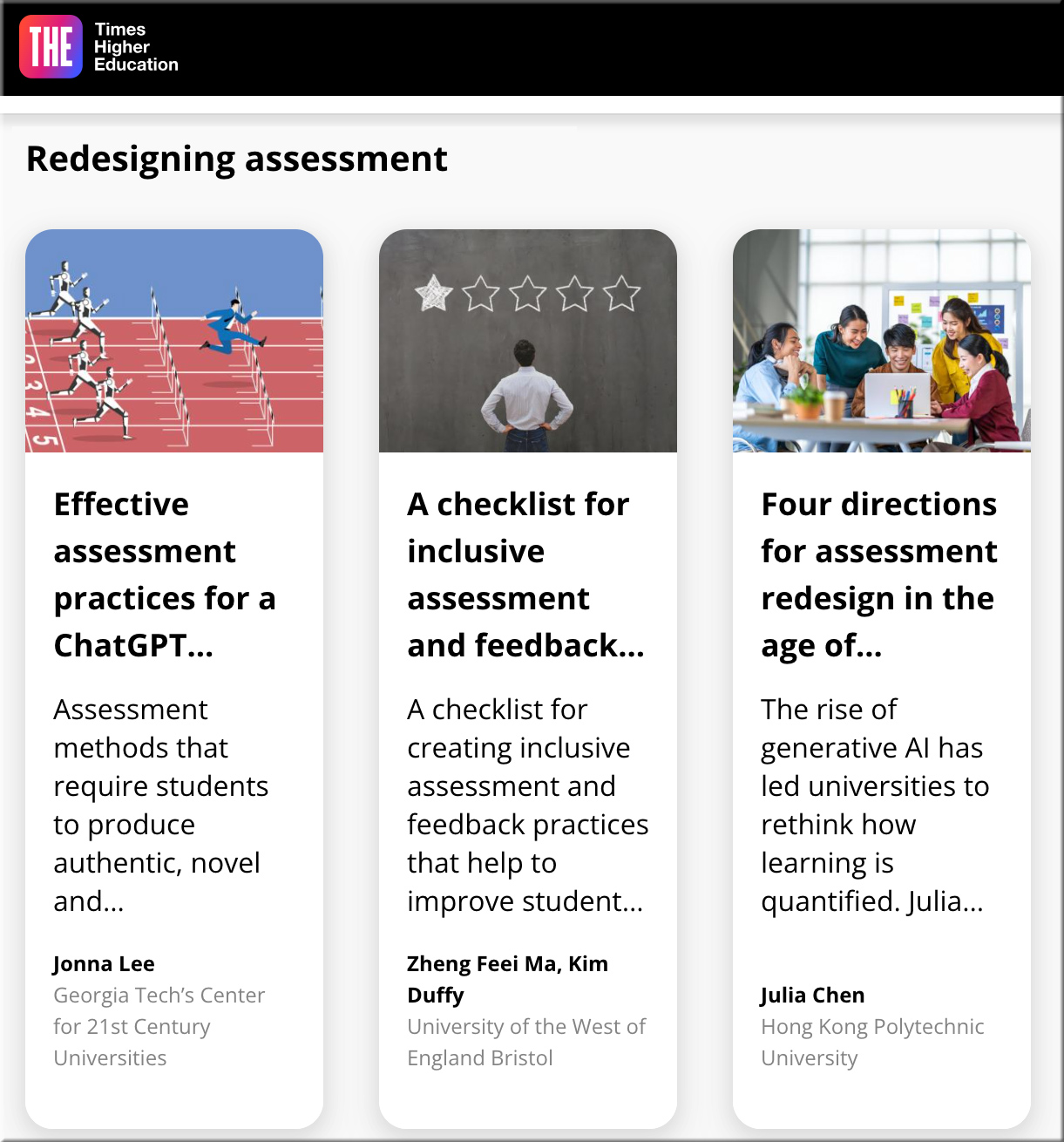
Four directions for assessment redesign in the age of generative AI— from timeshighereducation.com by Julia Chen The rise of generative AI has led universities to rethink how learning is quantified. Julia Chen offers four options for assessment redesign that can be applied across disciplines
Direction 1: From written description to multimodal explanation and application
Direction 2: From literature review alone to referencing lectures
Direction 3: From presentation of ideas to defence of views
Direction 4: From working alone to student-staff partnership
With the latest national test results showing a dispiriting lack of progress in catching students up academically in the wake of the pandemic, one potential explanation stands out: stubbornly high rates of student absenteeism. Vast numbers of students haven’t returned to class regularly since schools reopened.
Are we on the frontier of unveiling an unseen revolution in education? The hypothesis is that this quiet upheaval’s importance is far more significant than we imagine. As our world adjusts, restructures, and emerges from a year which launched an era of mass AI, so too does a new academic year dawn for many – with hope and enthusiasm about new roles, titles, or simply just a new mindset. Concealed from sight, however, I believe a significant transformative wave has started and will begin to reshape our education systems and push us into a new stage of innovative teaching practice whether we desire it or not. The risk and hope is that the quiet revolution remains outside the regulator’s and ministries’ purview, which could risk a dangerous fragmentation of education policy and practice, divorced from the actualities of the world ‘in and outside school’.
“This goal can be achieved through continued support for introducing more new areas of study, such as ‘foresight and futures’, in the high school classroom.”
Four directions for assessment redesign in the age of generative AI— from timeshighereducation.com by Julia Chen The rise of generative AI has led universities to rethink how learning is quantified. Julia Chen offers four options for assessment redesign that can be applied across disciplines
Direction 1: From written description to multimodal explanation and application
Direction 2: From literature review alone to referencing lectures
Direction 3: From presentation of ideas to defence of views
Direction 4: From working alone to student-staff partnership
If you are just back from vacation and still not quite sure what to do about AI, let me assure you that you are not the only one. My advice for you today is this: fill your LinkedIn-feed and/or inbox with ideas, inspirational writing and commentary on AI. This will get you up to speed quickly and is a great way to stay informed on the newest movements you need to be aware of.
My personal recommendation for you is to check out these bright people who are all very active on LinkedIn and/or have a newsletter worth paying attention to. I have kept the list fairly short – only 15 people – in order to make it as easy as possible for you to begin exploring.
Understanding the nature of generative AI is crucial for educators to navigate the evolving landscape of teaching and learning. In a new report from the Next Level Lab, Lydia Cao and Chris Dede reflect on the role of generative AI in learning and how this pushes us to reconceptualize our visions of effective education. Though there are concerns of plagiarism and replacement of human jobs, Cao and Dede argue that a more productive way forward is for educators to focus on demystifying AI, emphasizing the learning process over the final product, honoring learner agency, orchestrating multiple sources of motivation, cultivating skills that AI cannot easily replicate, and fostering intelligence augmentation (IA) through building human-AI partnerships.
Have you used chatbots to save time this school year? ChatGPT and generative artificial intelligence (AI) have changed the way I think about instructional planning. Today on the blog, I have a selection of ChatGPT prompts for ELA teachers.
You can use chatbots to tackle tedious tasks, gather ideas, and even support your work to meet the needs of every student. In my recent quick reference guide published by ISTE and ASCD, Using AI Chatbots to Enhance Planning and Instruction, I explore this topic. You can also find 50 more prompts for educators in this free ebook.
Professors Craft Courses on ChatGPT With ChatGPT — from insidehighered.com by Lauren Coffey While some institutions are banning the use of the new AI tool, others are leaning into its use and offering courses dedicated solely to navigating the new technology.
Maynard, along with Jules White at Vanderbilt University, are among a small number of professors launching courses focused solely on teaching students across disciplines to better navigate AI and ChatGPT.
The offerings go beyond institutions flexing their innovation skills—the faculty behind these courses view them as imperative to ensure students are prepared for ever-changing workforce needs.
That’s a solid report card for a freshman in college, a respectable 3.57 GPA. I recently finished my freshman year at Harvard, but those grades aren’t mine — they’re GPT-4’s.
…
Three weeks ago, I asked seven Harvard professors and teaching assistants to grade essays written by GPT-4 in response to a prompt assigned in their class. Most of these essays were major assignments which counted for about one-quarter to one-third of students’ grades in the class. (I’ve listed the professors or preceptors for all of these classes, but some of the essays were graded by TAs.)
Here are the prompts with links to the essays, the names of instructors, and the grades each essay received…
The impact that AI is having on liberal-arts homework is indicative of the AI threat to the career fields that liberal-arts majors tend to enter. So maybe what we should really be focused on isn’t, “How do we make liberal-arts homework better?” but rather, “What are jobs going to look like over the next 10–20 years, and how do we prepare students to succeed in that world?”
The great assessment rethink — from timeshighereducation.com by How to measure learning and protect academic integrity in the age of ChatGPT