Some announcements from NVIDIA today:


Nvidia unveils server CPU to challenge Intel and AMD in the data center — from protocol.com by Max A. Cherney
Nvidia’s CEO Jensen Huang announced the company’s next-generation GPU architecture and a new CPU Tuesday.

The new Grace processor is designed for AI, high-performance computing and hyperscale data center applications.

Nvidia launched a mapping product for the autonomous vehicle industry — from techcrunch.com by Rebecca Bellan

Nvidia has launched a new mapping platform that will provide the autonomous vehicle industry with ground truth mapping coverage of over 300,000 miles of roadway in North America, Europe and Asia by 2024, founder and CEO Jensen Huang said at the company’s GTC event on Tuesday.

NVIDIA Launches AI Computing Platform for Medical Devices — from hitconsultant.net by Jasmine Pennic

Nvidia Unveils AI Chips and Software, Plus Tools for Creating Virtual Worlds — by Eric Savitz and Conor Smith

Excerpt:

Nvidia is doubling down on artificial-intelligence  technology that CEO Jensen Huang predicts will revolutionize every industry.

In the keynote speech for the annual Nvidia GTC conference—the acronym once stood for GPU Technology Conference, a reference to the company’s roots in graphics processing chips—Huang focused specifically on expanding the company’s portfolio of AI-focused chips and software applications.

Nvidia CEO lays out plans after Arm deal fell through, reveals new Hopper GPU — from marketwatch.com by Jeremy C. Owens
Roadmap seems little changed after chip maker ditched $40 billion acquisition of designer Arm, with new GPUs and first server CPU still on track as EV makers sign on for autonomous-driving tech


Addendum 3/26/22:

Nvidia’s Clara Holoscan MGX means to bring high-powered AI to the doctor’s office — from techcrunch.com


Addendum 3/28/22:

Nvidia’s $1 trillion ambitions draw cheers as software becomes a bigger piece of the pie — from marketwatch.com
 

Reflections on “Do We Really Want Academic Permanent Records to Live Forever on Blockchain?” [Bohnke]

From DSC:
Christin Bohnke raises a great and timely question out at edsurge.com in her article entitled:
Do We Really Want Academic Permanent Records to Live Forever on Blockchain?

Christin does a wonderful job of addressing the possibilities — but also the challenges — of using blockchain for educational/learning-related applications. She makes a great point that the time to look at this carefully is now:

Yet as much as unchangeable education records offer new chances, they also create new challenges. Setting personal and academic information in stone may actually counter the mission of education to help people evolve over time. The time to assess the benefits and drawbacks of blockchain technology is right now, before adoption in schools and universities is widespread.

As Christin mentions, blockchain technology can be used to store more than formal certification data. It could also store such informal certification data such as “research experience, individual projects and skills, mentoring or online learning.”

The keeping of extensive records via blockchain certainly raises numerous questions. Below are a few that come to my mind:

  • Will this type of record-keeping help or hurt in terms of career development and moving to a different job?
  • Will — or should — CMS/LMS vendors enable this type of feature/service in their products?
  • Should credentials from the following sources be considered relevant?
    • Microlearning-based streams of content
    • Data from open courseware/courses
    • Learning that we do via our Personal Learning Networks (PLNs) and social networks
    • Learning that we get from alternatives such as bootcamps, coding schools, etc.
  • Will the keeping of records impact the enjoyment of learning — or vice versa? Or will it depend upon the person?
  • Will there be more choice, more control — or less so?
  • To what (granular) level of competency-based education should we go? Or from project-based learning?
  • Could instructional designers access learners’ profiles to provide more personalized learning experiences?
  • …and I’m certain there are more questions than these.

All that said…

To me, the answers to these questions — and likely other questions as well — lie in:

  1. Giving a person a chance to learn, practice, and then demonstrate the required skills (regardless of the data the potential employer has access to)
    .
  2. Giving each user the right to own their own data — and to release it as they see fit. Each person should have the capability of managing their own information/data without having to have the skills of a software engineer or a database administrator. When something is written to a blockchain, there would be a field for who owns — and can administer — the data.

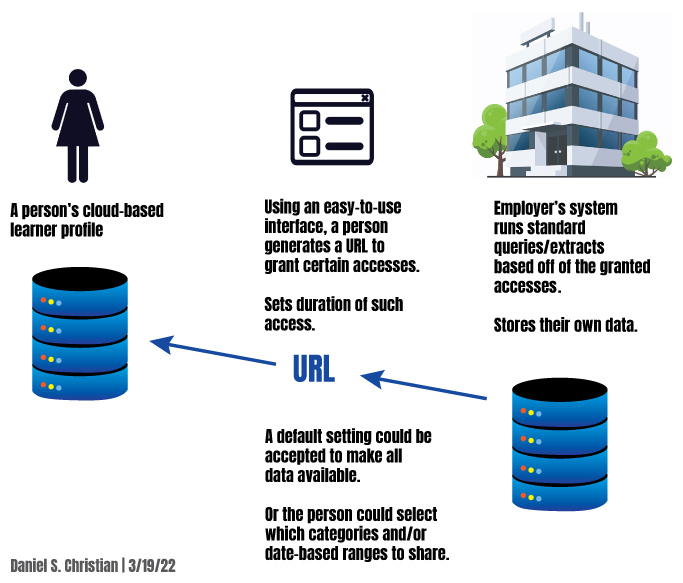
In the case of finding a good fit/job, a person could use a standardized interface to generate a URL that is sent out to a potential employer. That URL would be good for X days. The URL gives the potential employer the right to access whatever data has been made available to them. It could be full access, in which case the employer is able to run their own queries/searches on the data. Or the learner could restrict the potential employer’s reach to a more limited subset of data.

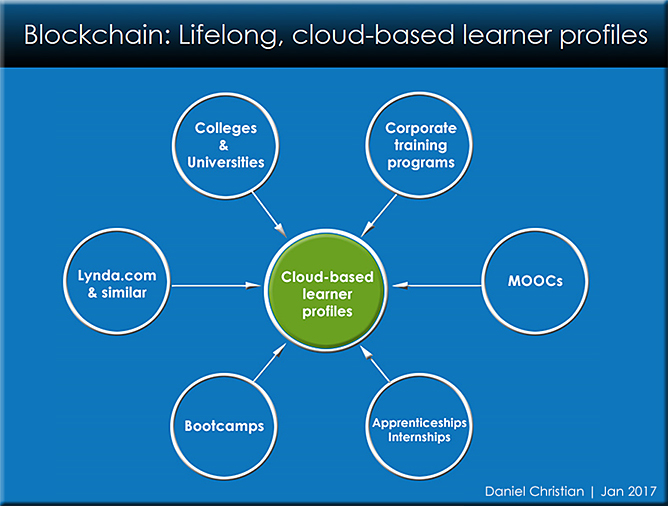
Visually, speaking:


Each learner can say who can access what data from their learner's profile


I still have a lot more thinking to do about this, but that’s where I’m at as of today. Have a good one all!


The Metaverse Will Radically Change Content Creation Forever — from forbes.com by Falon Fatemi

Excerpt:

Although the metaverse promises to touch nearly every person in our society, there’s one demographic that will almost certainly see disproportionately strong disruption: creators. The metaverse has the potential to fundamentally disrupt the content creation process.

The metaverse is slated to help creators make more interactive and immersive content, thanks in large part to advances in VR and AR. The stakes will be raised as creators will be expected to build more immersive and interactive content than ever before.

Also related/see:

The Amazing Possibilities Of Healthcare In The Metaverse — from forbes.com by Bernard Marr

Excerpts:

What’s generally agreed on, however, is that it’s effectively the next version of the internet – one that will take advantage of artificial intelligence (AI), augmented reality (AR), virtual reality (VR), and ever-increasing connectivity (for example, 5G networks) to create online environments that are more immersive, experiential and interactive than what we have today.

Metaverse involves the convergence of three major technological trends, which all have the potential to impact healthcare individually. Together, though, they could create entirely new channels for delivering care that have the potential to lower costs and vastly improve patient outcomes. These are telepresence (allowing people to be together virtually, even while we’re apart physically), digital twinning, and blockchain (and its ability to let us create a distributed internet).

From DSC:
That last paragraph could likely apply to our future learning ecosystems as well. Lower costs. A greater sense of presence. Getting paid for one’s teaching…then going to learn something new and paying someone else for that new training/education.


MUHC uses artificial intelligence to train neurosurgery students — from montreal.ctvnews.ca by Rob Lurie

Excerpt:

“I think above all it just provides an opportunity for junior learners to get some hands-on exposure,” said medical student Ali Fazlollahi.
…
“Basically, it was inspired by the idea of how do we prevent error in the operating room,” said Neurosurgeon Dr. Rolando De Maestro. Maestro says virtual reality has been a game-changer when it comes to teaching.


From DSC:
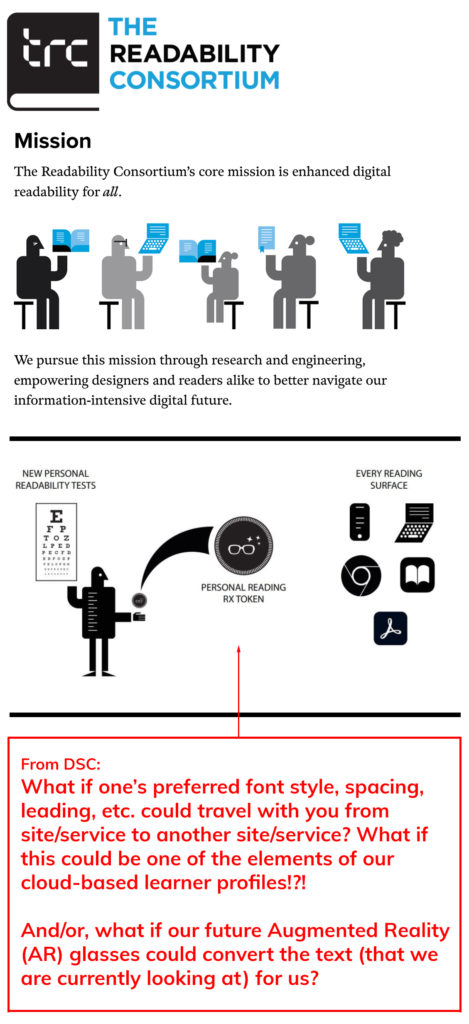
After checking out the following two links, I created the graphic below:

  1. Readability initiative > Better reading for all. — from Adobe.com
    We’re working with educators, nonprofits, and technologists to help people of all ages and abilities read better by personalizing the reading experience on digital devices.
  2. The Readability Consortium > About page


What if one's preferred font style, spacing, leading, etc. could travel with you from site to site? Or perhaps future AR glasses will be able to convert the text that we are looking at for us


Also related/see:


A whole new world: Education meets the metaverse — from brookings.edu by Kathy Hirsh-Pasek, Jennifer M. Zosh, Helen Shwe Hadani, Roberta Michnick Golinkoff, Kevin Clark, Chip Donohue, and Ellen Wartella

Excerpt:

The metaverse is upon us. Soon it will be as omnipresent as TikTok, Instagram, and Facebook (now Meta). As technology advances to bring us new immersive and imaginary worlds, how we educate children and prepare teachers must also advance to meet these new opportunities. When education lags the digital leaps, the technology rather than educators defines what counts as educational opportunity. This is largely what happened with the introduction of “educational” apps designed to be used on smartphones and tablets meant for adults. Today, as the metaverse infrastructure is still under construction, researchers, educators, policymakers, and digital designers have a chance to lead the way rather than get caught in the undertow. To leverage the potential of the metaverse as a 3D, global, interconnected, immersive, and real-time online space, we need new ways to connect the physical world with augmented and virtual reality (VR) experiences.

In the end, we challenge those creating educational products for the metaverse to partner with educators and scientists to ensure that children experience real human social interaction as they navigate virtual spaces, children’s agency is supported as they explore these spaces, and there is a real eye to diversity in the representation and access to what is created.  

Also relevant/see:

The metaverse can provide a whole new opportunity for education. Here’s what to consider — from fastcompany.com by Stephen Fromkin
The cofounder of Talespin looks at an existing immersive learning program that delivers results and says our next priority should be getting it into the hands of as many learners as possible through the metaverse.


Holograms? Check! Now what? — from blog.webex.com by Elizabeth Bieniek

Excerpt (emphasis DSC):

Two years ago, I wrote about the Future of Meetings in 2030 and hinted at an effort my team was building to make this a reality. Now, we have publicly unveiled Webex Hologram and brought the reality of a real-time, end-to-end holographic meeting solution to life.

With Webex Hologram, you can feel co-located with a colleague who is thousands of miles away. You can share real objects in incredible multi-dimensional detail and collaborate on 3D content to show perspective, share, and approve design changes in real-time, all from the comfort of your home workspace.

As the hype dies down, the focus on entirely virtual experiences in fanciful environments will abate and a resurgence in focus on augmented experiences—interjecting virtual content into the physical world around you for an enhanced experience that blends the best of physical and virtual—will emerge.

The ability to have curated information at one’s fingertips, still holds an incredible value prop that has yet to be realized. Applying AI to predict, find, and present this type of augmented information in both 2D and 3D formats will become incredibly useful. 

From DSC:
As I think of some of the categories that this posting about establishing a new kind of co-presence relates to, there are many relevant ones:

  • 21st century
  • 24x7x365
  • 3D
  • Audio/Visual (A/V)
  • Artificial Intelligence (AI)
  • Cloud-based
  • Collaboration/web-based collaboration
  • Intelligent tutoring
  • Law schools, legal, government
  • Learning, learning agents, learning ecosystems, Learning from the Living [Class] Room, learning spaces/hubs/pods
  • Libraries/librarians
  • K-12, higher education, corporate training
  • Metaverse
  • Online learning
  • Telelegal, telemedicine
  • Videoconferencing
  • Virtual courts, virtual tutoring, virtual field trips
  • Web3
 

Exploring Virtual Reality [VR] learning experiences in the classroom — from blog.neolms.com by Rachelle Dene Poth

Excerpt:

With the start of a new year, it is always a great time to explore new ideas or try some new methods that may be a bit different from what we have traditionally done. I always think it is a great opportunity to stretch ourselves professionally, especially after a break or during the spring months.

Finding ways to boost student engagement is important, and what I have found is that by using tools like Augmented Reality (AR) and Virtual Reality (VR), we can immerse students in unique and personalized learning experiences. The use of augmented and virtual reality has increased in K-12 and Higher Ed, especially during the past two years, as educators have sought new ways to facilitate learning and give students the chance to connect more with the content. The use of these technologies is increasing in the workplace, as well.

With all of these technologies, we now have endless opportunities to take learning beyond what has been a confined classroom “space” and access the entire world with the right devices.


From DSC:
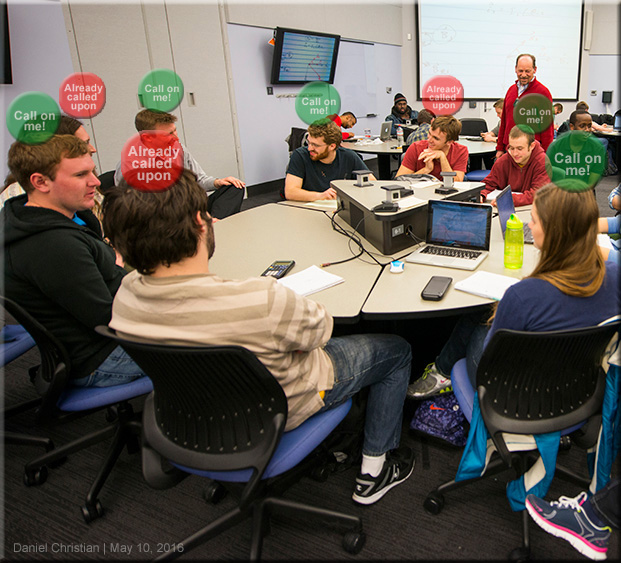
Here’s a brief example of what teaching & learning could like in the metaverse. I realize this is just one example, and there will likely be a variety of options and formats…but it’s an interesting thought experiment.


Resource via @ernperez
at this article/page.

From DSC:

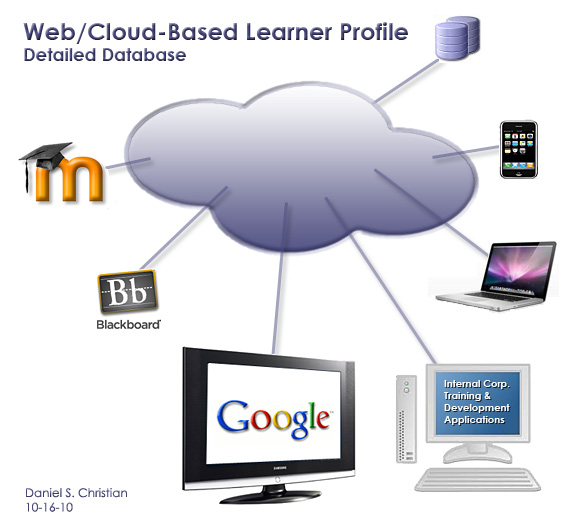
Cloud-based learner profiles are a likely element of our future learning ecosystems


Also see:

 
© 2025 | Daniel Christian