It’s an era many instructors would like to put behind them: black boxes on Zoom screens, muffled discussions behind masks, students struggling to stay engaged. But how much more challenging would teaching during the pandemic have been if colleges did not have experts on staff to help with the transition? On many campuses, teaching-center directors, instructional designers, educational technologists, and others worked alongside professors to explore learning-management systems, master video technology, and rethink what and how they teach.
A new book out this month, Higher Education Beyond Covid: New Teaching Paradigms and Promise, explores this period through the stories of campus teaching and learning centers. Their experiences reflect successes and failures, and what higher education could learn as it plans for the future.
As usual, our readers were full of suggestions. Kathryn Schild, the lead instructional designer in faculty development and instructional support at the University of Alaska at Anchorage, shared a guide she’s compiled on holding asynchronous discussions, which includes a section on difficult topics.
In an email, Schild also pulled out a few ideas she thought were particularly relevant to Le’s question, including:
Set the ground rules as a class. One way to do this is to share your draft rules in a collaborative document and ask students to annotate it and add suggestions.
Plan to hold fewer difficult discussions than in a face-to-face class, and work on quality over quantity. This could include multiweek discussions, where you spiral through the same issue with fresh perspectives as the class learns new approaches.
Start with relationship-building interactions in the first few weeks, such as introductions, low-stakes group assignments, or peer feedback, etc.
Artificial intelligence is disrupting higher education — from itweb.co.za by Rennie Naidoo; via GSV Traditional contact universities need to adapt faster and find creative ways of exploring and exploiting AI, or lose their dominant position.
Higher education professionals have a responsibility to shape AI as a force for good.
Introducing Canva’s biggest education launch — from canva.com We’re thrilled to unveil our biggest education product launch ever. Today, we’re introducing a whole new suite of products that turn Canva into the all-in-one classroom tool educators have been waiting for.
Also seeCanva for Education. Create and personalize lesson plans, infographics,
posters, video, and more. 100% free for
teachers and students at eligible schools.
ChatGPT and generative AI: 25 applications to support student engagement — from timeshighereducation.com by Seb Dianati and Suman Laudari In the fourth part of their series looking at 100 ways to use ChatGPT in higher education, Seb Dianati and Suman Laudari share 25 prompts for the AI tool to boost student engagement
There are two ways to use ChatGPT — from theneurondaily.com
Type to it.
Talk to it (new).
… Since then, we’ve looked to it for a variety of real-world business advice. For example, Prof Ethan Mollick posted a great guide using ChatGPT-4 with voice as a negotiation instructor.
In a similar fashion, you can consult ChatGPT with voice for feedback on:
Job interviews.
Team meetings.
Business presentations.
With a prompt, GPT-4 with voice does a pretty good job of acting as a negotiation simulator/instructor. It is not all the way there, but as someone who builds educational simulations, I can tell you this is already impressively far along towards an effective teaching tool.… pic.twitter.com/IphPHF95cL
Via The Rundown:Google is using AI to analyze the company’s Maps data and suggest adjustments to traffic light timing — aiming to cut driver waits, stops, and emissions.
The camera never lies. Except, of course, it does – and seemingly more often with each passing day.
In the age of the smartphone, digital edits on the fly to improve photos have become commonplace, from boosting colours to tweaking light levels.
Now, a new breed of smartphone tools powered by artificial intelligence (AI) are adding to the debate about what it means to photograph reality.
Google’s latest smartphones released last week, the Pixel 8 and Pixel 8 Pro, go a step further than devices from other companies. They are using AI to help alter people’s expressions in photographs.
Still using AI to help you mark a student’s work?
Mark a full class’s worth with one prompt.
Here’s the Whole Class Feedback Giant Prompt.
Comment & retweet & I’ll DM it to you.
Discover why thousands of teachers subscribe to the Sunday AI Educator ?https://t.co/ivpXYyWNzN
— Dan Fitzpatrick – The AI Educator (@theaieducatorX) October 22, 2023
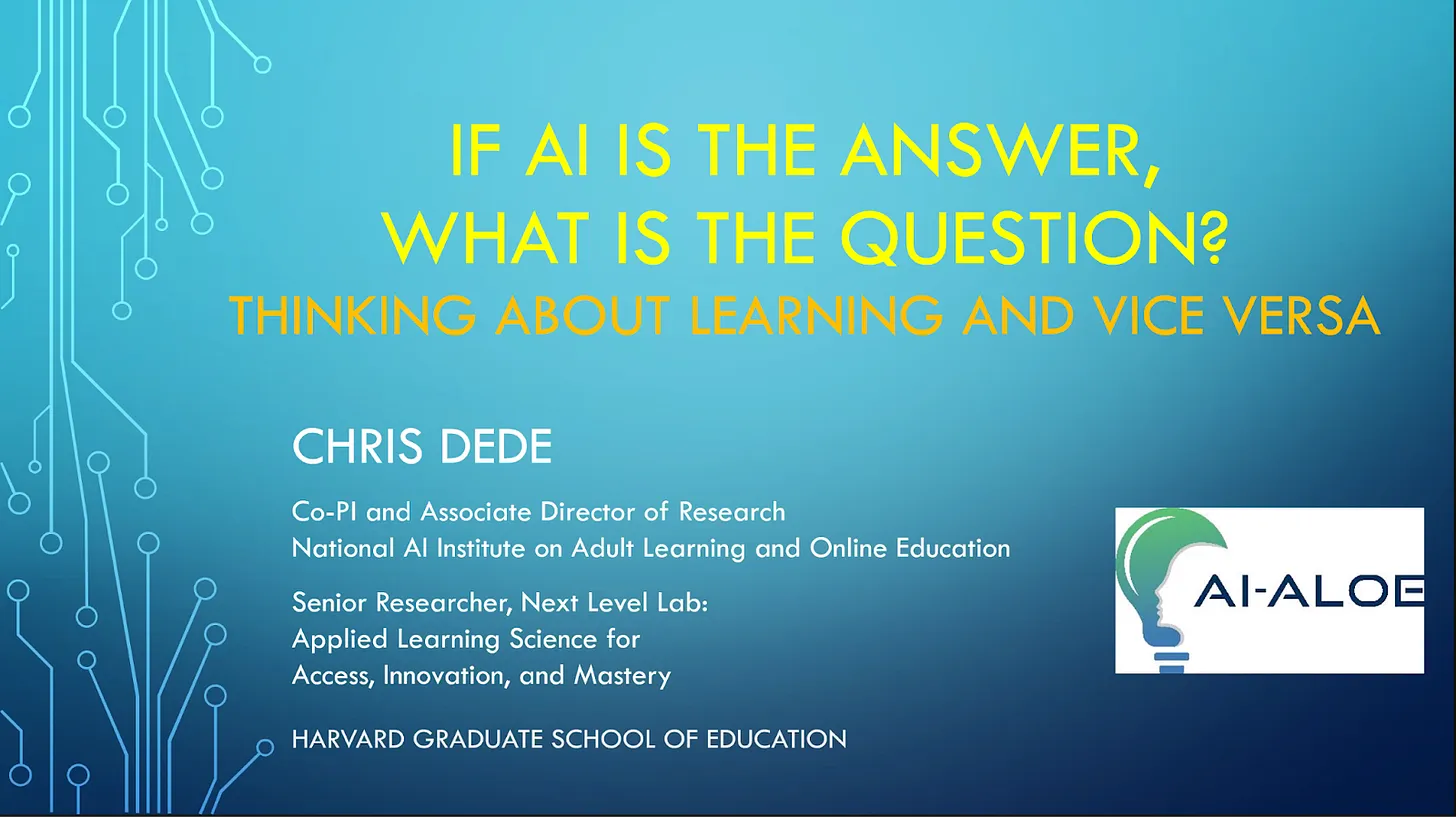
Dr. Chris Dede, of Harvard University and Co-PI of the National AI Institute for Adult Learning and Online Education, spoke about the differences between knowledge and wisdom in AI-human interactions in a keynote address at the 2022 Empowering Learners for the Age of AI conference. He drew a parallel between Star Trek: The Next Generation characters Data and Picard during complex problem-solving: While Data offers the knowledge and information, Captain Picard offers the wisdom and context from on a leadership mantle, and determines its relevance, timing, and application.
This “decreasing obstacles” framing turned out to be helpful in thinking about generative AI. When the time came, my answer to the panel question, “how would you summarize the impact generative AI is going to have on education?” was this:
“Generative AI greatly reduces the degree to which access to expertise is an obstacle to education.”
We haven’t even started to unpack the implications of this notion yet, but hopefully just naming it will give the conversation focus, give people something to disagree with, and help the conversation progress more quickly.
How to Make an AI-Generated Film — from heatherbcooper.substack.com by Heather Cooper Plus, Midjourney finally has a new upscale tool!
From DSC: I’m not excited about this, as I can’t help but wonder…how long before the militaries of the world introduce this into their warfare schemes and strategies?
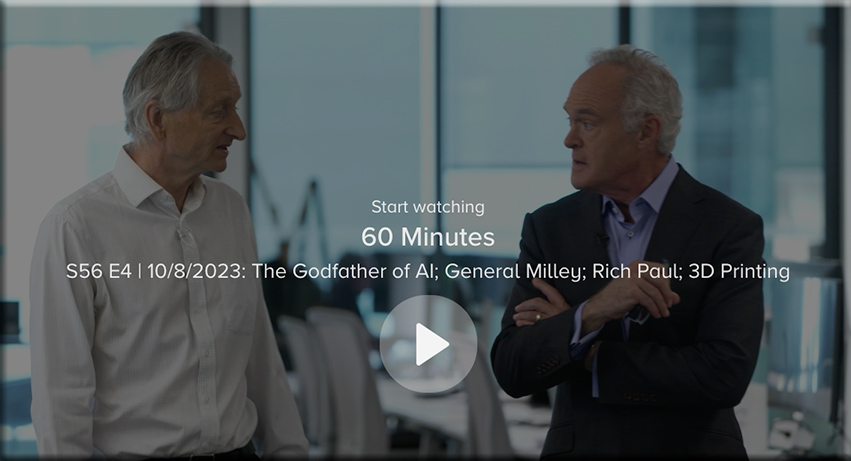
Background (emphasis DSC):60 Minutesdid an interviewwith ‘the Godfather of AI’, Geoffrey Hinton. In response, Gary Marcus wrote a columnin which he inserted his own set of responses into the transcript,as though he were a panel participant. Neat idea. So, of course, I’m stealing it, and in what follows, I insert my own comments as I join the 60 Minutes panel with Geoffrey Hinton and Gary Marcus.
Usually I put everyone else’s text in italics, but for this post I’ll put it all in normal font, to keep the format consistent.
OpenAI, the company behind the viral conversational AI ChatGPT, is experiencing explosive revenue growth. The Information reports that CEO Sam Altman told the staff this week that OpenAI’s revenue is now crossing $1.3 billion on an annualized basis. This means the company is generating over $100 million per month—a 30% increase from just this past summer.
Since the launch of a paid version of ChatGPT in February, OpenAI’s financial growth has been nothing short of meteoric. Additionally, in August, the company announced the launch of ChatGPT Enterprise, a commercial version of its popular conversational AI chatbot aimed at business users.
For comparison, OpenAI’s total revenue for all of 2022 was just $28 million. The launch of ChatGPT has turbocharged OpenAI’s business, positioning it as a bellwether for demand for generative AI.
The State of AI Report 2023 is live!
Check it out here to learn about key AI developments in research, industry, politics, safety, and predictions for what’s next.
New ways to get inspired with generative AI in Search — from blog.google We’re testing new ways to get more done right from Search, like the ability to generate imagery with AI or creating the first draft of something you need to write.
Wagner herself recently relied on the power of collegial conversations to probe the question: What’s on the minds of educators as they make ready for the growing influence of AI in higher education? CT asked her for some takeaways from the process.
We are in the very early days of seeing how AI is going to affect education. Some of us are going to need to stay focused on the basic research to test hypotheses. Others are going to dive into laboratory “sandboxes” to see if we can build some new applications and tools for ourselves. Still others will continue to scan newsletters like ProductHunt every day to see what kinds of things people are working on. It’s going to be hard to keep up, to filter out the noise on our own. That’s one reason why thinking with colleagues is so very important.
We are interested how K-12 education will change in terms of foundational learning. With in-class, active learning designs, will younger students do a lot more intensive building of foundational writing and critical thinking skills before they get to college?
The Human in the Loop: AI is built using math: think of applied statistics on steroids. Humans will be needed more than ever to manage, review and evaluate the validity and reliability of results. Curation will be essential.
We will need to generate ideas about how to address AI factors such as privacy, equity, bias, copyright, intellectual property, accessibility, and scalability.
Have other institutions experimented with AI detection and/or have held off on emerging tools related to this? We have just recently adjusted guidance and paused some tools related to this given the massive inaccuracies in detection (and related downstream issues in faculty-elevated conduct cases)
Even though we learn repeatedly that innovation has a lot to do with effective project management and a solid message that helps people understand what they can do to implement change, people really need innovation to be more exciting and visionary than that. This is the place where we all need to help each other stay the course of change.
I have been talking to a lot of people about Generative AI, from teachers to business executives to artists to people actually building LLMs. In these conversations, a few key questions and themes keep coming up over and over again. Many of those questions are more informed by viral news articles about AI than about the real thing, so I thought I would try to answer a few of the most common, to the best of my ability.
I can’t blame people for asking because, for whatever reason, the companies actually building and releasing Large Language Models often seem allergic to providing any sort of documentation or tutorial besides technical notes. I was given much better documentation for the generic garden hose I bought on Amazon than for the immensely powerful AI tools being released by the world’s largest companies. So, it is no surprise that rumor has been the way that people learn about AI capabilities.
Currently, there are only really three AIs to consider: (1) OpenAI’s GPT-4 (which you can get access to with a Plus subscription or via Microsoft Bing in creative mode, for free), (2) Google’s Bard (free), or (3) Anthropic’s Claude 2 (free, but paid mode gets you faster access). As of today, GPT-4 is the clear leader, Claude 2 is second best (but can handle longer documents), and Google trails, but that will likely change very soon when Google updates its model, which is rumored to be happening in the near future.
Next month Microsoft Corp. will start making its artificial intelligence features for Office widely available to corporate customers. Soon after, that will include the ability for it to read your emails, learn your writing style and compose messages on your behalf.
From DSC: As readers of this blog know, I’m generally pro-technology. I see most technologies as tools — which can be used for good or for ill. So I will post items both pro and con concerning AI.
But outsourcing email communications to AI isn’t on my wish list or to-do list.
In this second edition, award-winning educator Sue Ellen Christian offers students an accessible and informed guide to how they can consume and create media intentionally and critically.
The textbook applies media literacy principles and critical thinking to the key issues facing young adults today, from analyzing and creating media messages to verifying information and understanding online privacy. Through discussion prompts, writing exercises, key terms, and links, readers are provided with a framework from which to critically consume and create media in their everyday lives. This new edition includes updates covering privacy aspects of AI, VR and the metaverse, and a new chapter on digital audiences, gaming, and the creative and often unpaid labor of social media and influencers. Chapters examine news literacy, online activism, digital inequality, social media and identity, and global media corporations, giving readers a nuanced understanding of the key concepts at the core of media literacy. Concise, creative, and curated, this book highlights the cultural, political, and economic dynamics of media in contemporary society, and how consumers can mindfully navigate their daily media use.
This textbook is perfect for students and educators of media literacy, journalism, and education looking to build their understanding in an engaging way.
Canva’s new AI tools automate boring, labor-intensive design tasks — from theverge.com by Jess Weatherbed Magic Studio features like Magic Switch automatically convert your designs into blogs, social media posts, emails, and more to save time on manually editing documents.
But this fall, a few educators are quietly charting a different course they believe could change everything: At least two groups are pushing to create new AI chatbots that would offer teachers unlimited access to sometimes confusing and often paywalled peer-reviewed research on the topics that most bedevil them.
Their aspiration is to offer new tools that are more focused and helpful than wide-ranging ones like ChatGPT, which tends to stumble over research questions with competing findings. Like many juveniles faced with questions they can’t answer, it has a frustrating tendency to make things up.
Then, I turned Custom Instructions on and gave it the same starting prompt. Here are a few of the responses (emphases are mine):
“Purpose:What’s the primary goal of the course? Is it to augment your existing offerings at Every, serve as a standalone product, or something else?”
“Content Depth: Given your love for detailed, intellectual writing, how in-depth will you go on each topic?”
“Guest Contributions: Do you plan to involve guest experts, perhaps even some of your writing heroes or team members like Kate Lee and Evan Armstrong?”
“Time Investment: Given that you’re already grappling with being too opportunistic and dutiful, how will you allocate time for this without sidelining your creative work or burdening yourself?”
AI for comics— from aiandacademia.substack.com by Bryan Alexander Exploring an entertaining new Hugging Face application
As generative AI grows, more uses appear. Beyond text and images, other domains for creation pop up as companies, groups, and individuals try out new functions.
Today’s case in point is AI Comic Factory from Hugging Face.* This service will generate a couple of comic book pages based on your text input. It gives you choices of comic style and page layout as well.
Items from Tom Barrett’ Promptcraft: AI for a better learning ecosystem
How many languages do you speak? Thanks to AI, that number could be as many as seven. Los Angeles-based AI video platform HeyGen has launched a new tool that clones your voice from a video and translates what you’re saying into seven different languages. If that wasn’t enough, it also syncs your lips to your new voice so the final clip looks (and sounds) as realistic as possible.
Microsoft and Project Gutenberg have used AI technologies to create more than 5,000 free audiobooks with high-quality synthetic voices.
For the project, the researchers combined advances in machine learning, automatic text selection (which texts are read aloud, which are not), and natural-sounding speech synthesis systems.
What if you could have a conversation with your notes?That question has consumed a corner of the internet recently, as companies like Dropbox, Box, Notion, and others have built generative AI tools that let you interact with and create new things from the data you already have in their systems.
Google’s version of this is called NotebookLM. It’s an AI-powered research tool that is meant to help you organize and interact with your own notes.
That got me to thinking…
What if the presenter/teacher/professor/trainer/preacher provided a set of notes for the AI to compare to the readers’ notes?
That way, the AI could see the discrepancies between what the presenter wanted their audience to learn/hear and what was actually being learned/heard. In a sort of digital Socratic Method, the AI could then generate some leading questions to get the audience member to check their thinking/understanding of the topic.
The end result would be that the main points were properly communicated/learned/received.
What if you could have a conversation with your notes?That question has consumed a corner of the internet recently, as companies like Dropbox, Box, Notion, and others have built generative AI tools that let you interact with and create new things from the data you already have in their systems.
Google’s version of this is called NotebookLM. It’s an AI-powered research tool that is meant to help you organize and interact with your own notes.
… Right now, it’s really just a prototype, but a small team inside the company has been trying to figure out what an AI notebook might look like.
The single narrative education system is no longer working.
Its main limitation is its inability to honor young people as the dynamic individuals that they are.
New models of teaching and learning need to be designed to center on the student, not the teacher.
When the opportunity arises to implement learning that uses immersive technology ask yourself if the learning you are designing passes the Ready Player One Test:
Does it allow learners to immerse themselves in environments that would be too expensive or dangerous to experience otherwise?
Can the learning be personalized by the student?
Is it regenerative?
Does it allow for learning to happen non-linearly, at any time and place?
10 Ways Artificial Intelligence Is Transforming Instructional Design — from er.educause.edu by Robert Gibson Artificial intelligence (AI) is providing instructors and course designers with an incredible array of new tools and techniques to improve the course design and development process. However, the intersection of AI and content creation is not new.
What does this mean for the field of instructional and course design? I have been telling my graduate instructional design students that AI technology is not likely to replace them any time soon because learning and instruction are still highly personalized and humanistic experiences. However, as these students embark on their careers, they will need to understand how to appropriately identify, select, and utilize AI when developing course content.
Here are a few interesting examples of how AI is shaping and influencing instructional design. Some of the tools and resources can be used to satisfy a variety of course design activities, while others are very specific.
GenAI Chatbot Prompt Library for Educators — from aiforeducation.io We have a variety of prompts to help you lesson plan and do adminstrative tasks with GenAI chatbots like ChatGPT, Claude, Bard, and Perplexity.
Also relevant/see:
AI for Education — from linkedin.com Helping teachers and schools unlock their full potential through AI
Check out https://t.co/sfWeOiOzP5, “Helping teachers bring AI to the classroom critically, ethically, & responsibly.”
You can submit assignments to their curated collection. From the amazing @SarahWNewman at @metalabharvard. (She also did the Data Nutrition Project).
— Anna Mills, amills@mastodon.oeru.org, she/her (@EnglishOER) August 18, 2023
Google’s AI-powered Search Generative Experience (SGE) is getting a major new feature: it will be able to summarize articles you’re reading on the web, according to a Google blog post. SGE can already summarize search results for you so that you don’t have to scroll forever to find what you’re looking for, and this new feature is designed to take that further by helping you out after you’ve actually clicked a link.
Weeks after The New York Times updated its terms of service (TOS) to prohibit AI companies from scraping its articles and images to train AI models, it appears that the Times may be preparing to sue OpenAI. The result, experts speculate, could be devastating to OpenAI, including the destruction of ChatGPT’s dataset and fines up to $150,000 per infringing piece of content.
NPR spoke to two people “with direct knowledge” who confirmed that the Times’ lawyers were mulling whether a lawsuit might be necessary “to protect the intellectual property rights” of the Times’ reporting.
So, as educators, mentors, and guides to our future generations, we must ask ourselves three pivotal questions:
What value do we offer to our students?
What value will they need to offer to the world?
How are we preparing them to offer that value?
The answers to these questions are crucial, and they will redefine the trajectory of our education system.
We need to create an environment that encourages curiosity, embraces failure as a learning opportunity, and celebrates diversity. We need to teach our students how to learn, how to ask the right questions, and how to think for themselves.
Leveraging ChatGPT for learning is the most meaningful skill this year for lifelong learners. But it’s too hard to find resources to master it.
As a learning science nerd, I’ve explored hundreds of prompts over the past months. Most of the advice doesn’t go beyond text summaries and multiple-choice testing.
That’s why I’ve created this article — it merges learning science with prompt writing to help you learn anything faster.
Midjourney AI Art for Teachers (for any kind of teacher, not just Art Teachers) — from The AI Educator on YouTube by Dan Fitzpatrick
From DSC: This is a very nice, clearly illustrated, free video to get started with the Midjourney (text-to-image) app. Nice work Dan!
In the new-normal of generative AI, how does one articulate the value of academic integrity? This blog presents my current response in about 2,500 words; a complete answer could fill a sizable book.
Massive amounts of misinformation are disseminated about generative AI, so the first part of my discussion clarifies what large language models (Chat-GPT and its counterparts) can currently do and what they cannot accomplish at this point in time. The second part describes ways in which generative AI can be misused as a means of learning; unfortunately, many people are now advocating for these mistaken applications to education. The third part describes ways in which large language models (LLM), used well, may substantially improve learning and education. I close with a plea for a robust, informed public discussion about these topics and issues.
Many of the more than a dozen teachers TIME interviewed for this story argue that the way to get kids to care is to proactively use ChatGPT in the classroom.
…
Some of those creative ideas are already in effect at Peninsula High School in Gig Harbor, about an hour from Seattle. In Erin Rossing’s precalculus class, a student got ChatGPT to generate a rap about vectors and trigonometry in the style of Kanye West, while geometry students used the program to write mathematical proofs in the style of raps, which they performed in a classroom competition. In Kara Beloate’s English-Language Arts class, she allowed students reading Shakespeare’s Othello to use ChatGPT to translate lines into modern English to help them understand the text, so that they could spend class time discussing the plot and themes.
I found that other developed countries share concerns about students cheating but are moving quickly to use AI to personalize education, enhance language lessons and help teachers with mundane tasks, such as grading. Some of these countries are in the early stages of training teachers to use AI and developing curriculum standards for what students should know and be able to do with the technology.
Several countries began positioning themselves several years ago to invest in AI in education in order to compete in the fourth industrial revolution.
AI in Education— from educationnext.org by John Bailey The leap into a new era of machine intelligence carries risks and challenges, but also plenty of promise
In the realm of education, this technology will influence how students learn, how teachers work, and ultimately how we structure our education system. Some educators and leaders look forward to these changes with great enthusiasm. Sal Kahn, founder of Khan Academy, went so far as to say in a TED talk that AI has the potential to effect “probably the biggest positive transformation that education has ever seen.” But others warn that AI will enable the spread of misinformation, facilitate cheating in school and college, kill whatever vestiges of individual privacy remain, and cause massive job loss. The challenge is to harness the positive potential while avoiding or mitigating the harm.
Generative AI and education futures — from ucl.ac.uk Video highlights from Professor Mike Sharples’ keynote address at the 2023 UCL Education Conference, which explored opportunities to prosper with AI as a part of education.
Bringing AI Literacy to High Schools— from by Nikki Goth Itoi Stanford education researchers collaborated with teachers to develop classroom-ready AI resources for high school instructors across subject areas.
To address these two imperatives, all high schools need access to basic AI tools and training. Yet the reality is that many underserved schools in low-income areas lack the bandwidth, skills, and confidence to guide their students through an AI-powered world. And if the pattern continues, AI will only worsen existing inequities. With this concern top of mind plus initial funding from the McCoy Ethics Center, Lee began recruiting some graduate students and high school teachers to explore how to give more people equal footing in the AI space.
Are we on the frontier of unveiling an unseen revolution in education? The hypothesis is that this quiet upheaval’s importance is far more significant than we imagine. As our world adjusts, restructures, and emerges from a year which launched an era of mass AI, so too does a new academic year dawn for many – with hope and enthusiasm about new roles, titles, or simply just a new mindset. Concealed from sight, however, I believe a significant transformative wave has started and will begin to reshape our education systems and push us into a new stage of innovative teaching practice whether we desire it or not. The risk and hope is that the quiet revolution remains outside the regulator’s and ministries’ purview, which could risk a dangerous fragmentation of education policy and practice, divorced from the actualities of the world ‘in and outside school’.
“This goal can be achieved through continued support for introducing more new areas of study, such as ‘foresight and futures’, in the high school classroom.”
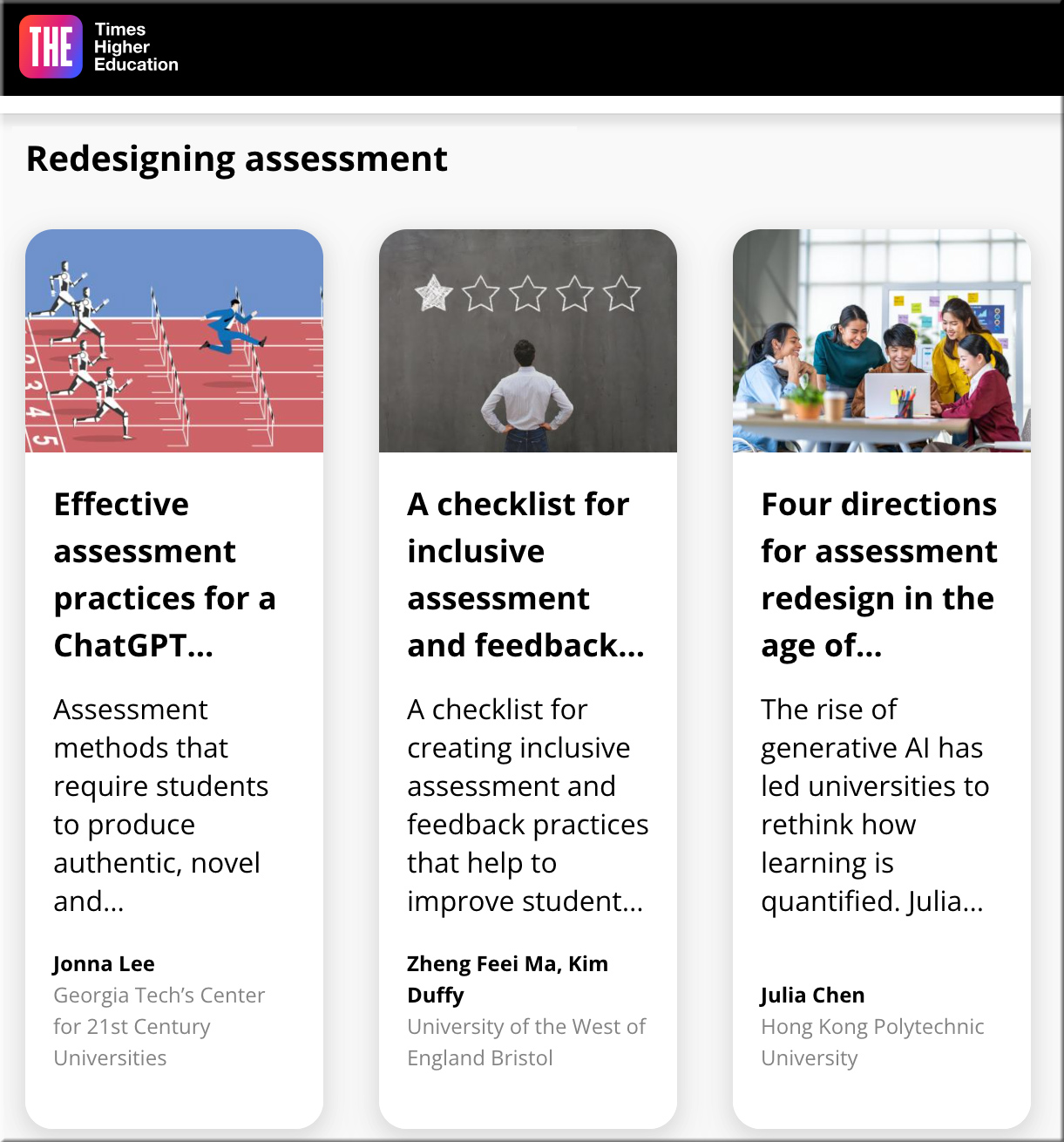
Four directions for assessment redesign in the age of generative AI— from timeshighereducation.com by Julia Chen The rise of generative AI has led universities to rethink how learning is quantified. Julia Chen offers four options for assessment redesign that can be applied across disciplines
Direction 1: From written description to multimodal explanation and application
Direction 2: From literature review alone to referencing lectures
Direction 3: From presentation of ideas to defence of views
Direction 4: From working alone to student-staff partnership
If you are just back from vacation and still not quite sure what to do about AI, let me assure you that you are not the only one. My advice for you today is this: fill your LinkedIn-feed and/or inbox with ideas, inspirational writing and commentary on AI. This will get you up to speed quickly and is a great way to stay informed on the newest movements you need to be aware of.
My personal recommendation for you is to check out these bright people who are all very active on LinkedIn and/or have a newsletter worth paying attention to. I have kept the list fairly short – only 15 people – in order to make it as easy as possible for you to begin exploring.
Understanding the nature of generative AI is crucial for educators to navigate the evolving landscape of teaching and learning. In a new report from the Next Level Lab, Lydia Cao and Chris Dede reflect on the role of generative AI in learning and how this pushes us to reconceptualize our visions of effective education. Though there are concerns of plagiarism and replacement of human jobs, Cao and Dede argue that a more productive way forward is for educators to focus on demystifying AI, emphasizing the learning process over the final product, honoring learner agency, orchestrating multiple sources of motivation, cultivating skills that AI cannot easily replicate, and fostering intelligence augmentation (IA) through building human-AI partnerships.
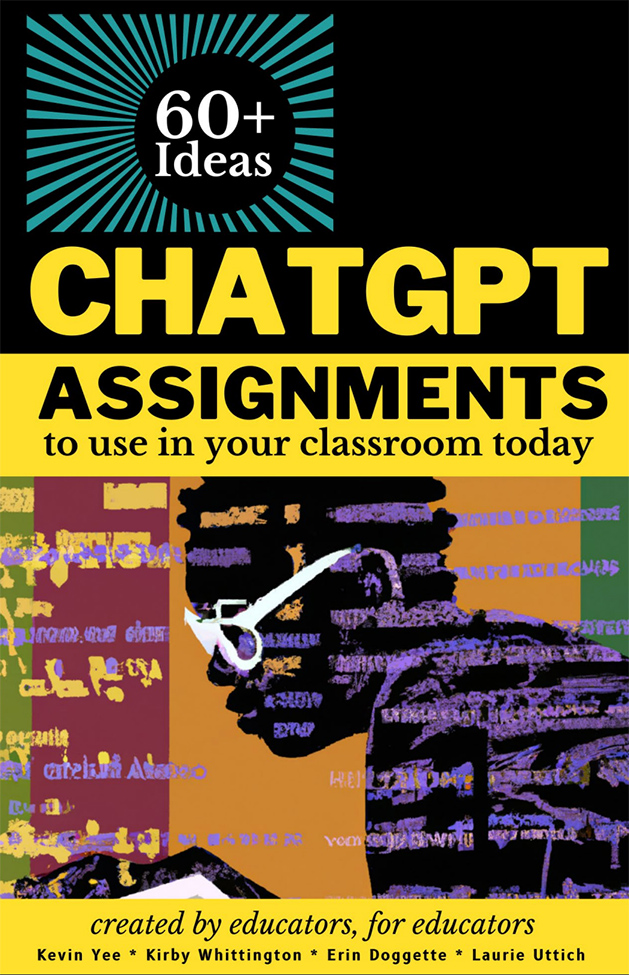
Have you used chatbots to save time this school year? ChatGPT and generative artificial intelligence (AI) have changed the way I think about instructional planning. Today on the blog, I have a selection of ChatGPT prompts for ELA teachers.
You can use chatbots to tackle tedious tasks, gather ideas, and even support your work to meet the needs of every student. In my recent quick reference guide published by ISTE and ASCD, Using AI Chatbots to Enhance Planning and Instruction, I explore this topic. You can also find 50 more prompts for educators in this free ebook.
Professors Craft Courses on ChatGPT With ChatGPT — from insidehighered.com by Lauren Coffey While some institutions are banning the use of the new AI tool, others are leaning into its use and offering courses dedicated solely to navigating the new technology.
Maynard, along with Jules White at Vanderbilt University, are among a small number of professors launching courses focused solely on teaching students across disciplines to better navigate AI and ChatGPT.
The offerings go beyond institutions flexing their innovation skills—the faculty behind these courses view them as imperative to ensure students are prepared for ever-changing workforce needs.
That’s a solid report card for a freshman in college, a respectable 3.57 GPA. I recently finished my freshman year at Harvard, but those grades aren’t mine — they’re GPT-4’s.
…
Three weeks ago, I asked seven Harvard professors and teaching assistants to grade essays written by GPT-4 in response to a prompt assigned in their class. Most of these essays were major assignments which counted for about one-quarter to one-third of students’ grades in the class. (I’ve listed the professors or preceptors for all of these classes, but some of the essays were graded by TAs.)
Here are the prompts with links to the essays, the names of instructors, and the grades each essay received…
The impact that AI is having on liberal-arts homework is indicative of the AI threat to the career fields that liberal-arts majors tend to enter. So maybe what we should really be focused on isn’t, “How do we make liberal-arts homework better?” but rather, “What are jobs going to look like over the next 10–20 years, and how do we prepare students to succeed in that world?”
The great assessment rethink — from timeshighereducation.com by How to measure learning and protect academic integrity in the age of ChatGPT




:format(webp)/cdn.vox-cdn.com/uploads/chorus_asset/file/24976021/Canva_Magic_Studio.png)