Copilot+ PCs are the fastest, most intelligent Windows PCs ever built. With powerful new silicon capable of an incredible 40+ TOPS (trillion operations per second), all–day battery life and access to the most advanced AI models, Copilot+ PCs will enable you to do things you can’t on any other PC. Easily find and remember what you have seen in your PC with Recall, generate and refine AI images in near real-time directly on the device using Cocreator, and bridge language barriers with Live Captions, translating audio from 40+ languages into English.
From DSC: As a first off-the-hip look, Recall could be fraught with possible security/privacy-related issues. But what do I know? The Neuron states “Microsoft assures that everything Recall sees remains private.” Ok…
From The Rundown AI concerning the above announcements:
The details:
A new system enables Copilot+ PCs to run AI workloads up to 20x faster and 100x more efficiently than traditional PCs.
Windows 11 has been rearchitected specifically for AI, integrating the Copilot assistant directly into the OS.
New AI experiences include a new feature called Recall, which allows users to search for anything they’ve seen on their screen with natural language.
Copilot’s new screen-sharing feature allows AI to watch, hear, and understand what a user is doing on their computer and answer questions in real-time.
Copilot+ PCs will start at $999, and ship with OpenAI’s latest GPT-4o models.
Why it matters: Tony Stark’s all-powerful JARVIS AI assistant is getting closer to reality every day. Once Copilot, ChatGPT, Project Astra, or anyone else can not only respond but start executing tasks autonomously, things will start getting really exciting — and likely initiate a whole new era of tech work.
AI’s New Conversation Skills Eyed for Education — from insidehighered.com by Lauren Coffey The latest ChatGPT’s more human-like verbal communication has professors pondering personalized learning, on-demand tutoring and more classroom applications.
ChatGPT’s newest version, GPT-4o ( the “o” standing for “omni,” meaning “all”), has a more realistic voice and quicker verbal response time, both aiming to sound more human. The version, which should be available to free ChatGPT users in coming weeks—a change also hailed by educators—allows people to interrupt it while it speaks, simulates more emotions with its voice and translates languages in real time. It also can understand instructions in text and images and has improved video capabilities.
…
Ajjan said she immediately thought the new vocal and video capabilities could allow GPT to serve as a personalized tutor. Personalized learning has been a focus for educators grappling with the looming enrollment cliff and for those pushing for student success.
There’s also the potential for role playing, according to Ajjan. She pointed to mock interviews students could do to prepare for job interviews, or, for example, using GPT to play the role of a buyer to help prepare students in an economics course.
A Guide to the GPT-4o ‘Omni’ Model — from aieducation.substack.com by Claire Zau The closest thing we have to “Her” and what it means for education / workforce
Today, OpenAI introduced its new flagship model, GPT-4o, that delivers more powerful capabilities and real-time voice interactions to its users. The letter “o” in GPT-4o stands for “Omni”, referring to its enhanced multimodal capabilities. While ChatGPT has long offered a voice mode, GPT-4o is a step change in allowing users to interact with an AI assistant that can reason across voice, text, and vision in real-time.
Facilitating interaction between humans and machines (with reduced latency) represents a “small step for machine, giant leap for machine-kind” moment.
Everyone gets access to GPT-4: “the special thing about GPT-4o is it brings GPT-4 level intelligence to everyone, including our free users”, said CTO Mira Murati. Free users will also get access to custom GPTs in the GPT store, Vision and Code Interpreter. ChatGPT Plus and Team users will be able to start using GPT-4o’s text and image capabilities now
ChatGPT launched a desktop macOS app: it’s designed to integrate seamlessly into anything a user is doing on their keyboard. A PC Windows version is also in the works (notable that a Mac version is being released first given the $10B Microsoft relationship)
In a surprise launch, OpenAI dropped GPT-4 Omni, their new leading model. They also made a bunch of paid features in ChatGPT free and announced a new desktop app. Pete breaks down what you should know and what this says about AI.
Hello GPT-4o — from openai.com We’re announcing GPT-4o, our new flagship model that can reason across audio, vision, and text in real time.
GPT-4o (“o” for “omni”) is a step towards much more natural human-computer interaction—it accepts as input any combination of text, audio, image, and video and generates any combination of text, audio, and image outputs. It can respond to audio inputs in as little as 232 milliseconds, with an average of 320 milliseconds, which is similar to human response time in a conversation. It matches GPT-4 Turbo performance on text in English and code, with significant improvement on text in non-English languages, while also being much faster and 50% cheaper in the API. GPT-4o is especially better at vision and audio understanding compared to existing models.
Providing inflection, emotions, and a human-like voice
Understanding what the camera is looking at and integrating it into the AI’s responses
Providing customer service
With GPT-4o, we trained a single new model end-to-end across text, vision, and audio, meaning that all inputs and outputs are processed by the same neural network. Because GPT-4o is our first model combining all of these modalities, we are still just scratching the surface of exploring what the model can do and its limitations.
This demo is insane.
A student shares their iPad screen with the new ChatGPT + GPT-4o, and the AI speaks with them and helps them learn in *realtime*.
Imagine giving this to every student in the world.
The rapid rise of artificial intelligence appears to be taking a toll on the shares of online education companies Chegg and Coursera.
Both stocks sank by more than 10% on Tuesday after issuing disappointing guidance in part because of students using AI tools such as ChatGPT from OpenAI.
“Combining AI Literacy with Core Humanities Learning Goals: Practical, Critical, and Playful Approaches”
It was amazing to get to do an in-person keynote at @csunorthridge‘s AI Pedagogy Showcase.
Sharing slides: https://t.co/LDIGAZ3ORO 1/2
— Anna Mills, annamillsoer.bsky.social, she/her (@AnnaRMills) May 3, 2024
Synthetic Video & AI Professors— from drphilippahardman.substack.com by Dr. Philippa Hardman Are we witnessing the emergence of a new, post-AI model of async online learning?
TLDR: by effectively tailoring the learning experience to the learner’s comprehension levels and preferred learning modes, AI can enhance the overall learning experience, leading to increased “stickiness” and higher rates of performance in assessments.
…
TLDR: AI enables us to scale responsive, personalised “always on” feedback and support in a way that might help to solve one of the most wicked problems of online async learning – isolation and, as a result, disengagement.
…
In the last year we have also seen the rise of an unprecedented number of “always on” AI tutors, built to provide coaching and feedback how and when learners need it.
Perhaps the most well-known example is Khan Academy’s Khanmigo and its GPT sidekick Tutor Me. We’re also seeing similar tools emerge in K12 and Higher Ed where AI is being used to extend the support and feedback provided for students beyond the physical classroom.
Given the potential ramifications of artificial intelligence (AI) diffusion on matters of diversity, equity, inclusion, and accessibility, now is the time for higher education institutions to adopt culturally aware, analytical decision-making processes, policies, and practices around AI tools selection and use.
The theme of the day was Human Connection V Innovative Technology. I see this a lot at conferences, setting up the human connection (social) against the machine (AI). I think this is ALL wrong. It is, and has always been a dialectic, human connection (social) PLUS the machine. Everyone had a smartphone, most use it for work, comms and social media. The binary between human and tech has long disappeared.
I recently created an AI version of myself—REID AI—and recorded a Q&A to see how this digital twin might challenge me in new ways. The video avatar is generated by Hour One, its voice was created by Eleven Labs, and its persona—the way that REID AI formulates responses—is generated from a custom chatbot built on GPT-4 that was trained on my books, speeches, podcasts and other content that I’ve produced over the last few decades. I decided to interview it to test its capability and how closely its responses match—and test—my thinking. Then, REID AI asked me some questions on AI and technology. I thought I would hate this, but I’ve actually ended up finding the whole experience interesting and thought-provoking.
From DSC: This ability to ask questions of a digital twin is very interesting when you think about it in terms of “interviewing” a historical figure. I believe character.ai provides this kind of thing, but I haven’t used it much.
Since AI in education has been moving at the speed of light, we built this AI Tools in Education database to keep track of the most recent AI tools in education and the changes that are happening every day. This database is intended to be a community resource for educators, researchers, students, and other edtech specialists looking to stay up to date. This is a living document, so be sure to come back for regular updates.
The day started out with a short talk about AI (slides). Some of it is my usual schtick where I do a bit of Q&A with folks around myths and misunderstandings of generative AI in order to establish some common ground. These are often useful both in setting the tone and giving folks a sense of how I come to explore generative AI: with a mixture of humor, concern, curiosity, and of course, cat pics.
From there, we launched into a series of mini-workshops where folks had time to first play around with some previously created prompts around teaching and learning before moving onto prompts for administrative work. The prompts and other support materials are in this Workshop Resource Document. The goal was to just get them into using one or more AI tools with some useful prompts so they can learn more about its capabilities.
The Edtech Insiders Rundown of ASU+GSV 2024 — from edtechinsiders.substack.com by by Sarah Morin, Alex Sarlin, and Ben Kornell And more on Edtech Insiders+, upcoming events, Gauth, AI Reading Tutors, The Artificial Intelligence Interdisciplinary Institute, and TeachAI Policy Resources
Alex Sarlin
4. Everyone is Edtech Now This year, in addition to investors, entrepreneurs, educators, school leaders, university admins, non-profits, publishers, and operators from countless edtech startups and incumbents, there were some serious big tech companies in attendance like Meta, Google, OpenAI, Microsoft, Amazon, Tiktok, and Canva. Additionally, a horde of management consultancies, workforce organizations, mental health orgs, and filmmakers were in attendance.
Edtech continues to expand as an industry category and everyone is getting involved.
It was such a delight to chat with Ana. She’s brilliant and passionate, a talented educator, and an advocate for better ways of learning for children and adults. We cover ways to transform schools so that students get real-world skills, learn resilience and how to embrace challenges, and are prepared for an unpredictable future. And we go hard on why we must keep learning no matter our age, become generalists, and leverage technology in order to adapt to the fast-changing world.
The Texas Tribune reports an “automated scoring engine” that utilizes natural language processing — the technology that enables chatbots like OpenAI’s ChatGPT to understand and communicate with users — is being rolled out by the Texas Education Agency (TEA) to grade open-ended questions on the State of Texas Assessments of Academic Readiness (STAAR) exams. The agency is expecting the system to save $15–20 million per year by reducing the need for temporary human scorers, with plans to hire under 2,000 graders this year compared to the 6,000 required in 2023.
Debating About AI: An Easy Path to AI Awareness and Basic Literacy — from stefanbauschard.substack.com by Stefan Bauschard If you are an organization committed to AI literacy, consider sponsoring some debate topics and/or debates next year and expose thousands of students to AI literacy.
Resolved: Teachers should integrate generative AI in their teaching and learning.
The topic is simple but raises an issue that students can connect with.
While helping my students prepare and judging debates, I saw students demonstrate an understanding of many key issues and controversies.
These included—
*AI writing assessment/grading
*Bias
*Bullying
*Cognitive load
*Costs of AI systems
*Declining test scores
*Deep fakes
*Differentiation
*Energy consumption
*Hallucinations
*Human-to-human connection
*Inequality and inequity in access
*Neurodiversity
*Personalized learning
*Privacy
*Regulation (lack thereof)
*The future of work and unemployment
*Saving teachers time
*Soft skills
*Standardized testing
*Student engagement
*Teacher awareness and AI training; training resource trade-offs
*Teacher crowd-out
*Transparency and explainability
*Writing detectors (students had an exaggerated sense of the workability of these tools).
[Per Chris Dede] We often think of the product of teaching as the outcome (e.g. an essay, a drawing, etc.). The essence of education, in my view, lies not in the products or outcomes of learning but in the journey itself. The artifact is just a symbol that you’ve taken the journey.
The process of learning — the exploration, challenges, and personal growth that occur along the way — is where the real value lies. For instance, the act of writing an essay is valuable not merely for the final product but for the intellectual journey it represents. It forces you to improve and organize your thinking on a subject.
This distinction becomes important with the rise of generative AI, because it uniquely allows us to produce these artifacts without taking the journey.
As I’ve argued previously, I am worried that all this hype around LLMs renders them a “type of digital duct-tape to hold together an obsolete industrial-era educational system”.
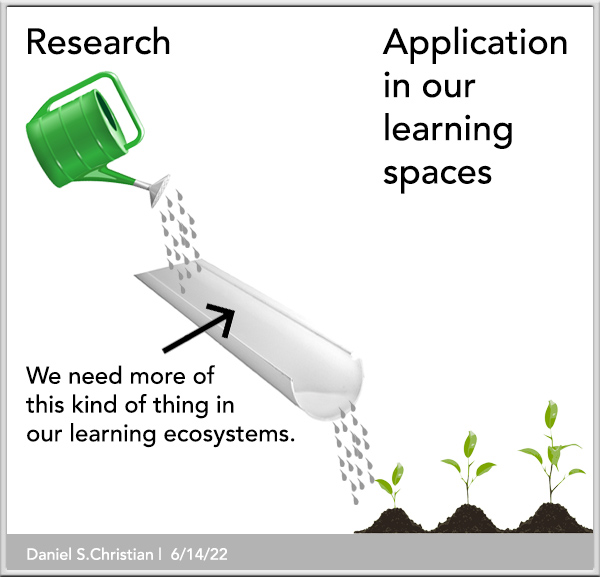
Speaking of AI in our learning ecosystems, also see:
Usage Guidelines for AI Generative Tools at College Unbound These guidelines were created and reviewed by College Unbound students in Spring 2023 with the support of Lance Eaton, Director of Faculty Development & Innovation. The students include S. Fast, K. Linder-Bey, Veronica Machado, Erica Maddox, Suleima L., Lora Roy.
A recent study has found that scientific citations generated by ChatGPT often do not correspond to real academic work. The study, published in the Canadian Psychological Association’s Mind Pad, found that “false citation rates” across various psychology subfields ranged from 6% to 60%. Surprisingly, these fabricated citations feature elements such as legitimate researchers’ names and properly formatted digital object identifiers (DOIs), which could easily mislead both students and researchers.
…
MacDonald found that a total of 32.3% of the 300 citations generated by ChatGPT were hallucinated. Despite being fabricated, these hallucinated citations were constructed with elements that appeared legitimate — such as real authors who are recognized in their respective fields, properly formatted DOIs, and references to legitimate peer-reviewed journals.
The artificial intelligence sector has never been more competitive. Forbes received some 1,900 submissions this year, more than double last year’s count. Applicants do not pay a fee to be considered and are judged for their business promise and technical usage of AI through a quantitative algorithm and qualitative judging panels. Companies are encouraged to share data on diversity, and our list aims to promote a more equitable startup ecosystem. But disparities remain sharp in the industry. Only 12 companies have women cofounders, five of whom serve as CEO, the same count as last year. For more, see our full package of coverage, including a detailed explanation of the list methodology, videos and analyses on trends in AI.
New Generative AI video tools coming to Premiere Pro this year will streamline workflows and unlock new creative possibilities, from extending a shot to adding or removing objects in a scene
Adobe is developing a video model for Firefly, which will power video and audio editing workflows in Premiere Pro and enable anyone to create and ideate
Adobe previews early explorations of bringing third-party generative AI models from OpenAI, Pika Labs and Runway directly into Premiere Pro, making it easy for customers to draw on the strengths of different models within the powerful workflows they use every day
AI-powered audio workflows in Premiere Pro are now generally available, making audio editing faster, easier and more intuitive
AI Resources and Teaching | Kent State University offers valuable resources for educators interested in incorporating artificial intelligence (AI) into their teaching practices. The university recognizes that the rapid emergence of AI tools presents both challenges and opportunities in higher education.
The AI Resources and Teaching page provides educators with information and guidance on various AI tools and their responsible use within and beyond the classroom. The page covers different areas of AI application, including language generation, visuals, videos, music, information extraction, quantitative analysis, and AI syllabus language examples.
For all its jaw-dropping power, Watson the computer overlord was a weak teacher. It couldn’t engage or motivate kids, inspire them to reach new heights or even keep them focused on the material — all qualities of the best mentors.
It’s a finding with some resonance to our current moment of AI-inspired doomscrolling about the future of humanity in a world of ascendant machines. “There are some things AI is actually very good for,” Nitta said, “but it’s not great as a replacement for humans.”
His five-year journey to essentially a dead-end could also prove instructive as ChatGPT and other programs like it fuel a renewed, multimillion-dollar experiment to, in essence, prove him wrong.
…
To be sure, AI can do sophisticated things such as generating quizzes from a class reading and editing student writing. But the idea that a machine or a chatbot can actually teach as a human can, he said, represents “a profound misunderstanding of what AI is actually capable of.”
Nitta, who still holds deep respect for the Watson lab, admits, “We missed something important. At the heart of education, at the heart of any learning, is engagement. And that’s kind of the Holy Grail.”
From DSC: This is why the vision that I’ve been tracking and working on has always said that HUMAN BEINGS will be necessary — they are key to realizing this vision. Along these lines, here’s a relevant quote:
Another crucial component of a new learning theory for the age of AI would be the cultivation of “blended intelligence.” This concept recognizes that the future of learning and work will involve the seamless integration of human and machine capabilities, and that learners must develop the skills and strategies needed to effectively collaborate with AI systems. Rather than viewing AI as a threat to human intelligence, a blended intelligence approach seeks to harness the complementary strengths of humans and machines, creating a symbiotic relationship that enhances the potential of both.
Per Alexander “Sasha” Sidorkin, Head of the National Institute on AI in Society at California State University Sacramento.
AWS, Educause partner on generative AI readiness tool — from edscoop.com by Skylar Rispens Amazon Web Services and the nonprofit Educause announced a new tool designed to help higher education institutions gauge their readiness to adopt generative artificial intelligence.
Amazon Web Services and the nonprofit Educause on Monday announced they’ve teamed up to develop a tool that assesses how ready higher education institutions are to adopt generative artificial intelligence.
Through a series of curated questions about institutional strategy, governance, capacity and expertise, AWS and Educause claim their assessment can point to ways that operations can be improved before generative AI is adopted to support students and staff.
“Generative AI will transform how educators engage students inside and outside the classroom, with personalized education and accessible experiences that provide increased student support and drive better learning outcomes,” Kim Majerus, vice president of global education and U.S. state and local government at AWS, said in a press release. “This assessment is a practical tool to help colleges and universities prepare their institutions to maximize this technology and support students throughout their higher ed journey.”
Speaking of AI and our learning ecosystems, also see:
At a moment when the value of higher education has come under increasing scrutiny, institutions around the world can be exactly what learners and employers both need. To meet the needs of a rapidly changing job market and equip learners with the technical and ethical direction needed to thrive, institutions should familiarize students with the use of AI and nurture the innately human skills needed to apply it ethically. Failing to do so can create enormous risk for higher education, business and society.
What is AI literacy?
To effectively utilize generative AI, learners will need to grasp the appropriate use cases for these tools, understand when their use presents significant downside risk, and learn to recognize abuse to separate fact from fiction. AI literacy is a deeply human capacity. The critical thinking and communication skills required are muscles that need repeated training to be developed and maintained.
Assessment of Student Learning Is Broken — from insidehighered.com by Zach Justus and Nik Janos And generative AI is the thing that broke it, Zach Justus and Nik Janos write.
Generative artificial intelligence (AI) has broken higher education assessment. This has implications from the classroom to institutional accreditation. We are advocating for a one-year pause on assessment requirements from institutions and accreditation bodies.
… Implications and Options
The data we are collecting right now are literally worthless. These same trends implicate all data gathered from December 2022 through the present. So, for instance, if you are conducting a five-year program review for institutional accreditation you should separate the data from before the fall 2022 term and evaluate it independently. Whether you are evaluating writing, STEM outputs, coding, or anything else, you are now looking at some combination of student/AI work. This will get even more confounding as AI tools become more powerful and are integrated into our existing production platforms like Microsoft Office and Google Workspace.
The burden of adapting to artificial intelligence has fallen to faculty, but we are not positioned or equipped to lead these conversations across stakeholder groups.