A Brilliant Image of the Solar Eclipse Wins the 2024 Astronomy Photographer of the Year — from thisiscolossal.com by Ryan Imperio and grace Ebert

A Brilliant Image of the Solar Eclipse Wins the 2024 Astronomy Photographer of the Year — from thisiscolossal.com by Ryan Imperio and grace Ebert
The Adorable and the Fierce Star in the 2024 Wildlife Photographer of the Year Contest — from thisiscolossal.com by Grace Ebert
The 2024 Wildlife Photographer of the Year competition broke its 60-year record with a whopping 59,228 entries from 117 countries and territories. Hosted annually by the Natural History Museum, the contest is known for showcasing the drama, humor, and harsh realities found in every part of the globe.

.

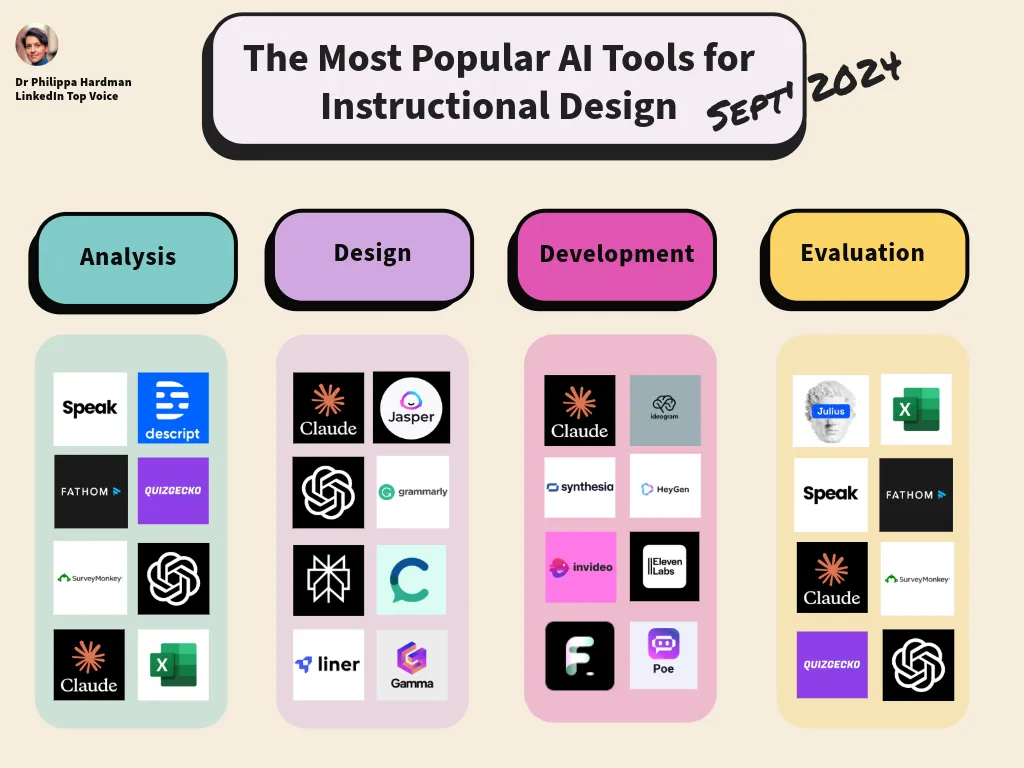
The Most Popular AI Tools for Instructional Design (September, 2024) — from drphilippahardman.substack.com by Dr. Philippa Hardman
The tools we use most, and how we use them
This week, as I kick off the 20th cohort of my AI-Learning Design bootcamp, I decided to do some analysis of the work habits of the hundreds of amazing AI-embracing instructional designers who I’ve worked with over the last year or so.
My goal was to answer the question: which AI tools do we use most in the instructional design process, and how do we use them?
Here’s where we are in September, 2024:
…
Developing Your Approach to Generative AI — from scholarlyteacher.com by Caitlin K. Kirby, Min Zhuang, Imari Cheyne Tetu, & Stephen Thomas (Michigan State University)
As generative AI becomes integrated into workplaces, scholarly work, and students’ workflows, we have the opportunity to take a broad view of the role of generative AI in higher education classrooms. Our guiding questions are meant to serve as a starting point to consider, from each educator’s initial reaction and preferences around generative AI, how their discipline, course design, and assessments may be impacted, and to have a broad view of the ethics of generative AI use.
The Impact of AI in Advancing Accessibility for Learners with Disabilities — from er.educause.edu by Rob Gibson
AI technology tools hold remarkable promise for providing more accessible, equitable, and inclusive learning experiences for students with disabilities.
Join our linked in group, AI in the Classroom https://t.co/rmfw0SvcW1 #edtech #GenAI @isteofficial @cosn @ascd @neatoday @aftunion @oecd_edu @ccsso @fetc @tcea @cueinc pic.twitter.com/Cxl80WuDuS
— David Ross (@DavidPBLRoss) August 20, 2024
This AI App Can Solve Your Math Homework, Steps Included — from link.wired.com by Will Knight
Right now, high schoolers and college students around the country are experimenting with free smartphone apps that help complete their math homework using generative AI. One of the most popular options on campus right now is the Gauth app, with millions of downloads. It’s owned by ByteDance, which is also TikTok’s parent company.
The Gauth app first launched in 2019 with a primary focus on mathematics, but soon expanded to other subjects as well, like chemistry and physics. It’s grown in relevance, and neared the top of smartphone download lists earlier this year for the education category. Students seem to love it. With hundreds of thousands of primarily positive reviews, Gauth has a favorable 4.8 star rating in the Apple App Store and Google Play Store.
All students have to do after downloading the app is point their smartphone at a homework problem, printed or handwritten, and then make sure any relevant information is inside of the image crop. Then Gauth’s AI model generates a step-by-step guide, often with the correct answer.
From DSC:
I do hesitate to post this though, as I’ve seen numerous posting re: the dubious quality of AI as it relates to giving correct answers to math-related problems – or whether using AI-based tools help or hurt the learning process. The situation seems to be getting better, but as I understand it, we still have some progress to make in this area of mathematics.
Redefining Creativity in the Age of AI — from gettingsmart.com by David Ross
Key Points

AI-Powered Instructional Design at ASU — from drphilippahardman.substack.com by Dr. Philippa Hardman
How ASU’s Collaboration with OpenAI is Reshaping the Role of Instructional Designers
The developments and experiments at ASU provide a fascinating window into two things:
In this week’s blog post, I’ll provide a summary of how faculty, staff and students at ASU are starting to reimagine education in the age of AI, and explore what this means for the instructions designers who work there.
PhysicsWallah’s ‘Alakh AI’ is Making Education Accessible to Millions in India — from analyticsindiamag.com by Siddharth Jindal
India’s ed-tech unicorn PhysicsWallah is using OpenAI’s GPT-4o to make education accessible to millions of students in India. Recently, the company launched a suite of AI products to ensure that students in Tier 2 & 3 cities can access high-quality education without depending solely on their enrolled institutions, as 85% of their enrollment comes from these areas.
Last year, AIM broke the news of PhysicsWallah introducing ‘Alakh AI’, its suite of generative AI tools, which was eventually launched at the end of December 2023. It quickly gained traction, amassing over 1.5 million users within two months of its release.
School is back in session, and so are AI art classes — from hyperallergic.com by Isa Farfan
New university programs are incorporating generative tools into studio art courses while attempting to address the murky ethics of the technology.

There’s a new addition to the course catalog at Ringling College of Art and Design, a small private art school in southwest Florida: an Artificial Intelligence Undergraduate Certificate.
The college claimed its new program is the first-of-its-kind AI certificate at an undergraduate arts institution in a news release earlier this month. Other schools in the United States offer courses and certificates focused on the integration of artificial intelligence and creative work, and educators across the country have already brought the technology into the art studio. Critics, however, say pushing AI into arts education won’t level the playing field for professional artists competing against increasingly sophisticated generative tools.
From DSC:
Though this next item is not necessarily related to AI, the following is still art and it’s very fun to watch!
Wait for the magic pic.twitter.com/peHgBHCoti
— Learn Something (@cooltechtipz) August 27, 2024
Here’s how we need to change our work lives:
The top 100 Gen AI Consumer Apps — 3rd edition — from a16z.com by Andreessen Horowitz
But amid the relentless onslaught of product launches, investment announcements, and hyped-up features, it’s worth asking: Which of these gen AI apps are people actually using? Which behaviors and categories are gaining traction among consumers? And which AI apps are people returning to, versus dabbling and dropping?
Welcome to the third installment of the Top 100 Gen AI Consumer Apps.
.
Gen AI’s next inflection point: From employee experimentation to organizational transformation — from mckinsey.com by Charlotte Relyea, Dana Maor, and Sandra Durth with Jan Bouly
As many employees adopt generative AI at work, companies struggle to follow suit. To capture value from current momentum, businesses must transform their processes, structures, and approach to talent.
To harness employees’ enthusiasm and stay ahead, companies need a holistic approach to transforming how the whole organization works with gen AI; the technology alone won’t create value.
Our research shows that early adopters prioritize talent and the human side of gen AI more than other companies (Exhibit 3). Our survey shows that nearly two-thirds of them have a clear view of their talent gaps and a strategy to close them, compared with just 25 percent of the experimenters. Early adopters focus heavily on upskilling and reskilling as a critical part of their talent strategies, as hiring alone isn’t enough to close gaps and outsourcing can hinder strategic-skills development. Finally, 40 percent of early-adopter respondents say their organizations provide extensive support to encourage employee adoption, versus 9 percent of experimenter respondents.
Adobe drops ‘Magic Fixup’: An AI breakthrough in the world of photo editing — from venturebeat.com by Michael Nuñez

Adobe researchers have revealed an AI model that promises to transform photo editing by harnessing the power of video data. Dubbed “Magic Fixup,” this new technology automates complex image adjustments while preserving artistic intent, potentially reshaping workflows across multiple industries.
Magic Fixup’s core innovation lies in its unique approach to training data. Unlike previous models that relied solely on static images, Adobe’s system learns from millions of video frame pairs. This novel method allows the AI to understand the nuanced ways objects and scenes change under varying conditions of light, perspective, and motion.
Top AI tools people actually use — from heatherbcooper.substack.com by Heather Cooper
How generative AI tools are changing the creative landscape
The shift toward creative tools
Creative tools made up 52% of the top generative AI apps on the list. This seems to reflect a growing consumer demand for accessible creativity through AI with tools for image, music, speech, video, and editing.
Creative categories include:
Why it matters:
Creative apps are gaining traction because they empower digital artists and content creators with AI-driven tools that simplify and enhance the creative process, making professional-level work more accessible than ever.

In India, an Undulating Biophilic Farmhouse Wraps Around a Small Mango Grove — from thisiscolossal.com by Grace Ebert

Dive Into Marine Drama Around the World with This Year’s Ocean Photographer of the Year Finalists — from thisiscolossal.com by Kate Mothes & others


MODA ramps rooftop garden along Calgary multifamily housing — from dezeen.com by Kate Mazade

Beth Cavener Molds Thousands of Pounds of Clay into Provocative Animals that Grapple with Trust — — from thisiscolossal.com by Kate Mothes & Beth Cavener

For 700 years of history, the tallest building on Earth was a church.
But do you ever wonder how medieval society built them — with no power tools or modern machines?
The answer may surprise you… (thread) ? pic.twitter.com/IgCQ65hdKX
— Culture Critic (@Culture_Crit) August 22, 2024
One thing often happens at keynotes and conferences. It surprised me…. — from donaldclarkplanb.blogspot.com by Donald Clark
AI is welcomed by those with dyslexia, and other learning issues, helping to mitigate some of the challenges associated with reading, writing, and processing information. Those who want to ban AI want to destroy the very thing that has helped most on accessibility. Here are 10 ways dyslexics, and others with issues around text-based learning, can use AI to support their daily activities and learning.
Let’s Make a Movie Teaser With AI — from whytryai.com by Daniel Nest
How to use free generative AI tools to make a teaser trailer.
Here are the steps and the free tools we can use for each.
Here we go.
Is AI in Schools Promising or Overhyped? Potentially Both, New Reports Suggest — from the74million.org by Greg Toppo; via Claire Zau
One urges educators to prep for an artificial intelligence boom. The other warns that it could all go awry. Together, they offer a reality check.
Are U.S. public schools lagging behind other countries like Singapore and South Korea in preparing teachers and students for the boom of generative artificial intelligence? Or are our educators bumbling into AI half-blind, putting students’ learning at risk?
Or is it, perhaps, both?
Two new reports, coincidentally released on the same day last week, offer markedly different visions of the emerging field: One argues that schools need forward-thinking policies for equitable distribution of AI across urban, suburban and rural communities. The other suggests they need something more basic: a bracing primer on what AI is and isn’t, what it’s good for and how it can all go horribly wrong.
Bite-Size AI Content for Faculty and Staff — from aiedusimplified.substack.com by Lance Eaton
Another two 5-tips videos for faculty and my latest use case: creating FAQs!
I had an opportunity recently to do more of my 15-minute lightning talks. You can see my lightning talks from late winter in this post, or can see all of them on my YouTube channel. These two talks were focused on faculty in particular.
Also from Lance, see:
AI in Education: Leading a Paradigm Shift — from gettingsmart.com by Dr. Tyler Thigpen
Despite possible drawbacks, an exciting wondering has been—What if AI was a tipping point helping us finally move away from a standardized, grade-locked, ranking-forced, batched-processing learning model based on the make believe idea of “the average man” to a learning model that meets every child where they are at and helps them grow from there?
I get that change is indescribably hard and there are risks. But the integration of AI in education isn’t a trend. It’s a paradigm shift that requires careful consideration, ongoing reflection, and a commitment to one’s core values. AI presents us with an opportunity—possibly an unprecedented one—to transform teaching and learning, making it more personalized, efficient, and impactful. How might we seize the opportunity boldly?
California and NVIDIA Partner to Bring AI to Schools, Workplaces — from govtech.com by Abby Sourwine
The latest step in Gov. Gavin Newsom’s plans to integrate AI into public operations across California is a partnership with NVIDIA intended to tailor college courses and professional development to industry needs.
California Gov. Gavin Newsom and tech company NVIDIA joined forces last week to bring generative AI (GenAI) to community colleges and public agencies across the state. The California Community Colleges Chancellor’s Office (CCCCO), NVIDIA and the governor all signed a memorandum of understanding (MOU) outlining how each partner can contribute to education and workforce development, with the goal of driving innovation across industries and boosting their economic growth.
Listen to anything on the go with the highest-quality voices — from elevenlabs.io; via The Neuron
The ElevenLabs Reader App narrates articles, PDFs, ePubs, newsletters, or any other text content. Simply choose a voice from our expansive library, upload your content, and listen on the go.
Per The Neuron
Some cool use cases:
Why it’s important: ElevenLabs shared how major Youtubers are using its dubbing services to expand their content into new regions with voices that actually sound like them (thanks to ElevenLabs’ ability to clone voices).
Oh, and BTW, it’s estimated that up to 20% of the population may have dyslexia. So providing people an option to listen to (instead of read) content, in their own language, wherever they go online can only help increase engagement and communication.
How Generative AI Improves Parent Engagement in K–12 Schools — from edtechmagazine.com by Alexadner Slagg
With its ability to automate and personalize communication, generative artificial intelligence is the ideal technological fix for strengthening parent involvement in students’ education.
As generative AI tools populate the education marketplace, the technology’s ability to automate complex, labor-intensive tasks and efficiently personalize communication may finally offer overwhelmed teachers a way to effectively improve parent engagement.
…
These personalized engagement activities for students and their families can include local events, certification classes and recommendations for books and videos. “Family Feed might suggest courses, such as an Adobe certification,” explains Jackson. “We have over 14,000 courses that we have vetted and can recommend. And we have books and video recommendations for students as well.”
Including personalized student information and an engagement opportunity makes it much easier for parents to directly participate in their children’s education.
Will AI Shrink Disparities in Schools, or Widen Them? — edsurge.com by Daniel Mollenkamp
Experts predict new tools could boost teaching efficiency — or create an “underclass of students” taught largely through screens.

Bisected by the Milky Way, a Stellar Image Captures the Perseid Meteor Shower Raining Down on Stonehenge — from thisiscolossal.com by Josh Dury

From DSC:
I thought this was very creative! Nice work.
A Curtain-Like Facade Wraps a Seoul Textile Maker in Billowing Brick — from thisiscolossal.com by Kate Mothes and German architecture firm behet bondzio lin architekten
A South Korea fashion brand and textile manufacturer’s headquarters in Seoul gets a stunning new look thanks to German architecture firm behet bondzio lin architekten. Located in Seongsu-dong, a neighborhood historically known for its red brick factory buildings, the new multistory structure defies the material’s traditionally angular application by incorporating an undulating, drapery-like facade.
The architects conceived of a design inspired both by the flow and flexibility of textiles and the consistent rhythm of ocean waves.
.

About this Project
The Digital Writing Lab is a key component of the Australian national Teaching Digital Writing project, which runs from 2022-2025.
This stage of the broader project involves academic and secondary English teacher collaboration to explore how teachers are conceptualising the teaching of digital writing and what further supports they may need.
Previous stages of the project included archival research reviewing materials related to digital writing in Australia’s National Textbook Collection, and a national survey of secondary English teachers. You can find out more about the whole project via the project blog.
Who runs the project?
Project Lead Lucinda McKnight is an Associate Professor and Australian Research Council (ARC) DECRA Fellow researching how English teachers can connect the teaching of writing to contemporary media and students’ lifeworlds.
She is working with Leon Furze, who holds the doctoral scholarship attached to this project, and Chris Zomer, the project Research Fellow. The project is located in the Research for Educational Impact (REDI) centre at Deakin University, Melbourne.
.