The boom in artificial intelligence is touching nearly every industry, and eLearning is no exception. From content creation to instructional design, industry professionals and organizations are finding innovative ways to apply AI in elearning. Whether creating training modules for corporate employees or crafting educational programs, professionals are making AI part of their standard toolkit.
At Teamed, we have the privilege of working and speaking with people from all over the elearning industry including instructional designers, content developers, and organizations considering how to apply it for productivity and the benefit of learners. AI and machine learning come up frequently in these conversations. Here’s what we’ve learned and observed about AI in elearning from experts in our industry.
“…what if generative AI could provide every instructor with a genuine teaching assistant – a teaching assistant that actually assisted instructors with their teaching?”
For my cryptography course, Mollick’s first option would probably mean throwing out all my existing reading questions. My intent with these reading questions was noble, that is, to guide students to the big questions and debates in the field, but those are exactly the kinds of questions for which AI can write decent answers. Maybe the AI tools would fare worse in a more advanced course with very specialized readings, but in my intro to cryptography course, they can handle my existing reading questions with ease.
What about option two? I think one version of this would be to do away with the reading response assignment altogether.
Generative AI imagines new protein structures — from news.mit.edu by Rachel Gordon; resource from Sunday Signal MIT researchers develop “FrameDiff,” a computational tool that uses generative AI to craft new protein structures, with the aim of accelerating drug development and improving gene therapy.
Ready to Sing Elvis Karaoke … as Elvis? The Weird Rise of AI Music — from rollingstone.com by Brian Hiatt; resource from Misha da Vinci From voice-cloning wars to looming copyright disputes to a potential flood of nonhuman music on streaming, AI is already a musical battleground
Why use animation in eLearning? Many people may think of animation in terms of entertainment value alone. Animation is far more valuable for its ability to engage learners, explain or illustrate ideas, and improve recall of complex relationships, such as cause and effect.
Look up these specific animation types for use in your projects:
Whiteboard animation: Not necessary to be able to draw the characters. Multiple brands.
Humans are good storytellers, and humans respond well to stories. We know this from our own experience. Not only that, people remember stories for a long time, far longer than we remember a lot of teaching. Do you recall stories that someone in your family told you? Why don’t we remember lessons from school as long or as vividly? Stories are powerful if we know how to use them. In this article I will introduce you to a way to use stories to achieve outcomes.
Any time you are designing a course, a learning experience, or just pitching an idea to your boss or an L&D stakeholder, it’s a story. Even if it does not seem like one, a successful production—whether it is an animated presentation, a virtual supporting example or other content—is based on some fundamental storytelling tactics. It doesn’t have to begin “Once Upon A Time,” it just needs to be constructed the right way for your purpose – To make it a memory.
Post-AI Assessment Design — from drphilippahardman.substack.com by Dr. Philippa Hardman A simple, three-step guide on how to design assessments in a post-AI world
Excerpt:
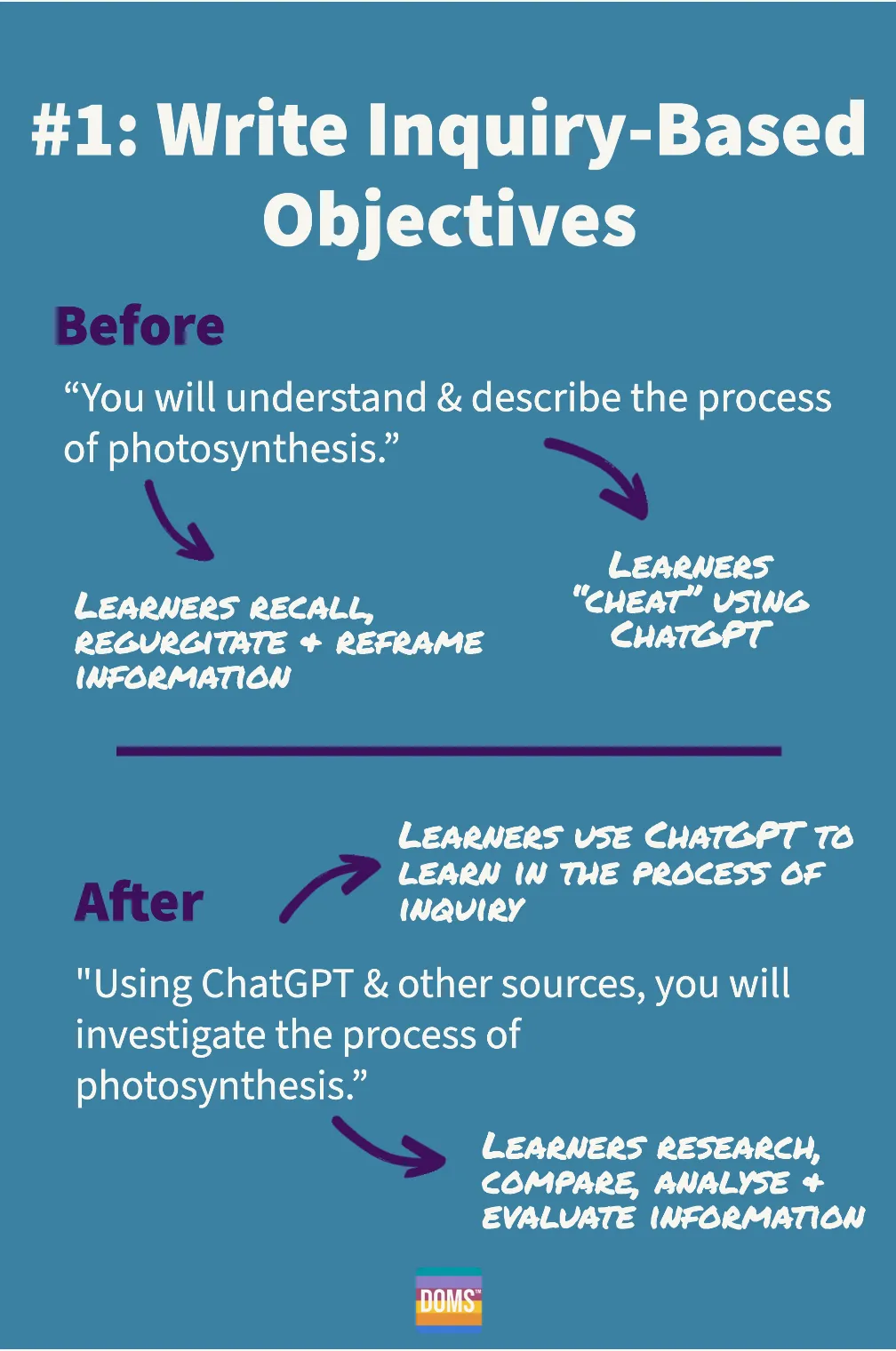
Step 1: Write Inquiry-Based Objectives
Inquiry-based objectives focus not just on the acquisition of knowledge but also on the development of skills and behaviours, like critical thinking, problem-solving, collaboration and research skills.
They do this by requiring learners not just to recall or “describe back” concepts that are delivered via text, lecture or video. Instead, inquiry-based objectives require learners to construct their own understanding through the process of investigation, analysis and questioning.
Just for a minute, consider how education would change if the following were true –
AIs “hallucinated” less than humans
AIs could write in our own voices
AIs could accurately do math
AIs understood the unique academic (and eventually developmental) needs of each student and adapt instruction to that student
AIs could teach anything any student wanted or need to know any time of day or night
AIs could do this at a fraction of the cost of a human teacher or professor
Fall 2026 is three years away. Do you have a three year plan? Perhaps you should scrap it and write a new one (or at least realize that your current one cannot survive). If you run an academic institution in 2026 the same way you ran it in 2022, you might as well run it like you would have in 1920. If you run an academic institution in 2030 (or any year when AI surpasses human intelligence) the same way you ran it in 2022, you might as well run it like you would have in 1820. AIs will become more intelligent than us, perhaps in 10-20 years (LeCun), though there could be unanticipated breakthroughs that lower the time frame to a few years or less (Benjio); it’s just a question of when, not “if.”
On one creative use of AI — from aiandacademia.substack.com by Bryan Alexander A new practice with pedagogical possibilities
Excerpt:
Look at those material items again. The voiceover? Written by an AI and turned into audio by software. The images? Created by human prompts in Midjourney. The music is, I think, human created. And the idea came from a discussion between a human and an AI?
…
How might this play out in a college or university class?
Imagine assignments which require students to craft such a video. Start from film, media studies, or computer science classes. Students work through a process:
I continue to try to imagine ways generative AI can impact teaching and learning, including learning materials like textbooks. Earlier this week I started wondering – what if, in the future, educators didn’t write textbooks at all? What if, instead, we only wrote structured collections of highly crafted prompts? Instead of reading a static textbook in a linear fashion, the learner would use the prompts to interact with a large language model.These prompts could help learners ask for things like:
overviews and in-depth explanations of specific topics in a specific sequence,
examples that the learner finds personally relevant and interesting,
interactive practice – including open-ended exercises – with immediate, corrective feedback,
the structure of the relationships between ideas and concepts,
Designed for K12 and Higher-Ed Educators & Administrators, this conference aims to provide a platform for educators, administrators, AI experts, students, parents, and EdTech leaders to discuss the impact of AI on education, address current challenges and potentials, share their perspectives and experiences, and explore innovative solutions. A special emphasis will be placed on including students’ voices in the conversation, highlighting their unique experiences and insights as the primary beneficiaries of these educational transformations.
The use of generative AI in K-12 settings is complex and still in its infancy. We need to consider how these tools can enhance student creativity, improve writing skills, and be transparent with students about how generative AI works so they can better understand its limitations. As with any new tech, our students will be exposed to it, and it is our task as educators to help them navigate this new territory as well-informed, curious explorers.
The education ministry has emphasized the need for students to understand artificial intelligence in new guidelines released Tuesday, setting out how generative AI can be integrated into schools and the precautions needed to address associated risks.
Students should comprehend the characteristics of AI, including its advantages and disadvantages, with the latter including personal information leakages and copyright infringement, before they use it, according to the guidelines. They explicitly state that passing off reports, essays or any other works produced by AI as one’s own is inappropriate.
Thanks to the rapid development of artificial intelligence tools like Dall-E and ChatGPT, my brother-in-law has been wrestling with low-level anxiety: Is it a good idea to steer his son down this path when AI threatens to devalue the work of creatives? Will there be a job for someone with that skill set in 10 years? He’s unsure. But instead of burying his head in the sand, he’s doing what any tech-savvy parent would do: He’s teaching his son how to use AI.
In recent months the family has picked up subscriptions to AI services. Now, in addition to drawing and sculpting and making movies and video games, my nephew is creating the monsters of his dreams with Midjourney, a generative AI tool that uses language prompts to produce images.
To bridge this knowledge gap, I decided to make a quick little dictionary of AI terms specifically tailored for educators worldwide. Initially created for my own benefit, I’ve reworked my own AI Dictionary for Educators and expanded it to help my fellow teachers embrace the advancements AI brings to education.
According to Accessibility.com, at least 2,387 web accessibility lawsuits were filed in 2022. Those lawsuits were either filed under the Americans with Disabilities Act (ADA) or California’s Unruh Act; any violation of the ADA is considered a violation of the Unruh Act.
While the plaintiffs cited a variety of issues, multimedia accessibility is a common point of concern. In 2015, the National Association of the Deaf (NAD) and other plaintiffs settled a lawsuit with Netflix, which cited a lack of captions for certain featured movies and TV shows.
That prompts an interesting question: Does the ADA require captions for internet videos — and if so, how can businesses make sure that they’re compliant?
Rachel Kapp, M.Ed., BCET, and Stephanie Pitts, M.Ed., BCET welcome back College Learning Disability Specialist Elizabeth Hamblet to discuss her new book 7 Steps to College Success: A Pathway for Students with Disabilities. She discusses the origin story of the book and the disconnect between what college disability services can do for learners and what learners and parents expect. She talks about reading this book when the learner is in 8th grade because of the specific impact it can have on parent and learner decisions on course selection. Elizabeth discusses how parents and learners can get surprised in the college disability process. Elizabeth talks about the critical importance of non-academic skills and how the drive for success in high school can stand in the way of independence necessary for college success.
If you’re interested in accessible digital design, pay attention to Apple. The company seems to approach accessibility from the perspective of users with disabilities.
Apple’s messaging treats accessibility as a fundamental design principle: Accessibility must be built into digital systems from the start, not tacked on as an afterthought. In other words, they take an accessibility-first mindset, and their commitment seems consistent.
The company’s track record continued in May 2023, when Apple announced its latest suite of accessibility features to launch later that year. One of these features, Assistive Access for iPhone and iPad, holds valuable lessons that web designers can apply to their own work.
Here’s what Apple accomplished with Assistive Access, plus a few ways web designers can achieve similar goals.
Their most recognisable role is to partner with faculty and provide them with inspiration, expertise and support in their teaching. But a broader role is emerging at institutional level- helping create a culture where people value talking about teaching and more generally, fostering a culture of continuous learning. In this respect, CTLs act as agents of change, aiming to influence the organizational (learning) environment.
…
CTLs are part of an ecosystem, internally and externally, and they have the potential to play a very important role, that of a network node. Internally, this can mean connecting various silos within the university, a much needed task, while externally it implies establishing collaboration flows with other CTLs that can in turn lead to broader inter-university collaboration. Making use of the full potential of this role can make a big difference for the success of a CTL.
Speaking of Teaching & Learning Centers, also see:
7 Questions on Engaging Faculty in Digital Accessibility — from campustechnology.com by Rhea Kelly We asked the Technical College System of Georgia’s accessibility champions how they help instructors create a more inclusive learning experience for all students.
After chronicling 160+ AI tools (which is surely only a small fraction of the total), we’re seeing a few clear patterns among the tools that have come out so far- here are 10 categories that are jumping out!
“I don’t usually get worked up about announcements but I see promise in JFF’s plans for a new Center for Artificial Intelligence & the Future of Work, in no small part because the organization bridges higher ed, K-12 education, employers, and policymakers.”
BOSTON June 14, 2023 —Jobs for the Future (JFF), a national nonprofit that drives transformation in the U.S. education and workforce systems, today announced the launch of its new Center for Artificial Intelligence &the Future of Work. This center will play an integral role in JFF’s mission and newly announced 10-year North Star goal to help 75 million people facing systemic barriers to advancement work in quality jobs. As AI’s explosive growth reshapes every aspect of how we learn, work, and live, this new center will serve as a nexus of collaboration among stakeholders from every part of the education-to-career ecosystem to explore the most promising opportunities—and profound challenges—of AI’s potential to advance an accessible and equitable future of learning and work.
OpenAI Considers ‘App Store’ For ChatGPT — from searchenginejournal.com by; with thanks to Barsee at AI Valley for this resource OpenAI explores launching an ‘app store’ for AI models, potentially challenging current partners and expanding customer reach.
Highlights:
OpenAI considers launching an ‘app store’ for customized AI chatbots.
This move could create competition with current partners and extend OpenAI’s customer reach.
Early interest from companies like Aquant and Khan Academy shows potential, but product development and market positioning challenges remain.
The rise of artificial intelligence, especially generative AI, boosts productivity in content creation–text, code, images and increasingly video.
Here are six preliminary conclusions about the nature of work and learning.
Wonder Tools: AI to try— from wondertools.substack.com by Jeremy Caplan 9 playful little ways to explore AI
Excerpt:
Create a personalized children’s story ? | Schrodi Collaborate with AI on a free customized, illustrated story for someone special. Give your story’s hero a name, pick a genre (e.g. comedy, thriller), choose an illustration style (e.g. watercolor, 3d animation) and provide a prompt to shape a simple story. You can even suggest a moral. After a minute, download a full-color PDF to share. Or print it and read your new mini picture book aloud.
Generate a quiz ? | Piggy Put in a link, a topic, or some text and you’ll get a quiz you can share, featuring multiple-choice or true-false questions. Example: try this quick entrepreneurship quiz Piggy generated for me.
Q: How will generative AI impact teaching and learning in the near and long term?
Baker Stein: One-on-one tutoring at scale is finally being unlocked for learners around the world. This type of quality education is no longer only available to students with the means to hire a private tutor.I’m also particularly excited to see how educators make use of generative AI tools to create courses much faster and likely at a higher quality with increased personalization for each student or even by experimenting with new technologies like extended reality. Professors will be able to put their time toward high-impact activities like mentoring, researching and office hours instead of tedious course-creation tasks. This helps open up the capacity for educators to iterate on their courses faster to keep pace with industry and global changes that may impact their field of study.
Another important use case is how generative AI can serve as a great equalizer for students when it comes to writing, especially second language learners.
From DSC: Dr. Nino makes several solid points in this article. The article won’t let me copy/paste some excerpts for you, but I would encourage you to look at it.
I would add a few things:
The huge advantage of online-based learning is that a significant amount of learning-related data is automatically captured and doesn’t need to be manually entered (if such manually entered data ever does get entered…which most of it doesn’t).
Learners have much more control over the pacing within the digital realm — i.e., which media they want to use as well as stopping/fast-forwarding/rewinding certain kinds of media.
Most people are now required to be lifelong learners — where convenience and time-savings become very important factors in continuing one’s education
And finally, as AI and other technologies continue to make their way forward, it will be hard to beat online-based and/or hybrid-based learning.
Ernst and Young dug a little deeper. “Today’s disruptive working landscape requires organisations to largely restructure the way they are doing work,” they noted in a bulletin in March this year. “Time now spent on tasks will be equally divided between people and machines. For these reasons, workforce roles will change and so do the skills needed to perform them.”
The World Economic Forum has pointed to this global skills gap and estimates that, while 85 million jobs will be displaced, 50% of all employees will need reskilling and/or upskilling by 2025. This, it almost goes without saying, will require Learning and Development departments to do the heavy-lifting in this initial transformational phase but also in an on-going capacity.
“And that’s the big problem,” says Hardman. “2025 is only two and half years away and the three pillars of L&D – knowledge transference, knowledge reinforcement and knowledge assessment – are crumbling. They have been unchanged for decades and are now, faced by revolutionary change, no longer fit for purpose.”
ChatGPT is the shakeup education needs— from eschoolnews.com by Joshua Sine As technology evolves, industries must evolve alongside it, and education is no exception–especially when students heavily and regularly rely on edtech
Key points:
Education must evolve along with technology–students will expect it
Embracing new technologies helps education leverage adaptive technology that engage student interest
From DSC: I also wanted to highlight the item below, which Barsee also mentioned above, as it will likely hit the world of education and training as well:
Last night, Jensen Huang of NVIDIA gave his very first live keynote in 4-years.
The most show-stopping moment from the event was when he showed off the real-time AI in video games. A human speaks, the NPC responds, in real time and the dialogue was generated with AI on the fly. pic.twitter.com/TDoUM1zSiy
Changed by Our Journey: Engaging Students through Simulive Learning — from er.educause.edu by Lisa Lenze and Megan Costello In this article, an instructor explains how she took an alternative approach to teaching—simulive learning—and discusses the benefits that have extended to her in-person classrooms.
Excerpts:
Mustering courage, Costello devised a novel way to (1) share the course at times other than when it was regularly scheduled and (2) fully engage with her students in the chat channel during the scheduled class meeting time. Her solution, which she calls simulive learning, required her to record her lectures and watch them with her students. (Courageous, indeed!)
Below, Costello and I discuss what simulive learning looks like, how it works, and how Costello has taken her version of remote synchronous teaching forward into current semesters.
Megan Costello: I took a different approach to remote synchronous online learning at the start of the pandemic. Instead of using traditional videoconferencing software to hold class, I prerecorded, edited, and uploaded videos of my lectures to a streaming website. This website allowed me to specify a time and date to broadcast my lectures to my students. Because the lectures were already prepared, I could watch and participate in the chat with my students as we encountered the materials together during the scheduled class time. I drove conversations in chat, asked questions, and got students engaged as we covered materials for the day. The students had my full attention.
NVIDIA ACE for Games is a new foundry for intelligent in-game characters powered by generative AI. Developers of middleware, tools, and games can use NVIDIA ACE for Games to build and deploy customized speech, conversation, and animation AI models in their software and games.
From DSC: I can’t wait to see this type of thing integrated into educational games/simulations/training.
Bard, Google’s answer to OpenAI’s ChatGPT, is getting new generative AI capabilities courtesy of Adobe.
Adobe announced today that Firefly, its recently introduced collection of AI models for generating media content, is coming to Bard alongside Adobe’s free graphic design tool, Adobe Express. Firefly — currently in public beta — will become the “premier generative AI partner” for Bard, Adobe says, powering text-to-image capabilities.