


It’s Time to Launch a National Initiative to Create the New American High School — from the74million.org by Robin Lake; via GSV
Robin Lake: We must start thinking, talking and acting bigger when it comes to preparing teens for both college and career.

One State Rolled Out a Promising Child Care Model. Now Others Are Replicating It. — from edsurge.com by Emily Tate Sullivan
Excerpt (emphasis DSC):
Last month, business leaders and child care advocates from a handful of states convened on Zoom. Representing Michigan, Kentucky, North Carolina and Virginia, they had come together to discuss a new child care model, called “Tri-Share,” that has gained traction across the country, including in their respective regions.
The cost-sharing model, in which the state government, the employer and the employee each pay for one-third of the cost of child care, first launched in 2021 in Michigan, where it is furthest along. But it has become so popular that other states, including New York, North Carolina and Kentucky, have already secured funding for their own adaptations of the program.
Also relevant/see:
- Emerging Solutions for America’s Broken Early Education System — from edsurge.com by Emily Tate Sullivan
Road Scholars: When These Families Travel, School Comes Along for the Ride — from the74million.org by Linda Jacobson; via Matthew Tower
‘It’s not just a pandemic thing,’ one industry expert said about the growing number of families ‘roadschooling’ across the country.

Using Technology for Students in Special Education: What the Feds Want Schools to Know — from edweek.org by Alyson Klein
But this is the first time the department has released guidance on how assistive technology relates to the special education law. That’s partly because schools have come to rely so much more on technology for teaching and learning, Wright-Gallo said.
The guidance, released last month, is aimed at parents, specialists who provide services to babies and toddlers at risk of developmental delays, special educators, general educators, school and district leaders, technology specialists and directors, and state education officials, Wright-Gallo said.
Guiding and Connecting the Homeschooling Community — from michaelbhorn.substack.com by Michael B. Horn
How ‘Teach Your Kids’ is Empowering Parents to Take Charge of their Students’ Educations
More and more parents are taking charge of their children’s education through homeschooling. Manisha Snoyer’s podcast and online homeschooling community, Teach Your Kids, is seeking to empower parents with the guidance, tools, and network they need to thrive as educators for their children. She joined the Future of Education to discuss her work, dispel misconceptions about homeschooling, and consider the future of this growing trend. I was intrigued to explore her observations that, through modularity, families can pull apart socialization, childcare, and the learning itself to make the benefits of homeschooling much more accessible. As always, subscribers can listen to the audio, watch the video, or read the transcript.
Can Career Learning Bring America’s Young People Back to School? — from realcleareducation.com by Taylor Maag
School absenteeism sky-rocketed post-pandemic: 6.5 million more students missed at least 10% or more of the 2021-22 school year than in 2017-18. This means 14.7 million students were chronically absent even after schools reopened from the pandemic. While preliminary data shows that absentee rates slightly decreased in the 2022-23 school year, truancy remains a serious concern for our nation’s K-12 system.
…
If we want to get students back in the classroom and avoid poor outcomes for our nation’s young people, U.S. leaders must rethink how we operate K-12 education. One potential solution is reinventing high school to ensure every young person is exposed to the world of work through career-oriented education and learning. An analysis of international cross-section data found that nations enrolling a large proportion of students in vocational or career-focused programs have significantly higher school attendance rates and higher completion rates than those that don’t.
My child with ADHD is being disciplined at school for things they can’t control. What can I do? — from understood.org by Julian Saavedra, MA
Is your child with ADHD being disciplined at school more and more? Get expert advice on how to manage school discipline. Learn the steps to better advocate for your child.
Also relevant/see:
- What can I do if my child’s teacher takes recess away? — from understood.org By Kristin J. Carothers, PhD
School can be extra hard for kids with ADHD when teachers take recess away. An expert weighs in on how you can work with teachers to find a solution. - For teachers: What to expect in an IEP meeting — from understood.org by Amanda Morin
You’re not alone in having questions about IEP meetings. If you’re not a special education teacher, you may not have a lot of training around the IEP process. Here are some of the basics:
Enter the New Era of Mobile AI With Samsung Galaxy S24 Series — from news.samsung.com
Galaxy AI introduces meaningful intelligence aimed at enhancing every part of life, especially the phone’s most fundamental role: communication. When you need to defy language barriers, Galaxy S24 makes it easier than ever. Chat with another student or colleague from abroad. Book a reservation while on vacation in another country. It’s all possible with Live Translate,2 two-way, real-time voice and text translations of phone calls within the native app. No third-party apps are required, and on-device AI keeps conversations completely private.
With Interpreter, live conversations can be instantly translated on a split-screen view so people standing opposite each other can read a text transcription of what the other person has said. It even works without cellular data or Wi-Fi.

Galaxy S24 — from theneurondaily.com by Noah Edelman & Pete Huang
Samsung just announced the first truly AI-powered smartphone: the Galaxy S24.

For us AI power users, the features aren’t exactly new, but it’s the first time we’ve seen them packaged up into a smartphone (Siri doesn’t count, sorry).
Samsung’s Galaxy S24 line arrives with camera improvements and generative AI tricks — from techcrunch.com by Brian Heater
Starting at $800, the new flagships offer brighter screens and a slew of new photo-editing tools
It’s only been 1 day of CES 2024, and the tech developments have been incredible.
The 10 most impressive reveals of CES 2024 so far:
1. The world’s first transparent MICROLED screen by Samsung pic.twitter.com/mie01Hvw1a
— Rowan Cheung (@rowancheung) January 9, 2024
From voice synthesis to fertility tracking, here are some actually helpful AI products at CES — from techcrunch.com by Devin Coldewey
But a few applications of machine learning stood out as genuinely helpful or surprising — here are a few examples of AI that might actually do some good.
The whole idea that AI might not be a total red flag occurred to me when I chatted with Whispp at a press event. This small team is working on voicing the voiceless, meaning people who have trouble speaking normally due to a condition or illness.
Whispp gives a voice to people who can’t speak

CES 2024: Everything revealed so far, from Nvidia and Sony to the weirdest reveals and helpful AI — from techcrunch.com by Christine Hall
Kicking off the first day were some bigger announcements from companies, including Nvidia, LG, Sony and Samsung. Those livestreams have ended, but you can watch most of their archives and catch up right here. And with the event still ongoing, and the show floor open, here’s how you can follow along with our team’s coverage.
Or, to dive into each day’s updates directly, you can follow these links:
What is assistive technology?— from understood.org by Andrew M.I. Lee, JD; expert reviewed by Shelley Haven
Assistive technology (AT) are tools that let people with differences work around challenges. They make tasks and activities accessible at school, work, and home. Learn how AT apps and software can help with reading, writing, math, and more.
What you’ll learn
- Assistive technology devices
- Assistive technology services
- Myths about assistive technology
- Selecting and using assistive technology
Last night, Jensen Huang of NVIDIA gave his very first live keynote in 4-years.
The most show-stopping moment from the event was when he showed off the real-time AI in video games. A human speaks, the NPC responds, in real time and the dialogue was generated with AI on the fly. pic.twitter.com/TDoUM1zSiy
— Matt Wolfe (@mreflow) May 29, 2023
From DSC:
And how long before that type of interactivity is embedded into learning-related applications/games?!
Nvidia ($960B) is now worth more than:
– Facebook ($665B)
– Tesla ($618B)
– Netflix ($168B)This is a company that started 30 years ago at Denny’s and was for decades only a video game chip maker.
Here’s why Nvidia is surging: pic.twitter.com/km7pECk4Kw
— Peter Yang (@petergyang) May 27, 2023
AI in Learning: The Impact of ChatGPT on L&D & Workflow Learning — from linkedin.com; this event by Bob Mosher features his conversation with Donald Clark
The future is already here.
The 1% who understand it will run the world.
Here’s a list of 24 top resources to get up to speed (for free):
— Misha (@mishadavinci) May 28, 2023
Bill Gates says AI is poised to destroy search engines and Amazon — from futurism.com by Victor Tangermann
Who will win the AI [competition]? (DSC: I substituted the word competition here, as that’s what it is. It’s not a war, it’s a part of America’s way of doing business.)
“Whoever wins the personal agent, that’s the big thing, because you will never go to a search site again, you will never go to a productivity site, you’ll never go to Amazon again,” Gates said during a Goldman Sachs event on AI in San Francisco this week, as quoted by CNBC.
These AI assistants could “read the stuff you don’t have time to read,” he said, allowing users to get to information without having to use a search engine like Google.
EdX launches ChatGPT-powered plugin, learning assistant — from edscoop.com
The online learning firm edX introduced two new tools powered by ChatGPT, the “first of many innovations” in generative AI for the platform.
The online learning platform edX introduced two new tools on Friday based on OpenAI’s ChatGPT technology: an edX plugin for ChatGPT and a learning assistant embedded in the edX platform, called Xpert.
According to the company, its plugin will enable ChatGPT Plus subscribers to discover educational programs and explore learning content such as videos and quizzes across edX’s library of 4,200 courses.
Bing is now the default search for ChatGPT — from theverge.com by Tom Warren; via superhuman.beehiiv.com
The close partnership between Microsoft and OpenAI leads to plug-in interoperability and search defaults.
Excerpt:
OpenAI will start using Bing as the default search experience for ChatGPT. The new search functionality will be rolling out to ChatGPT Plus users today and will be enabled for all free ChatGPT users soon through a plug-in in ChatGPT.
How ChatGPT Could Help or Hurt Students With Disabilities — from chronicle.com by Beth McMurtrie
Excerpt:
- Students with mobility challenges may find it easier to use generative AI tools — such as ChatGPT or Elicit — to help them conduct research if that means they can avoid a trip to the library.
- Students who have trouble navigating conversations — such as those along the autism spectrum — could use these tools for “social scripting.” In that scenario, they might ask ChatGPT to give them three ways to start a conversation with classmates about a group project.
- Students who have trouble organizing their thoughts might benefit from asking a generative AI tool to suggest an opening paragraph for an essay they’re working on — not to plagiarize, but to help them get over “the terror of the blank page,” says Karen Costa, a faculty-development facilitator who, among other things, focuses on teaching, learning, and living with ADHD. “AI can help build momentum.”
- ChatGPT is good at productive repetition. That is a practice most teachers use anyway to reinforce learning. But AI can take that to the next level by allowing students who have trouble processing information to repeatedly generate examples, definitions, questions, and scenarios of concepts they are learning.
It’s not all on you to figure this out and have all the answers. Partner with your students and explore this together.
A new antibiotic, discovered with artificial intelligence, may defeat a dangerous superbug — from edition.cnn.com by Brenda Goodman
8 YouTube Channels to Learn AI — from techthatmatters.beehiiv.com by Harsh Makadia
- The AI Advantage (link)
- Jason West (link)
- TheAIGRID (link)
- Prompt Engineering (link)
- Matt Wolfe (link)
- Two-Minute Papers (link)
- Brett Malinowski (link)
- 10X Income (link)
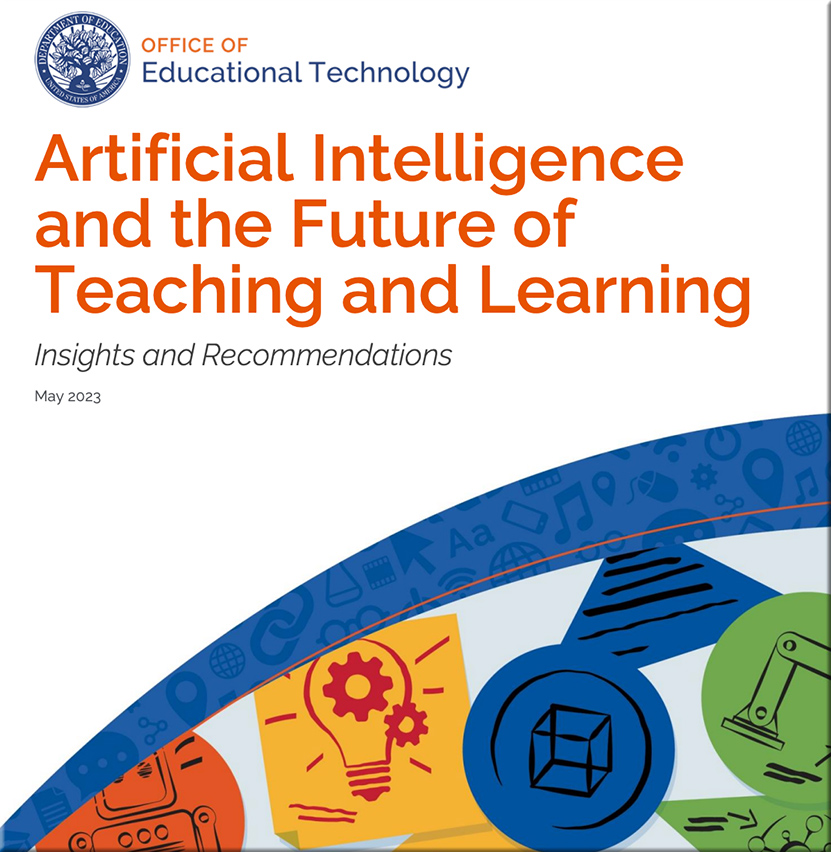
Artificial Intelligence and the Future of Teaching and Learning | Insights and Recommendations — with thanks to Robert Gibson on LinkedIn for this resource
Apple reveals new accessibility features, like custom text-to-speech voices — from techcrunch.com by Amanda Silberling
Excerpt:
Apple previewed a suite of new features today to improve cognitive, vision and speech accessibility. These tools are slated to arrive on the iPhone, iPad and Mac later this year. An established leader in mainstream tech accessibility, Apple emphasizes that these tools are built with feedback from disabled communities.
Assistive Access, coming soon to iOS and iPadOS, is designed for people with cognitive disabilities. Assistive Access streamlines the interface of the iPhone and iPad, specifically focusing on making it easier to talk to loved ones, share photos and listen to music. The Phone and FaceTime apps are merged into one, for example.
Accessibility Do’s and Don’ts for Website Navigation — from boia.org
Excerpt:
If people can’t navigate your website, they can’t use it — and you miss an opportunity to connect with your audience.
Navigation controls can present a significant barrier to people with disabilities, making it difficult for them to find and interact with the content they need.
The Web Content Accessibility Guidelines (WCAG) includes a list of success criteria to ensure that navigation controls are operable (they don’t require interactions that a user can’t perform). These criteria are put in place to assist users with a wide variety of abilities, including individuals who use assistive technologies (AT).
If you’re new to web accessibility, WCAG’s requirements may seem overwhelming. Fortunately, they’re based on simple principles — and by understanding a few basic concepts, you can avoid common mistakes.
Also relevant/see:
Assistive Technology: What’s an “Alternative Input Device?” — from boia.org
Examples:
- Eye-Tracking Systems
- Sip-and-Puff Systems
- Head Mouse
- Modified Keyboards
- Joysticks
Work Shift: How AI Might Upend Pay — from bloomberg.com by Jo Constantz
Excerpt:
This all means that a time may be coming when companies need to compensate star employees for their input to AI tools rather than their just their output, which may not ultimately look much different from their AI-assisted colleagues.
“It wouldn’t be far-fetched for them to put even more of a premium on those people because now that kind of skill gets amplified and multiplied throughout the organization,” said Erik Brynjolfsson, a Stanford professor and one of the study’s authors. “Now that top worker could change the whole organization.”
Of course, there’s a risk that companies won’t heed that advice. If AI levels performance, some executives may flatten the pay scale accordingly. Businesses would then potentially save on costs — but they would also risk losing their top performers, who wouldn’t be properly compensated for the true value of their contributions under this system.
US Supreme Court rejects computer scientist’s lawsuit over AI-generated inventions — from reuters.com by Blake Brittain
Excerpt:
WASHINGTON, April 24 – The U.S. Supreme Court on Monday declined to hear a challenge by computer scientist Stephen Thaler to the U.S. Patent and Trademark Office’s refusal to issue patents for inventions his artificial intelligence system created.
The justices turned away Thaler’s appeal of a lower court’s ruling that patents can be issued only to human inventors and that his AI system could not be considered the legal creator of two inventions that he has said it generated.
Deep learning pioneer Geoffrey Hinton has quit Google — from technologyreview.com by Will Douglas Heaven
Hinton will be speaking at EmTech Digital on Wednesday.
Excerpt:
Geoffrey Hinton, a VP and engineering fellow at Google and a pioneer of deep learning who developed some of the most important techniques at the heart of modern AI, is leaving the company after 10 years, the New York Times reported today.
According to the Times, Hinton says he has new fears about the technology he helped usher in and wants to speak openly about them, and that a part of him now regrets his life’s work.
***
In the NYT today, Cade Metz implies that I left Google so that I could criticize Google. Actually, I left so that I could talk about the dangers of AI without considering how this impacts Google. Google has acted very responsibly.
— Geoffrey Hinton (@geoffreyhinton) May 1, 2023
What Is Agent Assist? — from blogs.nvidia.com
Agent assist technology uses AI and machine learning to provide facts and make real-time suggestions that help human agents across retail, telecom and other industries conduct conversations with customers.
Excerpt:
Agent assist technology uses AI and machine learning to provide facts and make real-time suggestions that help human agents across telecom, retail and other industries conduct conversations with customers.
It can integrate with contact centers’ existing applications, provide faster onboarding for agents, improve the accuracy and efficiency of their responses, and increase customer satisfaction and loyalty.
From DSC:
Is this type of thing going to provide a learning assistant/agent as well?
A chatbot that asks questions could help you spot when it makes no sense — from technologyreview.com by Melissa Heikkilä
Engaging our critical thinking is one way to stop getting fooled by lying AI.
Excerpt:
AI chatbots like ChatGPT, Bing, and Bard are excellent at crafting sentences that sound like human writing. But they often present falsehoods as facts and have inconsistent logic, and that can be hard to spot.
One way around this problem, a new study suggests, is to change the way the AI presents information. Getting users to engage more actively with the chatbot’s statements might help them think more critically about that content.
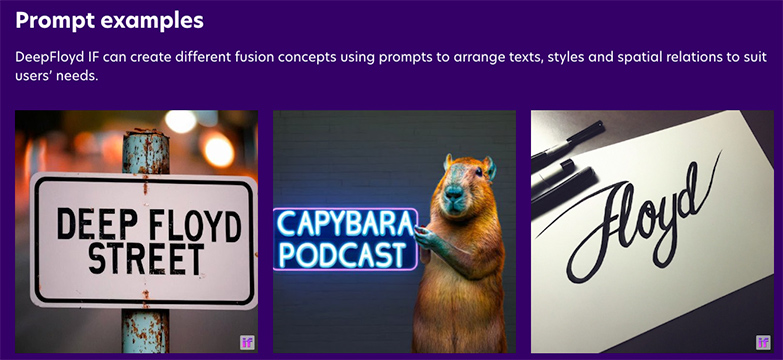
Stability AI releases DeepFloyd IF, a powerful text-to-image model that can smartly integrate text into images — from stability.ai
New AI Powered Denoise in PhotoShop — from jeadigitalmedia.org
In the most recent update, Adobe is now using AI to Denoise, Enhance and create Super Resolution or 2x the file size of the original photo. Click here to read Adobe’s post and below are photos of how I used the new AI Denoise on a photo. The big trick is that photos have to be shot in RAW.
DC: I wonder if this will come standard in the future. Nice feature.#accessibility https://t.co/vC4xoMLQYI
— Daniel Christian (he/him/his) (@dchristian5) April 24, 2023