


How to start teaching online in 2011 — Kirsten Winkler
On 03/28/2011,
in online tutoring, teaching online,
by Daniel Christian
On 03/25/2011,
in 21st century, 24x7x365 access, A/V -- audio/visual, Adobe, art, content development, aggregation, repositories, creativity, dangers of the status quo, Daniel S. Christian, digital audio, digital learning, digital storytelling, digital textbooks, digital video, ideas, instructional design, interactivity, interface design, learning ecosystem, learning spaces, media/film, multimedia, new media literacies, online learning, online media, presentations, quality, teaching & learning, teaching online,
by Daniel Christian
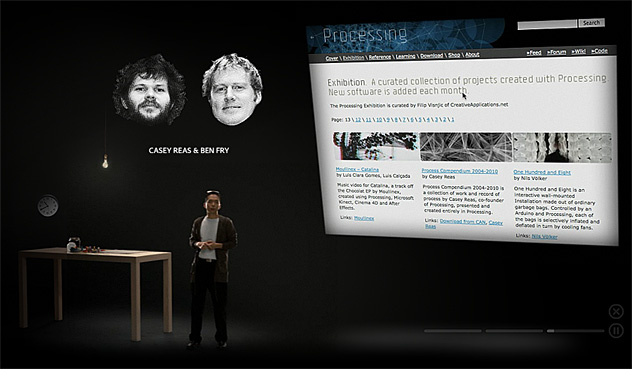
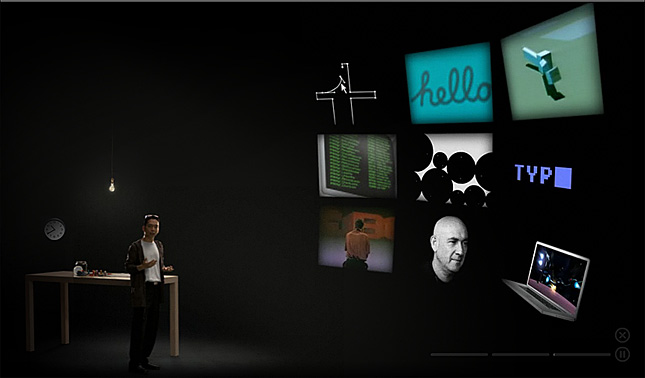
Adobe Museum of Digital Media, A lecture by John Maeda
From DSC:
If online courses could feature content done this well…wow! Incredibly well done. Engaging. Professsional. Cross-disciplinary. Multimedia-based. Creative. Innovative. Features a real craftsman at his work. The Forthcoming Walmart of Education will feature content at this level…blowing away most of the competition.




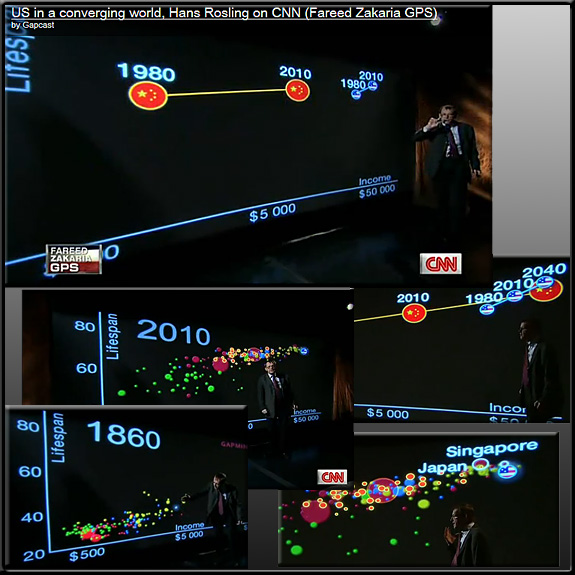
This is also true for materials like the item below!
On 03/23/2011,
in Australia, online learning, online media, teaching online, UK,
by Daniel Christian
Why is online teaching important? — originally saw this at creativityineducation.co.uk
.

.
Also see COFA’s series of videos:

On 03/03/2011,
in education technology, K-12 related, online learning, open courseware and systems, professional development, teachers, teaching online,
by Daniel Christian
Get connected to the online learning culture — from Edutopia.org
.

.
Professional Development: Starter Kit for Teaching Online
Get expert advice on how you can get started as an online educator.
Making the Case for Open-Source Textbooks
Futurist David Thornburg on why open-source textbooks have the advantage of being free of cost and provide greater value to the users.
Beyond Paper and Pencil
Technology expert Ben Johnson wonders how learning — and schools — would change if teachers stopped using paper.
On 02/24/2011,
in assessment, blogs / blogging / vlogging, digital audio, digital learning, digital video, education technology, multimedia, online learning, pedagogy, teaching online, tools,
by Daniel Christian
Evidence of learning online: Assessment beyond the paper — from CampusTechnology.com by Judith Boettcher
…learning designer Judith Boettcher examines online assessment strategies beyond the traditional end-of-term paper.
Excerpts:
Professional Work Products
- Written and audio communications of all types, such as press announcements, white papers, briefs, summaries, memos, project management documentation
- Creating and planning news events, such as announcements, interviews, or regular updates of interests, such as podcasts
- Setting up personal or group blogs within different contexts of leadership, business, etc.
- Setting up wikis for team projects, areas for monitoring developments
- Many more listed…
Interviews
The interview medium is a very flexible communication tool and can be used by both faculty and students for demonstrating understanding and eliciting the state of concept development. Here are some possible strategies that can require research, critical thinking, and writing.
- Learners identify an expert or a person of interest to them in a particular field germane to the course and then prepare the interview questions, do the interview, and then post the results
- Learners identify and interview the author of a textbook or article closely related to the course, possibly updating information critical to the course
- Many more listed…
Audio, Video, and Visual Projects
What about other media such as audio and video projects? Today’s learners live surrounded by audio and video and the tools that make it possible for everyone to create and produce audio and video products. Here are some of the possibilities with audio and video spaces.
- Podcasting resources now are very common so learners are familiar enough with the format to embrace creating audio and video podcasts of their own
- Video shorts and ad hoc documentaries engage learners and draw in their friends and families
- Creating and posting short reports via VoiceThread is another “writing space” to consider as are Flickr, YouTube, and Slideshare
Blogs
Blogs are a very underutilized writing space. Blogs share many characteristics with journals and thus can capture snapshots of what learners are thinking, and when; plus they often can also capture the sources of some of their thinking. Blogs help learners understand the growth cycle of learning new concepts and how and why they think the way they do. Here are some ideas on how blogs, both personal and class, might be used.
- Personal commentary and self-reflection
- Capturing thought processes and generating new ideas
- Assist learners in finding their “voice”
- Many more…
Wikis
- Collaborating on group and team projects of all kinds
- Capturing and developing ideas for solving critical problems and case studies and simulations
- Developing “featured” Bronze star Wikipedia articles on specific topics in particular disciplines
On 02/06/2011,
in adjunct faculty, change, cost of getting a degree, disruption, faculty/staff, global, higher education, internet, marketplaces, mobile learning, new business models, social learning / networks, teachers, teaching & learning, teaching online,
by Daniel Christian
‘Social teaching’ company bets buy-in from Capella Education — from The Chronicle by Josh Fischman
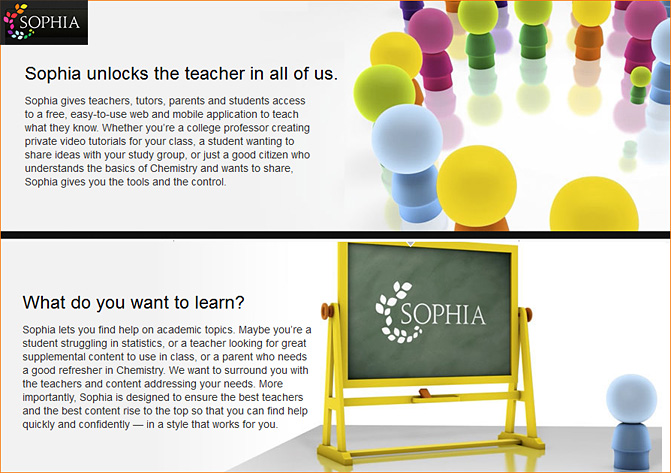
The basic idea behind Sophia is to identify the best teachers for any concept, put their instruction for that concept online, and students all over the world can use these “learning packets” free of charge. For example, a professor who has a really great lesson on how to factor polynomials can package that lesson—complete with video and any other materials—on Sophia, and search engines like Google will let students find it and use it.
From DSC:
Will the Forthcoming Walmart of Education turn out to be that we teach each other, free of charge? Online marketplaces and exchanges continue to appear; the game-changing environment — filled with disruption and change — continues to develop.
But know this, teaching is tough. It’s not easy, and it’s not an exact science; it’s also an art.
Our minds — and the ways in which we learn — are unbelievably complex. After decades of trying, scholars still do not agree on how we learn. There are numerous learning theories out there (still) and though we’ve come a long way, there are no silver bullets of the teaching and learning world.
So if you decide to be a teacher, you better get ready to spend some serious time honing your craft…otherwise, your ratings on these types of sites will plummet and few will see your modules/contributions. conversely, if you are an effective teacher, your ratings will reflect that and your contributions will be seen/linked to quite frequently — from people all over the world.
Also see:
On 01/28/2011,
in emerging technologies, journalism, teaching & learning, teaching online,
by Daniel Christian
Can journalism education rise to the challenge? — from Teaching Online Journalism by Mindy McAdams
Excerpt:
Most journalism programs face the same challenges:
- How to find, employ and retain faculty who are comfortable teaching new skills and techniques.
- How to provide equipment and software to students (especially with shrinking budgets).
- How to keep up with a rapidly changing field.
- Perhaps most important: How to determine the best ways to prepare the journalists of tomorrow—our students.
Overall, considering programs of every size and at every kind of four-year college and university, I would say that just about everyone needs to do better. Yet the core issue really is that final point on my list—and I think every journalism program can address that and come up with satisfying answers.
Seek out new exemplars
The first step in determining the best ways to prepare the journalists of tomorrow is to go beyond traditional journalism organizations. Don’t look only at what newspapers, magazines, and radio and television news organizations are doing…
On 12/10/2010,
in career development, elearning, game-changing environment, K-12 related, online learning, professional development, teachers, teaching online,
by Daniel Christian
.
Also see:
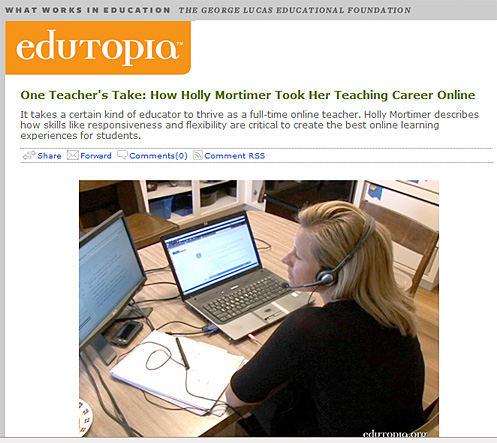
- The online learning story — from Edutopia.org
On 12/03/2010,
in 21st century, 24x7x365 access, marketplaces, online learning, personalized/customized learning, teaching online,
by Daniel Christian

On 11/23/2010,
in A/V -- audio/visual, cloud-based computing / apps / other cloud-related, digital audio, digital learning, digital photography, digital storytelling, digital textbooks, distance education, homeschooling/homeschoolers, innovation, internet, media/film, mobile learning, multimedia, music, online learning, online media, online tutoring, podcasting, teaching online, technologies for your home, workplace,
by Daniel Christian
Cutting the Pay TV Cord, Chapter 5: Unlimited Internet TV — from Phil Leigh

In short, often there is no reason why modern flat panel TV screens cannot function as giant monitors for up-do-date computers.
Thus a growing number of us are attaching computers to our TVs. The trend is especially prevalent for WiFi enabled computers because they can connect over a home network and thence to the Internet. In such configurations computers – commonly dedicated laptops – function as Internet gateways for televisions. They transform TVs into dual function devices normally controlled from a comfortable viewing distance with ordinary TV remote units.
Also see:
- Cutting the Pay TV Cord, Chapter 4: Broadcast Reception
- Cutting the Pay TV Cord, Chapter 3: Televisions
- Cutting the Pay TV Cord, Chapter 2
- Cutting the Pay TV Cord, Chapter 1
If you’re tired of paying for television service you’re not alone. The number of domestic pay TV subscribers declined for the first time ever at the end of the June, 2010 calendar quarter. The drop was about 200,000. It declined again at the end of the September quarter by an estimated 100,000. Since there are over 95 million pay TV subscribers, the industry publicly minimizes the significance of the trend reversal. But they are wrong to do so. It’s been a growth business for half a century. It’s run its course and Internet video is the successor.
On 11/15/2010,
in Daniel S. Christian, leadership, online learning, strategy, teaching online, using teams,
by Daniel Christian
From DSC:
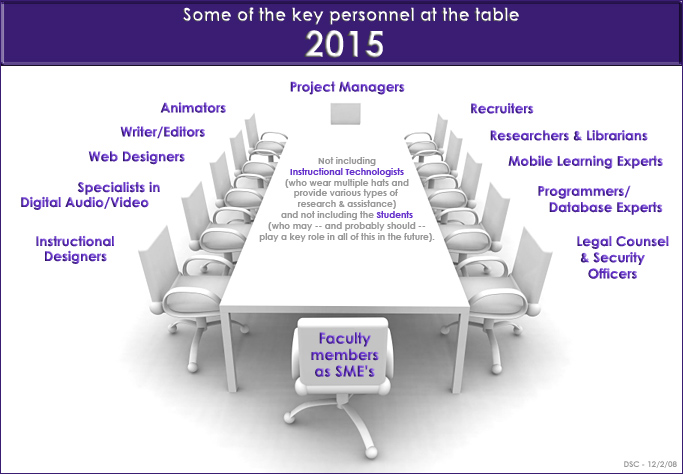
I have it that higher education has reached the point where we need teams of specialists to create and deliver the content. (This is probably also true for K-12 as well.) If we want to engage the (already developing) new type of student these days, things have become far too complex for one person to do it all anymore.
- You don’t walk into a hospital and only see one type of doctor listed there.
- You don’t see only one person’s name who was responsible for building that spectacular new building on your campus.
- The credits at the end of any major motion picture don’t show one person’s name.
- The list goes on and on.
Often, for complex endeavors, we need teams of people.
To be fair…given that we use textbooks created by publishers, I suppose that we already employ teams of people to a significant extent…but it is not enough…at least not yet. This point was brought home to me again while reviewing the article, Online Education: Budgets, Leadership Changes Drive Restructuring by David Nagel. David states that “the vast majority of online program managers claimed in a recent survey that faculty resistance is a significant hindrance to the expansion of their online education programs.”
This should not come as a surprise for several reasons (at least):
1) Faculty may not have taken a course online themselves yet. They may not have personally experienced this manner of teaching and learning. They may not have seen how effective it can be (if it’s done well and properly).
2) Secondly, it must be very difficult to invite other people to the table or to let others bring their chairs up to the table.
3) Thirdly, and more of my focus here, is that learning how to teach online is a new ball game — requiring a variety of skills and interests — of which few have all of the skills and interests involved and none have all of the necessary time required. Teaching an effective online course requires a great deal of time and work to understand what’s possible in that particular teaching and learning environment, and which tools to use when, and to pull together the resources needed to create effective, engaging, multimedia-based online-based materials for the first time. Heck, we instructional technologists struggle to keep up here, and it’s but one piece of the puzzle.
The problem is, with this new environment, a whole new set of skills are necessary, as captured in this graphic I created a while back:
In citing why restructurings are so prevalent, the following caught my eye:
- Most (59 percent) cited budget issues, while 38 percent also cited coordination of instructional resources as factors

.
Now that “coordination of instructional resources” probably covers a variety of needs, requirements, and goals. But one of those goals/needs, at least in my mind and based upon my experience, is the need to create a team of specialists.
No longer can we expect to be able to put everything on the plate of one person. Because rare will that faculty member be who has the all the new prerequisite interests and abilities and software and hardware. And if they are that good, they won’t have the time to do it all anyway.
On 10/20/2010,
in 21st century, Adobe, Apple, blogs / blogging / vlogging, cloud-based computing / apps / other cloud-related, CMS/LMS, collaboration, corporate / business world, corporate universities / corporate training, creativity, digital audio, digital learning, digital photography, digital storytelling, digital textbooks, digital video, e-readers, education technology, emerging technologies, engagement / engaging students, higher education, K-12 related, learning ecosystem, mobile learning, mobile technologies, multimedia, new media literacies, online learning, online media, open courseware and systems, platforms, podcasting, presentations, productivity / tips and tricks, social learning / networks, social media, storytelling, student-related, teaching & learning, teaching online, tools, training / L&D, UK, United States, videoconferencing, web-based collaboration, workplace,
by Daniel Christian
Top 100 Tools for Learning 2010: Final list, presentation and more — from Jane Knight
Yesterday I finalised the Top 100 Tools for Learning 2010 list. Many thanks to the 545 people who shared their Top 10 Tools for Learning and contributed to the building of the list. Although this list is available online, I also created this presentation which provides the information as a slideset – embedded below.
Jane Hart, a Social Business Consultant, and founder
of the Centre for Learning & Performance Technologies.
On 10/18/2010,
in blended learning, education technology, hybrid learning, online learning, online media, teaching online, web-based collaboration,
by Daniel Christian
.
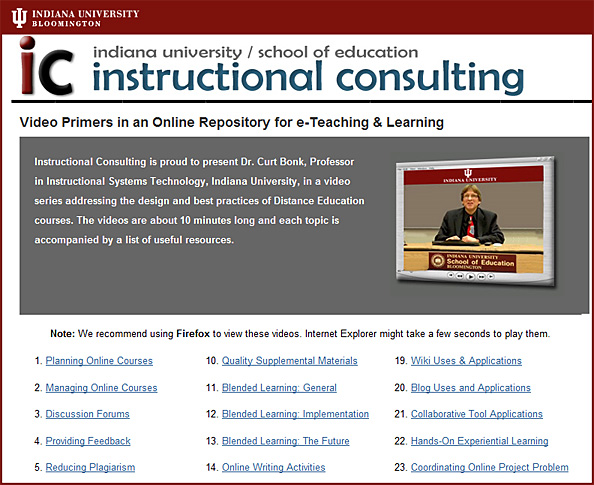
Resource from George Siemens who mentions:
I recently encountered this group of 27 online teaching and learning video resources, featuring Curt Bonk. Each video runs approximately 10 minutes and serves as an introduction to key ideas in planning and delivery technology enhanced learning.
On 10/18/2010,
in copyright/ownership/NFTs, teaching online,
by Daniel Christian
Intellectual property, copyright, and harassment: Navigating the murky legal waters of online teaching — from FacultyFocus.com by Mary Bart