E-Learning 2010: E-Educators Evolving — from EducationWeek.com (9/20/10)

This special report, the second in a three-part series on e-learning, aims to answer questions related to the growing role of e-educators in K-12 education. It provides perspectives and advice from state policymakers and virtual school providers navigating through the new and often murky policy waters of online-only education, and features insights from e-educators in the trenches of virtual schooling.

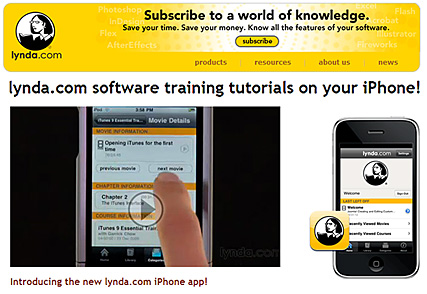
We use Lynda.com and the feedback has been excellent. Back in 1997, I took a 1-day seminar from Lynda Weinman out at SFSU’s Multimedia Studies Program. I learned more from her in a few hours then I have in many courses. She knows how to make things very understandable…and she’s a great teacher. If she doesn’t know the topic, she selects people who know how to explain that topic in easy-to-understand terms.

So when I saw this item — Connect@NMC: Panel Discussion Led By Laurie Burruss of Lynda.com – Implementing Lynda.com Campus-Wide — I felt that I should pass it along.

.

Watch out for the digital trees — from odysseyware.com

For the first time ever, iNACOL (International Association for K-12 Online Learning) teamed up with the SREB (Southern Regional Education Board) to honor an “outstanding online teacher for exceptional contributions to online K-12 education as the nation’s K-12 Online Teacher of the Year.”

Teresa Dove, a Virginia math teacher, was chosen from more than 50 nominations of online educators in public schools and state virtual schools nationwide.

Dove said after receiving the award that teaching online allows her to spend much more time working individually with students than she did previously in a traditional classroom. Spending only a moment with students in a traditional classroom is “not enough, and our kids deserve better,” she said.

What struck me most about this award, was the advice Dove offered to online teachers as reported in an article from eClassroom News. When asked about her success, she didn’t talk about technology or the way to deliver information in an online format. She didn’t talk about how to create lessons that “translate” in the digital format.

She offered five lessons – practices – that make her effective. All of them were about relationships.

More here…

Good Teaching: The Top 10 Requirements — from Faculty Focus by Richard W. Leblanc

A Top Ten List for Successful Online Courses — Journal of Online Learning and Teaching (JOLT)

Abstract
Many of us have been teaching online courses for several years. In that time we have learned what works and what doesn’t from a mix of hands-on-experience, fellow online faculty, platform specific training, and exposure to pedagogical research. While training and research have their value, we learned the most about preparing an effective online course from personal experience and working with our peers. When asked to prepare a presentation for new online faculty we sat down and pooled our knowledge with respect to course design and course management. The result of this collaborative session was a list of pragmatic practices required for a successful online course. While the list could be longer, and certainly doesn’t include all our favorite practices, we believe we have included those practices that are the key to success.
Checklist for Evaluating Online Courses (2006).
Southern Regional Education Board.
http://publications.sreb.org/2006/06T06_Checklist_for_Evaluating-Online-Courses.pdf
…
Online course evaluation rubric. (2007).
The online course evaluation project (OCEP) criteria. Monterey Institute for Technology and Education.
http://alt.usg.edu/collaborative/templates/OnlineCourseEvaluationRubric.pdf
…
The online course evaluation project (OCEP) overview. (2006).
http://www.montereyinstitute.org/pdf/OCEP%20Evaluation%20Categories.pdf

E-Learning Journals — from e-taalim.com[via S. Downes]

Tagged with: • • •  

Arizona State launching online credential for online teaching — from The Journal by Dian Schaffhauser (06/21/10)

Arizona State University has expanded its online degree and certification programs for PK-12 teachers, including the addition of a new credential for online teaching. Tuition will be the same whether the student is in state or out of state.

Beginning with the fall 2010 semester, six new programs in the education area will be available completely online. Arizona preschool and kindergarten teachers will also have the opportunity to fulfill their early childhood education certification requirement online in order to meet a state department of education July 2012 deadline.

Tagged with: • •  

‘Virtual’ internships prepare student teachers for new world of online schooling — from University of Florida, via Virtual School Meanderings blog

From DSC:
This brings up some very interesting points and questions. If K-12 education continues to use more online learning:

  • Shouldn’t colleges of education be teaching their students how to teach in an online environment? Or at least in a blended-learning environment?
  • Should students who are studying to become educators be asked to specialize in either face-to-face-based teaching, or teaching online, or teaching in blended learning environment?
  • Or should they get exposure to f2f, online and blended as part of that education…?

Hmmm…I’m not sure. But I don’t think we can expect to make as much progress if our colleges of education aren’t adapting to the changing learning environment out there.

Tagged with: •  

Wimba Connect 2010


Wimba Connect 2010 — check out the applications of these tools


OPENING KEYNOTE
Carol Vallone, CEO, Wimba


Teaching Math & Sciences
with Wimba (Panel)Andrew Byrne & Kurt Mederer, Convent of the Sacred Heart; David Tao, Santosh Madhavan & Dan Lim, Florida Hospital College of Health Sciences; Michele Barbeau & Kem Rogers, The University of Western Ontario

Using Wimba to Engage and Empower an Academic Community of Learners: The Case of the Global Citizen
Linda Ralston & Rebekah Grow, University of Utah

Faculty Development Wimba Style
Janet Welch & Stacey Mateika, Red Deer College

Using Wimba Voice, Pronto, and Create in Synchronously in Wimba Classroom and Asynchronously in an Online Environment
Brooke Eberwine, Steven Frecka & Jamie Westyn, OHDELA

Small Scale Implementation of Wimba Classroom – The Possibilities Are Endless
Regina Bobak & Julie Wolfe, Bloomsburg University of PA

Language Learning with Wimba (Panel)
Teresa MacKinnon, University of Warwick Language Centre; Ana Garcia Allen, The University of Western Ontario; Barbara Cohen, Berkeley College

Wikis, Wimbas, Whatevers! What Teachers Weave!
Jane Overmoe, Dakota Prairie HS

Taking the Troy Colloquium Online + Wimba: The Solution to Quality Online Learning
Gayle Nelson & Peter Paige, Troy University

Wimba Product Presentation
Annie Chechitelli, Wimba

Presentations Live or On-the-Go with Wimba Classroom MP4 Archives
Jason Rhode, Northern Illinois University & Larry Holland, University of Arkansas at Little Rock

NCVPS Cultural Cafe
Thomas Moncrief, North Carolina Virtual Public School

Our Journey: From Face 2 Face 2 Online Masters Degree
Gary Shouppe & Tom McCormack, Columbus State University

So Many Choices, So Little Time: Effective Voice Tools Training
Stacey Powell & Kathy McClelland, Auburn University

Features, Technical Problems and Technical Support in Higher Education Wimba Classrooms
Mary Nell McNeese, Amy Thornton & Jalynn Roberts, University of Southern Mississippi

ALAKAZAM!!! Instantly Transform your Physical Classrooms into Lecture Capture Spaces Using Wimba!
Scott Smith & Brian Reed, Wimba; Mark Burris, Michael Merritt & Linda Stauffer, University of Arkansas at Little Rock

Using Wimba to Prepare for H1N1 and other Potential Disasters (Panel)
Phil O’Hara & Tim Fedak, Dalhousie University; David Tao & Dan Lim, Florida Hospital College of Health Sciences

Diminishing the Distance in Distance Ed – Wimba’s Live Tools: People Reaching People
Crystal Havely Stratton & Patricia Landy, Laramie County Community College

“Keep It Live” – What the Students Say!
Mike Scheuermann, Drexel University

Wimba Pronto 4 All: Pronto Invitations and Universal Integration
Marlen Rattiner & Chris Dixon, Wimba

Online Learning is all about Collaboration!
Mark Gensimore, Jed Friedrichsen & blendedschools.net

Bringing In Local and Global Guest Speakers through Wimba Classroom
Chunyan Song , Ann Steckel & Laura Sederberg, California State University, Chico

Envelop, Develop: Building a Statewide and College-Level Professional Development System with Wimba and your LMS
Terry Pollard & Christian Pruett, Mississippi SBCJC; Rebecca Butler, Northwest Mississippi Community College; Jennifer Nowotny, Wimba

Where Did My Wimba Go and Do Users Know It’s Missing?
Michael Rogers & Jim Wolfgang, University System of Georgia; Sean Hessenthaler, Wimba

The Professor is In: Lessons Learned in Delivery of Online Student Support
Michelle Escudier & Sharon Davis, Central Texas College

Pet Kangaroos and Other Tall Tails – Live and MP4 Examples, Best Practices and Case Studies on Using Wimba Down Under
Steve Watt & Thalia Cosmidis, NetSpot Pty Ltd

Reaching Over Wall: Linking Kindred Spirits via Live Web Conferencing
Phil O’Hara & Corinne Tobin, Dalhousie Unversity; Paul Lowe, University of the Arts London

Collaborating With Students – A Glimpse of the Future With Blackboard
Brian DeKemper, Solutions Engineer, Blackboard

The Blended Language Learning Consortium (presented remotely)
Paul Snookes & Judy Barker, University of Worcester

Bringing Wimba out of the Web and into the Classroom
Bryan Vandiviere, Kansas State University

Wimba Classroom Beyond Classes
Cory Stokes, Univeristy of Utah & Edwin Perez, Wimba

The Power of Wimba 6.0 Archives: Developing and Editing the Archive Library
Jun Yang, University of Maryland

From the Lands Down Under – Wimba Firing Up Staff and Students in Australia and New Zealand
Lisa Ransom & Oriel Kelly, Manukau Institute of Technology; Kerry Trabinger, Canberra Institute of Technology

A Triple Threat to Student Attrition: Three Disciplines, Three Perspectives, and Three Uses of Wimba Classroom to Improve Student Retention
Monica Brooks, Tracy Christofero, Karen Mitchell, & Marty Laubach, Marshall University

High Impact Pedagogy: Bringing Online and Blended Courses to ‘Life’ through Learning Simulation and Wimba
Kristen Betts, Drexel University

Video, Vodcasts, and YouTube – Oh My!
Sarah Bryans Bongey & Chery Takkunen, The College of St. Scholastica

Online Education and the Power of Web 2.0 for Student Retention
Felice Nudelman, The New York Times / Epsilen

The Ways Wimba Classroom Can Revolutionize the Offering of Online Degree Programs
Daniel Powell, University of Alabama School of Law

Using Breakout Rooms to Foster Faculty Development
Ann Morgan, Kelly Kist & Heather Zink, Rasmussen College

Computer Science “eXperience:” Using Wimba Tools to Enhance Computer Science Education
Adel Abunawass, Alexandra Young & Edwin Rudolph, University of West Georgia

The Virtual Student Experience: Addressing Emotional & Multiple Intelligences & Soliciting Student Feedback
Dawn Muhammad, Calumet College of St. Joseph & H. Jean Bryan, Ed.D., DePaul University

CLOSING KEYNOTE BY JEFF NOEL, THE DISNEY INSTITUTE
Jeff Noel, The Disney Institute


Poster Presentations

  • Online Office Hours: How I Get Them To Attend
    Lyndasu Crowe, Darton College
  • Enhancing Student/Instructor Interaction in the Online Environment through Podcasting
    Heather Zink, Rasmussen College
  • Mastering the Point: Using Wimba Live Classroom with Effective PowerPoint Presentations to Enhance Online Learning
    Sue Burris, National Park Community College
  • Unleashing Wimba: Letting Students Take Control. A case study in providing webinar technology for students to facilitate group work.
    Laurie Grosik, Indiana University of Pennsylvania & Cori Dunagan, Edinboro University
  • Building Tech Capacity in a Non-Profit Collaborative Using Wimba Classroom
    Bruce Roxburgh, Green Communities Canada

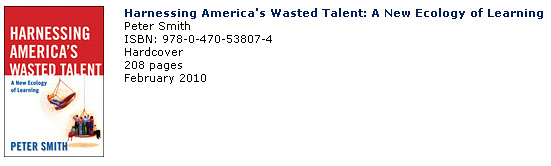
Harnessing America’s Wasted Talent — from Peter Smith

Harnessing America's Wasted Talent

“President Obama offered America and the world renewed hope for a better tomorrow. With decades of experience in alternative forms of higher education, Peter Smith grabs that optimistic spirit and seizes the moment to reveal to us the exciting age of Web-based teaching and learning, which is opening access to untold numbers of learners while harnessing the previously wasted talents of millions of people in America and billions around the world. Those seeking insights, a vision of the future, and a chance to join this educational revolution should look forward to Harnessing America’s Wasted Talent.”
—Curtis J. Bonk, professor, Indiana University, and author, The World Is Open: How Web Technology Is Revolutionizing Education

“Anyone who wants to understand where American higher education is headed should read Harnessing America’s Wasted Talent. Peter Smith’s vision of the future of higher education is based on several decades of experience—at the national, state, and international levels. He brings a rare perspective that will interest students, educators, politicians, and those American business leaders who are worried about the future of our workforce and the health of our democracy.”
—Charles Kolb, president, The Committee for Economic Development

“Harnessing America’s Wasted Talent is a must-read for those of us concerned about the increasing economic and education gaps in our country. Peter Smith takes on an important American disconnect: the need for an educated workforce and the fact that most working Americans lack a college degree. Drawing upon his experience in higher education and politics, Smith dissects the problem and presents a contemporary, practical plan to enhance the learning capacity of our country.”
—Joseph B. Moore, president, Lesley University


Table of Contents


Part One: The Law of Thirds.

1 Wasted Talent.

2 Maxed Out: Why Colleges Can’t Meet This Challenge.

3 The Paradox of Personal Learning.

Part Two: Dangerous Conceits.

4 Different Strokes for Different Folks.

5 Learning Is More Than “Strictly Academic”.

6 You Can’t Get There from Here.

Part Three: From Access to Success: A New Ecology of Learning.

7 The End of Scarcity: Education’s Emerging Long Tail.

8 Game Changers: New Media and the Open Education Resource Movement.

9 Reaching the Middle Third: Talent-Friendly Colleges for the Twenty-First Century (C21Cs).

Conclusion: A New Ecology of Learning.

Tagged with: • •  
© 2025 | Daniel Christian