Academic Partnerships

Excerpt from their Value Proposition page:

The concept of a broad based, highly educated population began its journey to reality a 150 years ago, when Abraham Lincoln signed the Morrill Act in 1862. The Act called for the establishment of “at least one College in every state upon a sure and perpetual foundation, accessible to all, but especially to the sons of toil” (emphasis DSC).

…

Despite the unprecedented success of America’s public university system that is the envy of the world, reduced state and federal funding, almost a trillion dollars in student loans, tuition soaring out of reach for middle class families, stunning demographic changes and declining preparedness for college-level work, today’s public higher education is at a crossroads. Our old ways of doing business are no longer sustainable and the promise of the Morrill Act is in peril (emphasis DSC).


Also see:

Indiana U. helps shape economic terms of eText transition — from convergemag.com by Tanya Roscorla

Excerpts:

As course material shifts from print to digital, Indiana University advocates on behalf of students for lower prices, more choices and common software platforms.

…

Based on feedback from students and faculty, Courseload rewrote the platform in HTML5 this summer.

…

When the university asked students why they liked e-textbooks better, 69 percent cited instructor annotations, followed closely by sustainability, cost, weight of books and student annotations.


Pearson acquires Connections Education
Gains leading position in fast-growing market for virtual schools

Excerpt:

(PRWEB) September 15, 2011
Pearson, the world’s leading learning company, [announced on 9/15/11] the acquisition of Connections Education from an investor group led by Apollo Management, L.P.

Through its Connections Academy business, the company operates online or ‘virtual’ public schools in 21 states in the US—serving more than 40,000 students in the current school year. These virtual charter schools are accredited and funded by the relevant state and are free to parents and students who choose a virtual school in place of a traditional public institution or other schooling options.

Virtual schools serve a diverse population of students including those who may be gifted, struggling, pursuing careers in sports or the arts, in need of scheduling flexibility, or who have chosen home schooling. It is a large and rapidly-growing segment in US K-12 education: in 2010, 48 states and Washington, D.C. had virtual school programs and 27 states allowed virtual charter schools. Approximately 200,000 students attended full-time online courses and an estimated 1.5 million students took one or more courses online. (Source: Keeping Pace with K-12 Online Learning, 2010, Evergreen Education Group).

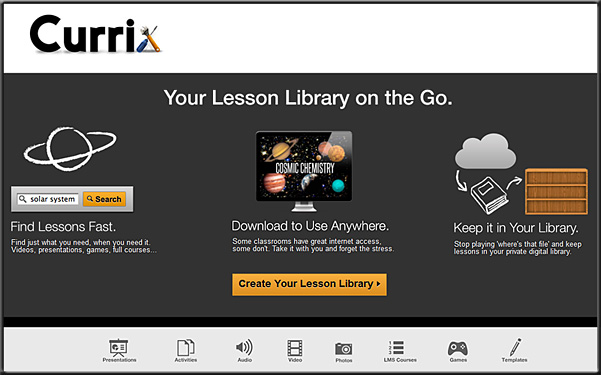
Currix.com: The Place to Buy and Sell Digital Content for Innovative Education — from Currix.com; originally saw this at Audrey Watters blog

Excerpt from Audrey’s article:

Currix is launching its beta today, aiming to become a destination for teachers to discover just these sorts of resources. It’s also a marketplace for this content: teachers will be able to monetize the lessons, activities, logos and more that they upload there. The prices range from free to a few dollars for activities to up to several hundred dollars for entire courses.

Also see:

http://www.currix.com/


From DSC:
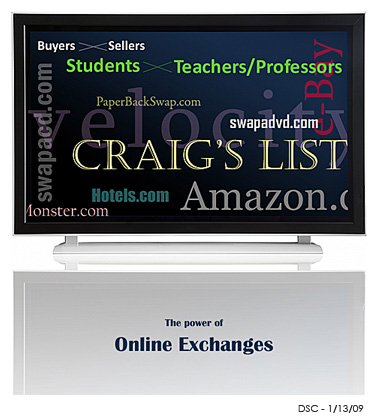
This reminds me of a graphic I periodically post:

The Power of Online Exchanges


Yale pushes online frontier — from Yale Daily News by David Burt, Drew Henderson [originally saw this at Ray Schroeder’s blog]

Excerpt:

Three Yale Summer Session professors taught their course material not only to students in New Haven, but also to their classmates thousands of miles away.

For the first time this summer, Yale Summer Session offered three online courses, two of them for Yale credit, in which students watched recorded lectures and joined live discussion sections with their professors and online classmates via video chat. With “uniformly positive” feedback from students and faculty, the University is now looking to expand this summer’s program for next summer, though Yale Summer Session Dean William Whobrey said there are no plans to use the technology during the academic year.

Resources for finding out how long it takes to develop eLearning — from kaplaneduneering.com by Karl Kapp

From DSC:
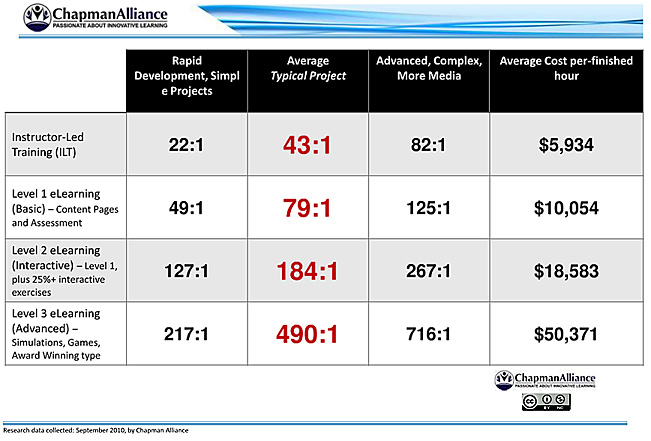
One resource mentioned was from the Chapman Alliance, from September 2010, of which these figures are from:


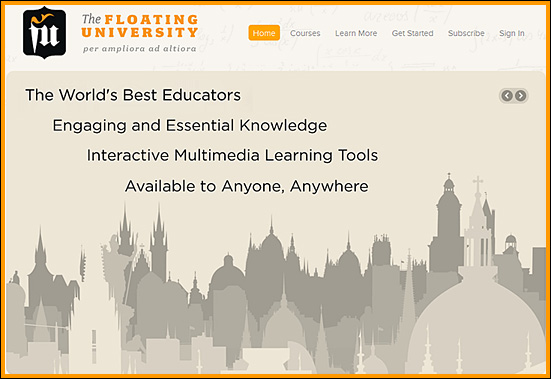
The Floating University

From their website:

Great Big Ideas delivers the key takeaways of an entire undergraduate education. It’s a survey of twelve major fields delivered by their most important thinkers and practitioners. Each lecture explores the key questions in the field, lays out the methods for answering those inquiries and explains why the field matters. It is an effective introduction to thinking differently, and a primer in the diverse modes of problem solving essential for success in the 21st century.

A wide range of subjects are covered including Psychology, Economics, Biomedical Research, Linguistics, History, Political Philosophy, Globalization, Investing and more. Within each topic, we will discuss the most current, innovative ideas in the field, dissect them, and look at how they impact not only the world-at-large, but our own lives as well. How does Demography predict our planet’s future? How is Linguistics a window to understanding the brain? What are the fundamentals of successful Personal Finance and Investing? Each of these lectures will be presented by top experts from top institutions around the country.

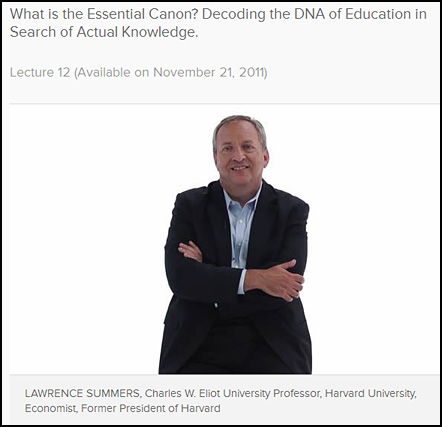
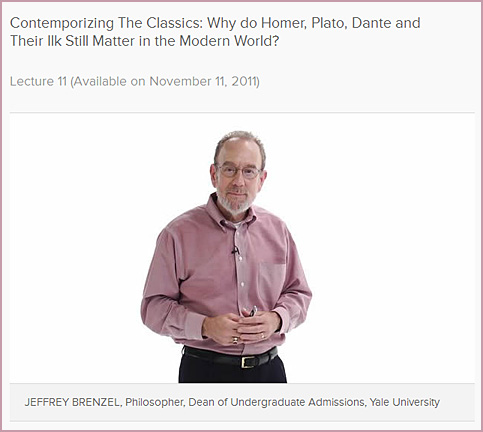
Two example lectures:


From DSC:
I post this not because I believe they have the world’s best educators — they may or may not.  But rather, I post this to:

  1. Provide a great resource for those who love to learn — i.e. lifelong learners
  2. To show another example of the disruption that technologies / the Internet bring to higher education.  Such technologies bring affordable, new models and  learning opportunities into the higher ed landscape in a big way.


Also see:


From DSC:
I was originally going to write this blog posting back in late July, when I read the first paragraphs of a solid article by Laura Pappano at the New York Times entitled, “The Master’s as the New Bachelor’s.”  At that time, I couldn’t help but think…“Houston we have a problem.”

(Disclosure: I completed my Master’s of Science in
Instructional Design for Online Learning in June 2011 from Capella University.)

Excerpt:

William Klein’s story may sound familiar to his fellow graduates. After earning his bachelor’s in history from the College at Brockport, he found himself living in his parents’ Buffalo home, working the same $7.25-an-hour waiter job he had in high school.

It wasn’t that there weren’t other jobs out there. It’s that they all seemed to want more education. Even tutoring at a for-profit learning center or leading tours at a historic site required a master’s. “It’s pretty apparent that with the degree I have right now, there are not too many jobs I would want to commit to,” Mr. Klein says.

Then, fast forward to today when I was further reminded to contact Houston Command Control Center (metaphorically speaking) when I read Jennifer Lee’s article in today’s New York Times entitled, “Generation Limbo: Waiting It Out“.

Excerpt (emphasis DSC):

“We did everything we were supposed to,” said Stephanie Morales, 23, who graduated from Dartmouth College in 2009 with hopes of working in the arts. Instead she ended up waiting tables at a Chart House restaurant in Weehawken, N.J., earning $2.17 an hour plus tips, to pay off her student loans. “What was the point of working so hard for 22 years if there was nothing out there?” said Ms. Morales, who is now a paralegal and plans on attending law school.

Some of Ms. Morales’s classmates have found themselves on welfare. “You don’t expect someone who just spent four years in Ivy League schools to be on food stamps,” said Ms. Morales, who estimates that a half-dozen of her friends are on the Supplemental Nutrition Assistance Program. A few are even helping younger graduates figure out how to apply. “We are passing on these traditions on how to work in the adult world as working poor,” Ms. Morales said.

…

The journey on the life path, for many, is essentially stalled.


The reasons that I say that we have a problem here in the world of higher education are probably already clear, but to further elaborate on them (with the lenses of my past experience):

  1. Why should I pay ~$55,000 a year — $54,763 for just the 2011-2012 academic year — to go to Northwestern University, only to find out that my $220,000+ investment doesn’t land me an excellent, top-rate job? Are we saying that a degree from NU’s College of Arts & Sciences (CAS as it was known in my day) is not enough of an investment to get a good job? Are we now saying that I need another degree before I can start paying off my ever-mounting debt? (i.e. that gorilla on my back that continues to gain weight and has implications for the types of jobs that I now have to go for, whether I like them or whether I am gifted for them or not)
  2. How convenient for corporate HR and hiring managers to be able to ask for the moon yet again — while often not lifting a finger to help these students/potential employees pay for that education! My experience was that corporations always wanted to have their new employees hit the ground running.  But with a crowd of people applying for each open position these days, I would be very interested to see the data on:
    • What % of today’s corporations are actively helping folks obtain the advanced degrees that they are requesting?
    • What % of the time these corporations do this?
    • What % of their employees do such corporations provide this type of assistance for?
    • What % of the degree — or up to what $$ amount — do they pay for?
      .

      Perhaps it is all to easy and convenient — and good for shareholders — during tough economic times to place all of the burden on the backs of the students/future employees; perhaps there are few incentives for companies to change the way the game is played.

      .
  3. Speaking of incentives…how convenient for higher education to go along with this trend as well.  After all, who wouldn’t want to support an environment that contributes to continued enrollments?


So…that’s why I say, “Houston, we have a problem.”

  • This type of phenomenon and economic environment seems to be stoking the growing dissatisfaction against the costs involved with obtaining a degree within higher education and the perceived/real return on such an investment.
  • Though “times might have been good” these last few decades, such times may be coming to an end; change is in the air..
  • How should we respond within higher education? Within the corporate world? How can we help more students/prospective employees obtain their college degrees?


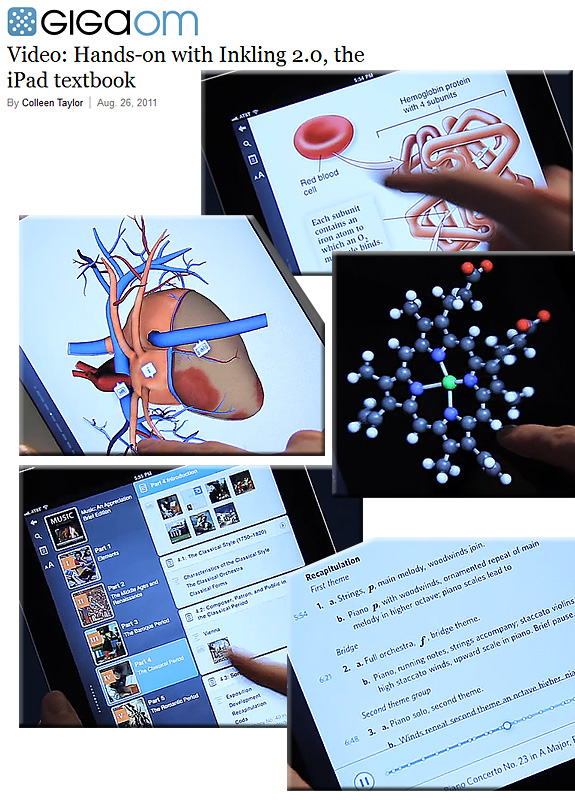
Video: Hands-on with Inkling 2.0, the iPad textbook — from gigaom.com by Colleen Taylor; my thanks go out to Mr. Johnny Ansari for this resource


A screenshot from GigaOM’s video demo of Inkling 2.0

Excerpt:

This week, digital publishing startup Inkling debuted the 2.0 version of its software, which provides interactive, digital versions of college textbooks for the iPad.

The San Francisco-based startup is just down the street from GigaOM’s office, so I headed on over to Inkling headquarters on Thursday to get an in-person demo from the company’s Founder and CEO Matt MacInnis. In short: It’s so awesome it actually makes me want to buy college textbooks again, just to play with the app some more.


From DSC:
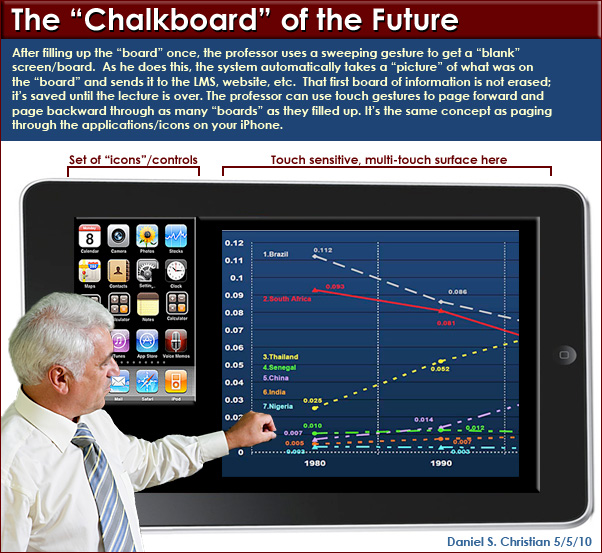
Why can’t these materials from publishers come right into an  8′ x 6′  “interactive whiteboard” (for lack of a better term) so that the professor can annotate/manipulate them in front of the classroom?

See:

Daniel Christian: The Chalkboard of the Future

and here


The impact of new business models for higher education on student financing

Financing Higher Education in Developing Countries
Think Tank | Bellagio Conference Centre | 8-12 August 2011

Sir John Daniel (Commonwealth of Learning)
&
Stamenka Uvali-Trumbi (UNESCO)

Excerpt:

The aim of this paper has been to suggest that in discussing student financing we need to look beyond the current standard model classroom teaching to the likely developments in learning systems over the next decade. These have the potential to cut costs dramatically and thereby lessen the challenge of student financing.

That is fortunate because nearly one-third of the world’s population (29.3%) is under 15. Today there are 165 million people enrolled in tertiary education.[2] Projections suggest that that participation will peak at 263 million in 2025.[3] Accommodating the additional 98 million students would require more than four major campus universities (30,000 students) to open every week for the next fifteen years unless alternative models emerge. (emphasis DSC)

Also see:

OER for beginners: An introduction to sharing learning resources openly in healthcare education
The Higher Education Academy (HEA) (www.heacademy.ac.uk) and the Joint information Systems Committee (JISC) (www.jisc.ac.uk) are working in partnership to develop the HEFCE-funded Open Educational Resources (OER) programme, supporting UK higher education institutions in sharing their teaching and learning resources freely online across the world.

Steve Jobs has resigned as Apple CEO "effective immediately"


From DSC:
I want to post a thank you note to Mr. Steven P. Jobs, whom you most likely have heard has resigned as Apple’s CEO. Some articles are listed below, but I want to say thank you to Steve and to the employees of Apple who worked at Apple while he was CEO:

  • Thank you for working hard to enhance the world and to make positive impacts to our world!
  • Thank you for painstakingly pursuing perfection, usability, and excellence!
  • Thank you for getting back up on the horse again when you came out of a meeting with Steve, Tim and others and you just got reamed for an idea or implementation that wasn’t quite there yet.
  • Thanks go out to all of the families who were missing a dad or mom for long periods of time as they were still at work cranking out the next version of ____ or ____.
  • Thanks for modeling what a vocation looks like — i.e. pursuing your God-given gifts/calling/passions; and from my economics training for modeling that everyone wins when you do what you do best!

Thanks again all!


Inkling 2.0: When a textbook becomes more than a textbook — from hackeducation.com by Audrey Watters

From DSC:
Audrey explores the trend that “books” are becoming more “app” like — and will likely be increasingly available as downloads via the Internet/cloud.


Khan Academy integrates with digital textbooks — from Mashable.com by Sarah Kessler

Excerpt:

E-textbook maker Kno announced Monday that it will integrate thousands of tutorial videos from Khan Academy into its books.


Also see:

© 2025 | Daniel Christian