Excerpts from An open letter to university administrators by Clayton Christensen

Defending the status quo is futile, and it’s no fun. Given fiscal realities beyond the control of university administrators, defending the operational status quo means choosing between big, focused cuts or death by a thousand small ones. Trading up to a larger school offers no escape from the grisly task of doing less with less.

…

Clinging to tradition will worsen individual and institutional disruption, while embracing innovation will hasten a new era of higher education productivity—not only of well-educated degree holders, but of new knowledge.

 Also see:

.

BERKELEY, Calif. — Across the nation, a historic collapse in state funding for higher education threatens to diminish the stature of premier public universities and erode their mission as engines of upward social mobility.

MIT launches online learning initiative –from MIT
‘MITx’ will offer courses online and make online learning tools freely available.

Excerpt:

MIT [on 12/19/11] announced the launch of an online learning initiative internally called “MITx.” MITx will offer a portfolio of MIT courses through an online interactive learning platform that will:

  • organize and present course material to enable students to learn at their own pace
  • feature interactivity, online laboratories and student-to-student communication
  • allow for the individual assessment of any student’s work and allow students who demonstrate their mastery of subjects to earn a certificate of completion awarded by MITx
  • operate on an open-source, scalable software infrastructure in order to make it continuously improving and readily available to other educational institutions.

Advancing the open front — from InsideHigherEd.com by Steve Kolowich

Excerpt:

Forget free content repositories; the Massachusetts Institute of Technology wants to deliver “interactive” elite education to the masses, complete with credentials certifying “mastery” of MIT-grade coursework.

In the latest boon for the “open education” movement, the engineering mecca on Monday announced a new online learning initiative, called MITx, that will give anyone the opportunity to work through MIT course material and earn a certificate of achievement.

M.I.T. expands its free online courses — from the New York Times by Tamar Lewin

Excerpt:

While students at the Massachusetts Institute of Technology pay thousands of dollars for courses, the university will announce a new program on Monday allowing anyone anywhere to take M.I.T. courses online free of charge — and for the first time earn official certificates for demonstrating mastery of the subjects taught.

…

M.I.T. led the way to an era of online learning 10 years ago by posting course materials from almost all its classes. Its free OpenCourseWare now includes nearly 2,100 courses and has been used by more than 100 million people.

But the new “M.I.T.x” interactive online learning platform will go further, giving students access to online laboratories, self-assessments and student-to-student discussions.


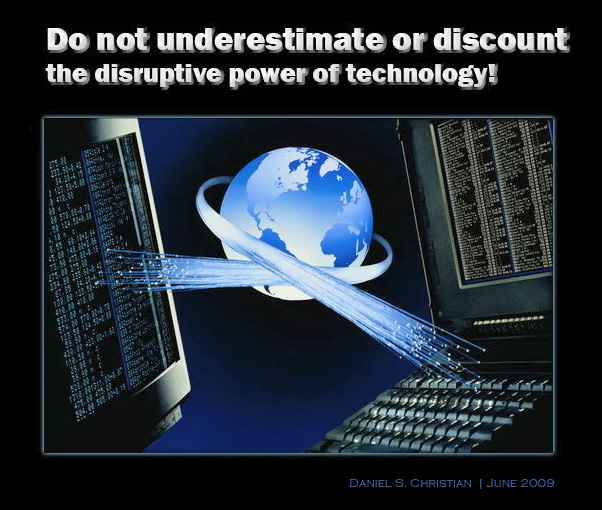
Do not underestimate or discount the disruptive power of technology! Daniel S. Christian -- June 2009


From DSC:
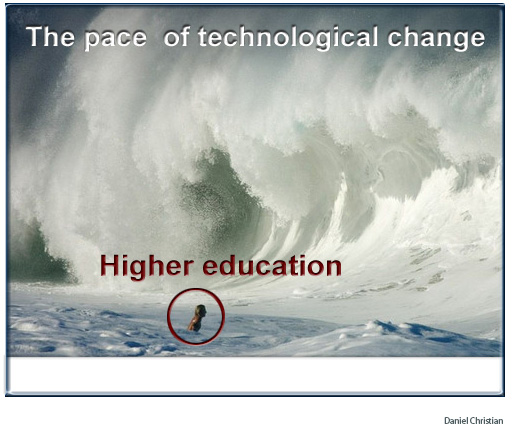
The tidal wave of technological change swept over Blockbuster and the article below shows how it drowned Kodak as well. These players were once at THEE top of their games…now they are either bankrupt or soon to be bankrupt (if things don’t change fast).

This relates to higher education as well, but I don’t think that we’ve seen anything yet (though 2012 may change that). Higher ed may have a limited window of time left before the conversation moves completely out of academia and higher ed as we know it gets left behind. The word “reinvent” and the phrases “staying relevant” as well as “lowering the price” should be at the top of the agendas for boards at most academic institutions of higher education throughout America (and other nations as well). I use the word most here because some folks will likely continue to pay enormous prices to get the name brands that they’ve been paying $50,000+ per year for.

If companies eventually don’t care who accredited your degree but rather what you can DO for them, watch out. The barriers to entry will plummet.


You Press the Button. Kodak Used to Do the Rest. — from technologyreview.com
Kodak saw the shift from analog to digital photography coming. Here’s why it couldn’t win.

.

Excerpt (emphasis from DSC):

But the industry landscape was completely different in the digital era. Barriers to entry were significantly lowered and the industry was flooded by entrants with a background in consumer electronics, such as Casio, Samsung, and Hewlett-Packard, not to mention Japanese camera manufacturers including Canon, Nikon, and Olympus. Large parts of Kodak’s competence base related to chemistry and film manufacturing were rendered obsolete. The vertical integration that had previously been a core asset to Kodak lost its value. Digital cameras became a commodity business with low margins. The problem facing Kodak wasn’t just that film profits had died but that those revenues could not be replaced.

Once images became digital, Kodak’s business model of “doing the rest” was effectively destroyed. Doing the rest used to entail a large and complex process that only a couple of companies in the world could master. Today, it is done by the click of a button.

Related graphic from DSC:
From Daniel S. ChristianAlso see:


12/15/11 addendum re: the conversation moving away from higher ed:

Excerpt (emphasis DSC):

No single blog can adequately capture or represent what was going on at Learning 2011. But if you are intrigued, I suggest you go to www.Learning2011and see what the agenda and the presentations looked like for yourself.
.
What I sensed, and what I am trying to describe here, was an accelerating transition in workforce education from a higher education-centric model to a learner-workplace-centric model. In a world where higher education institutions have dominated, controlled, and driven the conversation about quality, content, access, and results; the balance of power is shifting away from that more monolithic tendency to a far more disaggregated power structure where good information, metrics, and results that can be validated against third party standards are the “coin of the realm”.


Blowing out the digital book as we know it –– from MindShift by Tina Barseghian

Excerpt (emphasis DSC):

Inkling also produced the epic The Professional Chef by the Culinary Institute of America. The book in its entirety costs $50, but you can also purchase individual chapters for $3 a piece. The new model makes book buying much like buying music — choose only the pieces you like best.  MacInnis fluidly demonstrates how to float from one chapter to the next, launch videos, close in on images, tap on sidebars and recipe instructions. It’s like watching a magician performing sleight-of-hand tricks.

From DSC:
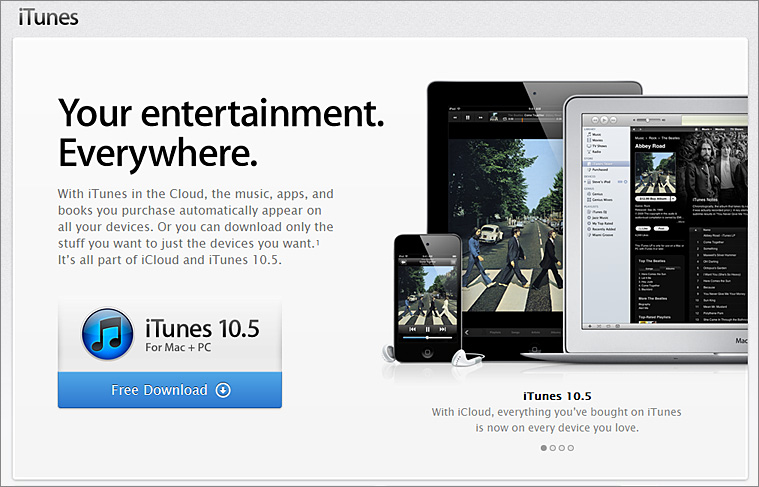
Books — and textbooks — will continue to be more cloud-based, interactive, multimedia-based, and will be able to be completely up-to-date as they move more towards becoming like apps (vs. hard copy books/textbooks). I see more experimentation in terms of the implementation of social media tools as well as in trying out different business models.  However, when all’s said and done (at least for this next phase), I hope that we can get to the iTunes-like purchasing model mentioned above. I think students, faculty, and staff at educational institutions would benefit greatly from this. 

Official calls for urgency on college costs— from the New York Times by Tamar Lewin

Excerpts:

As Occupy movement protests helped push spiraling college costs into the national spotlight, Education Secretary Arne Duncan urged higher-education officials Tuesday to “think more creatively — and with much greater urgency” about ways to contain costs and reduce student debt.

…

“Three in four Americans now say that college is too expensive for most people to afford,” Mr. Duncan said. “That belief is even stronger among young adults — three-fourths of whom believe that graduates today have more debt than they can manage.”

Also see:

Addendum later on 11/30/11:

.

(Official Department of Education Photo by Joshua Hoover)

“My chief message today is a sobering one,” said Secretary Duncan yesterday at the annual Federal Student Aid conference in Las Vegas, Nev. “I want to ask you, and the entire higher education community, to look ahead and start thinking more creatively—and with much greater urgency—about how to contain the spiraling costs of college and reduce the burden of student debt on our nation’s students.”

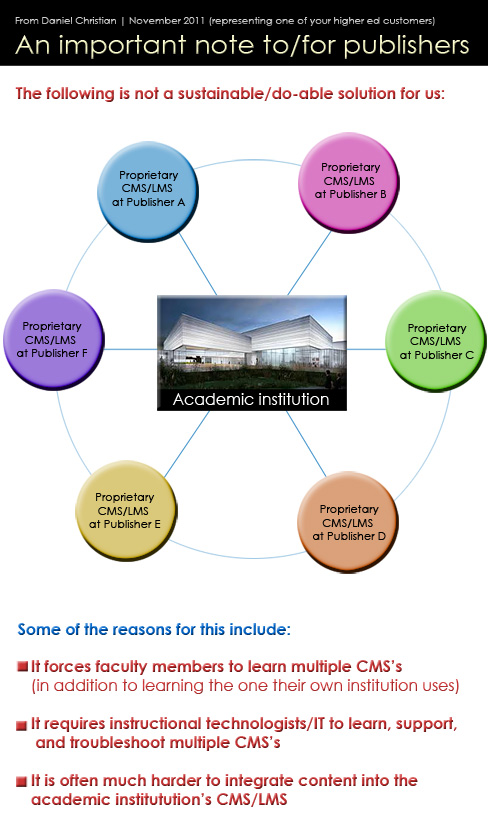
From Daniel Christian -- November 2011 -- An important note to publishers of academic/educational materials!


From DSC:
We really need a much more granular approach — like an iTunes for academic content.


One iPad publishing platform to rule them all — from Mashable.com by Josh Koppel, Co-founder and Chief Creative Officer at ScrollMotion

.

Excerpt:

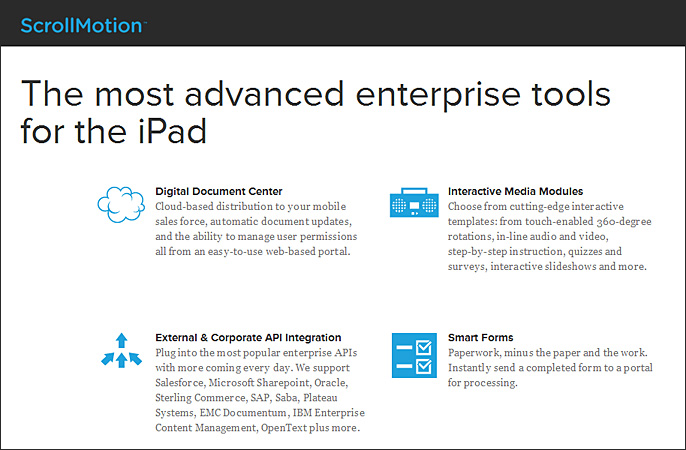
App developer ScrollMotion has created tablet content for some of the world’s largest publishers. At the Mashable Media Summit last Friday, its co-founder and chief creative officer Josh Koppel showed off a single platform built to run the entire gamut of enterprise media publishing.

.Also see:

Scrollmotion.com -- solutions

Digital Publishing: Interlinking publishing’s future with jobs, books, social media, and English majors [11-2-11 presentation] — published with permission from Steven Chevalia [Steven is a senior at Calvin College and recently did an internship at Zondervan]

Agenda/topics covered:

  • What is Digital Media?
  • Legal Jargon (Sneak Peek)
  • e-Readers
  • Tablets vs. e-Readers
  • e-Reading Software
  • Books or Apps?
  • Publishing [publishers / self-publishing]

Addendums later on 11/9/11:

IBM sends Watson supercomputer to business school – from wired.com by Eric Smalley


IBM's Watson takes on Harvard and MIT students.

Excerpt:

There have been four waves of technological innovation that disrupted the labor market over the last two and a half centuries starting with the Industrial Revolution, and we’re beginning the fifth, said IBM Chief Economist Martin Fleming. “We’re now beginning to enter into, in my view, a period where the economy is beginning to open up opportunities for the deployment of very significant innovation … We’re going to see many new industries get created, radical new technologies being deployed, but being deployed in the context of new business models,” he said.

“This will have significant implications from an income and income distribution point of view.”

The MIT economists generally agree that we’re at the beginning of a technology-driven shift in the economy and ultimately the labor market will adjust. But no one had any good news for workers in the middle of economy during the transition. “The future is already here in many ways, in terms of what technology can do,” Brynjolfsson said. “But right now the benefits are not very evenly distributed.”

Thinking about innovation in higher education — from Tony Bates

Excerpt:

This article by Peter Stokes, an executive vice-president at Eduventures, has some interesting ideas about how to promote real innovation in the higher education system. In principle, he’s suggesting US Federal funding for a conventional public institution to set up a parallel organization to test alternative ways of organizing, delivering and assessing teaching and learning, but within the Federal regulatory environment to stop diploma mills benefiting from the funding.

Also see:


Addendums later on 10/28/11:

  • Where’s the Innovation: Part 1 (Dr. Peter Smith)
    In my next three blogs, I will discuss, with examples, the obstacles faced by existing institutions when they try to innovate, where innovation has already begun and where innovation will come from in the future.
    …
    What makes this moment in time so compelling is that, just as we see the need for a vastly better educated citizenry, the tools to do just that have been revolutionized by the web. For the first time, the tools to drive change and improve learning lie beyond the scope and the control of the academy, in the community which surrounds it. So, for the first time in our history, colleges and universities do not control either the conversation or the drive to innovate. As a consequence, also for the first time, if they stand still, they will be left behind, bobbing in the wake of rapid change (emphasis DSC).
  • Where will innovation begin? — from the Chronicle by Jeff Selingo
    If there was any question that the current model for the vast majority of colleges is not sustainable for much longer, two pieces of news this past week should give the remaining skeptics yet more evidence (emphasis DSC).
    .
    First was the news from a survey of economists that Americans’ incomes, which have dropped some 7 percent since 2000, aren’t expected to even recover those losses until 2021. What’s more, a third of the respondents to the survey said today’s college grads would fare worse than their parents’ generation.
    .
    Then earlier this week we saw news reports of a previously published study on household debt by the Federal Reserve Bank of New York, which predicted that the total amount of student-loan debt would hit $1-trillion before the end of the year.

8 Colleges Collaborate on Open Courses — from Converge Magazine by Tanya Roscorla

Excerpt:

Many students can’t pay hundreds of dollars each term for textbooks. So they choose not to buy any of them.

“They just try to take the class without the book, and boy, that’s hard,” said Marty Christofferson, dean of campus technology at Tompkins Cortland Community College in New York.

This year, eight colleges that primarily serve at-risk students are working together on Project Kaleidoscope. In California, New York and Nebraska, faculty members are collaborating on open general education courses that will cut student textbook costs to less than $30 per class.


From DSC:
For some archived examples of pooling resources — and the use of consortiums — see this page on my old website:

© 2025 | Daniel Christian