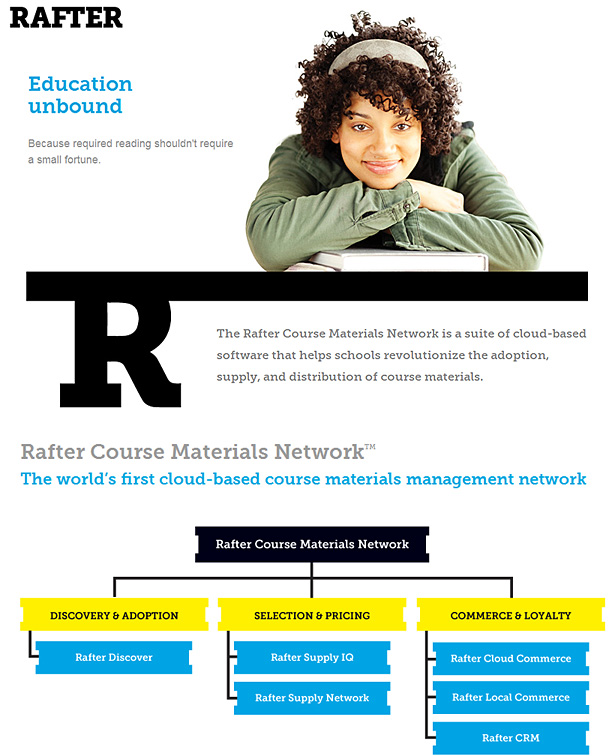
Rafter™ launches to revolutionize the entire course materials process for students, educators, and administrators, making education more affordable, accessible and effective — from Rafter
Rafter Delivers First-of-its-Kind Technology to Manage Textbooks and Digital Content On Campus and Online

 Excerpt:

SAN MATEO, CA–(Marketwire – Feb 28, 2012) – Rafter today launched as a new education technology company offering a network of software services that enable administrators and educators to better control costs and manage course materials for their students. Addressing higher education course materials management at an enterprise level, the Rafter Course Materials Network™ is the first suite of cloud-based software services that helps reduce costs for students and stores, helps educators discover and adopt the best materials, and provides college administrators with unprecedented power to control the complexities and reduce the costs of the entire course materials management process.

Rafter evolved out of one of the fastest growing education technology companies, textbook rental company BookRenter, which has saved millions of students more than $175 million across more than 5,000 campuses nationwide. In 2010, the company began to partner directly with schools to co-develop services to reduce the cost of and improve the experience associated with textbooks. Today, more than 500 schools have adopted BookRenter’s solution.

.

See also:.

.

rafter.com

.

Also see:

Who decides what gets sold in the bookstore? — from paidcontent.org by Seth Godin

Excerpt:

I just found out that Apple is rejecting my new manifesto Stop Stealing Dreams and won’t carry it in their store because inside the manifesto are links to buy the books [at Amazon.com] I mention in the bibliography.


From DSC:
By the way, some nice quotes from the Stop Stealing Dreams page:

  • The economy has changed, probably forever.  School hasn’t.
    .
  • Our kids are too important to sacrifice to the status quo.

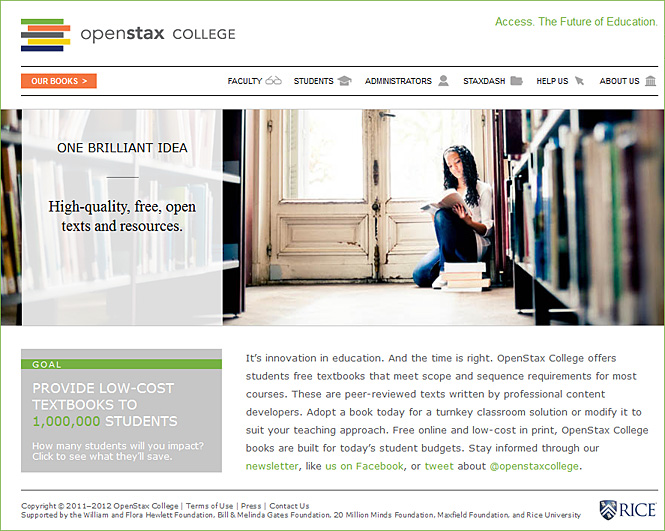
openstaxcollege.org -- Access. The future of education.

Living room video calling users to surpass 16 million in 2015 — from instat.com

Excerpt:

The video calling market can be divided into three sub-markets depending on the device which is being used to make the call: PCs, Mobile, and living room (digital home) devices.  Living room video calling is a nascent market and currently has a relatively small user base. New NPD In-Stat (www.in-stat) research forecasts that total users will increase from 1.5 million in 2011 to 16.4 million in 2015. Asia Pacific will be the largest market for living room video calling by a significant margin as this is the region with the highest video calling enabled device shipments.

.

From DSC:

  1. The massive convergence of the TV, the computer, and the telephone continues
  2. The current model of higher ed has run it’s course — the model is breaking down
  3. The cost of obtaining an education must decrease; new business models are and will continue to come to fruition
  4. One of those business models is what I call “The Forthcoming Walmart of Education“
  5. One of the pieces of this “Walmart of Education” will involve “learning from the living room“
  6. “Students” will be able to watch one device while interacting with another device (though I could also see everything happening via one device as well)
  7. Learning will likely be more interactive, multimedia-based, available 24x7x365, personalized, customized and backed up by some serious social networking/learning, analytics, artificial intelligence, learning agents, and online-based tutoring
  8. “Textbooks” will flow into the living rooms as well as to tablets, smart phones, and other devices; but they will be more like apps where updates will occur as necessary
  9. Rock-star profs are likely to emerge
  10. Anyway…”stay tuned”


Also see:

A Disrupted Higher-Ed System — from The Chronicle by Jeff Selingo

Excerpt:
Just look at the last month:

  • The Massachusetts Institute of Technology announced that it would create MITx, a self-service learning system in which students can take online tests and earn certificates after watching free course materials posted by the university.
  • StraighterLine, which offers self-paced introductory courses online, said that it would give students access to the Collegiate Learning Assessment and other similar tests, allowing them to take results to employers or colleges to demonstrate their proficiency in certain academic areas.
  • Apple introduced three free pieces of software that allow students to download or create textbooks, and that permit instructors to create a digital curriculum in iTunesU.


Free courses, elite colleges — from InsideHigherEd.com by Steve Kolowich

Excerpt:

Robert Garland, a professor of classics at Colgate University, is not accustomed to discussing Greek religion with the lifeless lens of his MacBook’s built-in video camera. But that was how Garland spent Wednesday afternoon: in his home study, recording lectures on his laptop in 20-minute chunks.

Garland, a novice to online teaching, says it is difficult to think of these solitary sessions as lectures. “I think of them more as chats,” he says.
…
Garland’s gear is lo-fi: just the laptop, which he owns, and a microphone mailed to him by Udemy, the company that roped him into this.

Obama wants lower college costs, higher dropout age — from edweek.org by Alyson Klein

.

SOTU_Blog.jpg

Excerpt (emphasis DSC):

President Obama gave college affordability a prominent place in his domestic agenda during his annual State of the Union address, calling directly on universities to hold down costs in order to make higher education more accessible to the middle class. He outlined a set of proposals that include threatening universities with a loss of federal money if they are unable to tamp down tuition.

“Let me put colleges and universities on notice: If you can’t stop tuition from going up, the funding you get from taxpayers will go down,” Obama said in his hour-long address. He didn’t offer specifics, however, and the blueprint document the White House sent out to accompany the speech didn’t get specific either. But advocates expect him to lay out more concrete details in the coming days.

.

State higher education spending sees big decline — from HuffingtonPost.com by Christine Armario

Excerpt:

MIAMI — State funding for higher education has declined because of a slow recovery from the recession and the end of federal stimulus money, according to a study released Monday.

Overall, spending declined by some $6 billion, or nearly 8 percent, over the past year, according to the annual Grapevine study by the Center for the Study of Education Policy at Illinois State University. The reduction was slightly lower, at 4 percent, when money lost from the end of the American Reinvestment and Recovery Act was not taken into account.

The funding reductions, seen across nearly every state, have resulted in larger class sizes and fewer course offerings at many universities and come as enrollment continues to rise.

.

Beware: Alternative certification is coming — from The Chronicle by Richard Vedder

Excerpt (emphasis DSC):

As college costs rise, however, people are asking: Aren’t there cheaper ways of certifying competence and skills to employers? Employers like the current system, because the huge (often over $100,000) cost of demonstrating competency is borne by the student, not by them. Employers seemingly have little incentive to look for alternative certification. That is why reformers like me cannot get employer organizations like the U.S. Chamber of Commerce to take alternative certification seriously. But if companies can find good employees with high-school diplomas who have demonstrated necessary skills and competency via some cheaper (to society) means, they might be able to hire workers more cheaply than before–paying wages that are high by high-school-graduate standards, but low relative to college-graduate norms. Employers can capture the huge savings of reduced certification costs. And students avoid huge debt, get four years more time in the labor force, and do not face the risks of not getting through college. Since millions of college grads have jobs which really do not use skills developed in college anyhow, alternative certification is more attractive than ever.

Addendums on 1/26:

  • President Obama: ‘Higher education can’t be a luxury – it is an economic imperative’ — from annarbor.com by Ryan Stanton
  • Survey finds that dwindling financial aid contributes to fewer college options — from the NYT by Daniel Slotnik
    Excerpt:
    College freshmen entering school last fall were less likely to attend their first choice of college, a function of both competition and cost, than at any other time since 1974, and fewer received financial aid through grants or scholarships, according to an annual survey of nearly 204,000 high school students.
  • Pressure remains for higher education: Moody’s — from Reuters
    The financial conditions of many U.S. colleges and universities will likely not improve much this year, as states continue cutting funding for public schools, students become more price sensitive, and areas for other revenue remain stretched, a lead rating agency said on Monday.  “During the past year, public and political scrutiny of colleges and universities, both not-for-profit and for-profit, has escalated and we expect that the sector will remain under the microscope in 2012 and beyond,” said Moody’s Investors Services in a report outlining why it is maintaining a “mixed outlook for U.S. not-for-profit private and public colleges and universities, mirroring our 2011 outlook.”

How iBooks Author Stacks Up to the Competition [CHART] — from Mashable.com by Chelsea Stark

Author, Author! Apple, Apple! — from The Journal by Therese Mageau
Apple’s new interactive textbook authoring system might just revolutionize the way districts develop their own curriculum. 

iTunes U vs. Blackboard – A Look at Apple’s New Online System — from padgadget.com

Thanks to iPads and Kindles, E-Book Lending at Libraries Explodes — from ReadWriteWeb.com by John Paul Titlow

Why textbooks of the future are not books — from gigaom.com by Erica Ogg

Apple Jumps Into Textbooks — from the WSJ
With More iPads in Classrooms, Education Push Would Help Fend Off Android-Device Competition

Apple’s iTunes U Morphs Into a Tool for Full Online Classes — from Mashable.com by Sarah Kessler

Reinventing Textbooks: A Hard Course — from the New York Times by David Streitfeld


Also see:

.

Donald Chan/Reuters
People flooded Foxconn Technology with résumés at a 2010 job fair in Henan Province, China.

Apple to announce tools, platform to “digitally destroy” textbook publishing –– by Chris Foresman

Excerpt:

GarageBand for e-books

At the same time, however, authoring standards-compliant e-books (despite some promises to the contrary) is not as simple as running a Word document of a manuscript through a filter. The current state of software tools continues to frustrate authors and publishers alike, with several authors telling Ars that they wish Apple or some other vendor would make a simple app that makes the process as easy as creating a song in GarageBand.

Our sources say Apple will announce such a tool on Thursday.


Some thoughts/reflections from DSC:

  • If the educational publishing industry doesn’t want to help students out by greatly lowering their prices…
    (But don’t relax people in higher ed…most likely, we are next.)
    .
  • Another example of “the dangers of the status quo.“
    .
  • We constantly need to be actively reinventing ourselves and our businesses so that we are staying relevant.
    (And at prices running up to and over $200,000 for 4 years of college — as of January 2012 —  the assertion that higher ed is not a business just doesn’t hold any water for me anymore.)
    .


Addendum later on 1/17/12:


Join us for an education announcement in the Big Apple. Jason O'Grady


From DSC:
Veeeeery interesting…perhaps Apple is building the Walmart of Education.


AcademicPub adds 22 new publishers to its content library — from edukwest.com by Kirsten Winkler

Excerpt:

AcademicPub is an online platform for college professors that enables them to create custom print or digital textbooks. This way professors can pick the content relevant to their course only which leads to much lower prices for the students when they purchase the books.

Launched in April 2011 by SharedBook Inc., AcademicPub started with less than 20 publishers but the platform quickly attracted new partners and now offers copyright-cleared material from over 100 publishers including…


Why tablet publishing is poised to revolutionize higher education — from Mashable.com by Trevor Bailey

Excerpt (emphasis DSC):

Richer than their print counterparts, digital textbooks include a number of interactive features. They are not limited to static pictures, but can integrate video, audio, animation, interactive simulations and even 360-degree rotations and panoramas. In addition, universities have the ability to create custom, institutionally branded viewers with unique displays and navigation options.

…

Digital publishing allows professors or subject matter experts to self-publish their own educational materials or research findings and distribute the information on tablet devices. Teachers can iterate content quickly, better keeping pace in a world where knowledge evolves every instant. On a smaller scale, they can post lesson documents online for students, versus relying on hard-copy materials.


From DSC:
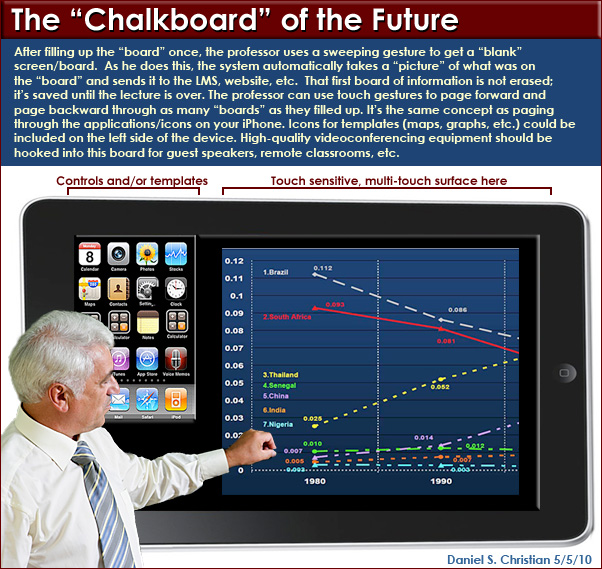
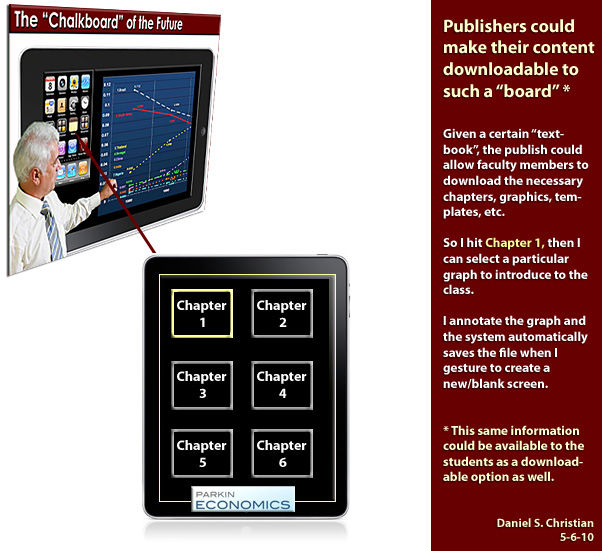
…and we’ll see what Apple says about this topic later this month; 2012 should be an interesting year indeed. I would like to see more of our professors’ e-books/self-published materials up on the Chalkboard of the Future:


.

One part of the board could provide downloadable, discipline-specific templates


.


Teaching resources could be downloaded by faculty and by students -- compliements of the publishers


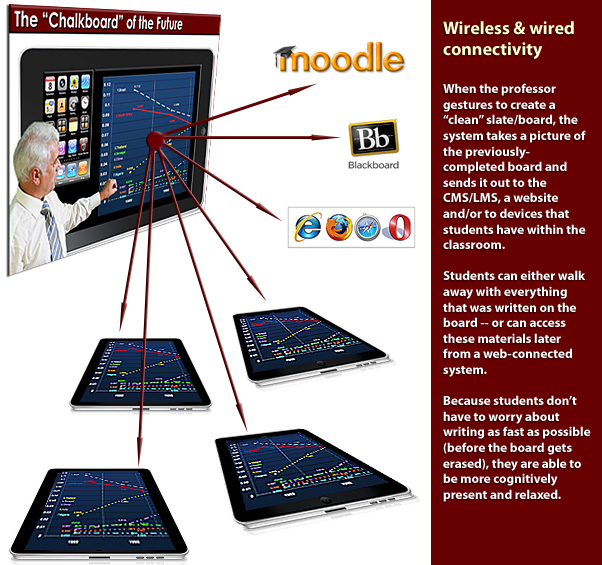
From Daniel Christian: The future chalkboard is connected to various other systems and devices -- wirelessly and via wired connections.

.


.

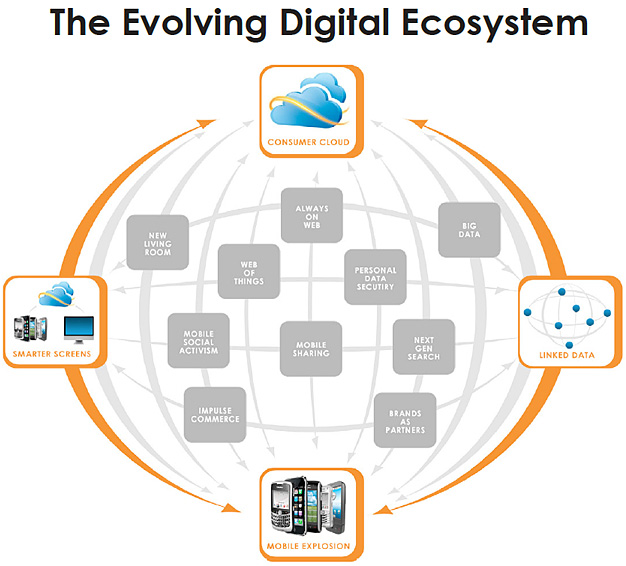
The Evolving Digital Ecosystem - from Moxie's Trends for 2012

  • The Always On Web
  • Web of Things
  • Big Data
  • Next Gen Search
  • Mobile Sharing
  • Mobile Social Activism
  • Impulse Commerce
  • Brands As Partners
  • The New Living Room  <– From DSC: This is one of those key areas that I’m trying to keep a pulse check on for re: our learning ecosystems of the future 
  • Personal Data Security


Also see:


teacherspayteachers.com

From DSC:
I read the following quote from Codecademy signs up 97,000 people for its New Year’s resolution coding class (emphasis mine):

Codecademy, a startup that uses interactive online lessons to turn anyone into a computer programmer, has signed up 97,000 students in less than 48 hours for its New Year’s resolution class Code Year.  That’s more than twice as many students as were enrolled in the 150 U.S. computer science undergraduate programs that the Computer Research Association surveyed last year.

This is both positive and troubling to me. Positive in that more people will learn how to program across the world, and thus (hopefully) becoming qualified to fill many of the open programming-related positions out there.  It’s troubling in that the quote mentions that within 48 hours, the number of students signed up was already more than twice the number of students enrolled in Computer Science programs at the undergraduate level in the entire United States.

What does that statement tell us?

  • Are there a lot more people interested in programming out there but can’t afford to pay their way through an undergraduate program?
  • That many people aren’t qualified to get into an undergraduate program but are hoping to gain skills anyway?
  • Perhaps people are just trying it out and many won’t actually pursue this route…
  • Perhaps there’s some duplication here, as some of the same undergrads are also enrolled in Codeacademy…
  • Perhaps the people taking these courses won’t be qualified…but perhaps they will be qualified…
  • Perhaps a student-teaching-student model will unfold here with massive FAQ’s and examples being developed over time…

Hmmm…regardless, this is an excellent example of the disruption being caused by technology and the Internet. I expect many more examples in 2012. Perhaps the “Walmart of Education” that I’ve been tracking over the years will have different components to it, with one major piece of it coming from the Codeacademy’s of the world.

Some of the questions that come to my mind for those of us working within higher education are:

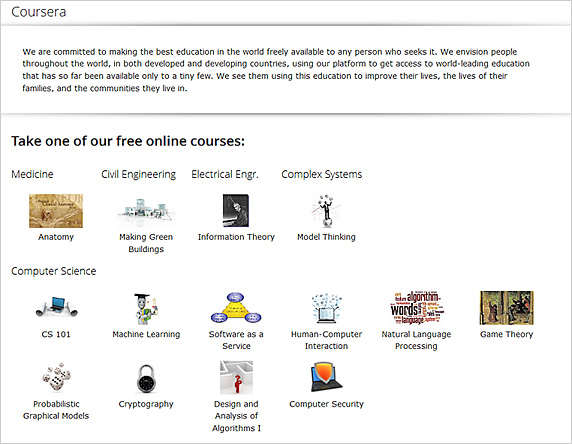
  • How do we help educate the world at more reasonable prices?
  • What opportunities does the Internet offer us?
  • What new business models and transformations should we be pursuing that use the Internet?
  • Are there things that we can do to better address why all of these people are not enrolling in our undergraduate CS programs?


© 2025 | Daniel Christian