Paying for Performance — from InsideHigherEd.com by Steve Kolowich

Excerpt:

Now one university is working with a major educational content company to shift some of that accountability from the institutions that enroll students in courses to the companies that supply them with educational texts and tutoring software.

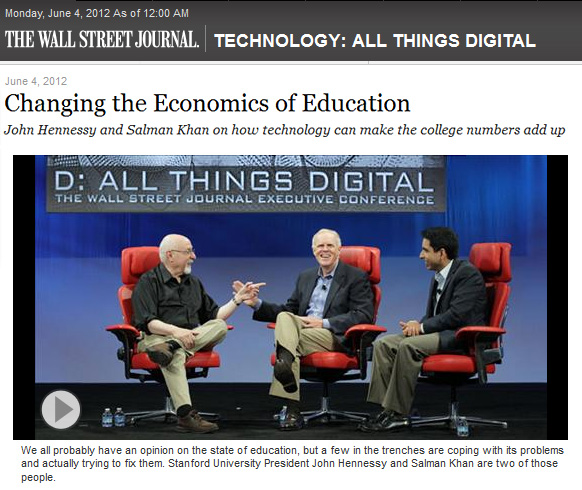
Changing the Economics of Education -- John Hennessy and Salman Khan at 2012 All Things Digitall


Excerpt:

Is there anything to be done about the rising price of higher education? That was the question posed to John Hennessy, president of Stanford University, and Salman Khan, founder of Khan Academy, a nonprofit online-learning organization. They sat down with The Wall Street Journal’s Walt Mossberg to discuss how technology might be part of the solution.

Here are edited excerpts of their conversation.


Addendum on 6/7/12:

  • D10: Stanford, Khan Academy, and the future of higher ed — from techhive.com by Jason Snell
    Excerpt:
    Though the crushing cost of college education wasn’t a major topic of Khan and Hennessy’s conversation with D10 co-host Walt Mossberg, it’s certainly a major cause of anxiety for parents. But most of the time, the conversation dwelled on the simple issue that technology is going to radically transform education—and right now everyone’s trying to figure out how to manage that change. “There’s a tsunami coming,” Hennessy said. “I don’t know how it’s going to break, but my goal is to try to surf it, not just stand there.” At its simplest form, technology needs to find ways to make education more efficient. That means serving more students, but also teaching them more effectively.


The Campus Tsunami — from The New York Times by David Brooks

Excerpts:

But, over the past few months, something has changed.The elite, pace-setting universities have embraced the Internet. Not long ago, online courses were interesting experiments. Now online activity is at the core of how these schools envision their futures.

…

What happened to the newspaper and magazine business is about to happen to higher education: a rescrambling around the Web.

From DSC:
What David Brooks said in this last bolded sentence (above) is what I have been saying, but in a slightly different way:

Other industries have been up to bat, and the Internet was pitching.  Higher education used to be on deck. But now, higher education is at bat.


Harvard, MIT to partner in $60 million initiative to offer free online classes to all — from Boston.com by Mary Carmichael and Johanna Kaiser, Globe Staff and Globe Correspondent

Excerpt:

CAMBRIDGE — Harvard University and the Massachusetts Institute of Technology said today they will team up to launch a $60 million initiative to offer free, online, college-level courses under a joint superbrand known as edX.

The announcement instantly makes the entity a preeminent player in the burgeoning worldwide online education sector, which has seen several major start-ups — including some affiliated with top-tier universities — in recent months.

Also see:

  • MIT and Harvard announce edX — from mit.edu
    Joint partnership builds on MITx and Harvard distance learning; aims to benefit campus-based education and beyond.
  • EdX: A platform for more MOOCs and an opportunity for more research about teaching and learning online — from InsideHigherEd.com by Audrey Watters
    Excerpt:
    At a joint press conference today, Harvard University President Drew Faust and MIT President Susan Hockfield announced a new nonprofit partnership, edX, that would offer free open online courses. If the “X” sounds familiar when paired with MIT, it’s because the Massachusetts Institute of Technology unveiled its plans for MITx late last year, its online learning initiative that would allow anyone with an Internet connection to take an online class from the university and receive a certificate upon successful completion. The first class, 6.002x Circuits and Electronics, is currently underway.
  • EdX: The Future of Online Education is Now
  • Harvard and MIT launch edX to offer free online classes — from CNN.com by James O’Toole
    NEW YORK (CNNMoney) — Always wanted to take a Harvard class? Soon you’ll be able to do so from the comfort of your own home.
  • Massive Courses, Massive Data — from InsideHigherEd.com by Steve Kolowich
    Harvard joins MT in platform to offer massive online courses

Are apps the future of book publishing? — from forbes.com by Alex Knapp

Excerpt:

It’s no surprise, then, that publishers are turning to the app as a possible product for books moving forward.  This has led to another movement towards enhanced books, particularly as apps for iPhone, Android, and other tablets. Are tablet apps the book of the future? In order to find out, I talked to authors, publishers, and app programmers, and read more than a few book apps.

Yes, University of Phoenix is disruptive; no, that doesn’t make it the end-all — from Disrupting Class by Michael Horn

Excerpt:

A disruptive innovation is one that transforms a sector by introducing a product or service that is more convenient, simple to use, and/or affordable than the existing products or services in a market. Disruptions tend to start as not as good as the existing products or services as judged by their historical measures of performance, and then, over time, they are able to march up market such that they are able to handle more complicated tasks. Many people flock to the disruptive innovation over time as it becomes good enough, as the customers are delighted by something that carries this new value proposition around convenience, simplicity, and/or affordability. As a result of these dynamics, disruptive innovations first serve nonconsumers (people who previously could not participate in the market) or people who have been overshot by the incumbents in the market. A critical thing to keep in mind is that this process does not occur over night; sometimes it occurs over several decades. And not every incumbent or traditional institution will be wiped away. Some will continue to perform important jobs for which a, relatively speaking, small set of customers are willing to pay.

Lastly, for something to be a disruptive innovation, it has to have two components: a technology enabler and a business model that together allow it to extend a low-cost value proposition up market.


From DSC: First, some articles that caused these reflections


Discounting heads — from insidehighered.com by Kevin Kiley

Excerpt:

Despite spending nearly 43 percent of their gross tuition revenue from first-time, full-time freshmen on institutional aid for those students, many private colleges and universities had a harder time enrolling students last year, with almost half seeing no growth or a decline in enrollment for 2011, according to survey results released today by the National Association of College and University Business Officers.

From DSC:
It seems to me that it’s highly-possible that the higher ed bubble has started to pop — at least at private colleges and universities. So why doesn’t change occur? See the next article for several reasons.

Failure to change — from insidehighered.com by Robert J. Sternberg

Excerpts:

Universities teach about the importance of societal and organizational change, but often have trouble changing themselves in any but the most superficial ways. As a psychology professor interested in both individual and organizational modifiability, I have studied organizations, including universities, and why it is so difficult for them to change. Meaningful organizational change requires five elements, and unless all five of them are present, the organization — whether a department, school, college, or university — remains static.
…
Change is not always for the better, of course. But a college or university that is static will inevitably fall behind more dynamic, positively changing institutions. And like any institution that fails to compete, it is on the path to stagnation or death. A dynamic institution will change and, if the change proves to be in the wrong direction, will redirect itself until it finds a sustainable path.

From DSC:
As a relevant aside, it’s not just the “younger folk” who are struggling with student loans either:

Student loans saddle both kinds of seniors: graduates and grandparents — from the Washington Post by Michelle Singletary

Excerpt:

Using data from Equifax credit reports, the Federal Reserve Bank of New York found that people 50 and older are carrying nearly $135 billion in student-loan debt. Those 60 or older have student-loan balances of more than $36 billion.


It’s these types of dynamics and trends that are catalysts for what I call:


“Learning from the Living Room”
Though 2-5 years away, signs point to it coming to fruition
(my prediction is that this movement will really gain traction when Apple’s Connected/Smart TV hits the market and as more people get fed up with the current, unresponsive accredidation monopolies within higher ed). Some example/recent articles:

  • The Evolution of the Digital Living Room — from digitalvideospace.blogspot.com by Chuck Parker
    Excerpt:

    Apple with its iPad, Apple TV and iCloud for movies and TV shows has delivered a seamless ecosystem to the consumer’s digital living room for owning and watching content from multiple devices in the home. The rest of the industry (SmartTVs, connected devices, Android tablets) struggles to create a similar experience when they are a single-brand ecosystem and fail miserably when there are devices from multiple manufacturers in the household.
    .
  • Google and Microsoft’s new battleground: Your living room — from ComputerWorld by Preston Gralla
    The upshot will have surprising implications for IT
    .
  • Why the future of Shazam is TV, not music — from readwriteweb.com by Richard MacManus
    Excerpt:

    Shazam is in the midst of a major pivot. Currently it earns most of its revenue off advertising from the music app. But within two years, the company told ReadWriteWeb, TV will provide the majority of Shazam’s revenue. Just how big an opportunity is TV for Shazam? According to statistics from the company, it is already outpacing both Facebook and Twitter in second screen user engagement.

“The Forthcoming Walmart of Education” …which is already happening, but far more significant changes will come in the next 1-5 years as people look for more affordable alternatives. A graphic I created back in 2008 states what I see developing and will be a piece of the higher ed landscape in the future:
.

.


Besides the items mentioned above (i.e. changes in price and delivery mechanisms),
what might some of these innovations look like? Here are some ideas/articles/examples:


  • Be more responsive to real-world/market needs
    Example:
    12 college majors we hope to see soon
    — from bestcollegesonline.com
    While some college majors have been around for decades or even centuries, others are relatively new and some are still waiting on the horizon to be added to college programs around the world as new technologies and demands shape the needs of modern students. While a host of degree programs have been added over the past 10 or 20 years, many related to computers and other forms of technology, many more will be needed in the future to keep up with a world that is rapidly changing.
    .
  • Introduce more innovations and be willing to experiment with different models
    Examples besides MITx, Udemy, U of People, iTunes U, YouTube Edu, etc.:
    ANGELS, a new European research project, a gateway to the future.

    ANGELS project (Augmented Reality Network Generating Learning on Safety), is the training system that will revolutionize education and learning on safety and health at work, particularly in the hospital facilities. This tool aims at innovating in terms of training on health and safety at work with the use of augmented reality (computer system that can superimpose 3D image on a real image to combine real and virtual). ANGELS introduces 4 key innovations: A practice adapted to an innovative new technology, a realistic assessment in tune with the XXIst century in the area of education and training, a large field of application in the health care facilities and the creation of a starter kit for public and private organizations, training centers and academic centers.
    .
  • …and bring the prices WAAAY down!!!


Could the next elite university be online and venture-backed? — from AllThingsD.com by Liz Gannes

Excerpt:

The Minerva Project says it’s planning to launch the first elite American university in a century. Sounds wacky, right?

But the project is starting to gather some heavyweight support: Former Harvard President and U.S. Secretary of the Treasury Larry Summers will chair its advisory board, and Benchmark Capital has committed $25 million, the VC firm’s largest seed investment ever.

Elite higher education is a stagnant market, argues Minerva CEO Ben Nelson. Far more people are qualified to get into top colleges than are admitted. Meanwhile, college education is too expensive and good teaching is undervalued. How can you address all that? By going online.


Also see:

minervaproject.com


 Also see:


Items re: the connected living room; relates to what I call a future “learning from the living room” environment

The human voice, as game changer — from nytimes.com by Natasha Singer


Matthew Cavanaugh for The New York Times

Vlad Sejnoha demonstrated Nuance’s Dragon TV system, which obeys spoken commands to
flip channels, for example, or shop on screen on Amazon.com.

Apple’s iCloud will teach Apple’s Smart TV remote new tricks — from patentlyapple.com

6 answers about your next TV, with or without Apple — from forbes.com by Michael Humphrey

10 tech commandments for the TV industry — from thenextweb.com by Martin Bryant

Smart TVs are growing in popularity — from business-news.thestreet.com by Steve Adams

smartTV Quincy gh 032112-284-wihr.jpg

Image from Gary Higgins/The Patriot Ledger

Paul Berrini, a salesman at Hancock T.V.& Appliance in Quincy, demonstrates
some of the new features of “smart” televisions, Wednesday, March 21.

.

10 AirPlay-ready iPad apps that make Apple TV worth it — from  readwriteweb.com by John Paul Titlow

Entertainment and Streaming Media – The Recent Past and the Future — from homesystemintegration.com by Alan Ruby

Connected Living Room 1

.

TVs may soon be used to spy on you — from smartplanet.com by Tuan C. Nguyen


From DSC:
Not that this is anything new…but the business model/strategy that FiftyThree, Inc. is following with their Paper app is very intriguing to me (and caused me to reflect, again, on the changing business models within higher ed)

  1. People can obtain the basic app for free
    To get an idea of the basic interface & functionality.
    .
  2. Additional functionality costs $
    People can purchase additional tools from the in-app store: such as Sketch, Write, Outline, and Color.

As I was reflecting on this business model, I wondered…will this be a part of our future educational marketplaces/exchanges?

Lynda.com (and many others as well I suppose) already does something similar to this by providing prospective students with a few modules — for free — but then requires a subscription for accessing the rest of the content/modules.

So…what if a student could bop into a “class” to get a feel for what the content was like — and perhaps the instructor/professor as well — before they ante up for additional information/learning opportunities/content?


Student-loan debt tops $1 trillion — from WSJ.com by Josh Mitchell and Maya Jackson-Randall

Excerpt:

The amount Americans owe on student loans is far higher than earlier estimates and could lead some consumers to postpone buying homes, potentially slowing the housing recovery, U.S. officials said Wednesday.

Total student debt outstanding appears to have surpassed $1 trillion late last year, said officials at the Consumer Financial Protection Bureau, a federal agency created in the wake of the financial crisis. That would be roughly 16% higher than an estimate earlier this year by the Federal Reserve Bank of New York.

From DSC:
Phrases/words that come to my mind include (which many readers of this blog and my archived website will instantly recognize:

  • Reinventing ourselves
  • Staying relevant /addressing our customers’ needs
  • Innovation
  • Strategy
  • Leadership
  • Vision
  • The business side of higher ed / new business models
  • Game-changing environment
  • Disruption
  • Dangers of the status quo
  • Student-related
  • Future of higher education
  • The Walmart of Education
  • Learning from the Living Room

Addendum on 3/23/12:


A Communiqué from the Horizon Project Retreat [2012]
Building on ten years of research into emerging technology in education

Excerpt:

From these discussions, 28 hugely important metatrends were identified. The ten most significant are listed here and will be the focus of the upcoming NMC Horizon Project 10th Anniversary Report:

  1. The world of work is increasingly global and increasingly collaborative. As more and more companies move to the global marketplace, it is common for work teams to span continents and time zones. Not only are teams geographically diverse, they are also culturally diverse.
  2. People expect to work, learn, socialize, and play whenever and wherever they want to. Increasingly, people own more than one device, using a computer, smartphone, tablet, and ereader. People now expect a seamless experience across all their devices.
  3. The Internet is becoming a global mobile network — and already is at its edges. Mobithinking reports there are now more than 6 billion active cell phone accounts. 1.2 billion have mobile broadband as well, and 85% of new devices can access the mobile web.
  4. The technologies we use are increasingly cloud-based and delivered over utility networks, facilitating the rapid growth of online videos and rich media. Our current expectation is that the network has almost infinite capacity and is nearly free of cost. One hour of video footage is uploaded every second to YouTube; over 250 million photos are sent to Facebook every day.
  5. Openness — concepts like open content, open data, and open resources, along with notions of transparency and easy access to data and information — is moving from a trend to a value for much of the world. As authoritative sources lose their importance, there is need for more curation and other forms of validation to generate meaning in information and media.
  6. Legal notions of ownership and privacy lag behind the practices common in society. In an age where so much of our information, records, and digital content are in the cloud, and often clouds in other legal jurisdictions, the very concept of ownership is blurry.
  7. Real challenges of access, efficiency, and scale are redefining what we mean by quality and success. Access to learning in any form is a challenge in too many parts of the world, and efficiency in learning systems and institutions is increasingly an expectation of governments — but the need for solutions that scale often trumps them both. Innovations in these areas are increasingly coming from unexpected parts of the world, including India, China, and central Africa.
  8. The Internet is constantly challenging us to rethink learning and education, while refining our notion of literacy. Institutions must consider the unique value that each adds to a world in which information is everywhere. In such a world, sense-making and the ability to assess the credibility of information and media are paramount.
  9. There is a rise in informal learning as individual needs are redefining schools, universities, and training. Traditional authority is increasingly being challenged, not only politically and socially, but also in academia — and worldwide. As a result, credibility, validity, and control are all notions that are no longer givens when so much learning takes place outside school systems.
  10.  Business models across the education ecosystem are changing. Libraries are deeply reimagining their missions; colleges and universities are struggling to reduce costs across the board. The educational ecosystem is shifting, and nowhere more so than in the world of publishing, where efforts to reimagine the book are having profound success, with implications that will touch every aspect of the learning enterprise.

These metatrends are the first of much yet to come in the next year. Watch NMC.org for news and more throughout the Horizon Project’s 10th Anniversary. To be part of the discussions, follow #NMChz!


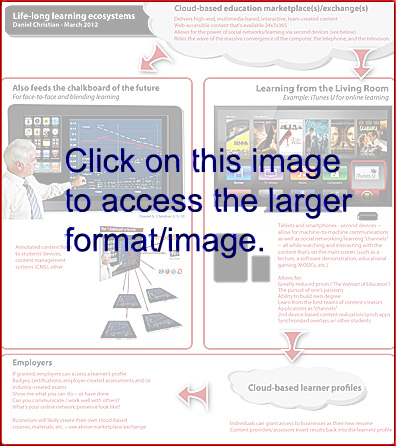
Lifelong learning ecosystems!!! A powerful vision for our future [Daniel Christian]

From DSC:
The vision below involves:
(click on the image below to access it)
 

  • The convergence of the telephone, the television, and the computer
  • Cloud-based education stores/marketplaces/exchanges
  • Second screen devices and machine-to-machine communications
  • Social networking/learning
  • Smart classrooms/learning spaces
  • Content recognition/synchronization applications
  • Apps as “channels”
  • Web-based learner profiles
  • Video overlays
  • New business models in higher ed
  • New jobs/needs for the future
  • A new way for employers to hire highly-effective employees/contractors/consultants
  • …and more


Click this thumbnail image to access the larger image / vision

.


Beyond the college degree, online educational badges— from the New York Times by Tamar Lewin

Excerpt:

With the advent of Massive Open Online Courses and other online programs offering informal credentials, the race is on for alternative forms of certification that would be widely accepted by employers.
…
By the end of this year, Mr. [David] Wiley predicted, it will become familiar to hear of people who earned alternative credentials online and got high-paying jobs at Google or other high-visibility companies.


Udemy’s Faculty Project nabs 50,000 students and an Ivy league professor — from gigaom.com by Ryan Lawler

Excerpt:

About six weeks ago, educational video startup Udemy launched its Faculty Project, a nonprofit program for distributing streaming university curriculum online. Early results have been pretty successful, with more than 50,000 students signing up for the program. But that’s not all: the Faculty Project is also bringing on ever more prestigious faculty, with its first Ivy League professor soon coming on board.

In contrast to Udemy’s for-profit platform, which enables teachers to create online courses and charges for access to them, the Faculty Project is a free offering that is designed to connect students from around the world with university faculty for high-quality courses online.

© 2025 | Daniel Christian