http://edfuture.net/


Excerpt:

In countries around the world, the transition to knowledge and service economies occurring rapidly. Competitive countries are no longer only those that have an abundance of natural resources, but also those with a highly educated populace. Higher education is increasingly recognized as a vehicle for economic development [1].

University leaders are struggling to make sense of how internationalization, the current economic conditions, and new technologies will impact their systems. Educators are uncertain of the impact of open educational resources, alternative accreditation models, de-professionalization of academic positions, and increased grant competitiveness. What is role of the academy in increasing national economic competitiveness while preserving the “vital combat for lucidity” [2] that defines an open democratic society?


Technology and the broken higher education cost model: Insights from the Delta Cost Project — from Educause by Rita Kirshstein and Jane Wellman

Excerpt:

Although U.S. higher education has faced numerous crises and dilemmas in its history, the situation in which colleges and universities find themselves at the moment is indeed different. Shrinking public subsidies coupled with historic rises in tuitions come at the same time that colleges and universities have been tasked to dramatically increase the number of individuals with postsecondary degrees. Additionally, many of these students need financial aid, putting further strains on the higher education system. The stratification between rich and poor institutions in their access to resources is also growing. These conditions make the current “cost model” under which higher education has typically operated no longer sustainable and have led to college and university leaders examining alternative ways to deliver both high-quality and affordable higher education. These alternatives incorporate technology and include access to distance-delivered education and services, a focus on learners’ outcomes rather than inputs, and technologically sophisticated buildings and classrooms.

The changes are welcome and largely overdue in much of higher education, but unless the use of technology, whether in instruction or in the operation of the institution, is guided by an understanding of higher education costs and cost structures, its use will not fix the problem of a broken higher education cost model. This problem is not confined to the way that instruction is funded and delivered; rather, it is much broader, including the costs of academic and administrative overhead and the largely unexamined “fixed costs” that drive so much of institutional spending. To implement technological innovations that can improve both efficiency and effectiveness, leaders must be guided in their efforts by a strong understanding of the impact of the innovations on both costs and revenues, as well as on learning outcomes. Without this understanding, leaders are likely to follow the usual model of innovation in higher education: implementing program add-ons, which are sometimes successful and sometimes not but which inevitably increase costs rather than replacing or reducing them and ultimately fail to take hold in ways that will leverage systemic improvements.

The Washington Monthly - The Magazine - The Siege of Academe [Kevin Carey]

Excerpt:

The ongoing carnage in the newspaper industry provides an object lesson of what can happen when a long-established, information-focused industry’s business model is challenged by low-price competitors online. The disruptive power of information technology may be our best hope for curing the chronic college cost disease that is driving a growing number of students into ruinous debt or out of higher education altogether. It may also be an existential threat to institutions that have long played a crucial role in American life.

.

From DSC:
If higher ed doesn’t respond more forcefully/significantly to the perfect storm it finds itself in, people will find other ways of getting employed and staying employed. The conversation continues to move away from institutions of traditional higher education (here’s but one example). Control is an illusion.

At new online university, advertisers will underwrite free degrees — from The Chronicle by Angela Chen

Excerpt:

An online degree-granting institution called World Education University, set to open this fall, plans to try an advertiser-driven model to support its free content.

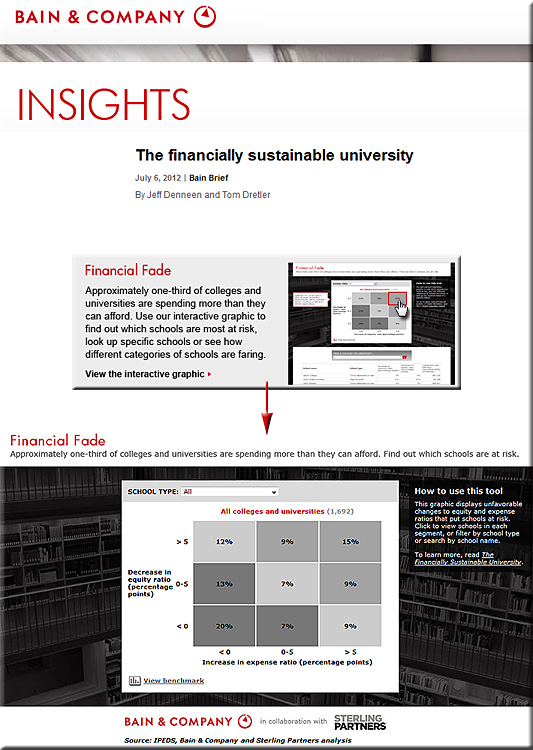
The financially sustainable university — from bain.com, a Bain Brief by Jeff Denneen and Tom Dretle

Excerpts (emphasis DSC):

Still, at the majority of institutions, the pace of change is slower than it needs to be. Plenty of hurdles exist, including the belief that things will return to the way they always were. (Note: They won’t.) But the biggest obstacle is more fundamental: While leaders might have a sense of what needs to be done, they may not know how to achieve the required degree of change that will allow their institution not just to survive, but also thrive with a focused strategy and a sustainable financial base.

…

Too often, stakeholders believe that the current cash crunch and need for change is a temporary phenomenon that will subside as the economy continues to improve. But those who see things this way probably haven’t been exposed to the data presented here and in other reports that show convincingly that this time is different. Faculty and other key stakeholders must be shown clear and compelling facts to disprove the “return to the status quo” notion and to clarify the corresponding negative implications and consequences of inaction.

.

The Financially Sustainable University - July 2012 - a Bain Brief by Denneen & Dretle

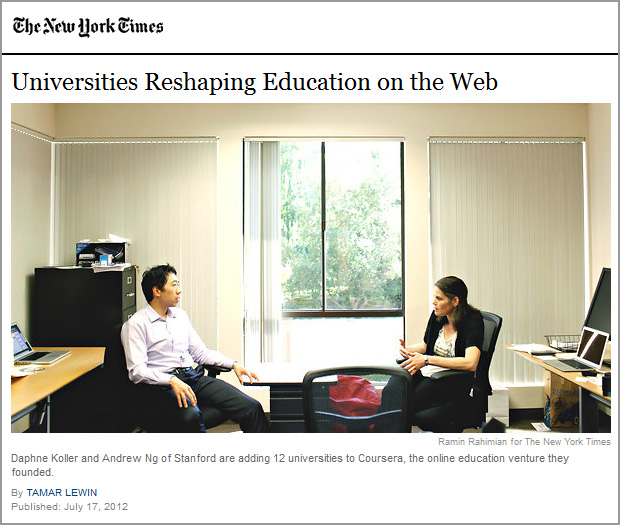
From the New York Times -- Universities Reshaping Education on the Web - July 17, 2012


Excerpt:

As part of a seismic shift in online learning that is reshaping higher education, Coursera, a year-old company founded by two Stanford University computer scientists, will announce on Tuesday that a dozen major research universities are joining the venture. In the fall, Coursera will offer 100 or more free massive open online courses, or MOOCs, that are expected to draw millions of students and adult learners globally.

Also see:


From DSC:

Notice the equity investors here…players outside the normal/traditional higher ed landscape continue to enter. Control is an illusion. The conversation continues to move…

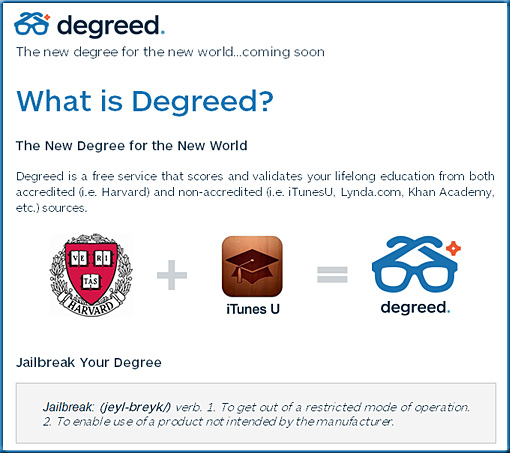
http://degreed.com/about/what_is_degreed

The glorious end of higher education’s monopoly on credibility — from business.time.com by  Michael Ellsberg
In the past, the only way to get professional credibility was with a college degree.  Now young people are using many different tools to gain a foothold in the business world.

From DSC:
Do you sense a bit of the build-up/angst against higher education in this article from TIME? If you’ve been reading much about higher ed these days, this type of perspective is increasingly being voiced.

As such, those of us working in higher education — especially those in leadership positions — need to work much harder at reinventing ourselves.  At least part of the solution involves significantly lowering the price of higher education to make it much more accessible, but still maintaining the quality of our programs. Online learning will play a large part in the solution; I realize that it can be expensive to create high-quality materials, but it doesn’t come with nearly as much overhead.

Higher ed institutions are starting to find themselves in the “Have you driven a Ford lately?” mode.  If the public’s perspective continues to move down this trajectory/path, it will be an uphill battle to regain the public’s trust and respect. Relevancy will become a much harder battle to win at that point.


Other examples of the changing conversation and where it’s being held:
 

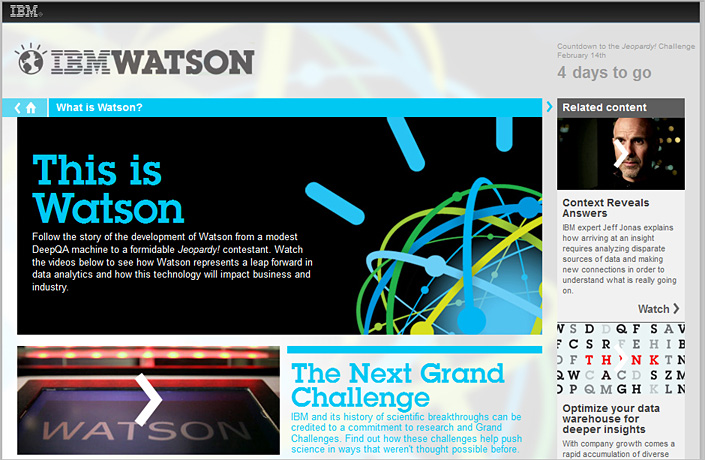
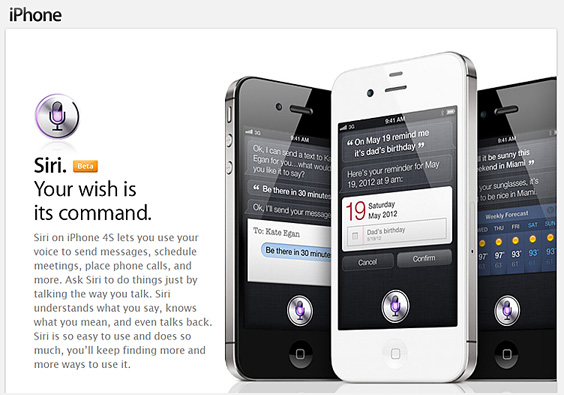
When the technologies behind Watson and Siri get perfected and integrated into the “Learning from the Living [Class] Room” environment [Christian]


From DSC:

When the technologies behind IBM’s Watson and Apple’s Siri get perfected and integrated into products and services that will make up the near future “Learning from the Living [Class] Room” environment— there will be:


  • A high degree of personalization and customization — available 24x7x365 on multiple kinds of devices
    .
  • The option to turn on tracking and analytics — reporting from which can be moved into the learner’s cloud-based profile upon completion of the unit/activity/badge
    .
  • Students of all ages will have access to their own virtual tutors so to speak
    .
  • When a virtual tutor is unable to resolve or address the student’s issue to the student’s satisfaction, the student will be able to instantly access a human tutor (with the option of keeping the existing work/issue/problems visible to the human tutor)


IBM's Watson -- incredible AI!


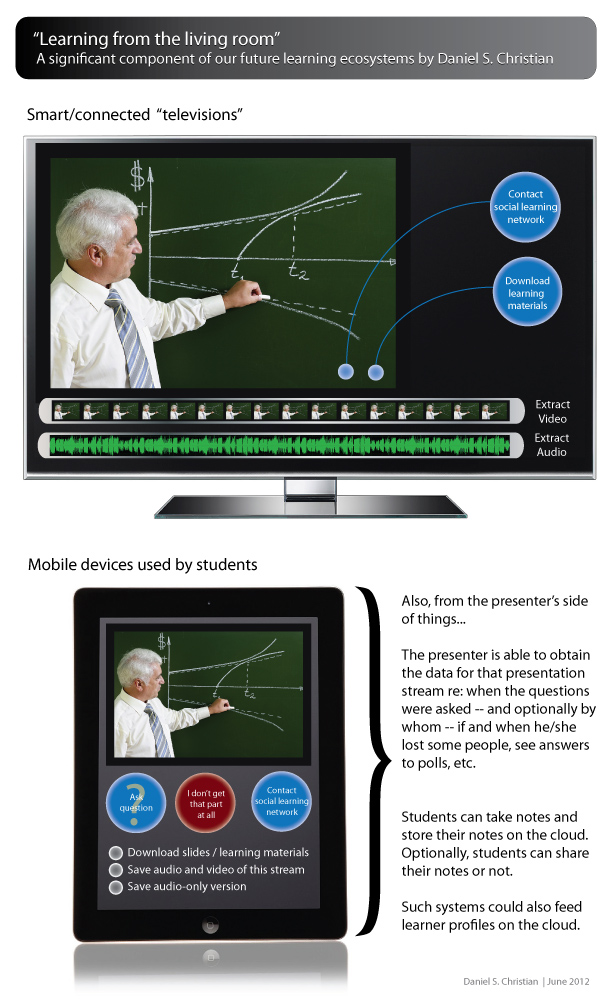
The Living [Class] Room -- by Daniel Christian -- July 2012 -- a second device used in conjunction with a Smart/Connected TV


.

Addendums:


“Learning from the living room” — Part I [Christian]

Learning from the living room -- a component of our future learning ecosystems -- by Daniel S. Christian, June 2012


Legal size PDF here


Addendum on 7/3/12 from an article I wrote for EvoLLLution.com (for LifeLong Learning):
Establishing better collaboration between the corporate world and higher education [Christian]

In the near future, perhaps we could have second screen-based activities whereby corporate leaders are giving TED-like presentations or expressing the current issues in their worlds via a program on Smart TVs, and the students are communicating and collaborating about these presentations via tablets or smart phones.  Perhaps there will be electronic means whereby students could submit their ideas and feedback to the presenting companies (and whereby selected ideas could be rewarded in terms of free products or services that the company produces).

Penn launches its first free online classes via Coursera — from the University of Pennsylvania

Excerpt (emphasis DSC):

PHILADELPHIA — This week, the University of Pennsylvania launched three free courses via Coursera, an online educational platform designed to make Web-based classes available more widely.

With the capacity to reach millions of people simultaneously, Coursera has a design inspired by educational research on effective learning practices and creates an interactive learning experience for the course offerings.

So far, more than 50,000 people from around the world have enrolled in these three online courses, all stemming from Penn’s Perelman School of Medicine:

  1. Fundamentals of Pharmacology with Emma Meagher, an attending physician in preventive cardiology at Penn Medicine and the director of Penn’s four-year pharmacology curriculum.
  2. Vaccines with Paul Offit, a professor of pediatrics in the Perelman School and the director of the Vaccine Education Center at the Children’s Hospital of Philadelphia, who has made it his life’s work to educate both the medical profession and the public on the value of vaccinations.
  3. Health Policy and the Affordable Care Act with Ezekiel Emanuel, the vice provost for global initiatives at Penn and the chair of the Department of Medical Ethics and Health Policy.  He is also a Penn Integrates Knowledge professor in the Perelman School and the Wharton School.

Online education startups: A field guide — from gigaom.com by Ki Mae Heussner

Public university becomes first to endorse untraditional online model — from by Denny Carter
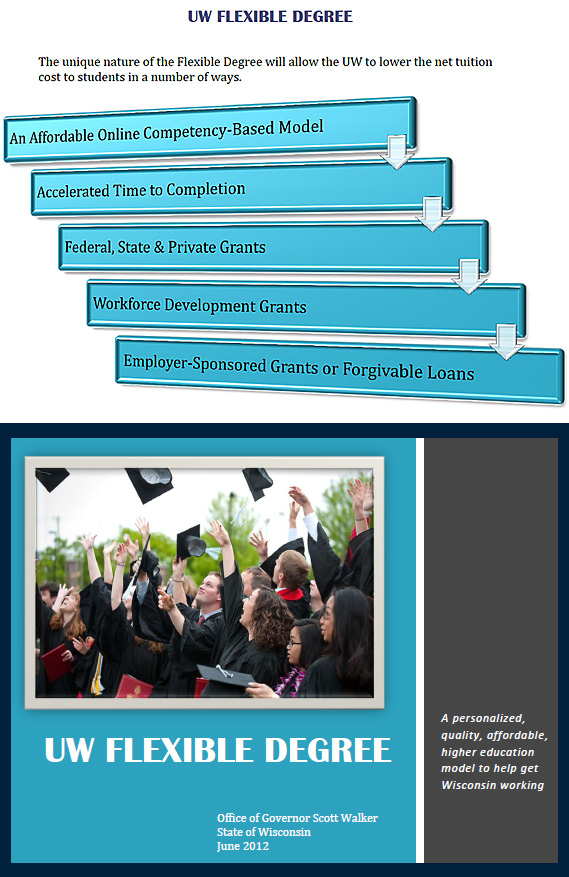
Some UW faculty members, after political clashes with Gov. Scott Walker, remain skeptical of UW Flexible Degree

Excerpt:

Students at the University of Wisconsin (UW) can earn college degrees based on proven competency in a subject, making UW the first publicly-funded school to launch a competency-based degree program.

Led by officials at UW-Extension, a continued learning program with offices located across Wisconsin, the UW Flexible Degree will let incoming students demonstrate their knowledge and cut down on the time it takes to earn a degree.

.

Making it count — from insidehighered.com by Paul Fain

Excerpt:

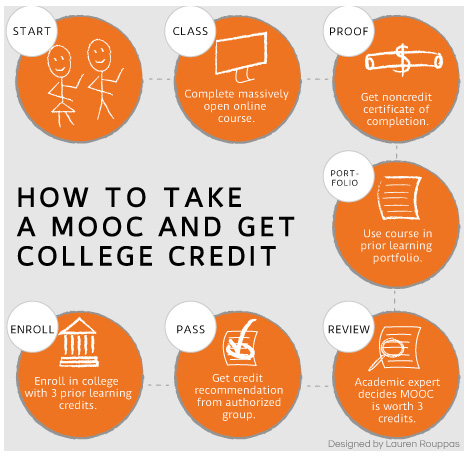
Massively open online courses, or MOOCs, are not credit-bearing. But a pathway to college credit for the courses already exists — one that experts say many students may soon take.

The diagram of this concept (note: at concept stage at this point) looks like this:

.


Tagged with: •  

Gates Foundation gives $9 million in grants to support ‘breakthrough’ education models — from The Chronicle by Jeffrey R. Young

Excerpt:

The Bill & Melinda Gates Foundation is stepping up its investment in innovative delivery models in higher education, announcing $9-million in grants today to support a range of new approaches.

© 2025 | Daniel Christian