The education giant adapts — from MIT Technology Review by Jessica Leber
Pearson is the world’s largest book publisher. Now it wants to be a one-stop shop for digital education.

Excerpt:

Pearson pulled this off with a decade-long string of acquisitions that helped it shift its emphasis from selling books to selling education services. The London-based company styles itself as the “world’s leading learning company,” even if that learning isn’t delivered through traditional books. These days, Pearson is more like an IT department for classrooms and schools. It sells technology infrastructure, software, and consulting services to schools—services that in turn help deliver the vast stock of textbook content Pearson owns. The company says its revenue from online content and services will surpass those of the traditional publishing business this year.

From DSC:
I congratulate Pearson on reinventing itself.  The words of Steve Jobs ring in my mind…something about cannibalizing one’s business before someone else does it for you.  Several other words and phrases come to my mind after seeing the above article — that regular readers of this blog and my archived website will instantly recognize:

  • Dangers of the status quo
  • Staying relevant
  • Survival
  • Disruption/change
  • New business models
  • Game-changing environment
  • Using teams of specialists

Also relevant here/see:


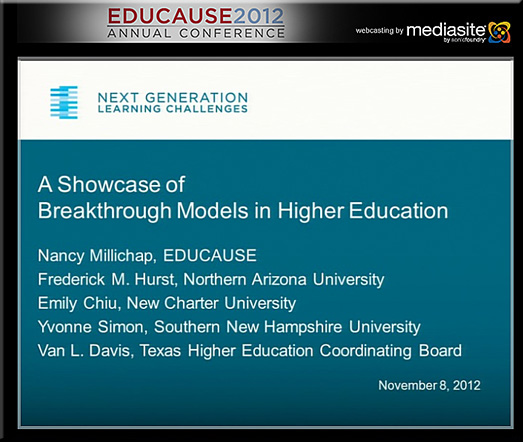
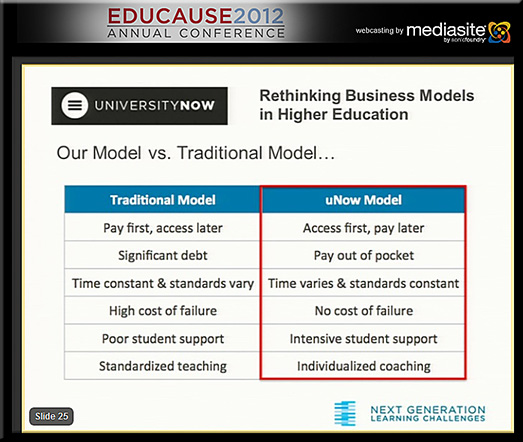
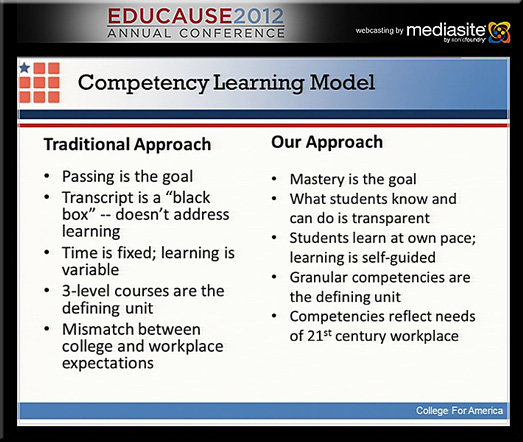
A showcase of breakthrough models in higher education — from the Educause 2012 Annual Conference

Example slides:


.


.


.

From DSC:
Again, this topic/presentation from Educause supports the idea of developing Centers of Innovation to have a smaller, more nimble group experiment with a variety of models, methods, pedagogies, etc.


Current/Future State of Higher Education — from Educause Live by George Siemens, Andy Caulkins, Malcolm Brown

Change drivers

  • Globalization
  • Commercial/entrepreneurial activity
  • Funding cuts
  • Online learning
  • Unbundling of education systems
  • Technology advancement (mobiles)
  • Employment-oriented education
  • Big data and analytics

Net Pedagogies: New Models for Teaching & Learning

  • New pedagogies emerging from:
    • Concerns about how well institutions are meeting their mission, on behalf of students they serve
    • Pressures resulting from feeling constrained within the “Iron Triangle” of costs, access, and quality
    • New technologies
  • How to balance personalization with competency-based pathways
  • How to build community among students who are geographically distant and proceeding at different rates (a different cohort dynamic taking place here)
  • Personalized learning divisions/groups
  • Innovation labs <– From DSC: This lines up nicely with my posting here

Entrepreneurship

  • Deborah Quazzo, GSV Advisors
  • Velocity of change
  • e-books up
  • 200K education apps
  • 98% of students own some sort of device
  • Coursera — 33 partners, 1.7 million students
  • 13% of students now at for-profits
  • The Bear Story
    • Readiness — freshmen often needing remediation
    • Completion rates
    • Cost
    • Career
  • Venture capital and startups increasing
  • What’s driving investment
    • Funding issues
    • Accountability
    • Technology
    • Consumer choice
  • Waves of HE innovation
  • “Traditional institutions are not standing still”
  • Higher ed arms race — online program delivery (tuition-based) / MOOC (free)
  • Growth in MOOC students — .51 in Fall 2011, 2.79 in Fall 2012; 447% growth rate
  • Need to increase learning outcomes, access, capacity, and decrease costs

Big Data & Analytics

  • Erik Duval, Simon Buckingham Shum, Caroline Haythornthwaite
  • State of learning analytics
    • Open analytics
    • Standards
    • Methods and metrics
    • Impact on learner success
    • Early risk detection
    • Common language
    • Institutional use of analytics
    • Planning and deployment of LA
    • Move from concept to application
  • Participation wall seems to be occurring 30-40% of the time into the course
  • 762 tweets, 305 links, 172 RTs, 244 Unique Twitter accounts

Leadership in Education

  • James Hilton
    • Characterizing change
    • Not a linear system often times; instead, an emergent change; not always orderly and linear
    • Unknown end point
    • Adjust as you go
    • Adjust fundamental conditions
      • 2 fundamental forces in HE
      • Commoditization
      • Unbundling
    • “Find your North Star”
  • George Mehaffy
    • Challenge and change article
    • Massive change and great uncertainty
    • Technology changes everything
    • Traditional institutions loss of control
    • Students abilities to interact and learn without mediating
    • “Outsiders” becoming players
    • Venture capital
    • Models of college changing
    • Course models
    • Data analytics
    • Cost discrepancies
    • Measuring success
    • Loss of credentialing monopoly
    • Leadership vacuum
    • Change is rapid, profound, emergent
    • We need to rethink HE leadership model
    • We need to rethink HE in many fundamental dimensions
    • Now is the time for bold, imaginative, entrepreneurial leadership

Distributed Research

  • Traditional methods of sharing research, established centuries ago
  • Need to re-imagine those methods and generate higher, faster, better outcomes from research
  • Challenges: pace, dissemination, incentive to collaborate
  • Opportunities: immediacy, openness, new/richer tools and indicators, unprecedented progress

Still some challenges in offering a MOOC-based course:

  • Skillset development
  • Getting participants orientated to the course
  • Technological glitches

.


Other resources/links:


New frontier for scaling up online classes: Credit – from the New York Times and the Associated Press

Also see:

Degreed wants to jailbreak the college degree — from techcrunch.com by Rip Empson

Excerpt:

One new San Francisco startup, Degreed, is on a mission to “jailbreak the degree” and give learners a new form of academic credentialing. The startup’s free service essentially scores and validates a host of different learning inputs, whether they be from formal institutions, like the University of California, or informal platforms like Khan, Lynda.com, iTunesU, Coursera and so on.

26 iBooks Author how-to videos — from freetech4teachers.com by Richard Byrne

Also see:

.


Also see:


Addendum on 11/19/12:

.

tablo.com.au

From DSC:
I wonder how MOOCs focused on language will go…?  It could be great to practice a language from folks all around the world — or will it be chaotic?  Different accents. Real-world speaking and listening. Real world conflict, perhaps, as well.  But it seems like there could be some effective learning going on — at least “on paper”.   I wonder, too, if 1/2 of the time folks could speak one language — and would be the students during that part of the class — while the other 1/2 of the time they speak another language — and would be the “teachers.”

.


http://spanishmooc.com/


And for yet another item on innovation within higher ed! Whew!

  • Excelsior College and three California Community Colleges offer credit for professor-less MOOC — from online colleges.com by Alex Wukman
    Excerpt:
    Excelsior College has partnered with San Diego City College, San Diego Miramar College, and Santa Rosa Junior College to offer credit for a professor-less, or mechanical, massive open online course (MOOC). The course, an introduction to statistics class, is being developed by the 20 Million Minds Foundation and the online learning community OpenStudy.

New consortium of leading universities will move forward with transformative, for-credit online education program — from 2U.com
Semester Online™ will be first of its kind featuring rigorous, innovative, live courses

Excerpt (emphasis DSC)

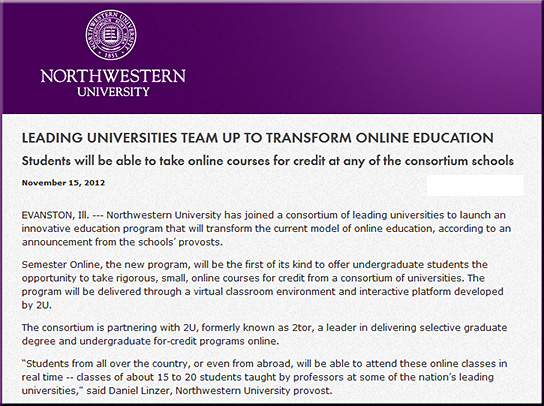
LANDOVER, Md. — Nov. 15, 2012 — Today, a group of the nation’s leading universities announced plans to launch a new, innovative program that transforms the model of online education. Consortium members include Brandeis University, Duke University, Emory University, Northwestern University, The University of North Carolina at Chapel Hill, University of Notre Dame, University of Rochester, Vanderbilt University, Wake Forest University and Washington University in St. Louis. The new online education program, Semester Online,will be the first of its kind to offer undergraduate students the opportunity to take rigorous, online courses for credit from a consortium of universities. The program is delivered through a virtual classroom environment and interactive platform developed by 2U, formerly known as 2tor.


From DSC:
Interesting to see the impact of competition…

.


Addendum on 11/16/12:

Elite Online Courses for Cash and Credit— from insidehigheredy.com by Steve Kolowich

Excerpt:

A consortium of 10 top-tier universities will soon offer fully online, credit-bearing undergraduate courses through a partnership with 2U, a company that facilitates online learning.

Any students enrolled at an “undergraduate experience anywhere in the world” will be eligible to take the courses, according to Chip Paucek, the CEO of 2U, which until recently was called 2tor. The first courses are slated to make their debut in the fall.

After a year in which the top universities in the world have clambered to offer massive open online courses (MOOCs) for no credit, this new project marks yet another turning point in online education. It is the first known example of top universities offering fully online, credit-bearing courses to undergraduates who are not actually enrolled at the institutions that are offering them.

.

From DSC:
It’s not a stretch to think that we’ll soon be able to take part in this type of thing from our living rooms…

The Living [Class] Room -- by Daniel Christian -- July 2012 -- a second device used in conjunction with a Smart/Connected TV


.

Also relevant here/see:
Attend the Global Education Conference
from your living room

Addendum on 11/19/12:
.

College crackup and the online future — from bloomberg.com by Mark C. Taylor

.

College Crackup

Illustration by Keith Shore

Excerpt:

In the coming decade, emerging technologies will thoroughly transform higher education. Although distance learning and computer-assisted education have been around since the 1960s, financial pressures are forcing institutions to develop aggressive online programs.

…

These practical considerations shouldn’t overshadow one of the most promising innovations that online education will bring: The very structure of knowledge will change.

…

As students mix and match courses online, pressure will increase for professors to develop classes that integrate different approaches and disciplines.

.

.

asdfsadf


Also see:


From DSC:
Creating “Innovation Labs” within each institution of higher education sounds like a good idea to me…we can experiment with things at smaller scales and see what works and what doesn’t.

Also see:
Take a lesson from Apple: A strategy to keep customers in your ecosystem — from forbes.com by Alonzo Canada

Excerpt (emphasis DSC):

1.     Set focused, strategic targets.
2.     Create a portfolio of experiments. Like Apple or Mercedes Benz, once you have focused, strategic targets set, create a series of experiments.  A general rule of thumb is the 7-2-1 rule:  one experiment should be big and relatively safe.  Two experiments should be slightly more risky and moderately sized.  Then seven experiments should be highly risky and low cost. These experiments can be scaled accordingly across teams, business units, and the entire company. 3M is one of the first companies to mandate that its employees spend 20% of their time thinking up blue sky ideas beyond its current lines of business and this is how Post-It Notes were born.  Art Fry, an engineer at 3M wanted to find a better way to manage notes in his hymnal on Sundays at church.
3.    Leverage learnings to inform new experiments.


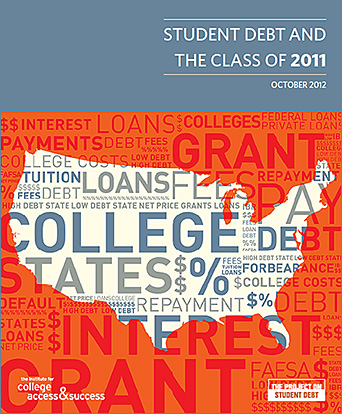
Average student debt climbs to $26,600 for Class of 2011 — from The Institute for College Access & Success
Report, website include state-by-state and campus-by-campus debt levels for 2011 graduates


Average student debt now up to 26K+ for Class of 2011


Excerpt:

TICAS recently released Student Debt and the Class of 2011, our seventh annual report on the debt carried by new college graduates. Hundreds of news outlets around the country have already run stories featuring our findings, including The New York Times, USA Today, and PBS NewsHour.

We found that two-thirds of college seniors who graduated from public and private nonprofit four-year schools in 2011 carried an average of $26,600 in student loan debt, up 5% from the previous year. Private student loans comprised about one-fifth of the Class of 2011’s debt. Meanwhile, unemployment for recent graduates dipped from last year’s peak of 9.1% but remained high at 8.8% (still less than half the unemployment rate for young adults with only a high school diploma).

The report also shows that average student debt levels vary widely by state as well as by college. To view debt levels for all 50 states plus the District of Columbia and more than 1,000 individual U.S. colleges and universities, visit our companion interactive map.

Read the press release
Read the report
Use the interactive map

.

From DSC:
The above items support the need for greater experimentation within higher ed.

Also see:


Excerpt:

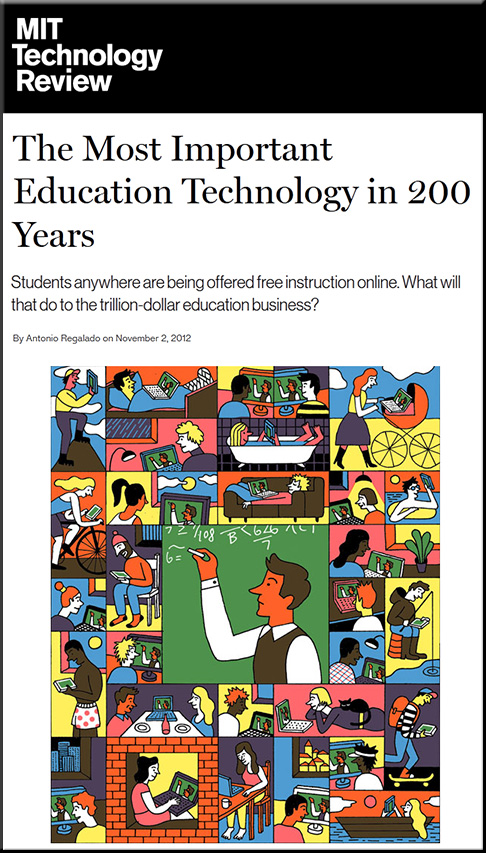
Agarwal believes that education is about to change dramatically. The reason is the power of the Web and its associated data-crunching technologies. Thanks to these changes, it’s now possible to stream video classes with sophisticated interactive elements, and researchers can scoop up student data that could help them make teaching more effective. The technology is powerful, fairly cheap, and global in its reach. EdX has said it hopes to teach a billion students.

.

Which brings me to this graphic:


asdfsadf


Also see:


Business model innovation: A blueprint for higher education — from Educause by Christine Flanagan

Excerpt:

Business model innovation is one of the most challenging components of 21st-century leadership. Making incremental improvements to a business model—creating new efficiencies, expanding into adjacent markets—is hard enough. Developing and experimenting with new business models that truly transform how an institution delivers value (while continuing to drive the performance of the current business model) is exceptionally difficult. Yet nowhere is the imperative for business model innovation more prevalent or more relevant than in higher education, which is under intense scrutiny and facing rising costs and potential disruption from all angles.

To compete in a world where the shelf life of business models is shortening, higher education leaders need the tools, skills, and experience to envision, test, and implement new business models. They must believe in the power of experimenting, in the real world, with a network of collaborators who have the audacity to change everything. As the legendary innovation mastermind Clayton Christensen says: “You don’t change a company by giving them ideas. You change them by training them to think a different way.”1

MOOCs for credit — from InsideHigherEd.com by Steve Kolowich

Excerpt:

Coursera, the largest provider of massive open online courses (MOOCs), has entered into a contract to license several of the courses it has built with its university partners to Antioch University, which would offer versions of the MOOCs for credit as part of a bachelor’s degree program.

The deal represents one of the first instances of a third-party institution buying permission to incorporate a MOOC into its curriculum — and awarding credit for the MOOC — in an effort to lower the full cost of a degree for students. It is also a first step for Coursera and its partners toward developing a revenue stream from licensing its courses.

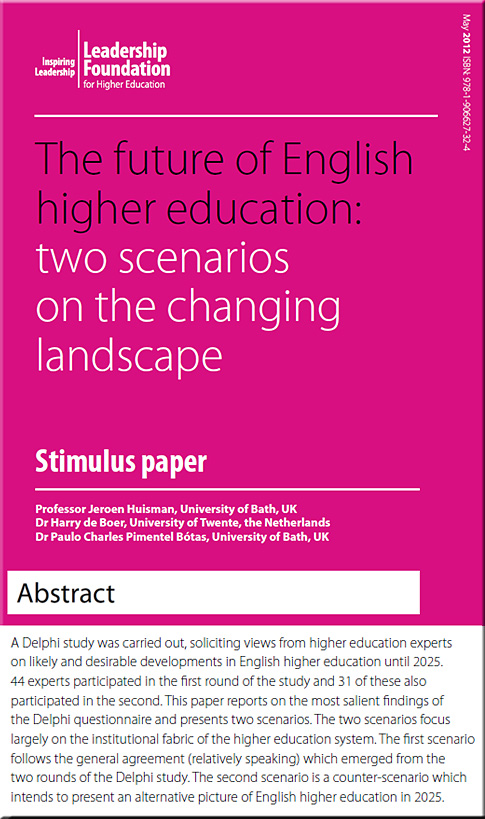
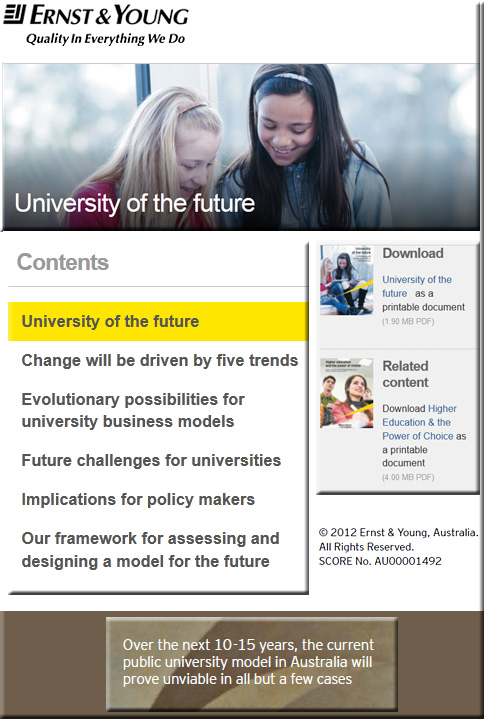
The future of English higher education: two scenarios on the changing landscape -- May 2012 by Huisman, de Boer, and Pimentel Botas

.

From DSC:
Whether one agrees or not with the scenarios…what’s important here is to promote discussions of the future of higher education across the world. Developing scenarios is an excellent way to jump start such conversations, contribute to strategic plans/visions, and develop responses to the changing higher education landscape.


.

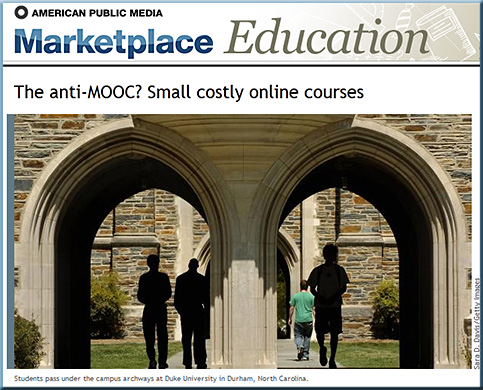
“A thousand year old industry on the cusp of profound change”

First university system joins edX — from by Tanya Roscorla

Excerpt:

Huge online courses will be coming to the University of Texas System next year, the system announced Monday, Oct. 15.


Who’s investing in ed-tech?: Tech investors and their education portfolios — from hackeducation.com by Audrey Watters

Excerpt:

Below is by no means a complete list of technology investors who have education companies in their portfolio. Nor is it a list of the “top” or the “best” or the “most profitable” or “most active” ones, although for what it’s worth the list does match closely the answer on Quora to “Who are the top (active) VCs in the education technology space?”

.

Student loan default rates jump — from money.cnn.com by Blake Ellis
The Department of Education said 218 schools had three-year default rates of 30% or more, putting the schools at risk of losing their federal student aid.

Excerpt:

NEW YORK (CNNMoney) — Borrowers are having a harder time repaying their student loans.

The percentage of borrowers who defaulted on their federal student loans within two years of their first payment jumped to 9.1% in fiscal year 2011, up from 8.8% the previous year, according to U.S. Department of Education data released Friday.


Too high a price? — from InsideHigherEd.com by Kevin Kiley

Excerpt:

Grinnell College, which this year reported the fifth-largest endowment of any liberal arts college, announced Thursday that it would spend the next few months engaged in a conversation with campus stakeholders about changing its financial aid policies – including potentially, but probably not, going as far as making changes to need-blind admission. That makes it the second high-profile liberal arts college, following Wesleyan University this summer, to broach the topic in recent months.

Grinnell’s announcement stands out for two major reasons. Grinnell is one of the wealthiest liberal arts colleges in the country, so the idea that it would view its current financial aid model as unsustainable could be a bellwether that the sector as a whole is reconsidering the model. Second, the college’s administrators are taking an unusually public approach to a discussion that arouses strong emotions, trying to educate all campus constituents on why they think change might be necessary and hoping that, in doing so, they can mollify potential critics.


Addendums/also see:

  • White House: FY 2012 Deficit $1.089 Trillion — from  finance.yahoo.com
  • Higher Ed Shrinks — from InsideHigherEd.com by Doug Lederman
  • Let’s make a deal— from InsideHigherEd.com by Kevin Kiley
  • What’s driving debt — from InsideHigherEd.com by Kevin Kiley
    Excerpt:
    In a new paper released by the Cornell Higher Education Research Institute, University of Richmond business professor James Monks finds that when it comes to getting burdened by debt, the increase in price isn’t an innocent bystander, but it has several accomplices, particularly the admissions and financial aid policies at a given institution.
  • Pearson doubles down online — from InsideHigherEd.com by Doug Lederman
  • Apollo Group to close 25 University of Phoenix campuses — from bizjournals.com
    Excerpt:
    The majority of its 328,400 students take classes online, which means those campuses aren’t in demand, said Alex Clark, spokesman for the Phoenix-based Apollo (Nasdaq: APOL). Plans call for closing 115 locations, impacting 13,000 students. Of those, 90 are learning centers and 25 are campuses. Following the closure, 112 locations in 36 states will remain.
© 2025 | Daniel Christian