SanJoseStatePlus-UdacityPartnership-Jan2013


Also see:

Excerpt:

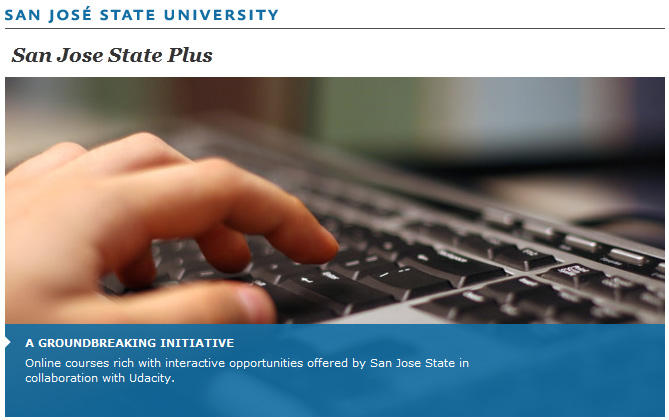
Today Udacity is thrilled to announce a partnership with San Jose State University to pilot three courses — Entry-Level Mathematics, College Algebra, and Elementary Statistics — available online at an affordable tuition rate and for college credit. To my knowledge, this is the first time a MOOC has been offered for credit and purely online. Much credit for this partnership goes to Mo Qayoumi and Ellen Junn, president and provost of SJSU, and to the five fearless SJSU professors who have chosen to work with us at Udacity to explore this new medium. The offices of Governor Brown and CSU Chancellor White have also been critically important to this partnership for their leadership and expediency. Last but not least, I want to personally thank our great Udacians who, like everyone on this list, have worked endless hours to drive innovation.
Over the past year, MOOCs have received a lot of attention in the media and education circles mostly because so many students are taking advantage of the course for free. Predictions that MOOCs would fundamentally change higher education often revolved around the fact that the courses have unprecedented reach and affordability.


From DSC:
Given that such “Walmarts of Education” (i.e. solid learning at a greatly reduced prices) continue to develop, what’s our/your plans for responding to this trend? How are we/you going to compete?  What’s our/your vision and strategy?  By the way, you can look all you want to for data — but at the end of the day, it’s likely with this sort of thing that you won’t find all of the data that you require to make a decision. Examples:

  • When I began working for Kraft Foods in 1990 (brought in to roll out email to 66 plants at the time), I believed in the power of email when few others did. Email was viewed as “fluff” and it would never be used for solid business practices; management put the project on hold. But I kept working with email at Kraft — trying to get others to use it. If you looked for data back then, you wouldn’t find it. But by the time I left Kraft in 1997, thousands of people could communicate with thousands of other people throughout the world — within minutes.
    .
  • When Alexander Graham Bell introduced the telephone, what data would support the success of his invention?  I suppose you could have pulled some data on the usage of the telegraph, but even then, vision would have had to trump the data (the ancestor of Western Union rejected his invention, as they questioned why anyone would need/use a telephone when there was already the telegraph in usage).
    .
  • Such technological developments often are not so easy to back up with data; they require some vision, experimentation, and risk taking.

 

Colleges lose pricing power — from the WSJ by Michael Corkery

Excerpt (emphasis DSC):

The demand for four-year college degrees is softening, the result of a perfect storm of economic and demographic forces that is sapping pricing power at a growing number of U.S. colleges and universities, according to a new survey by Moody’s Investors Service.

Facing stagnant family income, shaky job prospects for graduates and a smaller pool of high-school graduates, more schools are reining in tuition increases and giving out larger scholarships to attract students, Moody’s concluded in a report set to be released Thursday.

.

From DSC:
To me, this is just another way of saying the higher education bubble is popping.  I think the bubble may pop at different times for different institutions, but the overall picture is clear: Higher ed will either reinvent itself — and hopefully quickly — or it will lose a portion of its relevance and place in society (how much is ultimately lost depends upon how much higher ed can experiment, innovate, and reinvent itself).

Also relevant here:


From DSC:
Whereas:

  • The Walmart of Education continues and higher ed finds itself in a game-changing environment
  • The pace of change continues to accelerate
  • Disruptive innovations continue to poke at the higher education bubble
  • There is danger in the status quo
  • We all need to constantly reinvent ourselves and our organizations in order to remain relevant…

…institutions of higher education would be wise to significantly increase the priority of experimentation on their campuses during 2013.  This might take the form of creating smaller, more nimble organizations within their overall universities or colleges, or it might be experimenting with new business models, or it might be identifying/experimenting with promising educational technologies or new pedagogies, etc.  I will have several blog postings re: experimentation — and potential things to try out — during 2013; so stay tuned.

Whether we are staff, faculty, or administration, change is coming our way in 2013.  So starting today, get involved with further innovations and experiments on your campus — don’t be a roadblock or you will likely find your institution eventually becoming irrelevant. As Steve Jobs did/believed, cannibalize your own organization before someone else does.


The pace has changed significantly and quickly


From the January/February 2013 issue of The American Interest:


.

Excerpts (emphasis DSC):

The most important part of the college bubble story—the one we will soon be hearing much more about—concerns the impending financial collapse of numerous private colleges and universities and the likely shrinkage of many public ones. And when that bubble bursts, it will end a system of higher education that, for all of its history, has been steeped in a culture of exclusivity*. Then we’ll see the birth of something entirely new as we accept one central and unavoidable fact: The college classroom is about to go virtual.

…

Because recent history shows us that the internet is a great destroyer of any traditional business that relies on the sale of information. The internet destroyed the livelihoods of traditional stock brokers and bonds salesmen by throwing open to everyone access to the proprietary information they used to sell. The same technology enabled bankers and financiers to develop new products and methods, but, as it turned out, the experience necessary to manage it all did not keep up. Prior to the Wall Street meltdown, it seemed absurd to think that storied financial institutions like Bear Stearns and Lehman Brothers could disappear seemingly overnight. Until it happened, almost no one believed such a thing was possible. Well, get ready to see the same thing happen to a university near you, and not for entirely dissimilar reasons.

The higher-ed business is in for a lot of pain as a new era of creative destruction produces a merciless shakeout of those institutions that adapt and prosper from those that stall and die.

…

But what happens when a limited supply of a sought-after commodity suddenly becomes unlimited? Prices fall. Yet here, on the cusp of a new era of online education, that is a financial reality that few American universities are prepared to face.

…

Anyone who can access the internet—at a public library, for instance—no matter how poor or disadvantaged or isolated or uneducated he or she may be, can access the teachings of some of the greatest scholars of our time through open course portals. Technology is a great equalizer.

Big changes are coming, and old attitudes and business models are set to collapse as new ones rise. Few who will be affected by the changes ahead are aware of what’s coming. Severe financial contraction in the higher-ed industry is on the way, and for many this will spell hard times both financially and personally. But if our goal is educating as many students as possible, as well as possible, as affordably as possible, then the end of the university as we know it is nothing to fear. Indeed, it’s something to celebrate.


* The old way:

Colleges rise as they reject — from online.wsj.com
Schools invite more applications, then use denials to boost coveted rankings


Daniel S. Christian - Think Virtual -- April 2012


Also relevant/see:

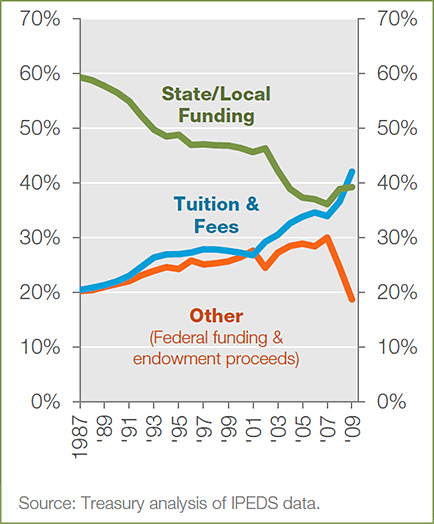
Combine the trends listed in this graphic:

.

Trends-ReportFromDeptOfEdu-2012

— from The Economics of Higher Education, Dec 2012 (pg 2)


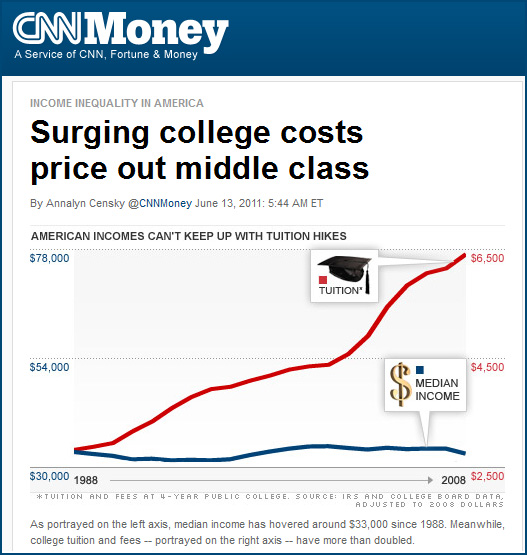
…with the next several graphics…

.

Surging college costs price out middle class -- from CNNMoney.com on June 13, 2011


.

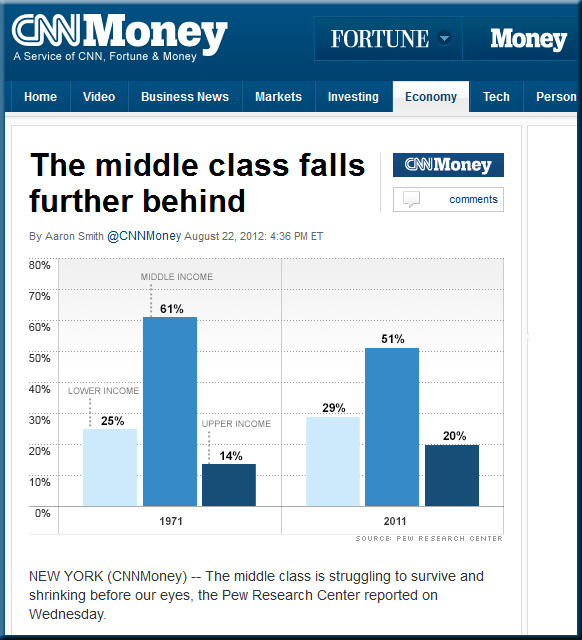
The middle class falls further behind


.

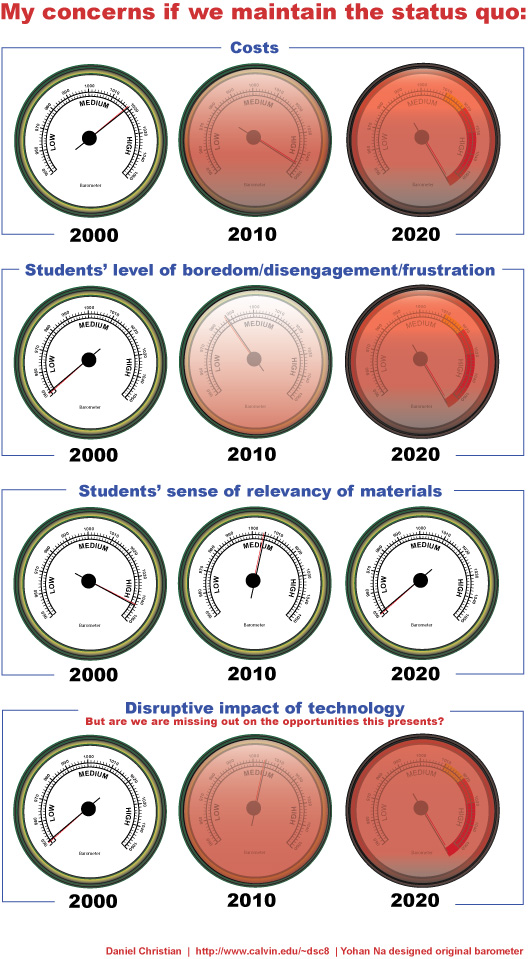
Daniel S. Christian: My concerns with just maintaining the status quo (from 2009).

From 5/21/09


…and you can see that the Perfect Storm in Higher Ed has been amassed.  Massive change is in the air. People will find a way to achieve their goals/objectives — one way or another. College is still a good call — but what “college” and “university life” will look like in 5 years will likely be very different from what they look like today.

There is no returning to the “good ol’ days” — things are not going back to the way they were 5-10 years ago.  It’s time for massive — but controlled/intentional — experimentation within higher ed, to find out how best to use the Internet in order to promote learning (and, hopefully, to still make a living!).

.


asdfsadf


Some examples that illustrate that change is in the air…and that the conversation continues to move outside traditional institutions of higher education (I mention these not to dog higher ed, but to get us to innovate, to reinvent ourselves, and to stay relevant!)


Big idea 2013: College becomes optional — from LinkedIn.com by Ben Smith

Jailbreaking the degree: The end of the 4 year diploma — from onlineuniversities.com by Justin Marquis

Excerpt:

What’s wrong with getting a college degree? According to the grassroots movement, “Jailbreaking the Degree,” being pushed by radical education startup Degreed.com, quite a bit. The organization has identified several fundamental flaws with the long standing college degree process. It aims to overcome them and dramatically change the nature of learning and credentialing in the process. In order to justify their initiative they present some dramatic numbers on their website…

Degreed wants to jailbreak the college degree — from techcrunch.com by Rip Empson

Saying no to college — NYT.com by Alex Williams

Do a Google search on uncollege.org and see what you get

The rise of college alternatives— from huffingtonpost.com by Dan Schawbel

educreations.com: Teach what you know. Learn what you don’t.

The future of corporate innovation and entrepreneurship — from SteveBlank.com

Excerpt:

A New Strategy for Entrepreneurship in the 21st Corporation
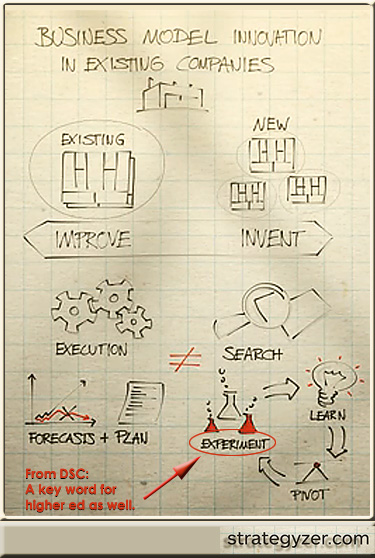
Yet, simply focusing on improving existing business models is not enough anymore. To assure their survival and produce satisfying growth, corporations need to invent new business models. This challenge requires entirely new organizational structures and skills.


Strategyzer-BusModelInnovation-2012


Also see:

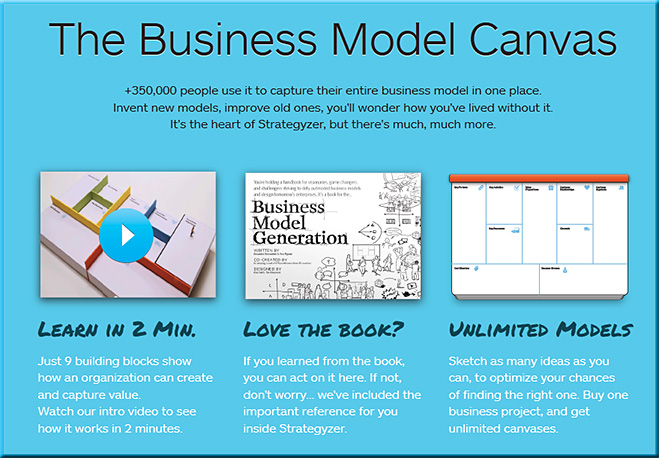
strategyzer.com

TheBusinessModelCanvas-2012


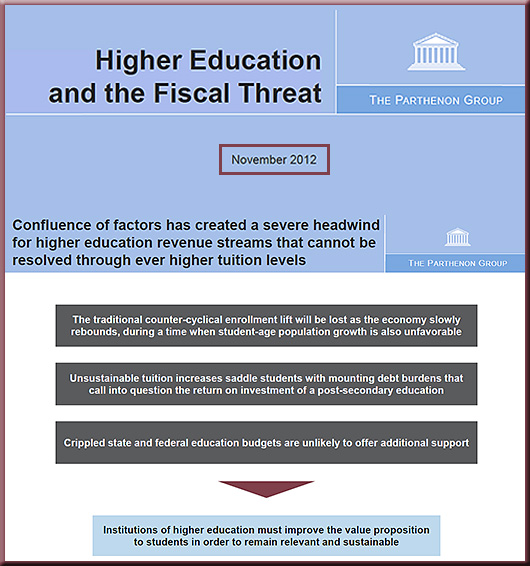
Higher education and the fiscal threat -- from The Parthenon Group - November 2012


Addendum on 12/14/12:

  • Big construction costs, MOOC disruption mean ominous cocktail for higher ed — from educationdive.com by Davide Savenije
    Dive Summary:

    • After years of aggressive expansion efforts, higher education is facing the consequences — according to Moody’s, overall debt levels for rated institutions more than doubled from 2000 to 2011 while donations and investments shrank by more than 40% relative to the debt.
    • While debt has swiftly reached a tipping point for universities, they are not alone —  the total amount of student debt currently exceeds $1 trillion and nearly one in every six borrowers’ student loan balance is in default.
    • Experts and school officials are predicting an imminent reshaping of the field of higher education — Harvard’s annual fiscal report claims “the need for change is clear” as institutions face a decreased “ability to generate […] new resources”.
    • As prospective students become aware of the decreasing value of the higher ed degree, the sudden emergence of MOOCs are becoming an increasingly viable and economically-friendly alternative.


From DSC:
We had better step up the pace of innovating/experimenting – and move to do so quickly. But the problem is, moving quickly is not in the cultures of most of the more traditional institutions of higher education.


Also relevant:

From DSC:
Some reflections on New platform lets professors set prices for their online courses — from InsideHigherEd.com by Jeffrey R. Young

Excerpt:

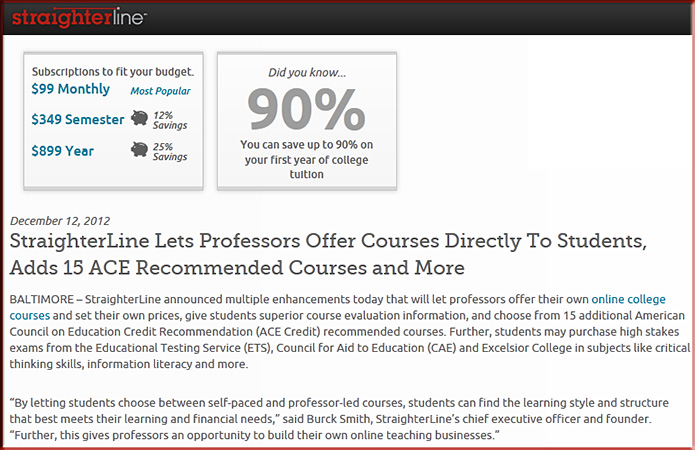
Professors typically don’t worry about what price point a course will sell at, or what amenities might attract a student to pick one course over another. But a new online platform, Professor Direct, lets instructors determine not only how much to charge for such courses, but also how much time they want to devote to services like office hours, online tutorials, and responding to students’ e-mails.

The new service is run by StraighterLine, a company that offers online, self-paced introductory courses. Unlike massive open online courses, or MOOC’s, StraighterLine’s courses aren’t free. But tuition is lower than what traditional colleges typically charge—the company calls its pricing “ultra-affordable.” A handful of colleges accept StraighterLine courses for transfer credit.
.

StraighterLine-ProfsDirectlyToStudents-12-12-12


From DSC:
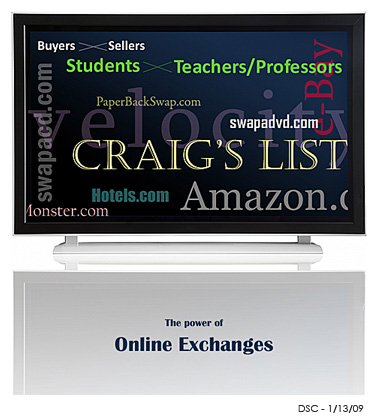
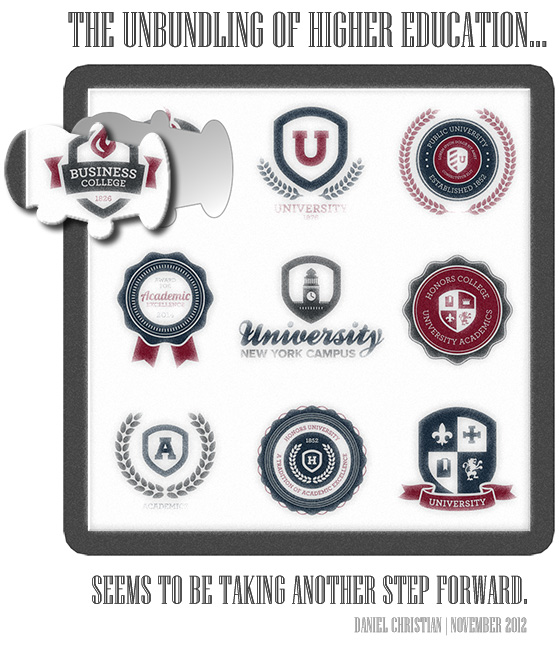
The power of online-based marketplaces. We’ve seen it in other industries.  Are we now going to see more of this within higher education as the unbundling of higher education seems to be a possibility?  Will there be an increased importance of professors’ individual brands? Could be.

The Power of Online Exchanges

.

DanielChristian-The-unbundling-of-higher-education


From DSC:
Congrats Burck & Co. on your continued innovative thinking and business models! Way to help keep a college education accessible to many!


Citing IT skills shortage, IBM wants to expand presence at universities — from wiredacademic.com

Excerpt (emphasis DSC):

“We want to be the scale up partner of choice for these universities,” said Jim Sporher, head of IBM’s university programs. “We want to make sure they have access to technology and understand our strategy.”  He also sees massive open online courses (MOOCs) as a mega-trend and will be considering ways for IBM to be part of the MOOC trend in the future, particularly as many of the MOOC providers such as Udacity and Coursera offer classes in computer science.

…

As a big blue-chip progenitor of the tech industry, IBM is worth listening to in many regards. For one, corporate computing trends often filter down into the education space. The corporate world often has the money to purchase and deploy game-changing technologies. IBM sees that it also works the other way too, where computing at the university level creates new businesses and ideas that move up into the corporate realm.

.

From DSC:
I wonder…will the corporations develop their own MOOCs?  Their own digital “playlists” and associated exams? (i.e. that someone needs to go through and pass in order to work for them…show me what you can do.)  Hmmm…

Also see:

.

McKinsey and Company -- Education to Employment -- An executive summary


.

Also see:


Excerpts from John Katzman’s Keynote:
Higher ed is made up of a series of smaller markets — niches [From DSC: What’s your niche?]

  • Elite level
  • Mid level
  • Entry level

Might have 2-3 high quality programs; and many smaller programs with lower production levels.

Fewer players of larger size

Consolidation is going to occur w/in higher ed. Besides consolidation, there will be collaboration/pooling of resources, and/or the hollowing out within higher ed.


From DSC:
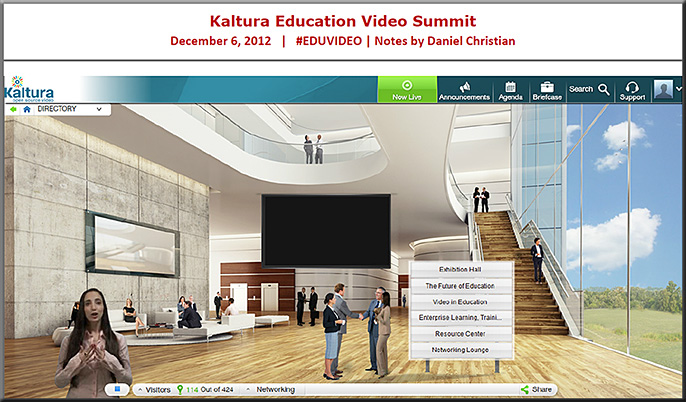
Not that this is new…but looking at the above image, I wonder if more 100% online-based courses and schools will adopt this sort of “space”/interface as a sort of entryway into their institution’s materials.


Excerpt from edSurge’s 12-4-12 newsletter:

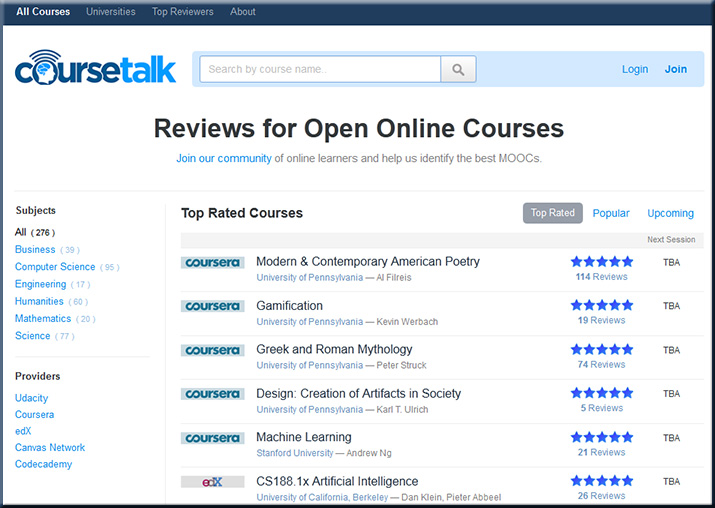
SO HOW WAS THAT MOOC FOR YA? First come the MOOCs, then come the reviews. First out of the box: Founded just six months ago, Knollop is a Yelp-like review and discovery site for MOOCs. It boasts courses from nine MOOCs: including Khan Academy, MIT, and Harvard, as well as favorites like edX, Udacity, and Coursera.

But Knollop has competition. A mere seven weeks ago, serial entrepreneur Jesse Spaulding (LunchTree, FourTonight) launched a rival site called CourseTalk. While CourseTalk features many of the same features as Knollop, it lists just 276 courses to Knollop’s 2,835.

.


.


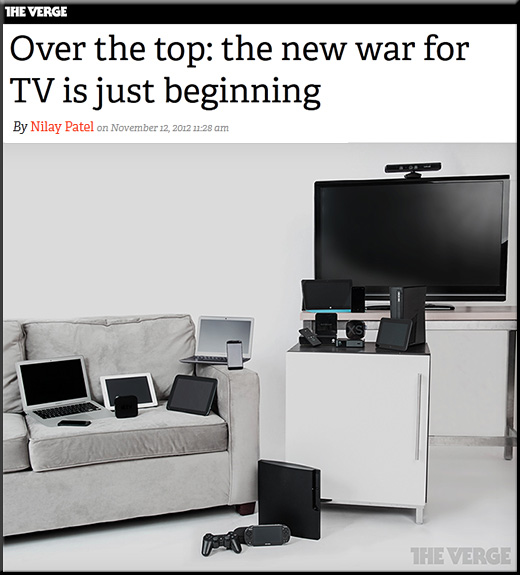
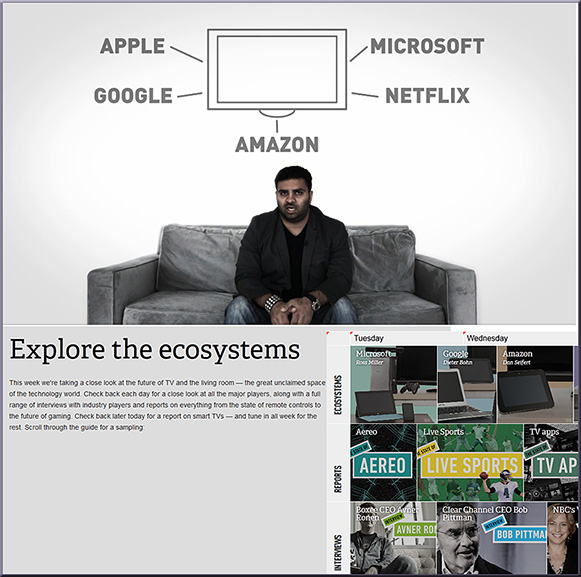
Over the top: the new war for TV is just beginning [Patel]

Over the top: the new war for TV is just beginning  -- from The Verge by Nilay Patel -- November 12 2012


.

 Future of TV


.
The Living [Class] Room -- by Daniel Christian -- July 2012 -- a second device used in conjunction with a Smart/Connected TV


.

From DSC:
I’m beginning to wonder if many of us will be moving off of Moodle, Sakai, Bb Learn, Desire2Learn, etc. to platforms and ecosystems that are being created by Apple, Google, Amazon, and Microsoft.  Rockstar professors on “primetime” — or anytime. If that happens, you can be sure there will be teams of specialists creating and delivering the content and learning experiences.


.


.

From DSC, some examples:

  • Unbundling and Unmooring: Technology and the Higher Ed Tsunami — from educause.org by Audrey Watters
  • Unbundling Higher Education | From the Bell Tower –– from lj.libraryjournal.com by Steven Bell
    Excerpt (emphasis DSC):
    Recent events in higher education suggest a new trend — earning degrees by the course from multiple providers. Are we looking at the iTunes model of unbundled higher ed? Call it alt-HE.
  • Napster, Udacity, and the Academy — from Clay Shirky
    Excerpt:
    Once you see this pattern—a new story rearranging people’s sense of the possible, with the incumbents the last to know—you see it everywhere. First, the people running the old system don’t notice the change. When they do, they assume it’s minor. Then that it’s a niche. Then a fad. And by the time they understand that the world has actually changed, they’ve squandered most of the time they had to adapt.
    .
    It’s been interesting watching this unfold in music, books, newspapers, TV, but nothing has ever been as interesting to me as watching it happen in my own backyard. Higher education is now being disrupted; our MP3 is the massive open online course (or MOOC), and our Napster is Udacity, the education startup.
    …
    But who faces that choice? Are we to imagine an 18 year old who can set aside $250K and 4 years, but who would have a hard time choosing between a residential college and a series of MOOCs? Elite high school students will not be abandoning elite colleges any time soon; the issue isn’t what education of “the very best sort” looks like, but what the whole system looks like.


Excerpt:

With the public’s continued focus on value and affordability, higher education finds itself at a critical juncture. Cost pressures and increased global demand for access have given rise to innovations that have unleashed new delivery models into the education marketplace. Such innovation is required if universities are to thrive, compete, and bring new relevance and meaning to the value of college in the 21st century.

Also see:

  • Americans believe higher education must innovate — from Northeastern News
  • President: Witt must adapt to survive — from springfieldnewssun.com by Tom Stafford
    Excerpt:
    Liberal arts colleges that ignore market realities “absolutely won’t exist in the next decade,” Wittenberg University President Laurie M. Joyner told Springfield Rotarians on Monday.  But the practical or applied liberal arts education that she predicts can sustain Wittenberg will encourage deeper connections with Springfield, she said while speaking at the Hollenbeck-Bayley Conference Center, because “our students learn better when dealing with real-world problems.” A shrinking pool of price-sensitive high school graduates has combined with a bad economy to produce “the equivalent of a perfect storm for some of us,” said Joyner, who succeeded Mark Erickson on July 1.
  • Surviving disruption — from hbr.og by Maxwell Wessel and Clayton M. Christensen
    Excerpt:
    …to meet disrupters with disruption of their own, but also to guide their legacy businesses toward as healthy a future as possible.
  • Sanjay Sarma appointed as MIT’s first director of digital learning — from MIT by Steve Bradt
    Mechanical engineering professor will shepherd efforts to integrate elements of online education into traditional MIT courses.

From DSC:
Experimentation. Innovation. Experimentation. Innovation. Fail. Fail. Succeed. Fail. Succeed. Fail. 


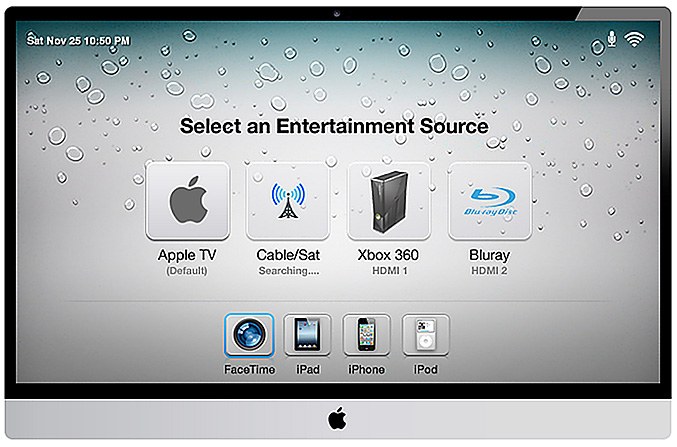
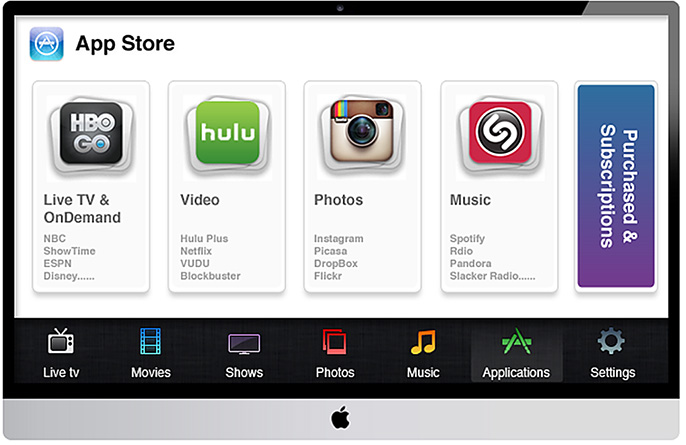
An innovative, sharp concept for a potential Apple TV

An à la carte Apple TV concept integrates Siri, FaceTime, and cable/satellite providers (Gallery) — from 9to5mac.com by Jordan Kahn

Example “screenshots” from this concept:

Apple TV Concept - Nov 2012

.


Also see:


From DSC:
This relates to what I’m calling “Learning from the Living [Class] Room”

.

The Living [Class] Room -- by Daniel Christian -- July 2012 -- a second device used in conjunction with a Smart/Connected TV


© 2025 | Daniel Christian