


New stats: Book publishing is growing; e-book revs and sales up over 1000% — PaidContent.org
On 07/24/2011,
in business, business side of he, change, corporate / business world, economics, game-changing environment, global, legislatures / government / legal, new business models, political science, United States,
by Daniel Christian
Analysis: In debt row, hints of emerging-economy crises — from Reuters by Pedro Nicolaci da Costa
WASHINGTON | Sun Jul 24, 2011 5:59pm EDT
Debt default. A ratings downgrade. Political deadlock. Such terms, once associated primarily with the developing world, now abound in the mighty United States.
On 07/14/2011,
in 21st century, 24x7x365 access, 3D, A/V -- audio/visual, animation, Apple, art, changing business models, convergence, creativity, digital audio, digital learning, digital storytelling, digital textbooks, digital video, disruption, educational games / serious games, elearning, emerging technologies, engagement / engaging students, generational differences, human-computer interaction (HCI), innovation, interaction design, interactivity, K-12 related, learning ecosystem, love of learning, media/film, multimedia, new business models, new media literacies, publishing, quality, reading, storytelling, technologies for your home, tools, trends, user experience (UX), user interface design, using teams,
by Daniel Christian
Check out:
- Fantastic new children’s iPad book by author William Joyce — from curiositycounts.com as curated by Maria Popova

Also see:
- iTunes Preview of “The Fantastic Flying Books of Mr. Morris Lessmore” by Moonbot Studios LA, LLC
- The Making Of Morris: Part 4 (Invitations To Adventure)
- The Making Of Morris: Part 3 (Thousands Of Books)
- morrislessmore.com
- MOONBOT Studios: An interplanetary creative expedition of story and art
From DSC:
This also nicely illustrates why I believe we need to use teams of specialists to create and deliver our learning materials (June 2009).
On 07/06/2011,
in business side of he, cost of getting a degree, leadership, new business models, student-related, vision/possibilities,
by Daniel Christian

Also see:
- Maintenance over management — from InsideHigherEd.com

The sky has not fallen — but pieces of it could soon be hitting a campus near you.
That is one way of summing up the findings of Inside Higher Ed’s first-ever Survey of College and University Business Officers, released today in advance of the annual meeting of the National Association of College and University Business Officers. (A copy of the survey report can be found here.)
On 07/05/2011,
in 21st century, 24x7x365 access, future of higher education, game-changing environment, new business models, organizational change, publishing, reinvent, staying relevant, UK, using teams,
by Daniel Christian
Royal Holloway to validate publisher Pearson’s degree — from the BBC
- Publishing giant Pearson has announced a partnership with Royal Holloway university that will allow it to enter the degree market.
- The university is to validate a degree in business, developed by Pearson, which says it eventually wants its own degree-awarding powers.
- A White Paper last week outlined government plans to allow the expansion of private degree providers.
- But the lecturers’ union warned of a possible focus on profitable courses.
- Pearson said the degree would be available from September 2012.
- It said it was in talks with further education colleges, which would teach the course.
From DSC:
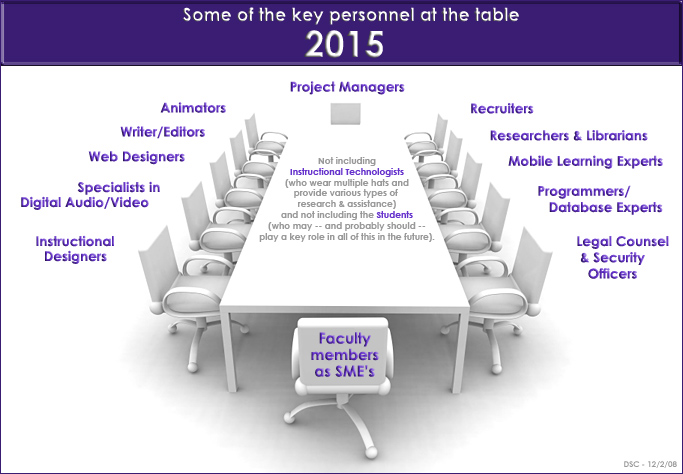
Many of the publishers already have teams of specialists in place; i.e. they’ve already set their tables (see the graphic I created below that represents where I believe ALL institutions of higher education need to get to — and as quickly as possible).
On 06/27/2011,
in 21st century, digital storytelling, disruption, interactivity, internet, new business models, publishing, storytelling,
by Daniel Christian
JK Rowling creates transmedia storytelling site Pottermore.com, dumps Amazon — from psfk.com by Piers Fawkes
From DSC:
Many of you have seen this already, but I just got back from vacation and I want to document this event.
Many of you have seen this already, but I just got back from vacation and I want to document this event.
On 06/20/2011,
in business side of he, change, colleges, cost of getting a degree, dangers of the status quo, Daniel S. Christian, future of higher education, game-changing environment, higher education, new business models, online learning, organizational change, reinvent, staying relevant, United States, universities, using teams,
by Daniel Christian
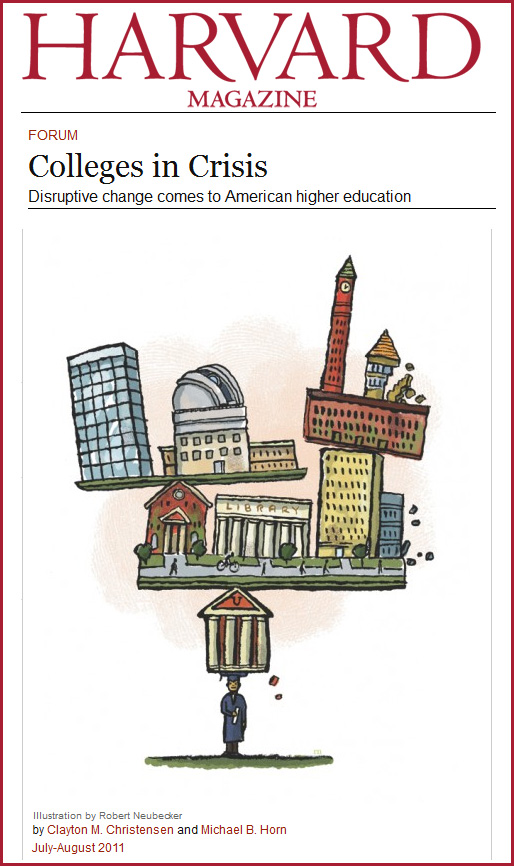
Excerpt (emphasis DSC):
Surveys of the American public and of more than 1,000 college and university presidents, conducted this past spring by the Pew Research Center in association with the Chronicle of Higher Education, revealed significant concerns not only about the costs of such education, but also about its direction and goals.
More fundamentally, the business model that has characterized American higher education is at—or even past—its breaking point. Many institutions are increasingly beset by financial difficulties, and the meltdown since 2008 is but a shadow of what is to come. Undergraduate tuition has risen dramatically: at a 6.3 percent annual clip for nearly the last three decades—even faster than the much-decried 4.9 percent annual cost increases plaguing the healthcare industry. The full increase in the price of higher education has actually been hidden from many students and families over the years because gifts from alumni, earnings from private university endowments, subsidies from state tax revenues for public universities, and federal subsidies for students have been used to mitigate some costs. But universities are exhausting these mechanisms.
…
A Thriving, Disruptive Innovation
Just at the moment when these challenges to established higher education have arisen and compounded, another group of universities has arisen whose financial health is strong and enrollments have been booming. And yet the brands of these schools are weak and their campuses far from glamorous; sometimes the campuses are even nonexistent from the perspective of students, as online learning has largely driven their growth. How could this upstart group be so successful when the rest of higher education is treading water at best?
On 06/15/2011,
in 21st century, 24x7x365 access, business side of he, cost of getting a degree, dangers of the status quo, Daniel S. Christian, future, future of higher education, game-changing environment, higher education, learning, new business models, open courseware and systems, reinvent, society, staying relevant, United States,
by Daniel Christian
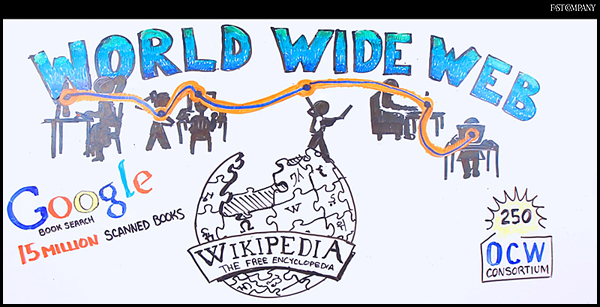
DIY U: The Future Of Learning [Video] — from FastCompany.com by Anya Kamenetz
From Khan Academy and TED Talks to instructional YouTube videos, the future of learning is open and free.
A related comment from DSC:
I have it that higher ed is a bubble and if an increasingly larger group of people can’t afford it — yet still want it — then, in my book, that’s a major problem.
I’ll use myself as an example. My wife and I could not begin to afford to send our kids to many of the colleges and universities out there right now — today, in 2011! (Let alone in 2017+ when our kids start hitting the college scene.) I should note that our kids are doing well in school and are very talented, hard workers. I should also point out that my wife and I place a very high value on being educated and we are both trying to pass that value along to the next generation.
But if you tell me that higher ed is not a bubble, the first question I will ask you (besides what planet are you living on) is what’s the gross income for your household? If you are making close to 6 figures, I highly doubt that your perspective will be the same as that of folks from households who are making $20,000-$50,000 a year. In fact, my hunch is that those who say higher ed is not a bubble are:
- Upper middle class to upper class (i.e. wealthy in the eyes of many in the world today)
- Folks who don’t have to worry about where their next paycheck is coming from (nor have they had to live like that in years!); that is, they are doing quite well these days…living quite comfortably
- College educated (nothing wrong with that!)
- Potentially involved with higher ed — or at least want to maintain the status quo
- Folks who do not have children
My take on this is that all of us in higher education need to figure out how we can greatly reduce the price of higher education. It shouldn’t be how well you understand the system or how many hours of work you have done to figure out the grants, loans, etc. that exist out there.
NEVER again should we be pleased with ANY sort of increase in tuition. Never again should we say, “Well, our tuition only went up by ___% which is the smallest increase in our history (or the smallest increase relative to our competition…or the smallest in our state/country/nation).”
Such a situation is causing a backlash against the current higher education environment/setup.
As such, we need to constantly be looking to reinvent ourselves — and to staying relevant.
Addendum on 6/17/11:
- Colleges add net price calculators to school prospective students on degree costs –– ecampusnews.com
New tool will give students a more accurate cost estimate
On 06/10/2011,
in blogs / blogging / vlogging, change, changing business models, disruption, higher education, new business models,
by Daniel Christian
Potential disrupters in the higher education space — Lloyd Armstrong, University Professor and Provost Emeritus at the University of Southern California
Excerpt:
…I thought it useful to introduce a blogroll on some companies, institutions, think tanks, etc. that seem to me to be doing interesting things that might well turn out to be disruptive for various aspects higher education, and/or sustaining for others. The blogroll will not seek to be all-inclusive. Rather, it will be indicative of areas in which I find that very interesting things are happening. I will add more sites to the roll from time to time as I see things that attract my interest.
The original set of sites I have chosen give an idea of some of the areas that I find to be interesting from the standpoint of disruption of traditional higher education. My descriptions of each are too short to serve them well, so follow some of the links for more details. Most are working on concepts that can be used in both sustaining and disrupting modes.