Paying vendors for student results — from hechingerreport.org by Jill Barshay
The first evaluation of outcomes-based contracting found student achievement sometimes improved under this approach

Instead of paying vendors simply for delivering these tools, school districts are experimenting with a new approach to purchasing, called outcomes-based contracting, in which part of a vendor’s payment depends on whether students actually use the service and meet agreed-upon academic goals. The idea is to share risk between schools and vendors — and create incentives for both sides to pay closer attention to whether an intervention is working.

From DSC:
This could be tough to do. But it’s an interesting posting/idea/approach/strategy. Are the goals reached due to the tools/products/services of the vendors or are those products and services just one piece of the overall learning pie?


How to Design Around Cognitive Offloading — from drphilippahardman.substack.com by Dr Philippa Hardman
Three new studies shed light on when offloading to AI harms learning, when it helps — and how to design for the difference

A cluster of new studies — most published in the last few weeks in the International Journal of Educational Technology in Higher Education — lets us answer two questions with more precision than ever before:

  1. When does cognitive offloading actually happen?
  2. When does using AI improve cognition?

The answers in turn help us to start to design learning which intentionally uses AI to drive – rather than diminish – learning.
.


15 Best Instructional Design Conferences To Attend — from elearningindustry.com by Christopher Pappas

Overview: Looking for the best Instructional Design conference in 2026? Explore 15 leading learning, L&D, eLearning, and training conferences worldwide to build skills, discover learning technology, and expand your professional network.


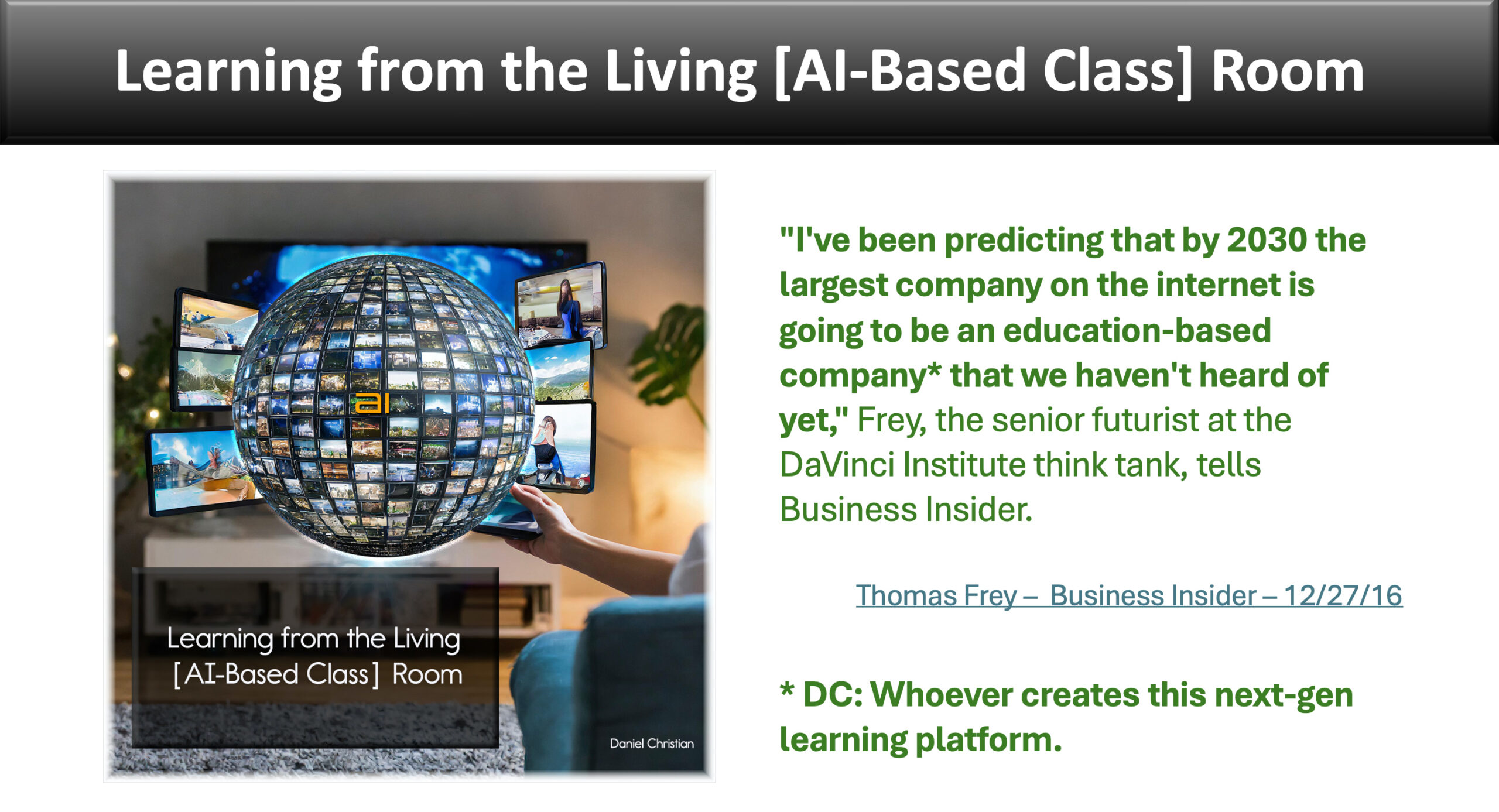
Will this new company be the largest company on the Internet by 2030? [Christian]

From DSC:
The vision that I’ve been tracking for well over a decade begins with this graphic:
.


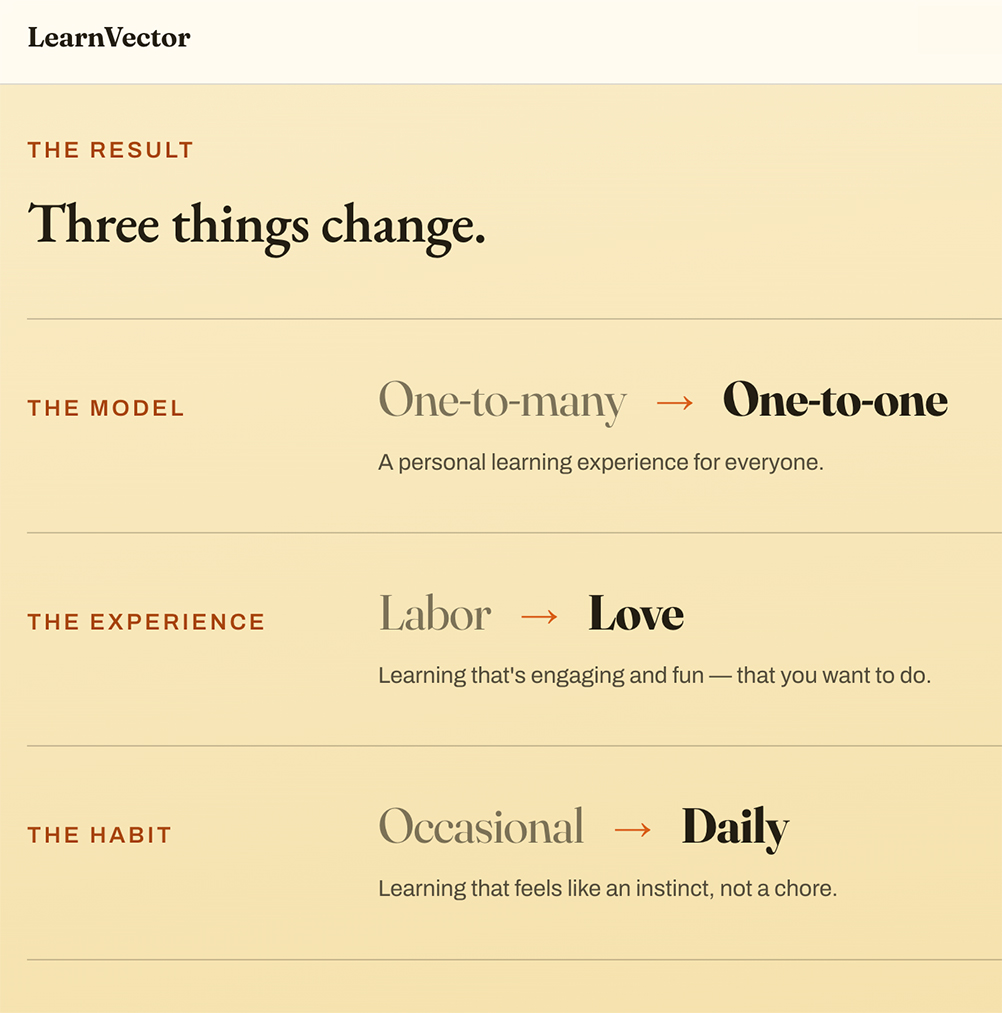
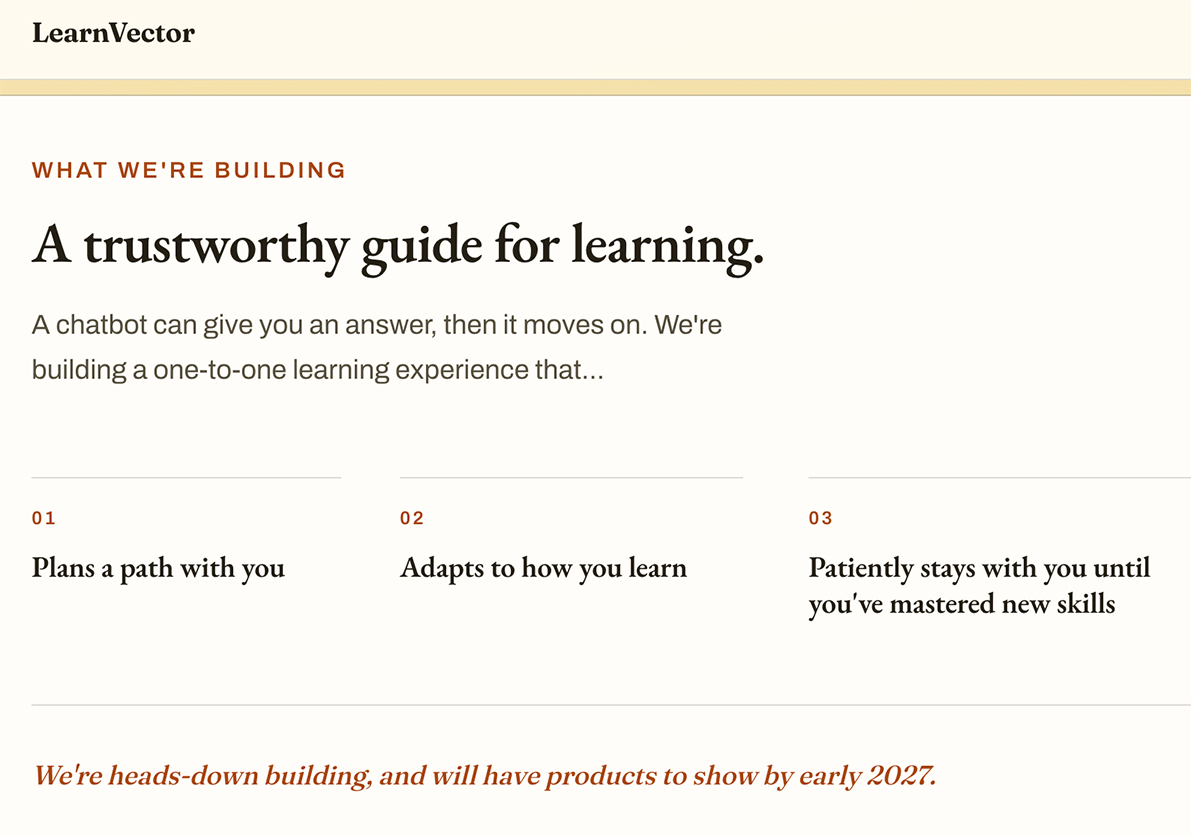
Could LearnVector be this next-generation company/platform? Perhaps. Time will tell.


Per Matt Tower via The EdSheet Vol. 38 dated 7/31/26:

  • Coursera bets $100M on its own co-founder: Andrew Ng’s new venture LearnVector lands one of the largest single checks in edtech this year — from Coursera, the company he founded 14 years ago.
    .


LearnVector.ai


How Explainer Video Production Turns Ideas Into Clear Stories — from bitrebels.com by Lauren Williamson

Ideas rarely arrive in a neat order. They show up as notes, claims, diagrams, feature lists, and customer questions. Explainer video production turns that raw material into a story people can process quickly. It clarifies the problem, frames the change, and shows why the answer matters. When the script, visuals, voice, and pacing work together, viewers spend less energy decoding the message and more attention on absorbing it.

Explainer video production works because it gives ideas a usable order. It turns scattered information into a story with purpose, pace, and visual evidence. The strongest results come from careful message decisions before animation starts. When script, design, voice, and timing support one central point, viewers can follow with less effort. That clarity helps organizations teach, persuade, and make it easier to remember.


What China’s Calligraphy Lessons Can Teach Us About AI — from linkedin.com by Rebecca Winthrop

He recalled visiting a primary school classroom in China several years ago where students were practicing calligraphy—the centuries-old art of writing Chinese characters with brush and ink. While the scene appeared entirely traditional, there was something innovative happening beneath the surface. Embedded in students’ desks was an AI system capable of providing immediate feedback on their brushwork, noting misplaced strokes and suggesting corrections.

The image is striking. Students were learning in much the same way generations before them had learned—brush in hand, immersed in a deeply human and cultural practice. Yet AI was quietly enhancing the experience by providing immediate, personalized feedback that would have been difficult for any teacher to provide to her whole class.

That example captures something important for me. The most promising uses of AI may not be the applications that place technology front and center, but those that support learners to do what they have always done: connect with educators, practice with concentration, and learn and grow.


AI Can Build Your Course, but Can it Design the Learning? — from drphilippahardman.substack.com by Dr. Philippa Hardman
Aka, the current state of AI’s instructional design ability & what it means for L&D

So these models have learned design artefacts in extraordinary volume and design method barely at all. They know what e-learning looks like. They have very little access to why any of it looks that way and whether it actually works or not.

That produces a completely consistent behaviour: ask an LLM for an e-learning module and it generates the statistical centre of every e-learning module it has ever seen. What AI produces isn’t the output of a design process. It’s the output of a sampling process — the statistical centre of every e-learning module it has ever seen.

So the honest conclusion isn’t that AI can design learning; it’s that AI executes design well when someone who already knows what to ask for is doing the asking and the checking.

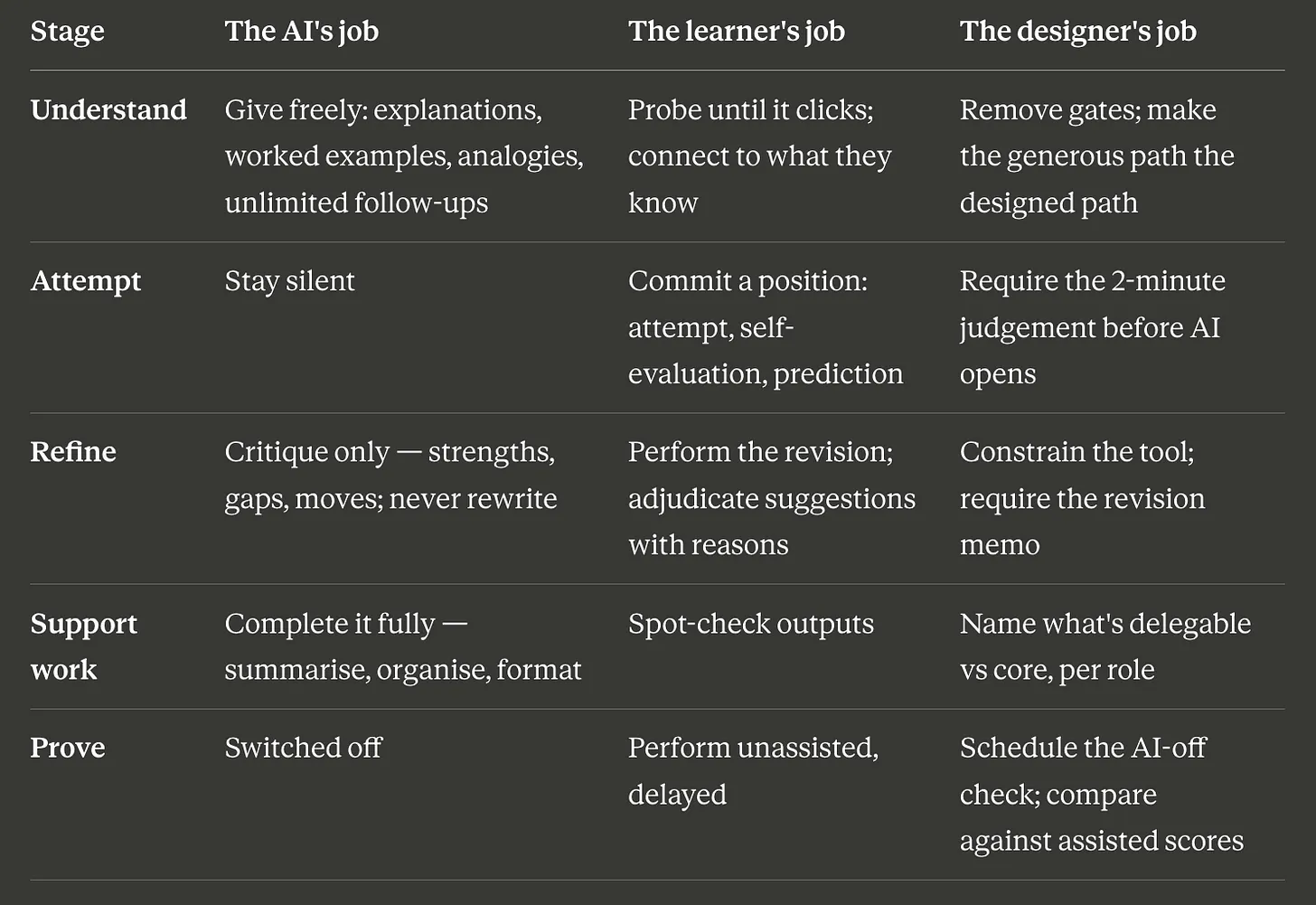
This finding gives us a clearer division of labour than we’ve had before and with it a clearer picture of what the AI-enhanced workflow might look like:


The Pedagogy of Trading Places: Lessons from an Unexpected Role Reversal with AI — from facultyfocus.com by Sherrie Myers Bartell, PhD

These disruptions matter. They remind us that teaching is not a static identity but a dynamic posture. They show us that our pedagogical selves are not fixed; they are responsive to context, energy, and attention. They reveal that the qualities we value most in our teaching—curiosity, metaphor, play, and expansiveness—are not automatic. They require care and cultivation.

The AI didn’t “teach” me in the traditional sense. But it did something pedagogically adjacent: it surprised me back into myself.


AI & Accessibility: 5 Practical Ways to Use LLMs to Support Inclusive Learning — from learningguild.com by Dr. Athena Joyce Stanley (B.A., M.A.E., Ph.D.)

The following strategies focus on how instructional designers can design for accessibility by embedding or enabling AI-supported tools within learning experiences. These approaches move beyond access to content and begin to support access to understanding, expression, and participation.

Personalized Clarification Through AI Copilots
Learners often need additional explanation, but may hesitate to ask questions in live sessions or require more individualized support.

Instructional designers can integrate AI copilots, LLM-powered conversational interfaces, into learning environments to provide on-demand clarification. These tools can act as digital coaches, helping learners understand concepts through simplified explanations and relevant examples.

This approach supports learners who benefit from additional processing time and personalized guidance.

Sample Prompt (for IDs Configuring Copilot Behavior)
You are a workplace learning coach.

Explain the following concept in a clear, simple way:

    • Use plain language
    • Provide one practical, job-relevant example
    • Avoid jargon unless necessary (and define it if used)

Then ask one follow-up question to check for understanding.


Jeff’s posting on LinkedIn.


Teaching AI Literacy with Susan Ray — from intentionalteaching.buzzsprout.com by Derek Bruff and Susan Ray

Per Derek Bruff:
In my conversation with Susan, we talk about that syllabus activity, as well as the AI transparency journals she asks her students to keep during her courses. We also talk about how her personal background prepared her to navigate the challenges and opportunities that AI has posed to her teaching, how she approaches assessing student learning in this age of AI—especially in her online asynchronous courses—and much more.


Building the AI-Native University: Student Success and Lifelong Learning — from coursera.org

In this episode, you’ll discover:

  • Why building an AI-native campus requires a data-first foundation
  • How to build an “achievement architecture” for lifelong success
  • How faculty-built AI tutors cut one program’s course attrition from 40% to 10%
  • What it means to be a lifelong learning companion

We’re Raising the First AI Generation. They’re Pushing Back. (Rebecca Winthrop, Brookings) — from humanistxyz.substack.com by Allison Dulin Salisbury
“Young people harbor real anger about AI because they’re already experiencing its consequences in their schools, relationships, job prospects, and feeds.”

As Rebecca told me:

“Kids harbor real anger. They’re pissed about climate impacts. They’re upset about job prospects. They’re outraged about AI being used to plagiarize writing and produce counterfeit artwork. Their relationships are being affected, and they’re seeing deepfakes in their feeds.”

Our conversation explores what follows from taking those concerns seriously. We discuss cognitive stunting, the case for small, purpose-built AI models over frontier models in education, why students should spend far more time in explorer mode, and how schools can cultivate agency, curiosity, and independent thinking in an age of AI.

The interview ends with one of Rebecca’s most practical recommendations: every school should have a student AI council, not as a symbolic gesture, but with real influence over the tools their schools adopt, the ways they’re used, and the data students are asked to hand over.

Every generation of technology seems to relearn the same lesson: build with people, not for them. AI should be no exception.


Steward Stories: How Heart of Oregon Corps Turns Service into Careers — from gettingsmart.com by Karen Pittman and Merita Irby

Our “Steward Stories” series captures lessons learned from interviews with leaders of mature, purpose-built ecosystem intermediaries. An ecosystem steward is a boundary-spanning leader who goes beyond traditional out-of-school time (OST) system building to weave together the diverse people, places, and possibilities that shape a young person’s daily life. Rather than managing a single isolated network, stewards collaborate across K-12 schools, youth development programs, and workforce systems to build vibrant, equitable learning ecosystems. They drive systemic change from practice to policy by creating purpose-built intermediaries, developing scalable cross-system training tools, and championing “Future Features” of learning. These core priorities include promoting learner agency, institutionalizing “unwalled” schools that connect community resources to formal education, broadening the definition of educators to include informal mentors, and normalizing pathways for students to receive school credit or credentials for out-of-school learning.

 The starting points, paths, and targets set by these stewards are as varied as the conditions and opportunities present within their communities. But they share similarities in vision and approach. Learn More Here.

Learning ecosystems may be found anywhere, but it takes careful stewardship to help them thrive.
— Shift, Remake Learning


Agilities — from agilities.org by the DeBruce Foundation; via Paul Fain
Help students build confidence and prepare for bright careers!
.


Also from Paul Fain, see:


Unlocking Opportunity: Progress on Moving More Students Toward Good Jobs — from highered.aspeninstitute.org

Released in partnership with the Community College Research Center (CCRC), Unlocking Opportunity: Progress on Moving More Students Toward Good Jobs highlights early outcomes from the first 10 colleges in the Unlocking Opportunity network. The report demonstrates that community colleges can rapidly increase enrollment in high-value workforce and transfer pathways while reducing enrollment in or improving programs with weaker labor market and bachelor’s degree outcomes.
.


Reconnecting Professional Learning — from elemenous.substack.com by Lucy Gray
Reflections from My Wednesday ISTE Panel

At ISTE this year, I facilitated a Wednesday morning panel on professional learning. The session I organized was titled, The Future of Professional Learning: Connecting Educators Across Borders. I was joined by fellow Apple Distinguished Educators Tami Brewster, Bethany LaDue Nugent, Marcus Borders, Jason Krug and global educator Julie Meltzer. Our focus: How do we move professional development away from isolated, one-time experiences and toward something more connected, meaningful, and human?

The panel was grounded in a few simple but powerful ideas: professional learning should nurture, guide, and empower. It should be relevant, contextual, reflective, and sustained. It should recognize educators as capable professionals, not as people who are broken and need to be fixed. Too often, professional development is still designed around deficit thinking. Too often, teachers’ needs are not the starting point, and sessions become dry, one-directional experiences where information is delivered at them rather than built through conversation and collaboration, with little choice, little personalization, and little connection to the realities of their classrooms. Our panel served as a call to action to re-think professional learning.

We explored six different approaches to professional learning, and while each model was distinct, a clear through line emerged: relationships matter most.

  1. Virtual Conferences at Scale — Lucy Gray — Actionable Innovations Events / GLOW
  2. Micro-Mentorship — Tami Brewster
  3. Networked, Values-Driven PD — Julie Meltzer — Institute for Humane Education
  4. AI-Personalized PD Pathways — Marcus Borders
  5. Share Stories with Voice — Bethany LaDue Nugent
  6. Speak Your Crazy — Jason Krug

  • Our Padlet – Share resources and introduce yourself
  • Our Slides – Meet our panelists and learn about our work
  • Our Google NotebookLM – This notebook contains dozens of resources related to research and best practices in educator professional learning
  • The Connected PD App – This is an app I’m building in Base 44 to help people plan great professional learning experiences

Also from Lucy Gray, see the following for some nice tips and resources:


This is the Future of High School
The Tennessee School Rewriting the Rules of High School — from xqsuperschool.org
At Elizabethton High School, students wanted more from their education. So they helped rebuild it—class by class, project by project. Their idea: give students real, meaningful work, and they’ll rise to the challenge.

A cold case became a Prime Video series. A robotics club became an international competitor. And an ordinary high school became something else entirely. Elizabethton is reinventing high school—and showing what’s possible for the rest of the country.

Watch the Elizabethton+XQ story
Ten years, one school, and a redesign still unfolding. It took courage to break with tradition—and that risk is paying off for an entire community.


Flipped Classrooms and Academic Achievement — from learningscientists.org by Megan Sumeracki

There are actually many, many ways to design a flipped classroom, and it has been fascinating to learn about the ways my colleague typically structures her hybrid, flipped-classroom courses. As a result, we’ve been able to engage in really interesting conversations about the best approach for this particular course, and why. As a result of some of these discussions, I came across a few recent meta-analyses related to the effects of flipped classrooms, the results of which I thought were worth sharing here (1, 2, 3).


Higher Education Can’t Wait for the Future to Arrive (Lev Gonick, Arizona State University) — from humanistxyz.substack.com by Allison Dulin Salisbury
“The biggest risk we face as a sector is assuming we can wait out AI.”

We have an opportunity right now to reorient the university around student experience—not as an aspiration, but as a necessity. I’m calling this shift TechEd, which I explore in detail in my LinkedIn series The TechEd Revolution.

AI poses a fundamental shift in how technology might empower students to own their discovery and educational journey, and to drastically reduce the friction that makes college so unappealing to so many.

To that end, we need to urgently redesign systems and opportunities around skills and competencies. That work should be far more advanced than it currently is. And one of the hardest challenges is rethinking how we operate as a workforce in academia. 


The Current State of Play: AI in Higher Education and the Road Ahead — from er.educause.edu by Tanya Gamby, David Kil, Rachel Koblic, Paul LeBlanc, Mihnea Moldoveanu and George Siemens

The conventional explanation for this strategic vacuum points to the speed of technological change; it is moving too fast for institutions built for deliberation. That is true. . . and incomplete. The deeper issue is cultural. In fairness to higher education, many industries are struggling to keep up with the pace of AI advances. Higher education, however, moves even more slowly and is not built for the kind of transformational speed now underway. Getting institutional stakeholders to engage, rethink the work, and move faster may be the central challenge facing presidents and chancellors today, and that’s saying a lot in such volatile times.

From DSC:
I highlighted this paragraph because it hits upon the key item involved here — culture. “The deeper issue is cultural.” I think that’s a very true statement.

Part of the culture and setup of many institutions includes giving faculty members full rein of their classes and their departments. Faculty members have a great deal of leeway and power in how they do things. So trying to get X faculty members to get on board — including the Department Chairs — is not an easy task. 

Another part of culture involves being willing — or not — to change in the first place. Some institutions are like Google and are used to making changes and being more innovative. But those institutions are not the norm, at least in my experience. And this doesn’t even address another topic the article mentioned — the pace of these changes. As the authors point out, most institutions of traditional higher education are not equipped to deal with the current pace of change (nor are most of our other types of institutions and our corporations as well). 

I’m going to end this posting with another brief excerpt from the article:

Institutions rooted in human relationships, committed to truth-seeking, and oriented toward the full development of persons play a central role. AI cannot manufacture the experience of mattering to another human being. It cannot model intellectual courage or ethical discernment. It cannot build the kind of community in which students discover who they are and what they believe.

These are not small things. They are, in fact, the things most worth doing. At their best, colleges and universities are not only preparing better workers but shaping individuals and strengthening society.


What a disco ball teaches us about learning and leadership — from timeshighereducation.com by Lauren Flannery
By acknowledging that perspectives are evolving and relational, educators and leaders can encourage contribution and connection without sacrificing what makes people distinct

It also shows us that difference does not always need to be resolved. In teaching, learning and leadership, the aim is not to create uniformity but to create conditions in which different people can contribute, connect and shine without losing what makes them distinct.

In classrooms, inclusion is sometimes approached as ensuring access to the same knowledge, resources and opportunities for all students. The beach ball helps here: it encourages us to explore multiple perspectives. But the disco ball pushes us further to explore how learning environments can support students to bring their experiences, identities and knowledge into the room – not to smooth them out but to draw from them.

Designing for multiple perspectives also means recognising that expressing an opinion is not only about confidence; it is also about conditions. People are more likely to speak when they feel their contribution will be heard without being dismissed, appropriated or flattened. Creating those conditions may involve discussing uncertainty, welcoming challenge, slowing down decision-making or making space for quieter forms of participation. The aim is not to make everyone agree, but to allow different reflections to interact in ways that generate richer understanding.

 
© 2025 | Daniel Christian