Ground-level Impacts of the Changing Landscape of Higher Education — from onedtech.philhillaa.com by Glenda Morgan; emphasis DSC
Evidence from the Virginia Community College System

In that spirit, in this post I examine a report from Virginia’s Joint Legislative Audit and Review Commission (JLARC) on Virginia’s Community Colleges and the changing higher-education landscape. The report offers a rich view of how several major issues are evolving at the institutional level over time, an instructive case study in big changes and their implications.

Its empirical depth also prompts broader questions we should ask across higher education.

  • What does the shift toward career education and short-term training mean for institutional costs and funding?
  • How do we deliver effective student supports as enrollment moves online?
  • As demand shifts away from on-campus learning, do physical campuses need to get smaller?
  • Are we seeing a generalizable movement from academic programs to CTE to short-term options? If so, what does that imply for how community colleges are staffed and funded?
  • As online learning becomes a larger, permanent share of enrollment, do student services need a true bimodal redesign, built to serve both online and on-campus students effectively? Evidence suggests this urgent question is not being addressed, especially in cash-strapped community colleges.
  • As online learning grows, what happens to physical campuses? Improving space utilization likely means downsizing, which carries other implications. Campuses are community anchors, even for online students—so finding the right balance deserves serious debate.
 

K-12 to Career — from the-job.beehiiv.com by Paul Fain
Ohio eases eligibility rules for high school students to pursue college-level coursework in high-demand fields.

Three Ohio community colleges offer free industry-recognized credentials in manufacturing to more high school students. Also, new career-connected AP courses designed with industry input, a partnership on skilled trade prep for K-12 students, and essays on the race to define the future of credentials and how data and research can inform Workforce Pell.


Artificial Intelligence in Vocational Education — from leonfurze.com by Leon Furze

The vocational education sector is incredibly diverse, covering everything from trades like building and construction, electrical, plumbing and automotive through to allied health, childcare, education, the creative arts and the technology industry. In Canberra, we heard from people representing every corner of the industry, including education, retail, tourism, finance and digital technologies. Every one of these industries is being impacted by the current AI boom.

A theme of the day was that whilst the vocational education sector is seen as a slow-moving beast with its own peculiar red tape, it is still possible to respond to emerging technologies like artificial intelligence, and there’s an imperative to do so.

Coming back to GenAI for small business owners, a qualified plumber running their own business, either as a solo operator or as manager of a team, probably doesn’t have many opportunities to keep up to date with the rapid developments of digital technologies. They’re far too busy doing their job.

So vocational education and training can be an initial space to develop some skills and understanding of the technology in a way which can be beneficial for managing that day-to-day job.


And speaking of the trade schools/vocational world…

Social media opens a window to traditional trades for young workers — from washingtonpost.com by Taylor Telford; this is a gifted article
Worker influencers are showing what life is like in fields such as construction, plumbing and manufacturing. Trade schools are trying to make the most of it.

Social media is increasingly becoming a destination for a new generation to learn about skilled trades — at a time when many have grown skeptical about the cost of college and the promise of white-collar jobs. These posts offer authentic insight as workers talk openly about everything from their favorite workwear to safety and payday routines.

The exposure is also changing the game for trade schools and employers in such industries as manufacturing and construction, which have long struggled to attract workers. Now, some are evolving their recruiting tactics by wading into content creation after decades of relying largely on word of mouth.


These ChatGPT Prompts Will Fast-Track Your Job Search — from builtin.com by Jeff Rumage
Used correctly, ChatGPT could help you land your dream job — but used incorrectly, it can cost you the offer. Here’s how you can make ChatGPT your secret weapon for research help, resume writing, interview prep and more.

Example prompt: Here are several bullet points from my resume: [paste bullets]. Rewrite them so each one begins with a strong action verb, clearly states what I did, and quantifies results or outcomes wherever possible. If metrics are missing, suggest realistic ways they could be added.

Example prompt: Here is my resume [paste resume]. Here’s the job description of a job I’m applying for [paste job description]. Highlight the most important skills and qualifications for this job. Without making up information, revise my resume to match these requirements. Include action verbs for each accomplishment on the resume, and highlight which accomplishments could be quantified.

Example prompt: What are the current trends impacting companies in the [industry]? How would [company name] be affected by these trends, and what might it do to adjust to/capitalize on these trends?

Example prompt: I’m a [current role] but want to become a [dream role]. Create a detailed career development plan outlining:

      • Skills I should develop
      • Relevant experiences I need to gain
      • Educational or certification needs
      • Recommended resources or programs
      • A realistic timeline with milestones for the next 1-3 years.
 

Here are my favorite back-to-school activities to strengthen learning — from retrievalpractice.org by Pooja K. Agarwal, Ph.D.

Welcome back to school! For most of us (myself included), the whirlwind of lesson prep, meetings, professional development—and of course, teaching—is here. Keep reading for my favorite back-to-school activities to engage students with retrieval practice during the first week of class.

It may (or may not) surprise you to know that my first day of class is full of retrieval practice. Even if you haven’t introduced content yet, use retrieval practice the first day or week of class. Here’s how, with quick activities you can adapt for K–12 students, higher ed courses, and all content areas:


How to Teach a Good First Day of Class — by James Lang; via Dr. Pooja Agarwal’s posting above

What you can expect to find here:

  • I’ll start, as we academics so love to do, with a little bit of theory — specifically, four core principles that can help shape your planning for the first day of your course.
  • Next, I’ll cover the logistics of a successful first day, including managing the space and technology as well as getting to know your students.
  • To show you how to put the principles and the logistics into practice, I will provide examples of what a good set of first-day activities might look like in four disciplines.
  • I’ll finish with some suggestions for how to support the good work you have done on the first day with some follow-up activities.

7 Pieces of Advice for New Teachers — from edutopia.org by Brienne May
Focus on relationships with students and colleagues to make a good start to the year—and remember to ask for what you need.

Too often, teacher preparation programs are rich in theory but light on practical guidance. After working hard through my undergraduate classes, completing student teaching, and spending countless hours laminating and cutting, I still found myself on the first day of school, standing in front of a room full of expectant faces with eager eyes, and realized I had no idea what to do next. I didn’t know what to say to students in that moment, let alone how to survive the following 180 days. Twelve years later, I have collected a trove of advice I wish I could have shared with that fresh-faced teacher.


The Transient Information Effect: Why Great Explanations Don’t Always Stick — from scienceoflearning.substack.com by Nidhi Sachdeva and Jim Hewitt
In this post, Dr. John Sweller describes how the Transient Information Effect can overload student working memory and what teachers can do about it.

Highlights:

  • The Transient Information Effect happens when important information disappears before learners can process and remember it.
  • Dr. John Sweller, who first studied the Transient Information Effect, answers our questions about this overlooked learning challenge.
  • Turning transient information into something students can revisit (like writing key steps on the board) can help explanations stick.

41 Elementary Classroom Jobs to Build Shared Responsibility and Community — from edutopia.org by Donna Paul
Classroom jobs help students feel seen, trusted, and excited to contribute to their classroom community.

Each fall, one of the first routines I introduce is our classroom job board. It’s more than a list of tasks—it helps students feel that they belong and have real roles in our shared space. Over the years, I’ve expanded beyond classic jobs like Line Leader and Pencil Sharpener to include creative roles with quirky titles that engage and resonate with students.

Here are the jobs that have helped my students feel seen, trusted, and excited to contribute.


Guiding Students to Overcome Learned Helplessness — from edutopia.org by Michelle Singh
New teachers can create an environment where students feel supported and understand that mistakes are part of the learning process.


Creating a Kid-Led Hall of Fame for Books — from edutopia.org by Eric Hall
Allowing elementary students to nominate and vote for their favorite books of the year can create a culture of celebration in the classroom.

When I started teaching, I remembered that conversation with my elementary school librarian. I thought, “Why should adults have all the fun?” I wanted my students to experience the excitement of recognizing books they thought were the best. And just like that, the Hallbery Awards were born and continued twice a year for over 15 years. (Why Hallbery? Because my last name is Hall.)


Understanding Diagnostic, Formative, and Summative Assessments — from edmentum.com

Today, we’re taking a look at the three primary forms of assessments—diagnostic, formative, and summative—with the goal of not only differentiating between them but also better understanding the purpose and potential power of each.

At their core, each of the three primary assessment types serves a distinct purpose. Diagnostic assessments are used before instruction to help identify where students are in their comprehension of academic content. Formative assessments are used while content is being taught to understand what students are picking up, to guide their learning, and to help teachers determine what to focus on moving forward. Summative assessments are used after instruction to evaluate the outcomes of student learning: what, or how much, they ultimately learned.


How one state revamped high school to reflect reality: Not everyone goes to college — from hechingerreport.org by Kavitha Cardoza
Indiana’s initial plan for revised graduation requirements was criticized for prioritizing workforce skills over academic preparedness. The state has tried to find a balance between the two

This story is part of Hechinger’s ongoing coverage about rethinking high school. Read about high school apprenticeships in Indiana, a new diploma in Alabama that trades chemistry for carpentry, and “career education for all” in Kentucky.

The “New Indiana Diploma” — which was signed into law in April and goes into effect for all incoming first-year students this academic year — gives students the option to earn different “seals” in addition to a basic diploma, depending on whether they plan to attend college, go straight to work or serve in the military. Jenner describes it as an effort to tailor the diploma to students’ interests, expose students to careers and recognize different forms of student achievement.


How Teachers in This District Pushed to Have Students Spend Less Time Testing — from edweek.org by Elizabeth Heubeck

Students in one Arizona district will take fewer standardized tests this school year, the result of an educator-led push to devote less time to testing.

The Tucson Education Association, backed by the school board and several parents, reached an agreement with the Tucson Unified school system in May to reduce the number of district-mandated standardized assessments students take annually starting in the 2025-26 academic year.

Just 25 percent of educators agreed that state-mandated tests provide useful information for the teachers in their school, according to a 2023 EdWeek Research Center survey of teachers, principals, and district leaders. 


30 Ways to Bring Calm to a Noisy High School Classroom — from edutopia.org by Anne Noyes Saini
From ‘finding the lull’ to the magic of a dramatic whisper, these teacher-tested strategies quickly get high school students focused and back on track.


Approaching Experiential Learning as a Continuum — from edutopia.org by Bill Manchester
Teachers can consider 12 characteristics of experiential learning to make lessons more or less active for students.


1 in 2 graduates believe their college major didn’t prepare them for today’s market — from hrdive.com by Carolyn Crist
Respondents said they felt unprepared in numerous ways, especially finding a job after graduation and navigating student debt and personal finances.

As today’s college graduates struggle to start a steady career, 1 in 2 Americans say their college major didn’t prepare them for the job market, according to a June 18 report from Preply.

Beyond that, 1 in 6 Americans who went to college said they regret it. When thinking about their college experience, college graduates said their top regrets included taking out student loans, not networking more and not doing internships.

College graduates said they felt unprepared in numerous ways, especially finding a job after graduation and navigating student debt and personal finances. 

From DSC:
The Career Placement Office at Northwestern University did not help build my skills to get a job, at all. I had no clue what I was doing. I had no idea what networking was even about, nor the power of it, and why it would be useful throughout my career. They provided conference rooms for interviews to occur…and that was about it, at least in my experience. In terms of my education, I didn’t get any real-world experience (such as apprenticeships, internships, capstone courses, etc.), nor did I pick up many practical or technical skills. 


Driving Culture Change in Higher Education — from jeffselingo.com by Jeff Selingo

The call for transformation in higher education has never been louder, yet the path forward remains unclear for many institutions. Leaders often struggle with the “how” of meaningful change. This five-part playbook by higher education author and strategist Jeff Selingo as well as other experts draws on proven methodologies to provide clear, actionable guidance from mapping current institutional culture to sustaining long-term momentum.


Employers’ emphasis on skilled trades lost on Gen Z: Harris poll — from facilitiesdive.com
Young workers don’t realize going into the trades can offer good pay more quickly than pursuing a college-based career, the report says.

A mismatch exists between the importance employers are putting on skilled trades and how the generation that’s newly joining the workforce views those jobs, a Harris poll finds.

Gen Z, the oldest members of which are 28, is the age cohort least focused on skilled trades, in part because they’re misinformed about the jobs, says the report based on 2,200 respondents to survey questions posted online in June.

“Only 38% of Gen Z says skilled trades offer the best job opportunities today” and “only 36% strongly agree skilled trades offer a faster and more affordable path to a good career,” the report says.


From DSC:
In looking at
 
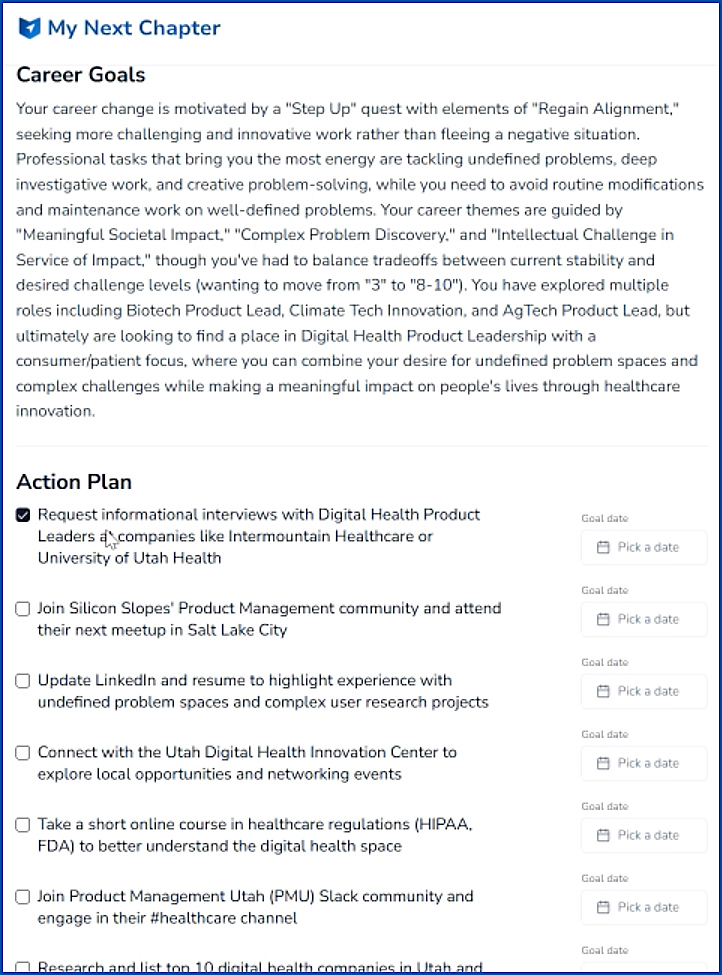
MyNextChapter.ai — THIS TYPE OF FUNCTIONALITY of an AI-based chatbot talking to you re: good fits for a future job — is the kind of thing that could work well in this type of vision/learning platform. The AI asks you relevant career-oriented questions, comes up with some potential job fits, and then gives you resources about how to gain those skills, who to talk with, organizations to join, next steps to get your foot in the door somewhere, etc.

The next gen learning platform would provide links to online-based courses, blogs, peoples’ names on LinkedIn, courses from L&D organizations or from institutions of higher education or from other entities/places to obtain those skills (similar to the ” Action Plan” below from MyNextChapter.ai).


Adulting and Career Exploration — from the-job.beehiiv.com by Paul Fain
Junior Achievement helps high school grads learn life skills and gain work experience while figuring out what comes next.

Bridging the Gap Between School and Careers
Junior Achievement has stepped into the blur space between high school and what comes next. The nonprofit’s 5th Year program gives young adults a structured year to live on a college campus and explore careers, gain work experience, and build life skills.

An initial cohort of 24 students graduated this May from a trial run of the program based in Toledo, Ohio. Each participant held two internships—one in the fall and one in the spring. They also visited 60 employers across the metro area. Represented industries included law, engineering, construction, accounting, healthcare, higher education, and nonprofit organizations.

The program is focused on helping students find a clear path forward, by guiding them to match their interests and abilities with in-demand careers and local job opportunities.

“We’re giving them the space to just pause,” he says. “To discover, to explore, to grow personally, to grow socially.”


Astronaut one day, artist the next: How to help children explore the world of careers — from apnews.com by Cathy Bussewitz

Sometimes career paths follow a straight line, with early life ambitions setting us on a clear path to training or a degree and a specific profession. Just as often, circumstance, luck, exposure and a willingness to adapt to change influence what we do for a living.

Developmental psychologists and career counselors recommend exposing children to a wide variety of career paths at a young age.

“It’s not so that they’ll pick a career, but that they will realize that there’s lots of opportunities and not limit themselves out of careers,” said Jennifer Curry, a Louisiana State University professor who researches career and college readiness.

Preparing for a world of AI
In addition to exposing children to career routes through early conversations and school courses, experts recommend teaching children about artificial intelligence and how it is reshaping the world and work.


Boys Are Struggling in School. What Can Be Done? — from edweek.org by Rick Hess
Scholar Richard Reeves says it’s time to take a hard look at gender equity

Rick: What kinds of strategies do you think would help?

Richard: In education, we should expand the use of male-friendly teaching methods, such as more hands-on and active learning approaches. We should also consider redshirting boys—starting them in school a year later—to account for developmental differences between boys and girls. We should also introduce more male mentors and role models in schools, particularly in elementary education, where male teachers are scarce. In the workforce, apprenticeship and vocational training programs need to be expanded to create pathways into stable employment for young men who may not pursue a four-year degree. Career counseling should also emphasize diverse pathways to ensure that boys who may not thrive in a traditional academic setting still have opportunities for success. Additionally, fatherhood policies should recognize the importance of male engagement in family life, supporting fathers in their role as caregivers and providers.


While on the topic of K12 education, also see:

How Electives Help All Students Succeed — from edutopia.org by Miriam Plotinsky
Giving students a choice of electives increases engagement and allows them to develop skills outside of core academic subjects.

I recently conducted a student focus group on the topic of school attendance. One of the participants, a high school junior who admitted to being frequently late or absent, explained why she still came to school: “I never want to miss Drama. My teacher is awesome. Her class is the reason I show up every day.” As the rest of the focus group chimed in with similar thoughts, I reflected on the power that elective courses hold for students of all ages.

These courses, from jazz band to yoga, cement students’ sense of self not just in their primary and secondary years, but also in their journey toward adulthood. In these tight economic times, schools or districts often slash electives to save money on staffing, which is highly detrimental to student success. Instead, not only should budget cuts be made elsewhere, but also elective offerings should increase to heighten student choice and well-being.


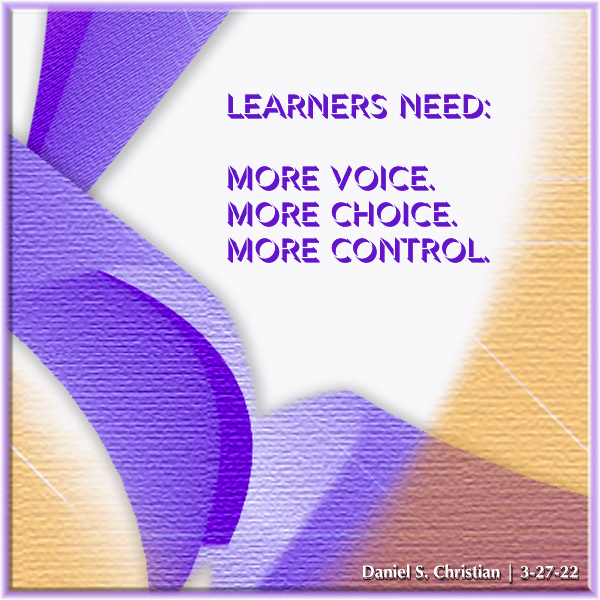
Learners need: More voice. More choice. More control. -- this image was created by Daniel Christian


Stop Trying to Make Everyone Go to College — from nytimes.com by Randi Weingarten; this is a gifted article

For years, America’s approach to education has been guided by an overly simplistic formula: 4+4 — the idea that students need four years of high school and four years of college to succeed in life.

Even with this prevailing emphasis on college, around 40 percent of high schoolers do not enroll in college upon graduating, and only 60 percent of students who enroll in college earn a degree or credential within eight years of high school graduation.

While college completion has positive effects — on health, lifetime earnings, civic engagement and even happiness — it’s increasingly clear that college for all should no longer be our North Star. It’s time to scale up successful programs that create multiple pathways for students so high school is a gateway to both college and career.

I propose a different strategy: aligning high school to both college prep and in-demand vocational career pathways. Just as students who plan to go to college can get a head start through Advanced Placement programs, high schools, colleges and employers should work together to provide the relevant coursework to engage students in promising career opportunities.


The Public Microschool Playbook — from gettingsmart.com

School systems today face a complex challenge: how to personalize learning while responding to the rapidly shifting needs of students, families, and communities. Enter the Public Microschool Playbook—a new, field-tested resource co-created by Getting Smart, Learner-Centered Collaborative, and Transcend to help public education leaders reimagine learning from the ground up.

This isn’t just about launching new schools. It’s about designing dynamic, student-centered ecosystems that live inside our public systems and reflect the aspirations of the communities they serve. With an intentional focus on access and opportunity, microschools offer more than just flexibility—they offer a path to more relevant, sustainable, and empowering learning for all.

Grounded in three key phases—Planning, Designing, and Implementing—the Playbook equips district leaders, charter networks, and innovators with real-world tools and insights to launch microschools that meet local needs and drive systemic transformation. From policy navigation and budgeting to learner-centered design elements like advisory, PBL, and multi-age cohorts, this guide is a blueprint for creating purpose-built environments that make learning personal and powerful.


Also from Getting Smart, see:

The Reboot of Readiness: It’s Time to Take Action in Renovating CTE from the Ground Up — from gettingsmart.com by Adam Kulaas

Key points:

  • CTE programs need to move beyond traditional frameworks and adopt the Career Clusters Framework to better prepare students for real-world opportunities.
  • It’s crucial to integrate career readiness into the entire educational experience, making it an intentional and structured pathway from early education through high school.


A new kind of high school diploma trades chemistry for carpentry — from hechingerreport.org by Ariel Gilreath
Starting this fall, Alabama high school students can choose to take state-approved career and technical education courses in place of upper level math and science, such as Algebra 2 or chemistry.

Alabama state law previously required students to take at least four years each of English, math, science and social studies to graduate from high school. The state is now calling that track the “Option A” diploma. The new “Option B” workforce diploma allows students to replace two math and two science classes with a sequence of three CTE courses of their choosing. The CTE courses do not have to be related to math or science, but they do have to be in the same career cluster. Already, more than 70 percent of Alabama high school students take at least one CTE class, according to the state’s Office of Career and Technical Education/Workforce Development.

***

BIRMINGHAM, Ala. — In a corner of Huffman High School, the sounds of popping nail guns and whirring table saws fill the architecture and construction classroom.

Down the hall, culinary students chop and saute in the school’s commercial kitchen, and in another room, cosmetology students snip mannequin hair to prepare for the state’s natural hair stylist license.

Starting this fall, Alabama high school students can choose to take these classes — or any other state-approved career and technical education courses — in place of upper level math and science, such as Algebra 2 or chemistry.

From DSC:
This is excellent. Provide more choice. Engage all kinds of students with all kinds of interests, gifts, and abilities. Make learning fun and enjoyable and practical for students. The setup in this article mentions that “many universities, including the state’s flagship University of Alabama, require at least three math credits for admission. The workforce diploma would make it more difficult for students on that track to get into those colleges.” But perhaps college is not where these students want to go. Or perhaps the colleges and universities across our land should offer some additional pathways into them as well as new sorts of curricula and programs.


The Anthropic Economic Index — from anthropic.com; via George Siemens

In the coming years, AI systems will have a major impact on the ways people work. For that reason, we’re launching the Anthropic Economic Index, an initiative aimed at understanding AI’s effects on labor markets and the economy over time.

The Index’s initial report provides first-of-its-kind data and analysis based on millions of anonymized conversations on Claude.ai, revealing the clearest picture yet of how AI is being incorporated into real-world tasks across the modern economy.

We’re also open sourcing the dataset used for this analysis, so researchers can build on and extend our findings.

 
© 2025 | Daniel Christian