From DSC:
You and I both know that numerous militaries across the globe are working on killer robots equipped with AI. This is nothing new. But I don’t find this topic to be entertaining in the least. Because it could be part of how wars are fought in the near future. And most of us wouldn’t have a clue how to stop one of these things.


AI and Higher Ed: An Impending Collapse — from insidehighered.com by Robert Niebuhr; via George Siemens; I also think George’s excerpt (see below) gets right to the point.
Universities’ rush to embrace AI will lead to an untenable outcome, Robert Niebuhr writes.

Herein lies the trap. If students learn how to use AI to complete assignments and faculty use AI to design courses, assignments, and grade student work, then what is the value of higher education? How long until people dismiss the degree as an absurdly overpriced piece of paper? How long until that trickles down and influences our economic and cultural output? Simply put, can we afford a scenario where students pretend to learn and we pretend to teach them?


This next report doesn’t look too good for traditional institutions of higher education either:


No Country for Young Grads — from burningglassinstitute.org

For the first time in modern history, a bachelor’s degree is no longer a reliable path to professional employment. Recent graduates face rising unemployment and widespread underemployment as structural—not cyclical—forces reshape entry?level work. This new report identifies four interlocking drivers: an AI?powered “Expertise Upheaval” eliminating many junior tasks, a post?pandemic shift to lean staffing and risk?averse hiring, AI acting as an accelerant to these changes, and a growing graduate glut. As a result, young degree holders are uniquely seeing their prospects deteriorate – even as the rest of the economy remain robust. Read the full report to explore the data behind these trends.

The above article was via Brandon Busteed on LinkedIn:


What borrowers should know about student loan changes in the One Big Beautiful Bill — from npr.org by Cory Turner

If you’re a federal student loan borrower or about to become one, your head may be spinning.

On July 4, when President Trump signed the One Big Beautiful Bill Act into law, he also greenlit a history-making overhaul of the federal student loan system — one that will affect the lives of many, if not most, of the United States’ nearly 43 million student loan borrowers.

And boy is it a lot to unpack, with new, tighter borrowing limits and dramatically reduced repayment options, to name just a few of the sweeping changes.

Under the One Big Beautiful Bill Act, borrowers in SAVE will have to change plans by July 1, 2028, when SAVE will be officially shut down. If they wait, though they currently can’t be required to make payments, they will see their loans explode with interest.


From DSC:
In looking at
 
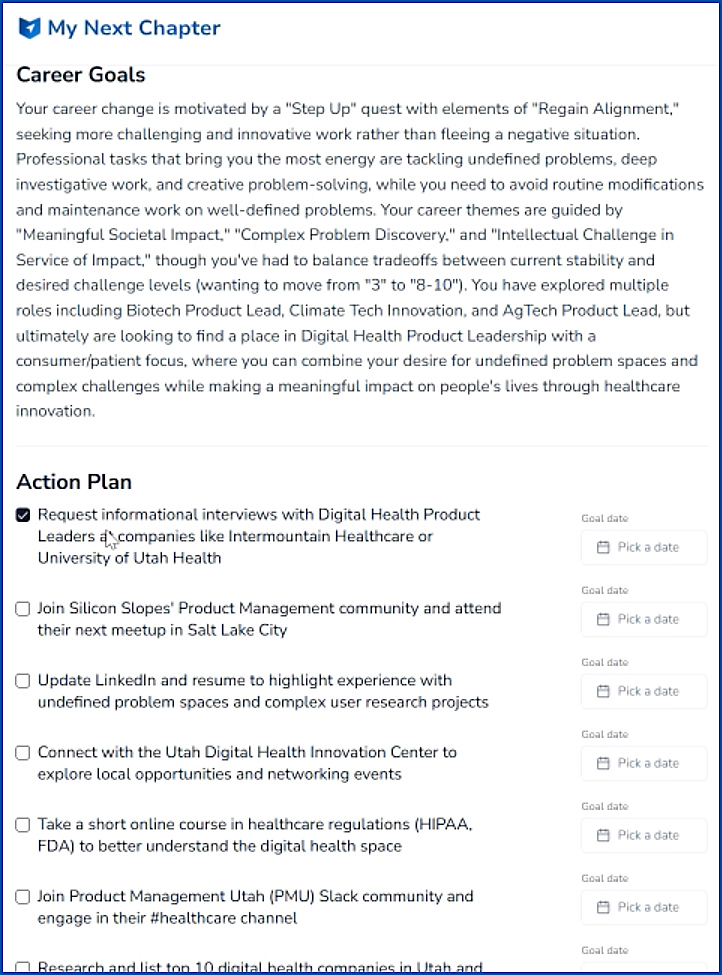
MyNextChapter.ai — THIS TYPE OF FUNCTIONALITY of an AI-based chatbot talking to you re: good fits for a future job — is the kind of thing that could work well in this type of vision/learning platform. The AI asks you relevant career-oriented questions, comes up with some potential job fits, and then gives you resources about how to gain those skills, who to talk with, organizations to join, next steps to get your foot in the door somewhere, etc.

The next gen learning platform would provide links to online-based courses, blogs, peoples’ names on LinkedIn, courses from L&D organizations or from institutions of higher education or from other entities/places to obtain those skills (similar to the ” Action Plan” below from MyNextChapter.ai).


To Bullied and Bored Teens, North Star Offers ‘Unschooling’ — and a Cup of Ramen — from the74million.org by Greg Toppo
‘We tend not to get your football player, cheerleader, sports team kids,’ says the school’s founder. ‘But we get all the kids they pick on.’

For 29 years, the private, non-profit center — don’t call it a school — has been a refuge for kids who chafe at the stress, loneliness or bullying of school. They spend a few months or a few years here, catching their breath as they prepare for life after graduation.

With an enrollment of 65, it offers rigorous, one-on-one tutoring; small, personalized classes in history, math, writing and the arts, and extracurriculars like weekly hiking club excursions. This year, young people designed and taught three courses on Dungeons & Dragons.

“You’re accountable to yourself. Is this the life you want?”

Kenneth Danford

While most mainstream educators would say letting young people “do nothing” for a year is out of the question, he sees it differently: In the unschooling world, he said, “there’s no such thing as ‘doing nothing.’ ”


From DSC:
This one is for the youth out there. Learn these lessons NOW, before you go too much further in your journey here on Earth. If you do, you will reap the benefits of this learning for the rest of your days.

As I mentioned to our own kids when I forwarded this article to them:


My dad passed along a bit of wisdom to me when he told me what *his* dad (my Grandpa Christian) had told him:
“If a job is worth doing, it’s worth doing well.” 
I’ve always remembered that and I *try* to do quality work.
The following article is worth your time. It touches upon a similar idea:
.
You’re Always Building Your Own House— from sahilbloom.com by Sahil Bloom; with thanks to Roberto Ferraro for this resource
.
I pass it along to help us *try* to do quality things and work…but NOT to load up unrealistic expectations on ourselves or create a harried, perfectionistic lifestyle. 

Excerpt:

An old carpenter told his boss that he planned to retire. The boss was sad to lose the carpenter, but understood.

He asked if he’d stick around for one last job—to build one final house.

The carpenter reluctantly agreed, figuring he could get it done quickly. He cut corners, used cheap materials, and rushed through the work.

When the house was done, his boss arrived for the final inspection. But instead of walking the house, he reached into his pocket, and handed the carpenter the keys.

“This is your house,” his boss smiled, “My retirement gift to you.”

The carpenter was stunned. If he’d known he was building his own house, he would have done it differently. Now he’d have to live in a house he had built none too well.

The lesson: You’re always building your own house.


Tech Layoffs 2025: Why AI is Behind the Rising Job Cuts — from finalroundai.com by Kaustubh Saini, Jaya Muvania, and Kaivan Dave; via George Siemens
507 tech workers lose their jobs to AI every day in 2025. Complete breakdown of 94,000 job losses across Microsoft, Tesla, IBM, and Meta – plus which positions are next.
.


.


I’ve Spent My Life Measuring Risk. AI Rings Every One of My Alarm Bells — from time.com by Paul Tudor Jones

Amid all the talk about the state of our economy, little noticed and even less discussed was June’s employment data. It showed that the unemployment rate for recent college graduates stood at 5.8%, topping the national level for the first and only time in its 45-year historical record.

It’s an alarming number that needs to be considered in the context of a recent warning from Dario Amodei, CEO of AI juggernaut Anthropic, who predicted artificial intelligence could wipe out half of all entry-level, white-collar-jobs and spike unemployment to 10-20% in the next one to five years.

The upshot: our college graduates’ woes could be just the tip of the spear.


I almost made a terrible mistake last week. — from justinwelsh.me by Justin Welsh; via Roberto Ferraro

But as I thought about it, it just didn’t feel right. Replying to people sharing real gratitude with a copy-paste message seemed like a terribly inauthentic thing to do. I realized that when you optimize the most human parts of your business, you risk removing the very reason people connect with you in the first place.


So much for saving the planet. Climate careers, and many others, evaporate for class of 2025 — from hechingerreport.org by Lawrence Lanahan
The Trump administration is disrupting career paths for new graduates hoping to work in climate and sustainability, international aid, public service and the sciences

As the class of 2025 enters the workforce, the Trump administration has dismantled career pathways for graduates interested in climate and sustainability work, international aid, public service and research across the natural, behavioral and social sciences. Federal jobs are disappearing, and the administration is eliminating grants and agency divisions that sustain university research programs and nonprofits that are crucial to launching careers.

The National Science Foundation, for example, halved graduate research fellowships, canceled some undergraduate research grants, stopped awarding new grants, froze funding for existing ones, and eliminated several hundred grants for focusing on diversity, equity and inclusion. In March, Robert F. Kennedy Jr. announced 10,000 layoffs at his agency, the Department of Health and Human Services; earlier buyouts and firings had already cut another 10,000 jobs.


Find Your Next Great Job with AI — from wondertools.substack.com by Jeremy Caplan

1. Explore career directions

Recommended tool: Google’s Career Dreamer

What it is: A career visualization tool. See a map of professional fields related to your interests. (See video demo below)

How to use it: Start by typing in a current or previous role, or a type of job that interests you, using up to five words. Then optionally add the name of an organization or industry.

The free service then confirms job activities of interest and shows you a variety of related career paths. Pick one at a time to explore. You can then browse current job openings, refining the search based on location, company size, or other factors you care about.

Example: I’m not job hunting, but I tested out the service by typing in “journalist, writer and educator” as roles and then “journalism and education” as my industries of interest.

Why it’s useful: I appreciate that Career Dreamer not only suggests a range of relevant fields, but also summarizes what a typical day in those jobs might be like. It also suggests skills you’ll develop and other jobs that might follow on that career path.

Next step: After exploring potential career paths and looking at available jobs, you can jump into Gemini — Google’s equivalent of ChatGPT — for further career planning.


From DSC:
This is the type of functionality that will be woven into the powerful, global, Artificial Intelligence (AI)-based, next-generation, lifelong learning platform that I’ve been tracking. AI will be constantly used to determine which skills are marketable and how to get those skills. The platform will feature personalized recommendations and help a person brainstorm about potential right turns in their career path.


Welcome to Planet Money

The current economic upheaval has a lot of us scratching our heads and scrambling to look up terms like “trade deficit” and “reserve currency.” If only there was a place you could go where friendly voices break down what’s going on in a way that’s fun and easy to understand. There is a place. It’s called Planet Money.

On each episode of the Planet Money podcast, the hosts tell a sometimes quirky, often surprising story that helps explain a topic you might be hearing about in the news, from tariffs to GDP to memecoins.

They walk you through complex concepts using examples from everyday life, like Tupperware and scratch-off lotto tickets, and people you can relate to, like a guy who’s just looking for a fair way to distribute his chickens’ wares during the current egg shortage.

And when someone else’s story isn’t enough to illustrate an economic principle, the hosts take matters into their own hands. In the process, they’ve shot a satellite into space, started a record label, made their own vodka, and shorted the entire stock market – all to help you grasp how the things you see every day came to be.

Visit Planet Money twice a week and you won’t only better understand money – you’ll better understand the world.


Personal Finance for Students? Teachers Could Use It, Too — from edweek.org by Elizabeth Heubeck

More states are mandating personal finance courses for high schoolers, but what if their teachers aren’t confident managing money themselves?

But as momentum grows around students’ financial education, a key issue is often overlooked: Many teachers don’t feel confident in their own financial knowledge.

It’s not a problem unique to teachers. Experts report that many U.S. adults lack financial literacy, which, until very recently, was rarely required as a high school graduation requirement. Few teachers study it in college, despite recent surveys of K-12 educators indicating a strong interest in the subject. And once in the classroom, teachers rarely take time to learn subjects that would benefit their own lives, like personal finance, says Yanely Espinal, a financial educator and former classroom teacher.

It’s very rare that you see a teacher pause and consider their own needs, asking themselves things like, ‘How can I set myself up financially? Am I on track?,’”


From DSC:
If you are working in K-12 or in higher education, don’t rely on the contributions that your organization makes to your 403(b) or your 401k plans (the type of plan depends upon your organization’s for-profit or non-profit/tax-exempt status). You should be investing wisely. Those 6-10% contributions won’t cut it these days, even after working 30+ years at a place that contributes that kind of funds to your retirement accounts. You need to invest aggressively if you are going to retire at age 65 (or even younger).

I worked in the corporate world for half of my career and I’m glad that I did. It helped me understand more about personal finance and investing. It helped me get started building a nest egg. But it was really aggressive investments in a couple of key companies that helped me the most. I’m not here to specify which companies to invest in. I’m just saying that if you are relying on 6%-10% contributions to meet your retirement-related needs, you may end up with far less than you’ll need to retire.

I’m glad that they are teaching personal finance these days in K-12. I hope they add some basic legal knowledge to the curricula as well.


2025: The Year the Frontier Firm Is Born — from Microsoft

We are entering a new reality—one in which AI can reason and solve problems in remarkable ways. This intelligence on tap will rewrite the rules of business and transform knowledge work as we know it. Organizations today must navigate the challenge of preparing for an AI-enhanced future, where AI agents will gain increasing levels of capability over time that humans will need to harness as they redesign their business. Human ambition, creativity, and ingenuity will continue to create new economic value and opportunity as we redefine work and workflows.

As a result, a new organizational blueprint is emerging, one that blends machine intelligence with human judgment, building systems that are AI-operated but human-led. Like the Industrial Revolution and the internet era, this transformation will take decades to reach its full promise and involve broad technological, societal, and economic change.

To help leaders understand how knowledge work will evolve, Microsoft analyzed survey data from 31,000 workers across 31 countries, LinkedIn labor market trends, and trillions of Microsoft 365 productivity signals. We also spoke with AI-native startups, academics, economists, scientists, and thought leaders to explore what work could become. The data and insights point to the emergence of an entirely new organization, a Frontier Firm that looks markedly different from those we know today. Structured around on-demand intelligence and powered by “hybrid” teams of humans + agents, these companies scale rapidly, operate with agility, and generate value faster.

Frontier Firms are already taking shape, and within the next 2–5 years we expect that every organization will be on their journey to becoming one. 82% of leaders say this is a pivotal year to rethink key aspects of strategy and operations, and 81% say they expect agents to be moderately or extensively integrated into their company’s AI strategy in the next 12–18 months. Adoption is accelerating: 24% of leaders say their companies have already deployed AI organization-wide, while just 12% remain in pilot mode.

The time to act is now. The question for every leader and employee is: how will you adapt?


On a somewhat related note, also see:

Exclusive: Anthropic warns fully AI employees are a year away — from axios.com by Sam Sabin

Anthropic expects AI-powered virtual employees to begin roaming corporate networks in the next year, the company’s top security leader told Axios in an interview this week.

Why it matters: Managing those AI identities will require companies to reassess their cybersecurity strategies or risk exposing their networks to major security breaches.

The big picture: Virtual employees could be the next AI innovation hotbed, Jason Clinton, the company’s chief information security officer, told Axios.


Another ‘shock’ is coming for American jobs — from washingtonpost.com by Heather Long. DSC: This is a gifted article
Millions of workers will need to shift careers. Our country is unprepared.

The United States is on the cusp of a massive economic shift due to AI, and it’s likely to cause greater change than anything President Donald Trump does in his second term. Much good can come from AI, but the country is unprepared to grapple with the need for millions — or perhaps tens of millions — of workers to shift jobs and entire careers.

“There’s a massive risk that entry-level, white-collar work could get automated. What does that do to career ladders?” asked Molly Kinder, a fellow at the Brookings Institution. Her research has found the jobs of marketing analysts are five times as likely to be replaced as those of marketing managers, and sales representative jobs are three times as likely to be replaced as those of sales managers.

Young people working in these jobs will need to be retrained, but it will be hard for them to invest in new career paths. Consider that many college graduates already carry a lot of debt (an average of about $30,000 for those who took student loans).What’s more, the U.S. unemployment insurance system covers only about 57 percent of unemployed workers and replaces only a modest amount of someone’s pay.

From DSC:
This is another reason why I think this vision here is at least a part of our future. We need shorter, less expensive credentials.

  • People don’t have the time to get degrees that take 2+ years to complete (after they have already gone through college once).
  • They don’t want to come out with more debt on their backs.
  • With inflation going back up, they won’t have as much money anyway.
  • Also, they may already have enough debt on their backs.
 

Reflections on “Are You Ready for the AI University? Everything is about to change.” [Latham]

.
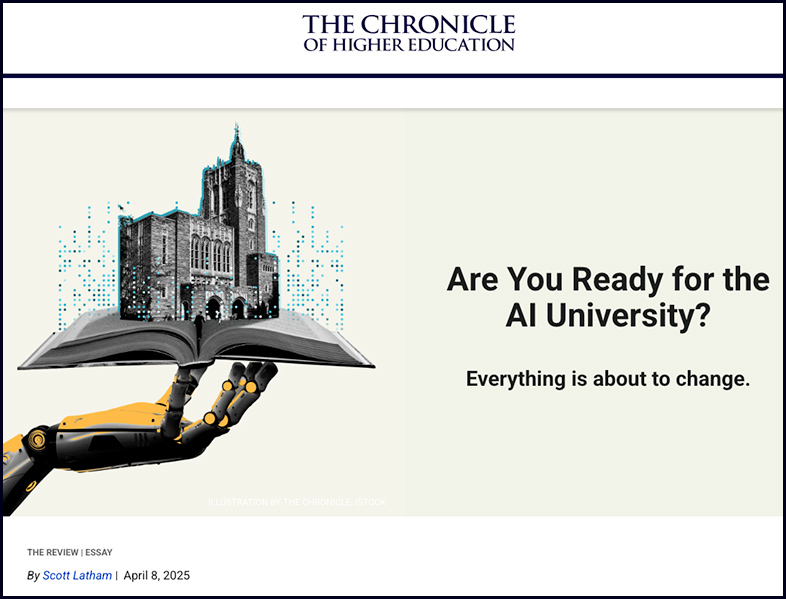
Are You Ready for the AI University? Everything is about to change. — from chronicle.com by Scott Latham

Over the course of the next 10 years, AI-powered institutions will rise in the rankings. US News & World Report will factor a college’s AI capabilities into its calculations. Accrediting agencies will assess the degree of AI integration into pedagogy, research, and student life. Corporations will want to partner with universities that have demonstrated AI prowess. In short, we will see the emergence of the AI haves and have-nots.

What’s happening in higher education today has a name: creative destruction. The economist Joseph Schumpeter coined the term in 1942 to describe how innovation can transform industries. That typically happens when an industry has both a dysfunctional cost structure and a declining value proposition. Both are true of higher education.

Out of the gate, professors will work with technologists to get AI up to speed on specific disciplines and pedagogy. For example, AI could be “fed” course material on Greek history or finance and then, guided by human professors as they sort through the material, help AI understand the structure of the discipline, and then develop lectures, videos, supporting documentation, and assessments.

In the near future, if a student misses class, they will be able watch a recording that an AI bot captured. Or the AI bot will find a similar lecture from another professor at another accredited university. If you need tutoring, an AI bot will be ready to help any time, day or night. Similarly, if you are going on a trip and wish to take an exam on the plane, a student will be able to log on and complete the AI-designed and administered exam. Students will no longer be bound by a rigid class schedule. Instead, they will set the schedule that works for them.

Early and mid-career professors who hope to survive will need to adapt and learn how to work with AI. They will need to immerse themselves in research on AI and pedagogy and understand its effect on the classroom. 

From DSC:
I had a very difficult time deciding which excerpts to include. There were so many more excerpts for us to think about with this solid article. While I don’t agree with several things in it, EVERY professor, president, dean, and administrator working within higher education today needs to read this article and seriously consider what Scott Latham is saying.

Change is already here, but according to Scott, we haven’t seen anything yet. I agree with him and, as a futurist, one has to consider the potential scenarios that Scott lays out for AI’s creative destruction of what higher education may look like. Scott asserts that some significant and upcoming impacts will be experienced by faculty members, doctoral students, and graduate/teaching assistants (and Teaching & Learning Centers and IT Departments, I would add). But he doesn’t stop there. He brings in presidents, deans, and other members of the leadership teams out there.

There are a few places where Scott and I differ.

  • The foremost one is the importance of the human element — i.e., the human faculty member and students’ learning preferences. I think many (most?) students and lifelong learners will want to learn from a human being. IBM abandoned their 5-year, $100M ed push last year and one of the key conclusions was that people want to learn from — and with — other people:

To be sure, AI can do sophisticated things such as generating quizzes from a class reading and editing student writing. But the idea that a machine or a chatbot can actually teach as a human can, he said, represents “a profound misunderstanding of what AI is actually capable of.” 

Nitta, who still holds deep respect for the Watson lab, admits, “We missed something important. At the heart of education, at the heart of any learning, is engagement. And that’s kind of the Holy Grail.”

— Satya Nitta, a longtime computer researcher at
IBM’s Watson
Research Center in Yorktown Heights, NY
.

By the way, it isn’t easy for me to write this. As I wanted AI and other related technologies to be able to do just what IBM was hoping that it would be able to do.

  • Also, I would use the term learning preferences where Scott uses the term learning styles.

Scott also mentions:

“In addition, faculty members will need to become technologists as much as scholars. They will need to train AI in how to help them build lectures, assessments, and fine-tune their classroom materials. Further training will be needed when AI first delivers a course.”

It has been my experience from working with faculty members for over 20 years that not all faculty members want to become technologists. They may not have the time, interest, and/or aptitude to become one (and vice versa for technologists who likely won’t become faculty members).

That all said, Scott relays many things that I have reflected upon and relayed for years now via this Learning Ecosystems blog and also via The Learning from the Living [AI-Based Class] Room vision — the use of AI to offer personalized and job-relevant learning, the rising costs of higher education, the development of new learning-related offerings and credentials at far less expensive prices, the need to provide new business models and emerging technologies that are devoted more to lifelong learning, plus several other things.

So this article is definitely worth your time to read, especially if you are working in higher education or are considering a career therein!


Addendum later on 4/10/25:

U-M’s Ross School of Business, Google Public Sector launch virtual teaching assistant pilot program — from news.umich.edu by Jeff Karoub; via Paul Fain

Google Public Sector and the University of Michigan’s Ross School of Business have launched an advanced Virtual Teaching Assistant pilot program aimed at improving personalized learning and enlightening educators on artificial intelligence in the classroom.

The AI technology, aided by Google’s Gemini chatbot, provides students with all-hours access to support and self-directed learning. The Virtual TA represents the next generation of educational chatbots, serving as a sophisticated AI learning assistant that instructors can use to modify their specific lessons and teaching styles.

The Virtual TA facilitates self-paced learning for students, provides on-demand explanations of complex course concepts, guides them through problem-solving, and acts as a practice partner. It’s designed to foster critical thinking by never giving away answers, ensuring students actively work toward solutions.


Job hunting and hiring in the age of AI: Where did all the humans go? — from washingtonpost.com by Taylor Telford
The proliferation of artificial intelligence tools and overreliance on software such as ChatGPT is making the job market increasingly surreal.

The speedy embrace of AI tools meant to make job hunting and hiring more efficient is causing headaches and sowing distrust in these processes, people on both sides of the equation say. While companies embrace AI recruiters and application scanning systems, many job seekers are trying to boost their odds with software that generates application materials, optimizes them for AI and applies to hundreds of jobs in minutes.

Meanwhile, recruiters and hiring managers are fielding more applicants than they can keep up with, yet contend that finding real, qualified workers amid the bots, cheaters and deepfakes is only getting tougher as candidates use AI to write their cover letters, bluff their way through interviews and even hide their identities.

“I’m pro-AI in the sense that it allows you to do things that were impossible before … but it is being misused wildly,” Freire said. The problem is “when you let it do the thinking for you, it goes from a superpower to a crutch very easily.”

 
© 2025 | Daniel Christian