Bringing the best of AI to college students for free — from blog.google by Sundar Pichai

Millions of college students around the world are getting ready to start classes. To help make the school year even better, we’re making our most advanced AI tools available to them for free, including our new Guided Learning mode. We’re also providing $1 billion to support AI education and job training programs and research in the U.S. This includes making our AI and career training free for every college student in America through our AI for Education Accelerator — over 100 colleges and universities have already signed up.

Guided Learning: from answers to understanding
AI can broaden knowledge and expand access to it in powerful ways, helping anyone, anywhere learn anything in the way that works best for them. It’s not about just getting an answer, but deepening understanding and building critical thinking skills along the way. That opportunity is why we built Guided Learning, a new mode in Gemini that acts as a learning companion guiding you with questions and step-by-step support instead of just giving you the answer. We worked closely with students, educators, researchers and learning experts to make sure it’s helpful for understanding new concepts and is backed by learning science.


BREAKING: Google introduces Guided Learning — from aieducation.substack.com by Claire Zau
Some thoughts on what could make Google’s AI tutor stand out

Another major AI lab just launched “education mode.”

Google introduced Guided Learning in Gemini, transforming it into a personalized learning companion designed to help you move from quick answers to real understanding.

Instead of immediately spitting out solutions, it:

  • Asks probing, open-ended questions
  • Walks learners through step-by-step reasoning
  • Adapts explanations to the learner’s level
  • Uses visuals, videos, diagrams, and quizzes to reinforce concepts

This Socratic style tutor rollout follows closely behind similar announcements like OpenAI’s Study Mode (last week) and Anthropic’s Claude for Education (April 2025).


How Sci-Fi Taught Me to Embrace AI in My Classroom — from edsurge.com by Dan Clark

I’m not too naive to understand that, no matter how we present it, some students will always be tempted by “the dark side” of AI. What I also believe is that the future of AI in education is not decided. It will be decided by how we, as educators, embrace or demonize it in our classrooms.

My argument is that setting guidelines and talking to our students honestly about the pitfalls and amazing benefits that AI offers us as researchers and learners will define it for the coming generations.

Can AI be the next calculator? Something that, yes, changes the way we teach and learn, but not necessarily for the worse? If we want it to be, yes.

How it is used, and more importantly, how AI is perceived by our students, can be influenced by educators. We have to first learn how AI can be used as a force for good. If we continue to let the dominant voice be that AI is the Terminator of education and critical thinking, then that will be the fate we have made for ourselves.


AI Tools for Strategy and Research – GT #32 — from goodtools.substack.com by Robin Good
Getting expert advice, how to do deep research with AI, prompt strategy, comparing different AIs side-by-side, creating mini-apps and an AI Agent that can critically analyze any social media channel

In this issue, discover AI tools for:

  • Getting Expert Advice
  • Doing Deep Research with AI
  • Improving Your AI Prompt Strategy
  • Comparing Results from Different AIs
  • Creating an AI Agent for Social Media Analysis
  • Summarizing YouTube Videos
  • Creating Mini-Apps with AI
  • Tasting an Award-Winning AI Short Film

GPT-Building, Agentic Workflow Design & Intelligent Content Curation — from drphilippahardman.substack.com by Dr. Philippa Hardman
What 3 recent job ads reveal about the changing nature of Instructional Design

In this week’s blog post, I’ll share my take on how the instructional design role is evolving and discuss what this means for our day-to-day work and the key skills it requires.

With this in mind, I’ve been keeping a close eye on open instructional design roles and, in the last 3 months, have noticed the emergence of a new flavour of instructional designer: the so-called “Generative AI Instructional Designer.”

Let’s deep dive into three explicitly AI-focused instructional design positions that have popped up in the last quarter. Each one illuminates a different aspect of how the role is changing—and together, they paint a picture of where our profession is likely heading.

Designers who evolve into prompt engineers, agent builders, and strategic AI advisors will capture the new premium. Those who cling to traditional tool-centric roles may find themselves increasingly sidelined—or automated out of relevance.


Google to Spend $1B on AI Training in Higher Ed — from insidehighered.com by Katherine Knott

Google’s parent company announced Wednesday (8/6/25) that it’s planning to spend $1 billion over the next three years to help colleges teach and train students about artificial intelligence.

Google is joining other AI companies, including OpenAI and Anthropic, in investing in AI training in higher education. All three companies have rolled out new tools aimed at supporting “deeper learning” among students and made their AI platforms available to certain students for free.


5 Predictions for How AI Will Impact Community Colleges — from pistis4edu.substack.com by Feng Hou

Based on current technology capabilities, adoption patterns, and the mission of community colleges, here are five well-supported predictions for AI’s impact in the coming years.

  1. Universal AI Tutor Access
  2. AI as Active Teacher
  3. Personalized Learning Pathways
  4. Interactive Multimodal Learning
  5. Value-Centric Education in an AI-Abundant World


One-size-fits-all learning is about to become completely obsolete. — from linkedin.com by Allie Miller


AI in the University: From Generative Assistant to Autonomous Agent This Fall — from insidehighered.com by
This fall we are moving into the agentic generation of artificial intelligence.

“Where generative AI creates, agentic AI acts.” That’s how my trusted assistant, Gemini 2.5 Pro deep research, describes the difference.

Agents, unlike generative tools, create and perform multistep goals with minimal human supervision. The essential difference is found in its proactive nature. Rather than waiting for a specific, step-by-step command, agentic systems take a high-level objective and independently create and execute a plan to achieve that goal. This triggers a continuous, iterative workflow that is much like a cognitive loop. The typical agentic process involves six key steps, as described by Nvidia:


AI in Education Podcast — from aipodcast.education by Dan Bowen and Ray Fleming


The State of AI in Education 2025 Key Findings from a National Survey — from Carnegie Learning

Our 2025 national survey of over 650 respondents across 49 states and Puerto Rico reveals both encouraging trends and important challenges. While AI adoption and optimism are growing, concerns about cheating, privacy, and the need for training persist.

Despite these challenges, I’m inspired by the resilience and adaptability of educators. You are the true game-changers in your students’ growth, and we’re honored to support this vital work.

This report reflects both where we are today and where we’re headed with AI. More importantly, it reflects your experiences, insights, and leadership in shaping the future of education.


Instructure and OpenAI Announce Global Partnership to Embed AI Learning Experiences within Canvas — from instructure.com

This groundbreaking collaboration represents a transformative step forward in education technology and will begin with, but is not limited to, an effort between Instructure and OpenAI to enhance the Canvas experience by embedding OpenAI’s next-generation AI technology into the platform.

IgniteAI announced earlier today, establishes Instructure’s future-ready, open ecosystem with agentic support as the AI landscape continues to evolve. This partnership with OpenAI exemplifies this bold vision for AI in education. Instructure’s strategic approach to AI emphasizes the enhancement of connections within an educational ecosystem comprising over 1,100 edtech partners and leading LLM providers.

“We’re committed to delivering next-generation LMS technologies designed with an open ecosystem that empowers educators and learners to adapt and thrive in a rapidly changing world,” said Steve Daly, CEO of Instructure. “This collaboration with OpenAI showcases our ambitious vision: creating a future-ready ecosystem that fosters meaningful learning and achievement at every stage of education. This is a significant step forward for the education community as we continuously amplify the learning experience and improve student outcomes.”


Faculty Latest Targets of Big Tech’s AI-ification of Higher Ed — from insidehighered.com by Kathryn Palmer
A new partnership between OpenAI and Instructure will embed generative AI in Canvas. It may make grading easier, but faculty are skeptical it will enhance teaching and learning.

The two companies, which have not disclosed the value of the deal, are also working together to embed large language models into Canvas through a feature called IgniteAI. It will work with an institution’s existing enterprise subscription to LLMs such as Anthropic’s Claude or OpenAI’s ChatGPT, allowing instructors to create custom LLM-enabled assignments. They’ll be able to tell the model how to interact with students—and even evaluate those interactions—and what it should look for to assess student learning. According to Instructure, any student information submitted through Canvas will remain private and won’t be shared with OpenAI.

Faculty Unsurprised, Skeptical
Few faculty were surprised by the Canvas-OpenAI partnership announcement, though many are reserving judgment until they see how the first year of using it works in practice.


Partnerships to make higher education work for the workforce — from timeshighereducation.com by Brooke Wilson
Fostering long-term industry partners can enhance student outcomes and prepare them for the workplace of the future. Here’s how to get the best out of them

As the pace of change accelerates across all industries, higher education institutions face increasing pressure to ensure their graduates are prepared for the workplace demands of today – and tomorrow. Cultivating meaningful partnerships with industry is no longer optional; it’s necessary.

From curriculum co-design to experiential learning, universities can collaborate with businesses and industries in several ways to enhance student outcomes and strengthen regional economies.


The keys to strong university–non-profit partnerships — from timeshighereducation.com by Mariana Leyva, Martha Sáenz, and Itzel Eguiluz
Collaborative projects between universities and non-profits nurture empathy and allow students to make a real-world impact. Here, three educators share their tips for building meaningful partnerships that benefit students and communities alike

Collaborative projects between universities and non-profits nurture empathy and allow students to make a real-world impact. Here, three educators share their tips for building meaningful partnerships that benefit students and communities alike.


AI and Higher Ed: An Impending Collapse — from insidehighered.com by Robert Niebuhr; via George Siemens; I also think George’s excerpt (see below) gets right to the point.
Universities’ rush to embrace AI will lead to an untenable outcome, Robert Niebuhr writes.

Herein lies the trap. If students learn how to use AI to complete assignments and faculty use AI to design courses, assignments, and grade student work, then what is the value of higher education? How long until people dismiss the degree as an absurdly overpriced piece of paper? How long until that trickles down and influences our economic and cultural output? Simply put, can we afford a scenario where students pretend to learn and we pretend to teach them?


This next report doesn’t look too good for traditional institutions of higher education either:


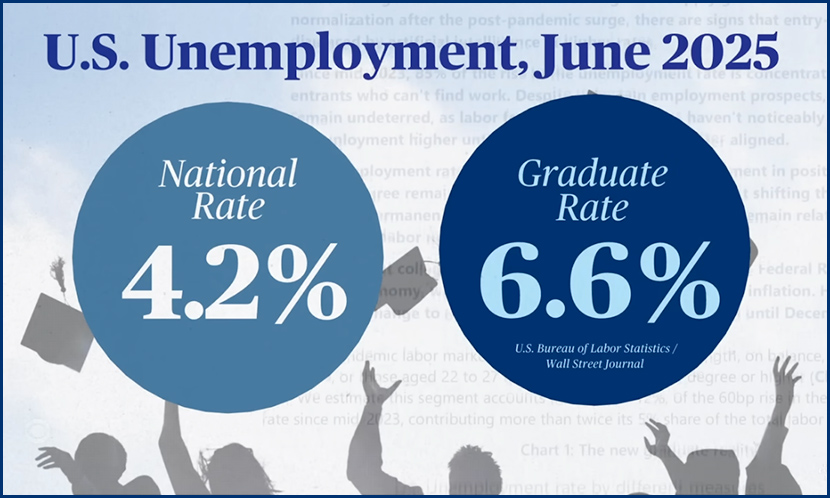
No Country for Young Grads — from burningglassinstitute.org

For the first time in modern history, a bachelor’s degree is no longer a reliable path to professional employment. Recent graduates face rising unemployment and widespread underemployment as structural—not cyclical—forces reshape entry?level work. This new report identifies four interlocking drivers: an AI?powered “Expertise Upheaval” eliminating many junior tasks, a post?pandemic shift to lean staffing and risk?averse hiring, AI acting as an accelerant to these changes, and a growing graduate glut. As a result, young degree holders are uniquely seeing their prospects deteriorate – even as the rest of the economy remain robust. Read the full report to explore the data behind these trends.

The above article was via Brandon Busteed on LinkedIn:


BREAKING: OpenAI Releases Study Mode — from aieducation.substack.com by Claire Zau
What’s New, What Works, and What’s Still Missing

What is Study Mode?
Study Mode is OpenAI’s take on a smarter study partner – a version of the ChatGPT experience designed to guide users through problems with Socratic prompts, scaffolded reasoning, and adaptive feedback (instead of just handing over the answer).

Built with input from learning scientists, pedagogy experts, and educators, it was also shaped by direct feedback from college students. While Study Mode is designed with college students in mind, it’s meant for anyone who wants a more learning-focused, hands-on experience across a wide range of subjects and skill levels.

Who can access it? And how?
Starting July 29, Study Mode is available to users on Free, Plus, Pro, and Team plans. It will roll out to ChatGPT Edu users in the coming weeks.


ChatGPT became your tutor — from theneurondaily.com by Grant Harvey
PLUS: NotebookLM has video now & GPT 4o-level AI runs on laptop

Here’s how it works: instead of asking “What’s 2+2?” and getting “4,” study mode asks questions like “What do you think happens when you add these numbers?” and “Can you walk me through your thinking?” It’s like having a patient tutor who won’t let you off the hook that easily.

The key features include:

  • Socratic questioning: It guides you with hints and follow-up questions rather than direct answers.
  • Scaffolded responses: Information broken into digestible chunks that build on each other.
  • Personalized support: Adjusts difficulty based on your skill level and previous conversations.
  • Knowledge checks: Built-in quizzes and feedback to make sure concepts actually stick.
  • Toggle flexibility: Switch study mode on and off mid-conversation depending on your goals.

Try study mode yourself by selecting “Study and learn” from tools in ChatGPT and asking a question.


Introducing study mode — from openai.com
A new way to learn in ChatGPT that offers step by step guidance instead of quick answers.

[On 7/29/25, we introduced] study mode in ChatGPT—a learning experience that helps you work through problems step by step instead of just getting an answer. Starting today, it’s available to logged in users on Free, Plus, Pro, Team, with availability in ChatGPT Edu coming in the next few weeks.

ChatGPT is becoming one of the most widely used learning tools in the world. Students turn to it to work through challenging homework problems, prepare for exams, and explore new concepts. But its use in education has also raised an important question: how do we ensure it is used to support real learning, and doesn’t just offer solutions without helping students make sense of them?

We’ve built study mode to help answer this question. When students engage with study mode, they’re met with guiding questions that calibrate responses to their objective and skill level to help them build deeper understanding. Study mode is designed to be engaging and interactive, and to help students learn something—not just finish something.


I Teach Creative Writing. This Is What A.I. Is Doing to Students. — from nytimes.com by Meghan O’Rourke; this is a gifted article.

We need a coherent approach grounded in understanding how the technology works, where it is going and what it will be used for.

From DSC:
I almost feel like Meghan should right the words “this week” or “this month” after the above sentence. Whew! Things are moving fast.

For example, we’re now starting to see more agents hitting the scene — software that can DO things. But that can open up a can of worms too. 

Students know the ground has shifted — and that the world outside the university expects them to shift with it. A.I. will be part of their lives regardless of whether we approve. Few issues expose the campus cultural gap as starkly as this one.ce 

From DSC:
Universities and colleges have little choice but to integrate AI into their programs and offerings. There’s enough pressure on institutions of traditional higher education to prove their worth/value. Students and their families want solid ROI’s. Students know that they are going to need AI-related skills (see the link immediately below for example), or they are going to be left out of the competitive job search process.

A relevant resource here:


Tech check: Innovation in motion: How AI is rewiring L&D workflows — from chieflearningofficer.com by Gabrielle Pike
AI isn’t here to replace us. It’s here to level us up.

For today’s chief learning officer, the days of just rolling out compliance training are long gone. In 2025, learning and development leaders are architects of innovation, crafting ecosystems that are agile, automated and AI-infused. This quarter’s Tech Check invites us to pause, assess and get strategic about where tech is taking us. Because the goal isn’t more tools—it’s smarter, more human learning systems that scale with the business.

Sections include:

  • The state of AI in L&D: Hype vs. reality
  • AI in design: From static content to dynamic experiences
  • AI in development: Redefining production workflows
  • Strategic questions CLOs should be asking
  • Future forward: What’s next?
  • Closing thought

American Federation of Teachers (AFT) to Launch National Academy for AI Instruction with Microsoft, OpenAI, Anthropic and United Federation of Teachers — from aft.org

NEW YORK – The AFT, alongside the United Federation of Teachers and lead partner Microsoft Corp., founding partner OpenAI, and Anthropic, announced the launch of the National Academy for AI Instruction today. The groundbreaking $23 million education initiative will provide access to free AI training and curriculum for all 1.8 million members of the AFT, starting with K-12 educators. It will be based at a state-of-the-art bricks-and-mortar Manhattan facility designed to transform how artificial intelligence is taught and integrated into classrooms across the United States.

The academy will help address the gap in structured, accessible AI training and provide a national model for AI-integrated curriculum and teaching that puts educators in the driver’s seat.


Students Are Anxious about the Future with A.I. Their Parents Are, Too. — from educationnext.org by Michael B. Horn
The fast-growing technology is pushing families to rethink the value of college

In an era when the college-going rate of high school graduates has dropped from an all-time high of 70 percent in 2016 to roughly 62 percent now, AI seems to be heightening the anxieties about the value of college.

According to the survey, two-thirds of parents say AI is impacting their view of the value of college. Thirty-seven percent of parents indicate they are now scrutinizing college’s “career-placement outcomes”; 36 percent say they are looking at a college’s “AI-skills curriculum,” while 35 percent respond that a “human-skills emphasis” is important to them.

This echoes what I increasingly hear from college leadership: Parents and students demand to see a difference between what they are getting from a college and what they could be “learning from AI.”


This next item on LinkedIn is compliments of Ray Schroeder:


How to Prepare Students for a Fast-Moving (AI)World — from rdene915.com by Dr. Rachelle Dené Poth

Preparing for a Future-Ready Classroom
Here are the core components I focus on to prepare students:

1. Unleash Creativity and Problem-Solving.
2. Weave in AI and Computational Thinking.
3. Cultivate Resilience and Adaptability.


AI Is Reshaping Learning Roles—Here’s How to Future-Proof Your Team — from onlinelearningconsortium.org by Jennifer Mathes, Ph.D., CEO, Online Learning Consortium; via Robert Gibson on LinkedIn

Culture matters here. Organizations that foster psychological safety—where experimentation is welcomed and mistakes are treated as learning—are making the most progress. When leaders model curiosity, share what they’re trying, and invite open dialogue, teams follow suit. Small tests become shared wins. Shared wins build momentum.

Career development must be part of this equation. As roles evolve, people will need pathways forward. Some will shift into new specialties. Others may leave familiar roles for entirely new ones. Making space for that evolution—through upskilling, mobility, and mentorship—shows your people that you’re not just investing in AI, you’re investing in them.

And above all, people need transparency. Teams don’t expect perfection. But they do need clarity. They need to understand what’s changing, why it matters, and how they’ll be supported through it. That kind of trust-building communication is the foundation for any successful change.

These shifts may play out differently across sectors—but the core leadership questions will likely be similar.

AI marks a turning point—not just for technology, but for how we prepare our people to lead through disruption and shape the future of learning.


.


“Using AI Right Now: A Quick Guide” [Molnick] + other items re: AI in our learning ecosystems

Thoughts on thinking — from dcurt.is by Dustin Curtis

Intellectual rigor comes from the journey: the dead ends, the uncertainty, and the internal debate. Skip that, and you might still get the insight–but you’ll have lost the infrastructure for meaningful understanding. Learning by reading LLM output is cheap. Real exercise for your mind comes from building the output yourself.

The irony is that I now know more than I ever would have before AI. But I feel slightly dumber. A bit more dull. LLMs give me finished thoughts, polished and convincing, but none of the intellectual growth that comes from developing them myself. 


Using AI Right Now: A Quick Guide — from oneusefulthing.org by Ethan Mollick
Which AIs to use, and how to use them

Every few months I put together a guide on which AI system to use. Since I last wrote my guide, however, there has been a subtle but important shift in how the major AI products work. Increasingly, it isn’t about the best model, it is about the best overall system for most people. The good news is that picking an AI is easier than ever and you have three excellent choices. The challenge is that these systems are getting really complex to understand. I am going to try and help a bit with both.

First, the easy stuff.

Which AI to Use
For most people who want to use AI seriously, you should pick one of three systems: Claude from Anthropic, Google’s Gemini, and OpenAI’s ChatGPT.

Also see:


Student Voice, Socratic AI, and the Art of Weaving a Quote — from elmartinsen.substack.com by Eric Lars Martinsen
How a custom bot helps students turn source quotes into personal insight—and share it with others

This summer, I tried something new in my fully online, asynchronous college writing course. These classes have no Zoom sessions. No in-person check-ins. Just students, Canvas, and a lot of thoughtful design behind the scenes.

One activity I created was called QuoteWeaver—a PlayLab bot that helps students do more than just insert a quote into their writing.

Try it here

It’s a structured, reflective activity that mimics something closer to an in-person 1:1 conference or a small group quote workshop—but in an asynchronous format, available anytime. In other words, it’s using AI not to speed students up, but to slow them down.

The bot begins with a single quote that the student has found through their own research. From there, it acts like a patient writing coach, asking open-ended, Socratic questions such as:

What made this quote stand out to you?
How would you explain it in your own words?
What assumptions or values does the author seem to hold?
How does this quote deepen your understanding of your topic?
It doesn’t move on too quickly. In fact, it often rephrases and repeats, nudging the student to go a layer deeper.


The Disappearance of the Unclear Question — from jeppestricker.substack.com Jeppe Klitgaard Stricker
New Piece for UNESCO Education Futures

On [6/13/25], UNESCO published a piece I co-authored with Victoria Livingstone at Johns Hopkins University Press. It’s called The Disappearance of the Unclear Question, and it’s part of the ongoing UNESCO Education Futures series – an initiative I appreciate for its thoughtfulness and depth on questions of generative AI and the future of learning.

Our piece raises a small but important red flag. Generative AI is changing how students approach academic questions, and one unexpected side effect is that unclear questions – for centuries a trademark of deep thinking – may be beginning to disappear. Not because they lack value, but because they don’t always work well with generative AI. Quietly and unintentionally, students (and teachers) may find themselves gradually avoiding them altogether.

Of course, that would be a mistake.

We’re not arguing against using generative AI in education. Quite the opposite. But we do propose that higher education needs a two-phase mindset when working with this technology: one that recognizes what AI is good at, and one that insists on preserving the ambiguity and friction that learning actually requires to be successful.


Leveraging GenAI to Transform a Traditional Instructional Video into Engaging Short Video Lectures — from er.educause.edu by Hua Zheng

By leveraging generative artificial intelligence to convert lengthy instructional videos into micro-lectures, educators can enhance efficiency while delivering more engaging and personalized learning experiences.


This AI Model Never Stops Learning — from link.wired.com by Will Knight

Researchers at Massachusetts Institute of Technology (MIT) have now devised a way for LLMs to keep improving by tweaking their own parameters in response to useful new information.

The work is a step toward building artificial intelligence models that learn continually—a long-standing goal of the field and something that will be crucial if machines are to ever more faithfully mimic human intelligence. In the meantime, it could give us chatbots and other AI tools that are better able to incorporate new information including a user’s interests and preferences.

The MIT scheme, called Self Adapting Language Models (SEAL), involves having an LLM learn to generate its own synthetic training data and update procedure based on the input it receives.


Edu-Snippets — from scienceoflearning.substack.com by Nidhi Sachdeva and Jim Hewitt
Why knowledge matters in the age of AI; What happens to learners’ neural activity with prolonged use of LLMs for writing

Highlights:

  • Offloading knowledge to Artificial Intelligence (AI) weakens memory, disrupts memory formation, and erodes the deep thinking our brains need to learn.
  • Prolonged use of ChatGPT in writing lowers neural engagement, impairs memory recall, and accumulates cognitive debt that isn’t easily reversed.
 

The Memory Paradox: Why Our Brains Need Knowledge in an Age of AI — from papers.ssrn.com by Barbara Oakley, Michael Johnston, Kenzen Chen, Eulho Jung, and Terrence Sejnowski; via George Siemens

Abstract
In an era of generative AI and ubiquitous digital tools, human memory faces a paradox: the more we offload knowledge to external aids, the less we exercise and develop our own cognitive capacities.
This chapter offers the first neuroscience-based explanation for the observed reversal of the Flynn Effect—the recent decline in IQ scores in developed countries—linking this downturn to shifts in educational practices and the rise of cognitive offloading via AI and digital tools. Drawing on insights from neuroscience, cognitive psychology, and learning theory, we explain how underuse of the brain’s declarative and procedural memory systems undermines reasoning, impedes learning, and diminishes productivity. We critique contemporary pedagogical models that downplay memorization and basic knowledge, showing how these trends erode long-term fluency and mental flexibility. Finally, we outline policy implications for education, workforce development, and the responsible integration of AI, advocating strategies that harness technology as a complement to – rather than a replacement for – robust human knowledge.

Keywords
cognitive offloading, memory, neuroscience of learning, declarative memory, procedural memory, generative AI, Flynn Effect, education reform, schemata, digital tools, cognitive load, cognitive architecture, reinforcement learning, basal ganglia, working memory, retrieval practice, schema theory, manifolds


AI & Schools: 4 Ways Artificial Intelligence Can Help Students — from the74million.org by W. Ian O’Byrne
AI creates potential for more personalized learning

I am a literacy educator and researcher, and here are four ways I believe these kinds of systems can be used to help students learn.

  1. Differentiated instruction
  2. Intelligent textbooks
  3. Improved assessment
  4. Personalized learning


5 Skills Kids (and Adults) Need in an AI World — from oreilly.com by Raffi Krikorian
Hint: Coding Isn’t One of Them

Five Essential Skills Kids Need (More than Coding)
I’m not saying we shouldn’t teach kids to code. It’s a useful skill. But these are the five true foundations that will serve them regardless of how technology evolves.

  1. Loving the journey, not just the destination
  2. Being a question-asker, not just an answer-getter
  3. Trying, failing, and trying differently
  4. Seeing the whole picture
  5. Walking in others’ shoes

The AI moment is now: Are teachers and students ready? — from iblnews.org

Day of AI Australia hosted a panel discussion on 20 May, 2025. Hosted by Dr Sebastian Sequoiah-Grayson (Senior Lecturer in the School of Computer Science and Engineering, UNSW Sydney) with panel members Katie Ford (Industry Executive – Higher Education at Microsoft), Tamara Templeton (Primary School Teacher, Townsville), Sarina Wilson (Teaching and Learning Coordinator – Emerging Technology at NSW Department of Education) and Professor Didar Zowghi (Senior Principal Research Scientist at CSIRO’s Data61).


Teachers using AI tools more regularly, survey finds — from iblnews.org

As many students face criticism and punishment for using artificial intelligence tools like ChatGPT for assignments, new reporting shows that many instructors are increasingly using those same programs.


Addendum on 5/28/25:

A Museum of Real Use: The Field Guide to Effective AI Use — from mikekentz.substack.com by Mike Kentz
Six Educators Annotate Their Real AI Use—and a Method Emerges for Benchmarking the Chats

Our next challenge is to self-analyze and develop meaningful benchmarks for AI use across contexts. This research exhibit aims to take the first major step in that direction.

With the right approach, a transcript becomes something else:

  • A window into student decision-making
  • A record of how understanding evolves
  • A conversation that can be interpreted and assessed
  • An opportunity to evaluate content understanding

This week, I’m excited to share something that brings that idea into practice.

Over time, I imagine a future where annotated transcripts are collected and curated. Schools and universities could draw from a shared library of real examples—not polished templates, but genuine conversations that show process, reflection, and revision. These transcripts would live not as static samples but as evolving benchmarks.

This Field Guide is the first move in that direction.


‘What I learned when students walked out of my AI class’ — from timeshighereducation.com by Chris Hogg
Chris Hogg found the question of using AI to create art troubled his students deeply. Here’s how the moment led to deeper understanding for both student and educator

Teaching AI can be as thrilling as it is challenging. This became clear one day when three students walked out of my class, visibly upset. They later explained their frustration: after spending years learning their creative skills, they were disheartened to see AI effortlessly outperform them at the blink of an eye.

This moment stuck with me – not because it was unexpected, but because it encapsulates the paradoxical relationship we all seem to have with AI. As both an educator and a creative, I find myself asking: how do we engage with this powerful tool without losing ourselves in the process? This is the story of how I turned moments of resistance into opportunities for deeper understanding.


In the AI era, how do we battle cognitive laziness in students? — from timeshighereducation.com by Sean McMinn
With the latest AI technology now able to handle complex problem-solving processes, will students risk losing their own cognitive engagement? Metacognitive scaffolding could be the answer, writes Sean McMinn

The concern about cognitive laziness seems to be backed by Anthropic’s report that students use AI tools like Claude primarily for creating (39.8 per cent) and analysing (30.2 per cent) tasks, both considered higher-order cognitive functions according to Bloom’s Taxonomy. While these tasks align well with advanced educational objectives, they also pose a risk: students may increasingly delegate critical thinking and complex cognitive processes directly to AI, risking a reduction in their own cognitive engagement and skill development.


Make Instructional Design Fun Again with AI Agents — from drphilippahardman.substack.com by Dr. Philippa Hardman
A special edition practical guide to selecting & building AI agents for instructional design and L&D

Exactly how we do this has been less clear, but — fuelled by the rise of so-called “Agentic AI” — more and more instructional designers ask me: “What exactly can I delegate to AI agents, and how do I start?”

In this week’s post, I share my thoughts on exactly what instructional design tasks can be delegated to AI agents, and provide a step-by-step approach to building and testing your first AI agent.

Here’s a sneak peak….


AI Personality Matters: Why Claude Doesn’t Give Unsolicited Advice (And Why You Should Care) — from mikekentz.substack.com by Mike Kentz
First in a four-part series exploring the subtle yet profound differences between AI systems and their impact on human cognition

After providing Claude with several prompts of context about my creative writing project, I requested feedback on one of my novel chapters. The AI provided thoughtful analysis with pros and cons, as expected. But then I noticed what wasn’t there: the customary offer to rewrite my chapter.

Without Claude’s prompting, I found myself in an unexpected moment of metacognition. When faced with improvement suggestions but no offer to implement them, I had to consciously ask myself: “Do I actually want AI to rewrite this section?” The answer surprised me – no, I wanted to revise it myself, incorporating the insights while maintaining my voice and process.

The contrast was striking. With ChatGPT, accepting its offer to rewrite felt like a passive, almost innocent act – as if I were just saying “yes” to a helpful assistant. But with Claude, requesting a rewrite required deliberate action. Typing out the request felt like a more conscious surrender of creative agency.


Also re: metacognition and AI, see:

In the AI era, how do we battle cognitive laziness in students? — from timeshighereducation.com by Sean McMinn
With the latest AI technology now able to handle complex problem-solving processes, will students risk losing their own cognitive engagement? Metacognitive scaffolding could be the answer, writes Sean McMinn

The concern about cognitive laziness seems to be backed by Anthropic’s report that students use AI tools like Claude primarily for creating (39.8 per cent) and analysing (30.2 per cent) tasks, both considered higher-order cognitive functions according to Bloom’s Taxonomy. While these tasks align well with advanced educational objectives, they also pose a risk: students may increasingly delegate critical thinking and complex cognitive processes directly to AI, risking a reduction in their own cognitive engagement and skill development.

By prompting students to articulate their cognitive processes, such tools reinforce the internalisation of self-regulated learning strategies essential for navigating AI-augmented environments.


EDUCAUSE Panel Highlights Practical Uses for AI in Higher Ed — from govtech.com by Abby Sourwine
A webinar this week featuring panelists from the education, private and nonprofit sectors attested to how institutions are applying generative artificial intelligence to advising, admissions, research and IT.

Many higher education leaders have expressed hope about the potential of artificial intelligence but uncertainty about where to implement it safely and effectively. According to a webinar Tuesday hosted by EDUCAUSE, “Unlocking AI’s Potential in Higher Education,” their answer may be “almost everywhere.”

Panelists at the event, including Kaskaskia College CIO George Kriss, Canyon GBS founder and CEO Joe Licata and Austin Laird, a senior program officer at the Gates Foundation, said generative AI can help colleges and universities meet increasing demands for personalization, timely communication and human-to-human connections throughout an institution, from advising to research to IT support.


Partly Cloudy with a Chance of Chatbots — from derekbruff.org by Derek Bruff

Here are the predictions, our votes, and some commentary:

  • “By 2028, at least half of large universities will embed an AI ‘copilot’ inside their LMS that can draft content, quizzes, and rubrics on demand.” The group leaned toward yes on this one, in part because it was easy to see LMS vendors building this feature in as a default.
  • “Discipline-specific ‘digital tutors’ (LLM chatbots trained on course materials) will handle at least 30% of routine student questions in gateway courses.” We learned toward yes on this one, too, which is why some of us are exploring these tools today. We would like to be ready how to use them well (or avoid their use) when they are commonly available.
  • “Adaptive e-texts whose examples, difficulty, and media personalize in real time via AI will outsell static digital textbooks in the U.S. market.” We leaned toward no on this one, in part because the textbook market and what students want from textbooks has historically been slow to change. I remember offering my students a digital version of my statistics textbook maybe 6-7 years ago, and most students opted to print the whole thing out on paper like it was 1983.
  • “AI text detectors will be largely abandoned as unreliable, shifting assessment design toward oral, studio, or project-based ‘AI-resilient’ tasks.” We leaned toward yes on this. I have some concerns about oral assessments (they certainly privilege some students over others), but more authentic assignments seems like what higher ed needs in the face of AI. Ted Underwood recently suggested a version of this: “projects that attempt genuinely new things, which remain hard even with AI assistance.” See his post and the replies for some good discussion on this idea.
  • “AI will produce multimodal accessibility layers (live translation, alt-text, sign-language avatars) for most lecture videos without human editing.” We leaned toward yes on this one, too. This seems like another case where something will be provided by default, although my podcast transcripts are AI-generated and still need editing from me, so we’re not there quite yet.

‘We Have to Really Rethink the Purpose of Education’
The Ezra Klein Show

Description: I honestly don’t know how I should be educating my kids. A.I. has raised a lot of questions for schools. Teachers have had to adapt to the most ingenious cheating technology ever devised. But for me, the deeper question is: What should schools be teaching at all? A.I. is going to make the future look very different. How do you prepare kids for a world you can’t predict?

And if we can offload more and more tasks to generative A.I., what’s left for the human mind to do?

Rebecca Winthrop is the director of the Center for Universal Education at the Brookings Institution. She is also an author, with Jenny Anderson, of “The Disengaged Teen: Helping Kids Learn Better, Feel Better, and Live Better.” We discuss how A.I. is transforming what it means to work and be educated, and how our use of A.I. could revive — or undermine — American schools.


2025 EDUCAUSE Horizon Report | Teaching and Learning Edition — from library.educause.edu

Higher education is in a period of massive transformation and uncertainty. Not only are current events impacting how institutions operate, but technological advancement—particularly in AI and virtual reality—are reshaping how students engage with content, how cognition is understood, and how learning itself is documented and valued.

Our newly released 2025 EDUCAUSE Horizon Report | Teaching and Learning Edition captures the spirit of this transformation and how you can respond with confidence through the lens of emerging trends, key technologies and practices, and scenario-based foresight.

#teachingandlearning #highereducation #learningecosystems #learning #futurism #foresight #trends #emergingtechnologies #AI #VR #gamechangingenvironment #colleges #universities #communitycolleges #faculty #staff #IT


© 2025 | Daniel Christian