From
http://www.lifewithsiri.com/siri-links

Also see:

What is Siri? — from Apple.com

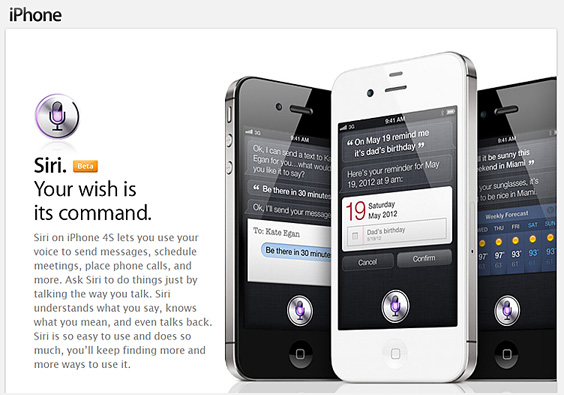
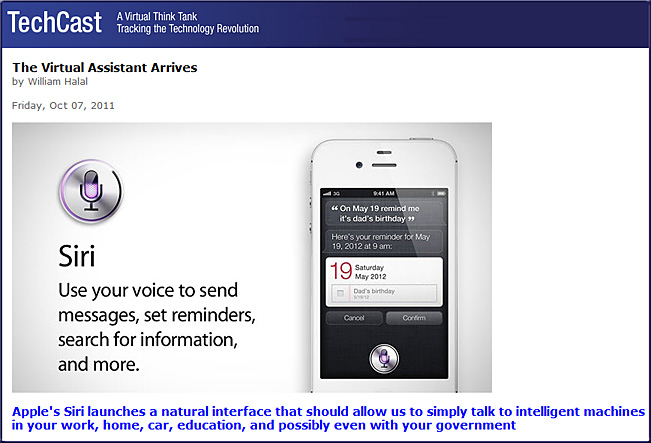
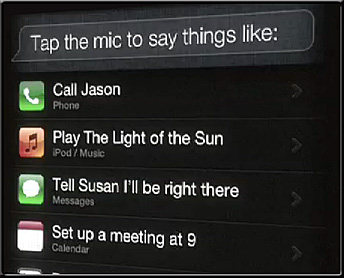
Siri is the intelligent personal assistant that helps you get things done just by asking. It allows you to use your voice to send messages, schedule meetings, place phone calls, and more. But Siri isn’t like traditional voice recognition software that requires you to remember keywords and speak specific commands. Siri understands your natural speech, and it asks you questions if it needs more information to complete a task.

Siri uses the processing power of the dual-core A5 chip in iPhone 4S, and it uses 3G and Wi-Fi networks to communicate rapidly with Apple’s data centers. So it can quickly understand what you say and what you’re asking for, then quickly return a response.

Siri is currently in beta and we’ll continue to improve it over time.


Also see:

Voice Control Will Disrupt Living Room Electronics — from techpinions.com by Patrick Moorhead
Excerpt:
In what seems to be a routine in high-tech journalism and social media now is to speculate on what Apple will do next. The latest and greatest rumor is that Apple will develop an HDTV set. I wrote back in September that Apple should build a TV given the lousy experience and Apple’s ability to fix big user challenges. What hasn’t been talked about a lot is why voice command and control makes so much sense in home electronics and why it will dominate the living room. Its all about the content.


Apple University will train executives to think like Steve Jobs — from good.is by Liz Dwyer

Excerpt:

If you want to honor Steve Jobs’ life by following in his entrepreneurial footsteps, forget heading to business school. The Los Angeles Times reports that an Apple team has been working on a top-secret project to create an executive training program called Apple University. The goal? To train people to think like Steve Jobs.

…

Apple refused to comment on the existence of Apple University, but the Times says that in 2008, Jobs “personally recruited” Joel Podolny, the dean of Yale Business School, to “help Apple internalize the thoughts of its visionary founder to prepare for the day when he’s not around anymore.” Apple analyst Tim Bajarin told the Times that, “it became pretty clear that Apple needed a set of educational materials so that Apple employees could learn to think and make decisions as if they were Steve Jobs.” Though the curriculum is still under wraps, Jobs himself oversaw the creation of the “university-caliber courses.” (emphasis DSC)

 Also see:


Steve Jobs’ virtual DNA to be fostered in Apple University:  To survive its late founder, Apple and Steve Jobs planned a training program in which company executives will be taught to think like him, in “a forum to impart that DNA to future generations.” Key to this effort is Joel Podolny, former Yale Business School dean.
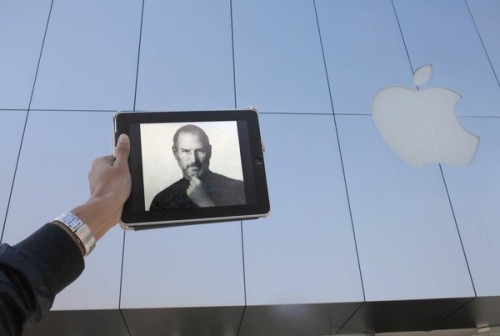
Photo: Steve Jobs helped plan Apple University — an executive training program to help Apple carry on without him. Credit: Michael Robinson Chavez / Los Angeles Times

Steve Jobs helped plan Apple University — an executive training program to help
Apple carry on without him. (Michael Robinson Chavez / Los Angeles Times / October 6, 2011)

From DSC:
If Apple were to choose to disrupt higher education, several other pieces of the puzzle have already been built and/or continue to be enhanced:

  • Siri — a serious start towards the use of intelligent agents / intelligent tutoring
  • An infrastructure to support 24x7x365 access and synchronization of content/assignments/files to a student’s various devices — via iCloud (available today via iTunes 10.5)
  • iTunes U already has millions of downloads and contains content from some of the world’s top universities
  • The internal expertise and teams to create incredibly-rich, interactive, multimedia-based, personalized, customized educational content
  • Students — like employees in the workplace — are looking for information/training/learning on demand — when they need it and on whatever device they need it
  • Apple — or other 3rd parties — could assist publishers in creating cloud-based apps (formerly called textbooks) to download to students’/professors’ devices as well as to the Chalkboards of the Future
  • The iPad continues to be implemented in a variety of education settings, allowing for some seriously interactive, mobile-based learning


At the least, I might be losing a bit more sleep if I were heading up an MBA program or a business school…


The Virtual Assistant Arrives - Oct 2011 by Halal

From DSC: Expectations, today, are getting hard to beat

Since Apple’s event yesterday, I’ve heard some conversations on the radio and reviewed several blog postings and articles about Apple’s announcements…many with a sense of let down (and some with the usual critical viewpoints by the backseat drivers out there who have never tried to invent anything, but who sure like to find fault with everyone else’s inventions and innovations).

It made me reflect on how high our expectations are becoming these days!  It wasn’t enough that iCloud is coming on 10/12 (and who knows the directions that will take society in). It wasn’t enough to introduce some serious software-based innovations such as Siri (which bring some significant advancements in the world of artificial intelligence) or AirPlay for the iPhone.  It wasn’t enough to enter into the multi-billion dollar card industry with their new Cards app for the iPhone.  Wow…tough crowd.

What might these announcements — and expectations — mean for education? 
Well…I can see intelligent tutoring, intelligent agents, machine-to-machine communications, the continued growth of mobile learning, learning from the living room, the initiation of programs/events caused by changes in one’s location, continued convergence of the television/computer/telephone, continued use of videoconferencing on handheld devices, cloud-based textbooks/apps, and more.


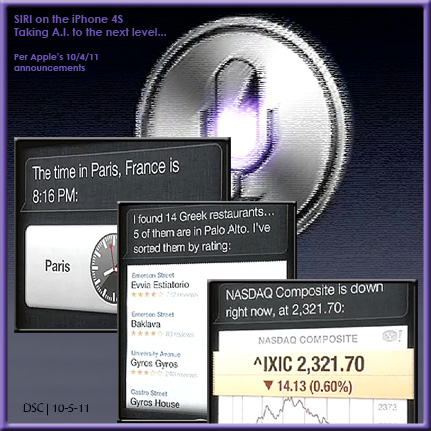
Siri on the iPhone 4S -- October 4, 2011


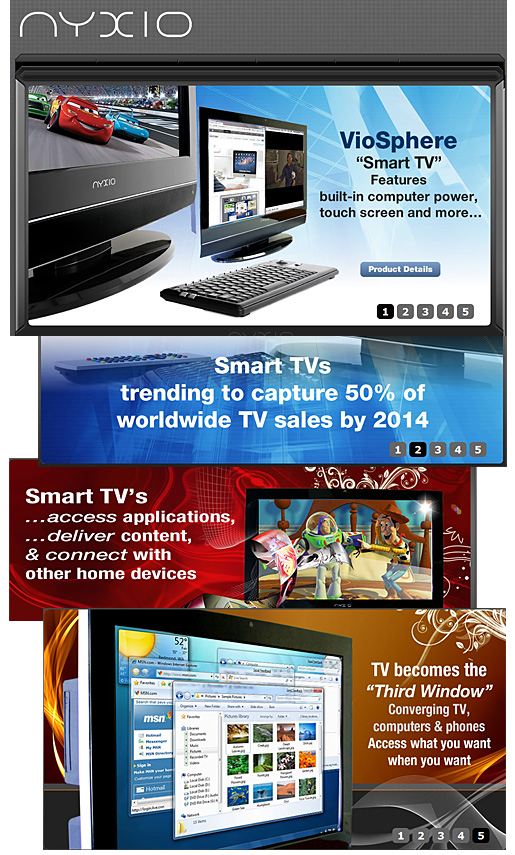
Intel predicts Smart TV is the device of the future — from nyxiotechnologies.com’s blog
Chipmaker Intel believes that the Smart TV is the electronic device of the future, in the living room anyway.

Excerpt:

The Smart TV is already upon us, in its various forms from various manufacturers. It has arrived with 3D capabilities, web browsing and social networking and applications. Currently Samsung and LG seem to be two of the big players pushing the Smart TV to consumers.

Also see:


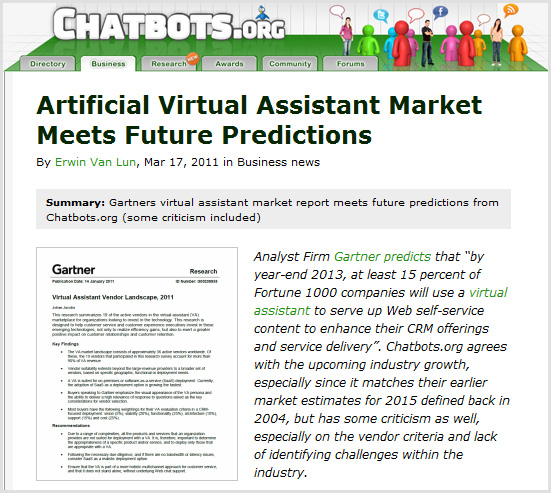
Artificial Virtual Assistants to grow in usage -- Gartner and Chatbots.org


From DSC:
Again, though this may be business/corporate-related news for now, learning-based apps may not be too far behind these sorts of innovations.

A hugely powerful vision: A potent addition to our learning ecosystems of the future


Daniel Christian:
A Vision of Our Future Learning Ecosystems


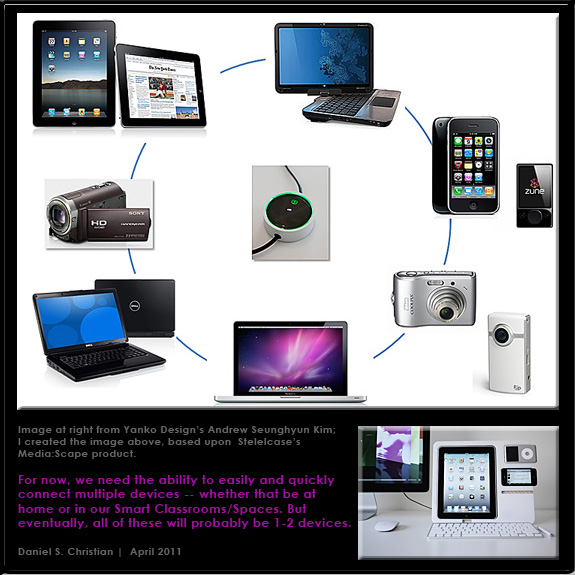
In the near future, as the computer, the television, the telephone (and more) continues to converge, we will most likely enjoy even more powerful capabilities to conveniently create and share our content as well as participate in a global learning ecosystem — whether that be from within our homes and/or from within our schools, colleges, universities and businesses throughout the world.

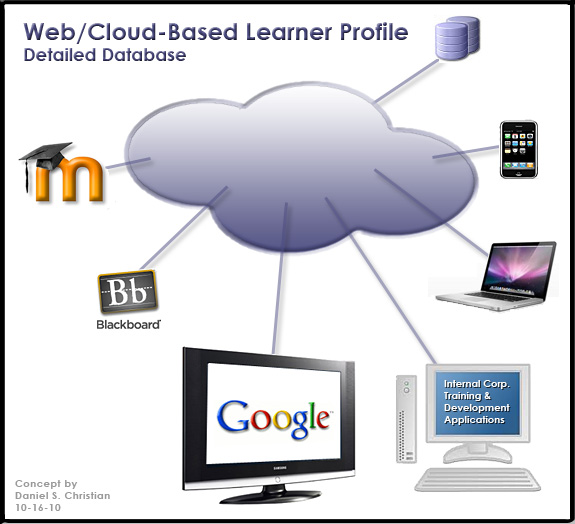
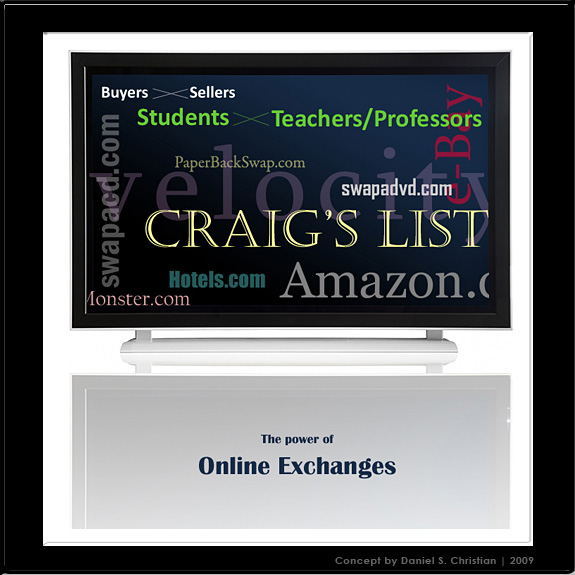
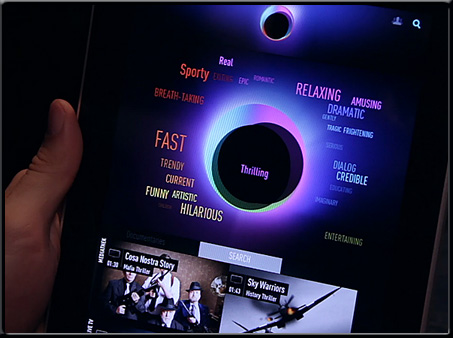
We will be teachers and students at the same time — even within the same hour — with online-based learning exchanges taking place all over the virtual and physical world.  Subject Matter Experts (SME’s) — in the form of online-based tutors, instructors, teachers, and professors — will be available on demand. Even more powerful/accurate/helpful learning engines will be involved behind the scenes in delivering up personalized, customized learning — available 24x7x365.  Cloud-based learner profiles may enter the equation as well.

The chances for creativity,  innovation, and entrepreneurship that are coming will be mind-blowing! What employers will be looking for — and where they can look for it — may change as well.

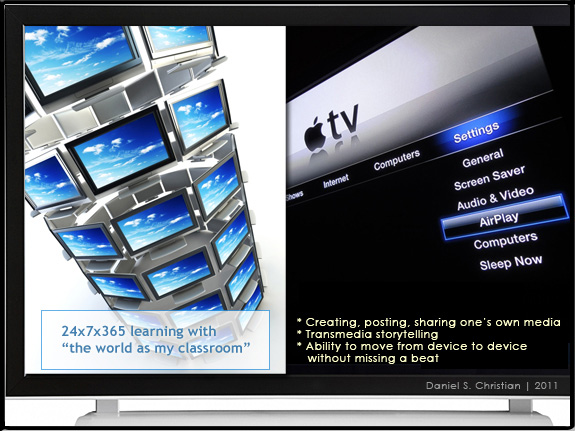
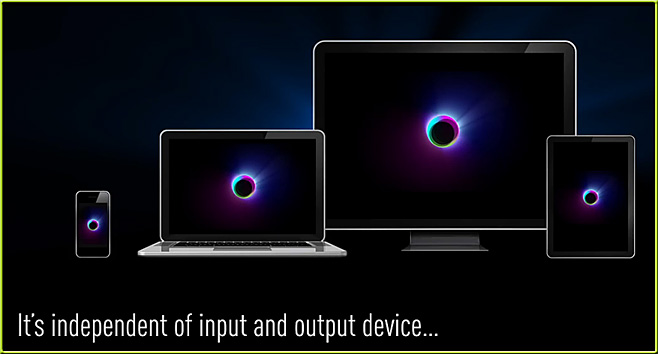
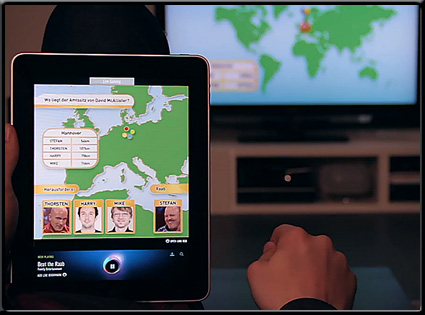
What we know today as the “television” will most likely play a significant role in this learning ecosystem of the future. But it won’t be like the TV we’ve come to know. It will be much more interactive and will be aware of who is using it — and what that person is interested in learning about. Technologies/applications like Apple’s AirPlay will become more standard, allowing a person to move from device to device without missing a  beat. Transmedia storytellers will thrive in this environment!

Much of the professionally done content will be created by teams of specialists, including the publishers of educational content, and the in-house teams of specialists within colleges, universities, and corporations around the globe. Perhaps consortiums of colleges/universities will each contribute some of the content — more readily accepting previous coursework that was delivered via their consortium’s membership.

An additional thought regarding higher education and K-12 and their Smart Classrooms/Spaces:
For input devices…
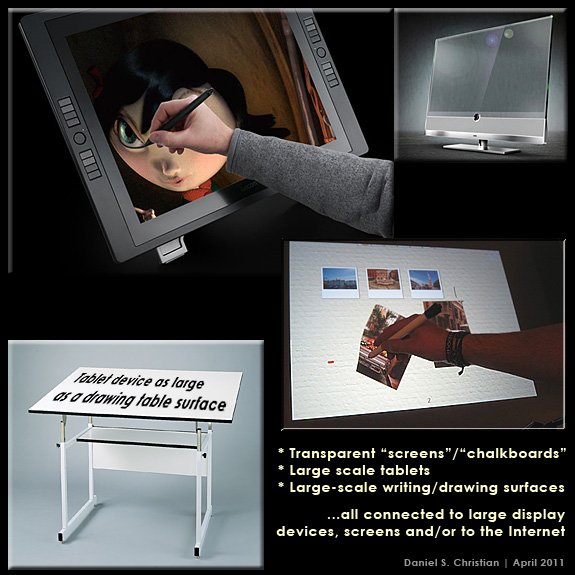
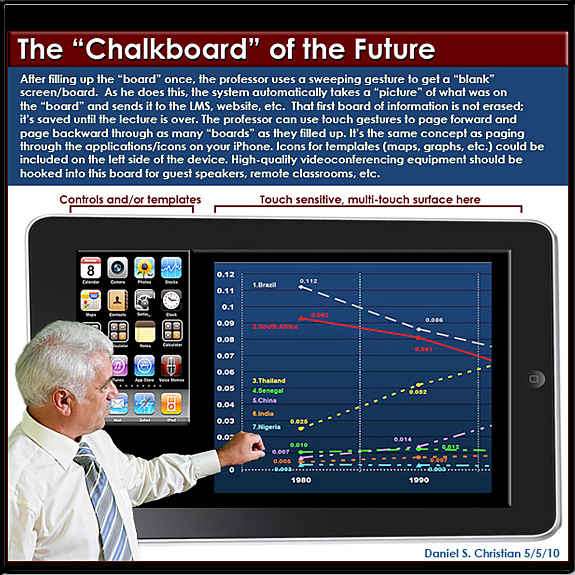
The “chalkboards” of the future may be transparent, or they may be on top of a drawing board-sized table or they may be tablet-based. But whatever form they take and whatever is displayed upon them, the ability to annotate will be there; with the resulting graphics saved and instantly distributed. (Eventually, we may get to voice-controlled Smart Classrooms, but we have a ways to go in that area…)

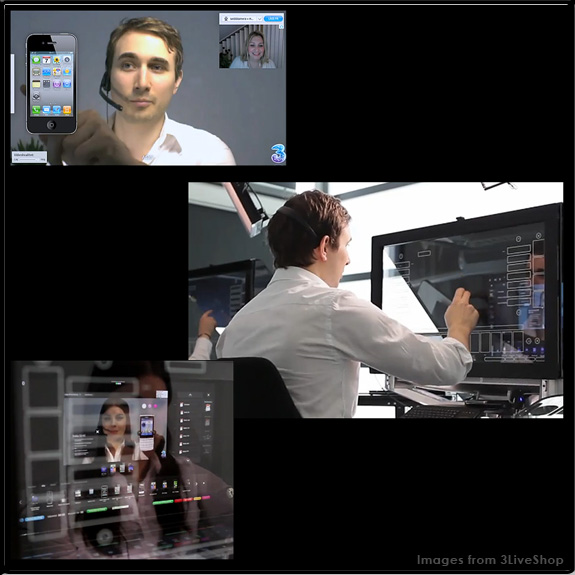
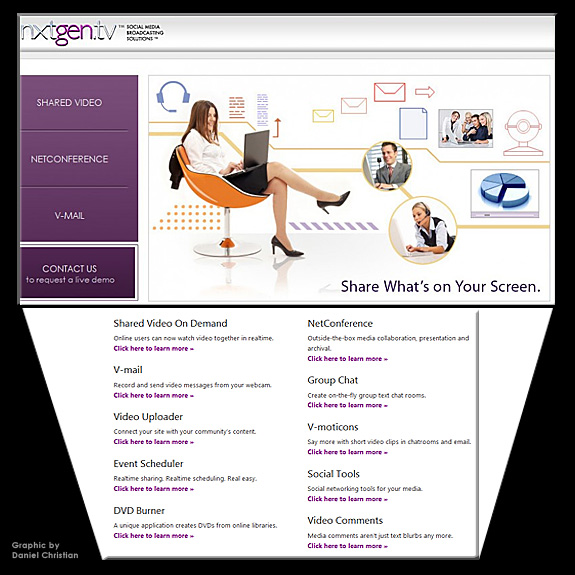
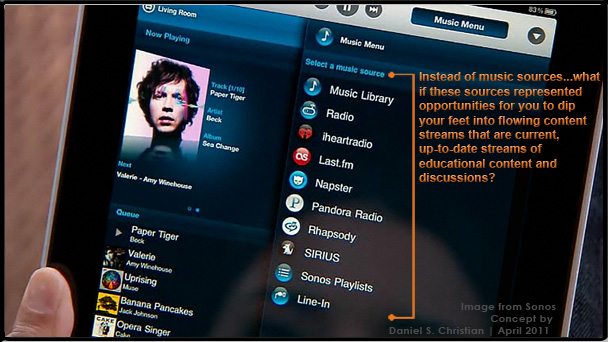
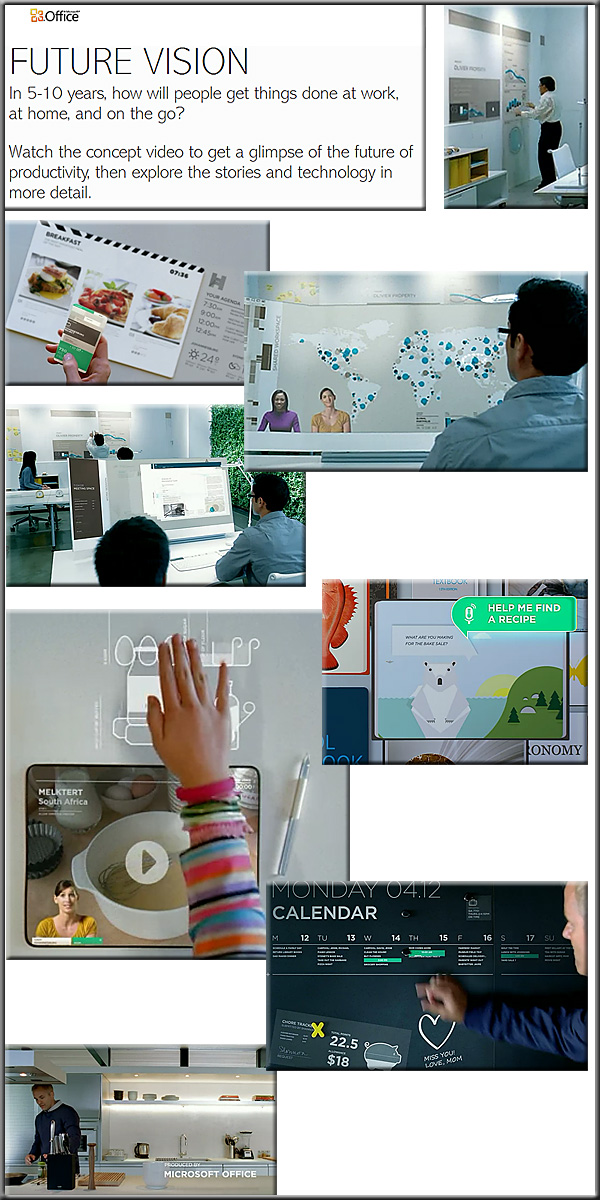
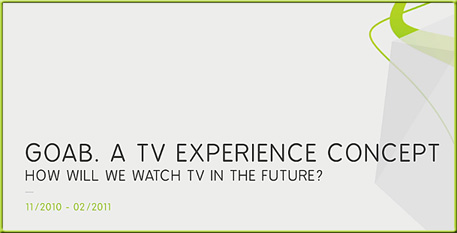
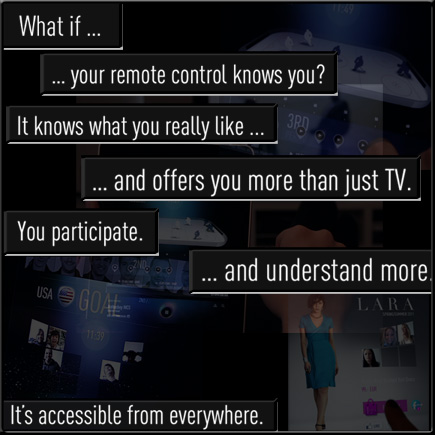
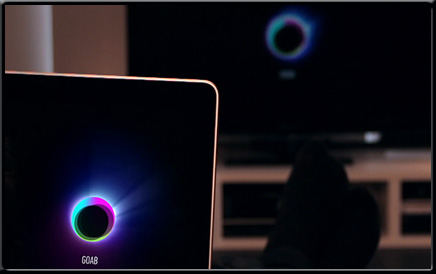
Below are some of the graphics that capture a bit of what I’m seeing in my mind…and in our futures.

Alternatively available as a PowerPoint Presentation (audio forthcoming in a future version)
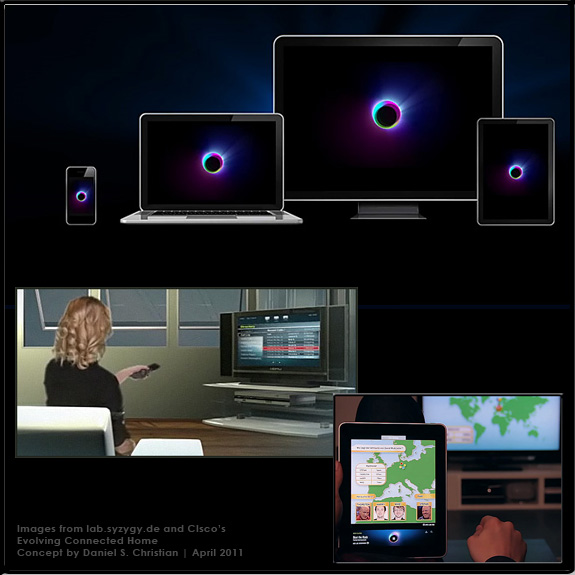


— from Daniel S. Christian | April 2011

See also:

Addendum on 4-14-11:
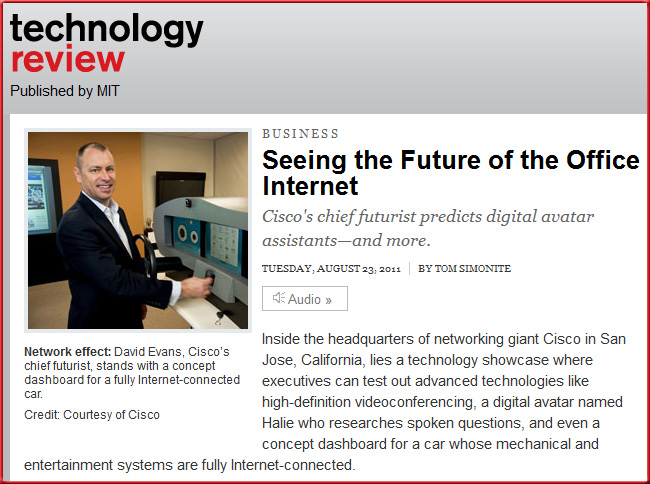
 

Tagged with: • • • • • • • • • • • • • • • • • • • • • • • • • • • • • • • • • • • • • • • • • • • • • • • • • • • • • • • • • • • • • • • • • • • • • • • • • • • • • • • • • • • • • • • • • • • • • • • • • • • • • • • • • • • • • • • • • • •  

From DSC:
In my mind, this area of intelligent systems and agents is one of the most important areas to watch in the years ahead.  Such efforts should help us develop sophisticated systems that can help deliver personalized, customized education at the K-12 and higher ed levels…and perhaps will be relevant in the L&D space as well.

The innovations that come from this area may make hybrid-based — as well as  100% online-based learning — incredibly powerful!

If someone can develop such systems and make them available at far cheaper prices than exist today, a quality “Walmart of Education” will truly have been built.


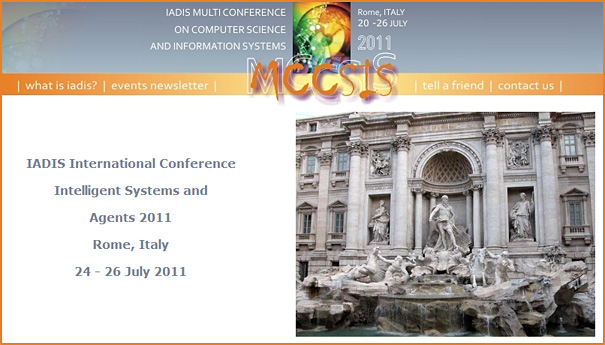
 IADIS International Conference: Intelligent Systems and Agents - in Rome, July 24-26, 2011


Per the Call for Papers section, the topics for this conference include, but are not limited to:


Area 1 – Intelligent Systems  

– Algorithms

– Artificial Intelligence

– Automation Systems and Control

– Bioinformatics

– Computational Intelligence

– Expert Systems

– Fuzzy Technologies and Systems

– Game and Decision Theories

– Intelligent Control Systems

– Intelligent Internet Systems

– Intelligent Software Systems

– Intelligent Systems

– Machine Learning

– Neural Networks

– Neurocomputers

– Optimization

– Parallel Computation

– Pattern Recognition

– Robotics and Autonomous Robots

– Signal Processing

– Systems Modelling

– Web Mining


Area 2 – Agents  

– Adaptive Agent Systems

– Agent Applications

– Agent Communication

– Agent Development

– Agent middleware

– Agent Models and Architectures

– Agent Ontologies

– Agent Oriented Systems and Engineering

– Agent Programming, Languages and Environments

– Agent Systems

– Agent Technologies

– Agent Theories

– Agent Trends

– Agents Analysis and Design

– Agents and Learning

– Agents and Ubiquitous Computing

– Agents in Networks

– Agents Protocols and Standards

– Artificial Systems

– Computational Complexity

– eCommerce and Agents

– Embodied Agents

– Mobile Agents

– Multi-Agent Systems

– Negotiation Strategies

– Performance Issues

– Security, Privacy and Trust

– Semantic Grids

– Simulation

– Web Agents


© 2025 | Daniel Christian