L&D Global Sentiment Survey 2026 — from linkedin.com by Donald H. Taylor
“But what’s happening right now is exponential.” — from linkedin.com by Josh Cavalier
Excerpt:
I need to be honest with you. I’ve been running experiments this week with Claude Code and Opus 4.6, and we have reached the precipice in the collapse of time required to produce high-quality text-based ID outputs.
This includes performance consulting reports, learning needs analyses, action mapping, scripts, storyboards, facilitator guides, rubrics, and technical specs.
I just mapped the entire performance consulting process into a multimodal AI integration architecture (diagram image). Every phase. Entry and contracting. Performance analysis. Cause analysis. Solution design. Implementation. Evaluation. Thirty files. System specifications for each. The next step is to vet out each “skill” with an expert performance consultant.
Then I attempted a learning output: an 8-module course built with a cognitive scaffold that moves beyond content delivery to facilitate deliberate practice, meaning-making, and guided reflection within the learner’s own context.
The result:
AI and human-centered learning — from linkedin.com by Patrick Blessinger
Democratizing opportunities
AI adaptive learning can adapt learning in real-time. These tools have the potential to provide a more personalized learning experience, but only if used properly.
The California State University system uses ChatGPT Edu (OpenAI, 2025). Students use it for AI-assisted tutoring, study aids, and writing support. These resources provide 24/7 availability of subject-matter expertise tailored to students’ learning needs. It is not a replacement for professors. Rather, it extends the reach of mentorship by reducing access barriers.
However, we must proceed with intellectual humility and ethical responsibility. Even though AI can customize messages, it cannot replace the encouragement of a teacher or professor, or the social and emotional aspects of learning. It’s at the intersection of humanistic values and knowledge development that education must find its balance.
Something Big Is Happening — from shumer.dev by Matt Shumer; see below from the BIG Questions Institute, where I got this article from
I’ve spent six years building an AI startup and investing in the space. I live in this world. And I’m writing this for the people in my life who don’t… my family, my friends, the people I care about who keep asking me “so what’s the deal with AI?” and getting an answer that doesn’t do justice to what’s actually happening. I keep giving them the polite version. The cocktail-party version. Because the honest version sounds like I’ve lost my mind. And for a while, I told myself that was a good enough reason to keep what’s truly happening to myself. But the gap between what I’ve been saying and what is actually happening has gotten far too big. The people I care about deserve to hear what is coming, even if it sounds crazy.
…
They’ve now done it. And they’re moving on to everything else.
The experience that tech workers have had over the past year, of watching AI go from “helpful tool” to “does my job better than I do”, is the experience everyone else is about to have. Law, finance, medicine, accounting, consulting, writing, design, analysis, customer service. Not in ten years. The people building these systems say one to five years. Some say less. And given what I’ve seen in just the last couple of months, I think “less” is more likely.
…
The models available today are unrecognizable from what existed even six months ago. The debate about whether AI is “really getting better” or “hitting a wall” — which has been going on for over a year — is over. It’s done. Anyone still making that argument either hasn’t used the current models, has an incentive to downplay what’s happening, or is evaluating based on an experience from 2024 that is no longer relevant. I don’t say that to be dismissive. I say it because the gap between public perception and current reality is now enormous, and that gap is dangerous… because it’s preventing people from preparing.
What “Something Big Is Happening” Means for Schools — from/by the BIG Questions Institute
Matt Shumer’s newsletter post Something Big is Happening has been read over 80 million times within the week when it was published, on February 9.
…
Still, it’s worth reading Shumer’s post. Given the claims and warnings in Something Big Is Happening (and countless other articles), how would you truly, honestly respond to these questions:
- What will the purpose of school be in 5 years?
- What are we doing now that we must leave behind right away?
- What can we leave behind gradually?
- What does rigor look like in this AI-powered world?
- Does our strategy look like making adjustments at the margins or are we preparing our students for a fundamental shift?
- What is our definition of success? How do the the implications of AI and jobs (and other important forces, from geopolitical shifts and climate change, to mental health needs and shifting generational values) impact the outcomes we prioritize? What is the story of success we want to pass on to our students and wider community?
Farewell to Traditional Universities | What AI Has in Store for Education
Premiered Jan 16, 2026
Description:
What if the biggest change in education isn’t a new app… but the end of the university monopoly on credibility?
Jensen Huang has framed AI as a platform shift—an industrial revolution that turns intelligence into infrastructure. And when intelligence becomes cheap, personal, and always available, education stops being a place you go… and becomes a system that follows you. The question isn’t whether universities will disappear. The question is whether the old model—high cost, slow updates, one-size-fits-all—can survive a world where every student can have a private tutor, a lab partner, and a curriculum designer on demand.
This video explores what AI has in store for education—and why traditional universities may need to reinvent themselves fast.
In this video you’ll discover:
- How AI tutors could deliver personalized learning at scale
- Why credentials may shift from “degrees” to proof-of-skill portfolios
- What happens when the “middle” of studying becomes automated
- How universities could evolve: research hubs, networks, and high-trust credentialing
- The risks: cheating, dependency, bias, and widening inequality
- The 3 skills that become priceless when information is everywhere: judgment, curiosity, and responsibility
From DSC:
There appears to be another, similar video, but with a different date and length of the video. So I’m including this other recording as well here:
The End of Universities as We Know Them: What AI Is Bringing
Premiered Jan 27, 2026
What if universities don’t “disappear”… but lose their monopoly on learning, credentials, and opportunity?
AI is turning education into something radically different: personal, instant, adaptive, and always available. When every student can have a 24/7 tutor, a writing coach, a coding partner, and a study plan designed specifically for them, the old model—one professor, one curriculum, one pace for everyone—starts to look outdated. And the biggest disruption isn’t the classroom. It’s the credential. Because in an AI world, proof of skill can become more valuable than a piece of paper.
This video explores the end of universities as we know them: what AI is bringing, what will break, what will survive, and what replaces the traditional path.
In this video you’ll discover:
- Why AI tutoring could outperform one-size-fits-all lectures
- How “degrees” may shift into skill proof: portfolios, projects, and verified competency
- What happens when the “middle” of studying becomes automated
- How universities may evolve: research hubs, networks, high-trust credentialing
- The dark side: cheating, dependency, inequality, and biased evaluation
- The new advantage: judgment, creativity, and responsibility in a world of instant answers
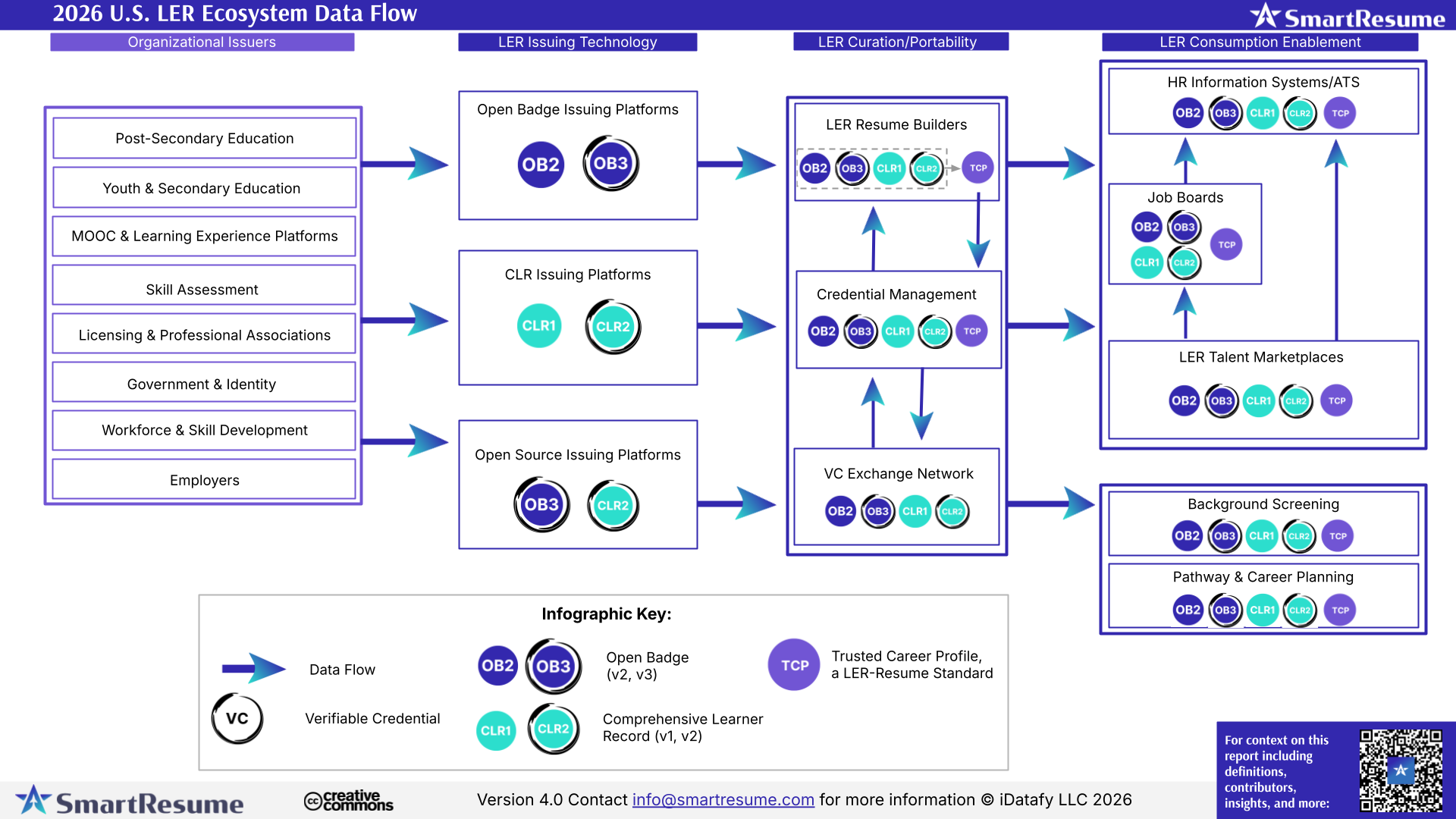
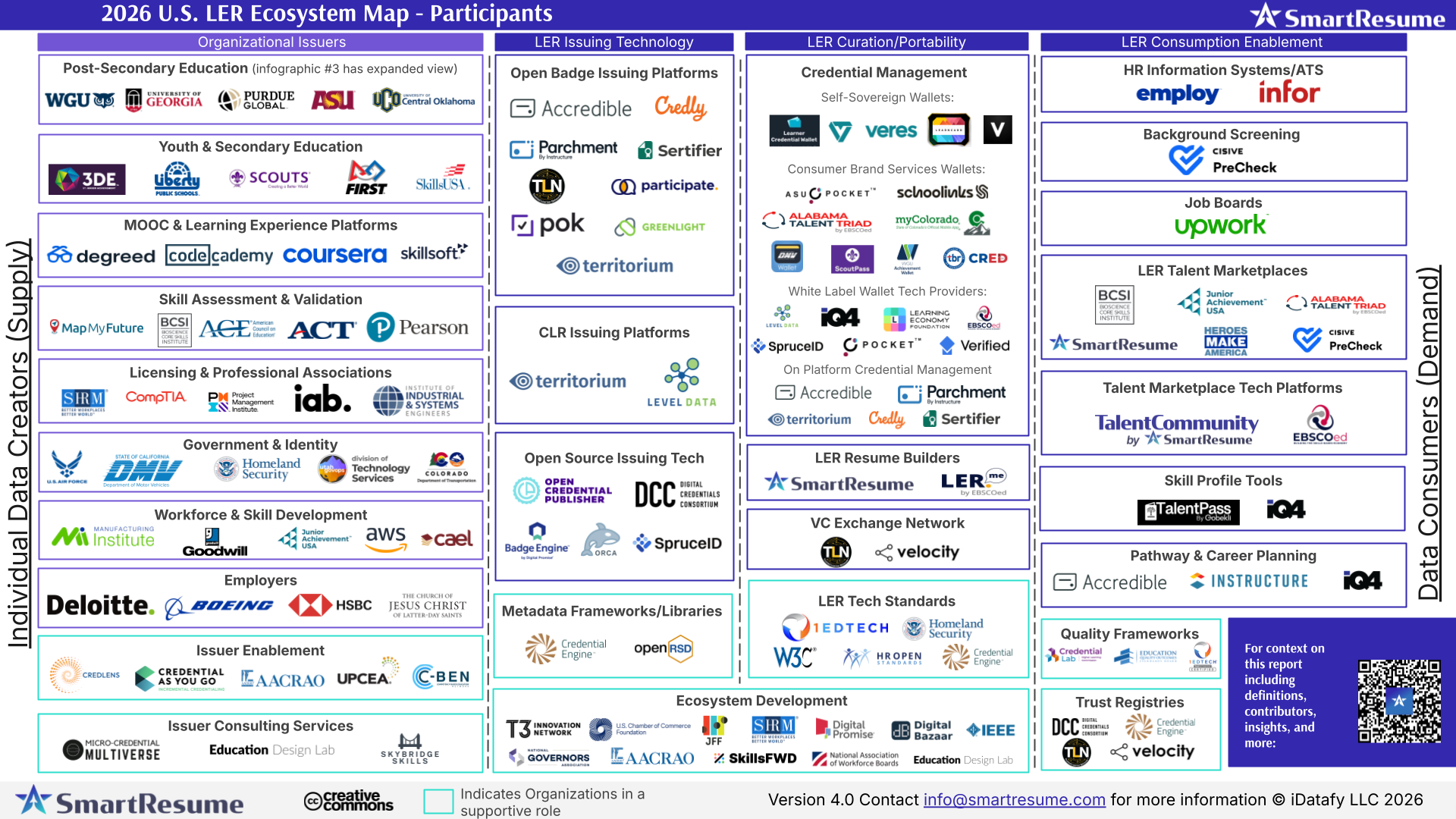
The Learning and Employment Records (LER) Report for 2026: Building the infrastructure between learning and work — from smartresume.com; with thanks to Paul Fain for this resource
Executive Summary (excerpt)
This report documents a clear transition now underway: LERs are moving from small experiments to systems people and organizations expect to rely on. Adoption remains early and uneven, but the forces reshaping the ecosystem are no longer speculative. Federal policy signals, state planning cycles, standards maturation, and employer behavior are aligning in ways that suggest 2026 will mark a shift from exploration to execution.
Across interviews with federal leaders, state CIOs, standards bodies, and ecosystem builders, a consistent theme emerged: the traditional model—where institutions control learning and employment records—no longer fits how people move through education and work. In its place, a new model is being actively designed—one in which individuals hold portable, verifiable records that systems can trust without centralizing control.
Most states are not yet operating this way. But planning timelines, RFP language, and federal signals indicate that many will begin building toward this model in early 2026.
As the ecosystem matures, another insight becomes unavoidable: records alone are not enough. Value emerges only when trusted records can be interpreted through shared skill languages, reused across contexts, and embedded into the systems and marketplaces where decisions are made.
Learning and Employment Records are not a product category. They are a data layer—one that reshapes how learning, work, and opportunity connect over time.
This report is written for anyone seeking to understand how LERs are beginning to move from concept to practice. Whether readers are new to the space or actively exploring implementation, the report focuses on observable signals, emerging patterns, and the practical conditions required to move from experimentation toward durable infrastructure.
…
…
“The building blocks for a global, interoperable skills ecosystem are already in place. As education and workforce alignment accelerates, the path toward trusted, machine-readable credentials is clear. The next phase depends on credentials that carry value across institutions, industries, states, and borders; credentials that move with learners wherever their education and careers take them. The question now isn’t whether to act, but how quickly we move.”
– Curtiss Barnes, Chief Executive Officer, 1EdTech
The above item was from Paul Fain’s recent posting, which includes the following excerpt:
SmartResume just published a guide for making sense of this rapidly expanding landscape. The LER Ecosystem Report was produced in partnership with AACRAO, Credential Engine, 1EdTech, HR Open Standards, and the U.S. Chamber of Commerce Foundation. It was based on interviews and feedback gathered over three years from 100+ leaders across education, workforce, government, standards bodies, and tech providers.
The tools are available now to create the sort of interoperable ecosystem that can make talent marketplaces a reality, the report argues. Meanwhile, federal policy moves and bipartisan attention to LERs are accelerating action at the state level.
“For state leaders, this creates a practical inflection point,” says the report. “LERs are shifting from an innovation discussion to an infrastructure planning conversation.”
The following resources were mentioned in Paul Fain’s posting entitled, “High Demand, Low Wage“ — from the-job.beehiiv.com by Paul Fain
- AI And Automation Will Take 6% Of US Jobs By 2030 — from forrester.com by J.P. Gownder
- Measuring US workers’ capacity to adapt to AI-driven job displacement — from brookings.edu by Sam Manning, Tomás Aguirre, Mark Muro, and Shriya Methkupally
- Anthropic Economic Index report: economic primitives — from anthropic.com
From DSC:
One of my sisters shared this piece with me. She is very concerned about our society’s use of technology — whether it relates to our youth’s use of social media or the relentless pressure to be first in all things AI. As she was a teacher (at the middle school level) for 37 years, I greatly appreciate her viewpoints. She keeps me grounded in some of the negatives of technology. It’s important for us to listen to each other.
The new legal intelligence — from jordanfurlong.substack.com by Jordan Furlong
We’ve built machines that can reason like lawyers. Artificial legal intelligence is becoming scalable, portable and accessible in ways lawyers are not. We need to think hard about the implications.
Much of the legal tech world is still talking about Clio CEO Jack Newton’s keynote at last week’s ClioCon, where he announced two major new features: the “Intelligent Legal Work Platform,” which combines legal research, drafting and workflow into a single legal workspace; and “Clio for Enterprise,” a suite of legal work offerings aimed at BigLaw.
Both these features build on Clio’s out-of-nowhere $1B acquisition of vLex (and its legally grounded LLM Vincent) back in June.
A new source of legal intelligence has entered the legal sector.
…
Legal intelligence, once confined uniquely to lawyers, is now available from machines. That’s going to transform the legal sector.
Where the real action is: enterprise AI’s quiet revolution in legal tech and beyond — from canadianlawyermag.com by Tim Wilbur
Harvey, Clio, and Cohere signal that organizational solutions will lead the next wave of change
The public conversation about artificial intelligence is dominated by the spectacular and the controversial: deepfake videos, AI-induced psychosis, and the privacy risks posed by consumer-facing chatbots like ChatGPT. But while these stories grab headlines, a quieter – and arguably more transformative – revolution is underway in enterprise software. In legal technology, in particular, AI is rapidly reshaping how law firms and legal departments operate and compete. This shift is just one example of how enterprise AI, not just consumer AI, is where real action is happening.
Both Harvey and Clio illustrate a crucial point: the future of legal tech is not about disruption for its own sake, but partnership and integration. Harvey’s collaborations with LexisNexis and others are about creating a cohesive experience for law firms, not rendering them obsolete. As Pereira put it, “We don’t see it so much as disruption. Law firms actually already do this… We see it as ‘how do we help you build infrastructure that supercharges this?’”
…
The rapid evolution in legal tech is just one example of a broader trend: the real action in AI is happening in enterprise software, not just in consumer-facing products. While ChatGPT and Google’s Gemini dominate the headlines, companies like Cohere are quietly transforming how organizations across industries leverage AI.
Also from canadianlawyermag.com, see:
- Harvey’s $5 billion bet: Why the hottest company in legal tech is eyeing Canada
Co-founder Gabe Pereyra says their new Toronto office will have both tech expertise and customer support
The AI company’s plan to open an office in Toronto isn’t just about expanding territory – it’s a strategic push to tap into top technical talent and capture a market known for legal innovation.
Unseeable prompt injections in screenshots: more vulnerabilities in Comet and other AI browsers — from brave.com by Artem Chaikin and Shivan Kaul Sahib
Building on our previous disclosure of the Perplexity Comet vulnerability, we’ve continued our security research across the agentic browser landscape. What we’ve found confirms our initial concerns: indirect prompt injection is not an isolated issue, but a systemic challenge facing the entire category of AI-powered browsers. This post examines additional attack vectors we’ve identified and tested across different implementations.
As we’ve written before, AI-powered browsers that can take actions on your behalf are powerful yet extremely risky. If you’re signed into sensitive accounts like your bank or your email provider in your browser, simplysummarizing a Reddit postcould result in an attacker being able to steal money or your private data.
The above item was mentioned by Grant Harvey out at The Neuron in the following posting:
- AI browser risks and the “AI trust tax” you’re already paying — from theneurondaily.com by Grant Harvey
PLUS: OpenAI’s new music maker + China’s 90% power?cut AI server.
Robin AI’s Big Bet on Legal Tech Meets Market Reality — from lawfuel.com
Robin’s Legal Tech Backfire
Robin AI, the poster child for the “AI meets law” revolution, is learning the hard way that venture capital fairy dust doesn’t guarantee happily-ever-after. The London-based legal tech firm, once proudly waving its genAI-plus-human-experts flag, is now cutting staff after growth dreams collided with the brick wall of economic reality.
The company confirmed that redundancies are under way following a failed major funding push. Earlier promises of explosive revenue have fizzled. Despite around $50 million in venture cash over the past two years, Robin’s 2025 numbers have fallen short of investor expectations. The team that once ballooned to 200 is now shrinking.
The field is now swarming with contenders: CLM platforms stuffing genAI into every feature, corporate legal teams bypassing vendors entirely by prodding ChatGPT directly, and new entrants like Harvey and Legora guzzling capital to bulldoze into the market. Even Workday is muscling in.
Meanwhile, ALSPs and AI-powered pseudo-law firms like Crosby and Eudia are eating market share like it’s free pizza. The number of inhouse teams actually buying these tools at scale is still frustratingly small. And investors don’t have much patience for slow burns anymore.
Why Being ‘Rude’ to AI Could Win Your Next Case or Deal — from thebrainyacts.beehiiv.com by Josh Kubicki
TL;DR: AI no longer rewards politeness—new research shows direct, assertive prompts yield better, more detailed responses. Learn why this shift matters for legal precision, test real-world examples (polite vs. blunt), and set up custom instructions in OpenAI (plus tips for other models) to make your AI a concise analytical tool, not a chatty one. Actionable steps inside to upgrade your workflow immediately.
Entrepreneurship: The New Core Curriculum — from gettingsmart.com by Tom Vander Ark
Key Points
- Entrepreneurship education fosters resilience, creativity, and financial literacy—skills critical for success in an unpredictable, tech-driven world.
- Programs like NFTE, Junior Achievement, and Uncharted Learning empower students by offering real-world entrepreneurial experiences and mentorship.
“Entrepreneurship is the job of the future.”
— Charles Fadel, Education for the Age of AI
This shift requires a radical re-evaluation of what we teach. Education leaders across the country are realizing that the most valuable skill we can impart is not accounting or marketing, but the entrepreneurial mindset. This mindset—built on resilience, creative problem-solving, comfort with ambiguity, and the ability to pivot—is essential in startups, as an intrapreuer in big organizations, or as a citizen working for the common good.
2. Concern and excitement about AI — from pewresearch.org by Jacob Poushter,Moira Faganand Manolo Corichi
Key findings
- A median of 34% of adults across 25 countries are more concerned than excited about the increased use of artificial intelligence in daily life. A median of 42% are equally concerned and excited, and 16% are more excited than concerned.
- Older adults, women, people with less education and those who use the internet less often are particularly likely to be more concerned than excited.
Also relevant here:
- The U.S. Public Wants Regulation (or Prohibition) of Expert-Level and Superhuman AI — from futureoflife.org
Three?quarters of U.S. adults want strong regulations on AI development, preferring oversight akin to pharmaceuticals rather than industry “self?regulation.”
AI Video Wars include Veo 3.1, Sora 2, Ray3, Kling 2.5 + Wan 2.5 — from heatherbcooper.substack.com by Heather Cooper
House of David Season 2 is here!
In today’s edition:
- Veo 3.1 brings richer audio and object-level editing to Google Flow
- Sora 2 is here with Cameo self-insertion and collaborative Remix features
- Ray3 brings world-first reasoning and HDR to video generation
- Kling 2.5 Turbo delivers faster, cheaper, more consistent results
- WAN 2.5 revolutionizes talking head creation with perfect audio sync
- House of David Season 2 Trailer
- HeyGen Agent, Hailuo Agent, Topaz Astra, and Lovable Cloud updates
- Image & Video Prompts
From DSC:
By the way, the House of David (which Heather referred to) is very well done! I enjoyed watching Season 1. Like The Chosen, it brings the Bible to life in excellent, impactful ways! Both series convey the context and cultural tensions at the time. Both series are an answer to prayer for me and many others — as they are professionally-done. Both series match anything that comes out of Hollywood in terms of the acting, script writing, music, the sets, etc. Both are very well done.
.
An item re: Sora:
- Association of Talent Agents, United Talent Agency, Creative Artists Agency also Join to Protect Performers. — from sagaftra.org
Other items re: Open AI’s new Atlas browser:
Introducing ChatGPT Atlas — from openai.com
The browser with ChatGPT built in.
[On 10/21/25] we’re introducing ChatGPT Atlas, a new web browser built with ChatGPT at its core.
AI gives us a rare moment to rethink what it means to use the web. Last year, we added search in ChatGPT so you could instantly find timely information from across the internet—and it quickly became one of our most-used features. But your browser is where all of your work, tools, and context come together. A browser built with ChatGPT takes us closer to a true super-assistant that understands your world and helps you achieve your goals.
With Atlas, ChatGPT can come with you anywhere across the web—helping you in the window right where you are, understanding what you’re trying to do, and completing tasks for you, all without copying and pasting or leaving the page. Your ChatGPT memory is built in, so conversations can draw on past chats and details to help you get new things done.
ChatGPT Atlas: the AI browser test — from getsuperintel.com by Kim “Chubby” Isenberg
Chat GPT Atlas aims to transform web browsing into a conversational, AI-native experience, but early reviews are mixed
OpenAI’s new ChatGPT Atlas promises to merge web browsing, search, and automation into a single interface — an “AI-native browser” meant to make the web conversational. After testing it myself, though, I’m still trying to see the real breakthrough. It feels familiar: summaries, follow-ups, and even the Agent’s task handling all mirror what I already do inside ChatGPT.
OpenAI’s new Atlas browser remembers everything — from theneurondaily.com by Grant Harvey
PLUS: Our AIs are getting brain rot?!
Here’s how it works: Atlas can see what you’re looking at on any webpage and instantly help without you needing to copy/paste or switch tabs. Researching hotels? Ask ChatGPT to compare prices right there. Reading a dense article? Get a summary on the spot. The AI lives in the browser itself.
OpenAI’s new product — from bensbites.com
The latest entry in AI browsers is Atlas – A new browser from OpenAI. Atlas would feel similar to Dia or Comet if you’ve used them. It has an “Ask ChatGPT” sidebar that has the context of your page, and choose “Agent” to work on that tab. Right now, Agent is limited to a single tab, and it is way too slow to delegate anything for real to it. Click accuracy for Agent is alright on normal web pages, but it will definitely trip up if you ask it to use something like Google Sheets.
One ambient feature that I think many people will like is “select to rewrite” – You can select any text in Atlas, hover/click on the blue dot in the top right corner to rewrite it using AI.
Your AI Resume Hacks Probably Won’t Fool Hiring Algorithms — from builtin.com by Jeff Rumage
Recruiters say those viral hidden prompt for resumes don’t work — and might cost you interviews.
Summary: Job seekers are using “prompt hacking” — embedding hidden AI commands in white font on resumes — to try to trick applicant tracking systems. While some report success, recruiters warn the tactic could backfire and eliminate the candidate from consideration.
The Job Market Might Be a Mess, But Don’t Blame AI Just Yet — from builtin.com by Matthew Urwin
A new study by Yale University and the Brookings Institution says the panic around artificial intelligence stealing jobs is overblown. But that might not be the case for long.
Summary: A Yale and Brookings study finds generative AI has had little impact on U.S. jobs so far, with tariffs, immigration policies and the number of college grads potentially playing a larger role. Still, AI could disrupt the workforce in the not-so-distant future.
Law Punx: The Future of the Legal Profession, With Electra Japonas — from artificiallawyer.com by Richard Tromans aand Electra Japonas
Takeaways:
- The legal profession is undergoing significant changes due to AI.
- Lawyers must adapt their skill sets to thrive in the future.
- Drafting will become less important as AI takes over.
- Understanding the ‘why’ behind legal work is crucial.
- Lawyers will need to design systems and guardrails for AI.
- The role of lawyers is shifting from executors to architects.
- Law schools need to teach legal technology and systems design.
- Client demands are changing the way law firms operate.
- Law firms must adapt to new client expectations for efficiency.
- The future of law will require a blend of legal knowledge and tech skills.
“We don’t want an opinion from you. We want a prompt from you.”
Legal Education Must Change Because of AI – Survey — from artificiallawyer.com
.

Guest Column: As AI Helps Close the Justice Gap, Will It Save the Legal Profession or Replace It? — from lawnexts.com by Bob Ambrogi
The numbers are stark: 92% of low-income Americans receive no help with substantial civil legal problems, while small claims filings have plummeted 32% in just four years. But AI is changing the game. By making legal procedures accessible to pro se litigants and supercharging legal aid organizations, these tools are reviving dormant disputes and opening courthouse doors that have been effectively closed to millions.
Guest post: IP professionals are enthusiastic about AI but should adopt with caution, report says — from legaltechnology.com by Benoit Chevalier
Aiming to discover more about AI’s impact on the intellectual property (IP) field, Questel recently released the findings of its 2025 IP Outlook Research Report entitled “Pathways to Productivity: AI in IP”, the much-awaited follow-up to its inaugural 2024 study “Beyond the Hype: How Technology is Transforming IP.” The 2025 Report (“the Report”) polled over 500 patent and trademark professionals from various continents and countries across the globe.
With AI, Junior Lawyers Will Excavate Insights, Not Review Docs — from news.bloomberglaw.com by Eric Dodson Greenberg; some of this article is behind a paywall
As artificial intelligence reshapes the legal profession, both in-house and outside counsel face two major—but not unprecedented—challenges.
The first is how to harness transformative technology while maintaining the rigorous standards that define effective legal practice.
The second is how to ensure that new technology doesn’t impair the training and development of new lawyers.
Rigorous standards and apprenticeship are foundational aspects of lawyering. Preserving and integrating both into our use of AI will be essential to creating a stable and effective AI-enabled legal practice.
The AI Lie That Legal Tech Companies Are Selling…. — from jdsupra.com
Every technology vendor pitching to law firms leads with the same promise: our solution will save you time. They’re lying, and they know it. The truth about AI in legal practice isn’t that it will reduce work. It’s that it will explode the volume of work while fundamentally changing what that work looks like.
New practice areas will emerge overnight. AI compliance law is already booming. Algorithmic discrimination cases are multiplying. Smart contract disputes need lawyers who understand both code and law. The metaverse needs property rights. Cryptocurrency needs regulation. Every technological advance creates legal questions that didn’t exist yesterday.
The skill shift will be brutal for lawyers who resist.
Finalists Named for 2025 American Legal Technology Awards — from lawnext.com by Bob Ambrogi
Finalists have been named for the 2025 American Legal Technology Awards, which honor exceptional achievement in various aspects of legal technology.
The awards recognize achievement in various categories related to legal technology, such as by a law firm, an individual, or an enterprise.
The awards will be presented on Oct. 15 at a gala dinner on the eve of the Clio Cloud Conference in Boston, Mass. The dinner will be held at Suffolk Law School.
Here are this year’s finalists:
OpenAI and NVIDIA announce strategic partnership to deploy 10 gigawatts of NVIDIA systems — from openai.com
- Strategic partnership enables OpenAI to build and deploy at least 10 gigawatts of AI datacenters with NVIDIA systems representing millions of GPUs for OpenAI’s next-generation AI infrastructure.
- To support the partnership, NVIDIA intends to invest up to $100 billion in OpenAI progressively as each gigawatt is deployed.
- The first gigawatt of NVIDIA systems will be deployed in the second half of 2026 on NVIDIA’s Vera Rubin platform.
The Neuron Daily comments on this partnership here and also see their thoughts here:
Why this matters: The partnership kicks off in the second half of 2026 with NVIDIA’s new Vera Rubin platform. OpenAI will use this massive compute power to train models beyond what we’ve seen with GPT-5 and likely also power what’s called inference (when you ask a question to chatGPT, and it gives you an answer). And NVIDIA gets a guaranteed customer for their most advanced chips. Infinite money glitch go brrr am I right? Though to be fair, this kinda deal is as old as the AI industry itself.
This isn’t just about bigger models, mind you: it’s about infrastructure for what both companies see as the future economy. As Sam Altman put it, “Compute infrastructure will be the basis for the economy of the future.”
…
Our take: We think this news is actually super interesting when you pair it with the other big headline from today: Commonwealth Fusion Systems signed a commercial deal worth more than $1B with Italian energy company Eni to purchase fusion power from their 400 MW ARC plant in Virginia. Here’s what that means for AI…
…and while you’re on that posting from The Neuron Daily, also see this piece:
AI filmmaker Dinda Prasetyo just released “Skyland,” a fantasy short film about a guy named Aeryn and his “loyal flying fish”, and honestly, the action sequences look like they belong in an actual film…
SKYLAND | AI Short Film Fantasy
Skyland is an AI-powered fantasy short film that takes you on a breathtaking journey with Aeryn Solveth and his loyal flying fish. From soaring above the futuristic city of Cybryne to returning to his homeland of Eryndor, Aeryn’s adventure is… https://t.co/Lz6UUxQvEx pic.twitter.com/cYXs9nwTX3— Dinda Prasetyo (@heydin_ai) September 20, 2025
What’s wild is that Dinda used a cocktail of AI tools (Adobe Firefly, MidJourney, the newly launched Luma Ray 3, and ElevenLabs) to create something that would’ve required a full production crew just two years ago.
The Era of Prompts Is Over. Here’s What Comes Next. — from builtin.com by Ankush Rastogi
If you’re still prompting your AI, you’re behind the curve. Here’s how to prepare for the coming wave of AI agents.
Summary: Autonomous AI agents are emerging as systems that handle goals, break down tasks and integrate with tools without constant prompting. Early uses include call centers, healthcare, fraud detection and research, but concerns remain over errors, compliance risks and unchecked decisions.
The next shift is already peeking around the corner, and it’s going to make prompts look primitive. Before long, we won’t be typing carefully crafted requests at all. We’ll be leaning on autonomous AI agents, systems that don’t just spit out answers but actually chase goals, make choices and do the boring middle steps without us guiding them. And honestly, this jump might end up dwarfing the so-called “prompt revolution.”
Chrome: The browser you love, reimagined with AI — from blog.google by Parisa Tabriz
A new way to get things done with your AI browsing assistant
Imagine you’re a student researching a topic for a paper, and you have dozens of tabs open. Instead of spending hours jumping between sources and trying to connect the dots, your new AI browsing assistant — Gemini in Chrome 1 — can do it for you. Gemini can answer questions about articles, find references within YouTube videos, and will soon be able to help you find pages you’ve visited so you can pick up exactly where you left off.
Rolling out to Mac and Windows users in the U.S. with their language set to English, Gemini in Chrome can understand the context of what you’re doing across multiple tabs, answer questions and integrate with other popular Google services, like Google Docs and Calendar. And it’ll be available on both Android and iOS soon, letting you ask questions and summarize pages while you’re on the go.
We’re also developing more advanced agentic capabilities for Gemini in Chrome that can perform multi-step tasks for you from start to finish, like ordering groceries. You’ll remain in control as Chrome handles the tedious work, turning 30-minute chores into 3-click user journeys.