


Claude is quietly becoming the go-to AI tool for learning designers. Here’s a 101 guide. — from Linkedin.com by Dr. Philippa Hardman
On 02/05/2026,
in adult learning, business, career development, change, corporate / business world, corporate universities / corporate training, training / L&D, trends, United States, vendors, workplace,
by Daniel Christian
Amid AI and Labor Market Changes, Companies Look to Grow Their Own Skilled Workers — from workshift.org by Colleen Connolly
The explosion of artificial intelligence, combined with slowing growth in the labor force, has many companies reconsidering how they hire and develop workers. Where they once relied on colleges and universities for training, a growing number of companies are now looking in-house.
Investment in developing employees and would-be hires is becoming a key differentiator for companies, according to a new report from the Learning Society, a collaborative effort led out of the Stanford Center on Longevity. And that’s true even as AI adoption grows.
The Big Idea: The report authors interviewed 15 human resources executives from major firms, which ranged in size from Hubbell, an electric and utility product manufacturer with about 17K employees, to Walmart with more than 2M employees. The authors asked about four topics: the impact of AI and technology on work, skill building and talent development, supporting workers over longer working lives, and new partnerships between businesses and higher education.
On 01/29/2026,
in 21st century, 24x7x365 access, Artificial Intelligence/Agents/LLMs/and Related, business, career development, corporate / business world, corporate universities / corporate training, skills, society, staying relevant, surviving, tools, training / L&D, United States, vendors, vision/possibilities,
by Daniel Christian
FutureFit AI — helping build reskilling, demand-driven, employment, sector-based, and future-fit pathways, powered by AI
.
The above item was from Paul Fain’s recent posting, which includes the following excerpt:
The platform is powered by FutureFit AI, which is contributing the skills-matching infrastructure and navigation layer. Jobseekers get personalized recommendations for best-fit job roles as well as education and training options—including internships—that can help them break into specific careers. The project also includes a focus on providing support students need to complete their training, including scholarships and help with childcare and transportation.
On 01/29/2026,
in 21st century, adult learning, Alternatives, apprenticeships, Artificial Intelligence/Agents/LLMs/and Related, business, career development, colleges, communities of practice, community colleges, consortiums, content development, aggregation, repositories, corporate / business world, corporate universities / corporate training, credentialing, Daniel S. Christian, education, future, game-changing environment, higher education, homeschooling/homeschoolers, ideas, innovation, intelligent systems, IT in HE, K-12 related, learner profiles, learning, learning agents, learning ecosystem, legislatures / government / legal, liberal arts, lifelong learning, marketplaces, platforms, professional development, skills, society, student-related, tools, training / L&D, United States, universities, vendors, vision/possibilities, workplace,
by Daniel Christian
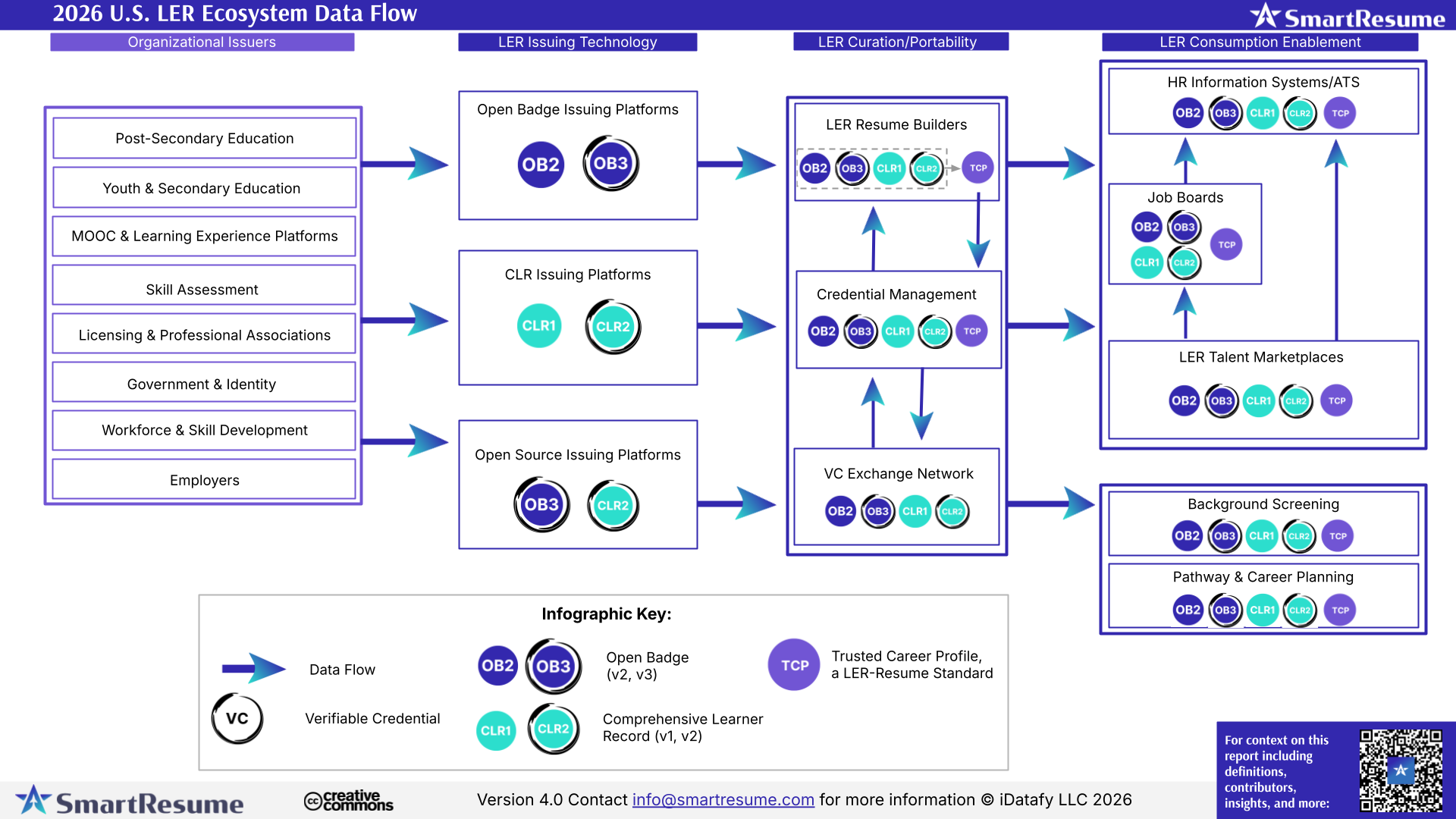
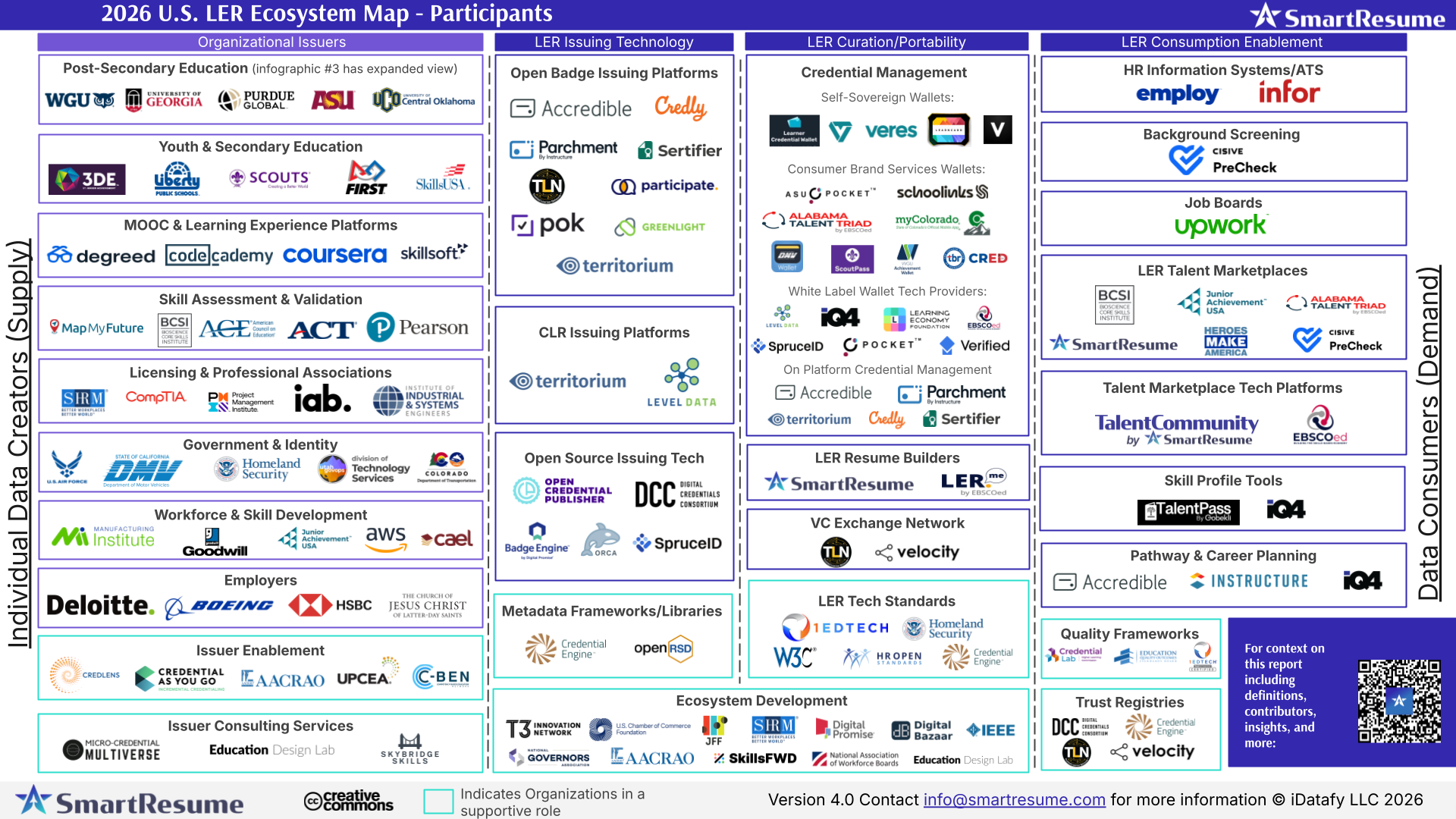
The Learning and Employment Records (LER) Report for 2026: Building the infrastructure between learning and work — from smartresume.com; with thanks to Paul Fain for this resource
Executive Summary (excerpt)
This report documents a clear transition now underway: LERs are moving from small experiments to systems people and organizations expect to rely on. Adoption remains early and uneven, but the forces reshaping the ecosystem are no longer speculative. Federal policy signals, state planning cycles, standards maturation, and employer behavior are aligning in ways that suggest 2026 will mark a shift from exploration to execution.
Across interviews with federal leaders, state CIOs, standards bodies, and ecosystem builders, a consistent theme emerged: the traditional model—where institutions control learning and employment records—no longer fits how people move through education and work. In its place, a new model is being actively designed—one in which individuals hold portable, verifiable records that systems can trust without centralizing control.
Most states are not yet operating this way. But planning timelines, RFP language, and federal signals indicate that many will begin building toward this model in early 2026.
As the ecosystem matures, another insight becomes unavoidable: records alone are not enough. Value emerges only when trusted records can be interpreted through shared skill languages, reused across contexts, and embedded into the systems and marketplaces where decisions are made.
Learning and Employment Records are not a product category. They are a data layer—one that reshapes how learning, work, and opportunity connect over time.
This report is written for anyone seeking to understand how LERs are beginning to move from concept to practice. Whether readers are new to the space or actively exploring implementation, the report focuses on observable signals, emerging patterns, and the practical conditions required to move from experimentation toward durable infrastructure.
…
…
“The building blocks for a global, interoperable skills ecosystem are already in place. As education and workforce alignment accelerates, the path toward trusted, machine-readable credentials is clear. The next phase depends on credentials that carry value across institutions, industries, states, and borders; credentials that move with learners wherever their education and careers take them. The question now isn’t whether to act, but how quickly we move.”
– Curtiss Barnes, Chief Executive Officer, 1EdTech
The above item was from Paul Fain’s recent posting, which includes the following excerpt:
SmartResume just published a guide for making sense of this rapidly expanding landscape. The LER Ecosystem Report was produced in partnership with AACRAO, Credential Engine, 1EdTech, HR Open Standards, and the U.S. Chamber of Commerce Foundation. It was based on interviews and feedback gathered over three years from 100+ leaders across education, workforce, government, standards bodies, and tech providers.
The tools are available now to create the sort of interoperable ecosystem that can make talent marketplaces a reality, the report argues. Meanwhile, federal policy moves and bipartisan attention to LERs are accelerating action at the state level.
“For state leaders, this creates a practical inflection point,” says the report. “LERs are shifting from an innovation discussion to an infrastructure planning conversation.”
On 01/22/2026,
in career development, corporate universities / corporate training, ideas, instructional design, learning ecosystem, strategy, training / L&D, trends, United States, vendors, workplace,
by Daniel Christian
Planning Your L&D Hiring for Next Year? Start With Skills, Salary Ranges, and Realistic Expectations — from teamedforlearning.com
Salary transparency laws across many states now require organizations to publish compensation ranges. While this can feel like a burden, the truth is: transparency can dramatically speed up hiring. Candidates self-select, mismatches decrease, and teams save time.
But transparency only works when the salary range itself is grounded in reality. And that’s where many organizations struggle.
Posting a salary range is the easy part.
Determining a fair, defensible range is where the work happens.
Also from Teamed for Learning, see:
Hiring Trends For 2026
The learning industry shifts fast, and this year is no exception. Here’s what’s shaping the hiring landscape right now:
- AI is now a core skill, not a bonus
- Project management is showing up in every job description
- Generalists with business awareness are beating tool-heavy candidates
- Universities and edtech companies are speeding up content refresh cycles
- Hiring budgets are tight – but expectations aren’t easing up
On 01/12/2026,
in business, content development, aggregation, repositories, corporate / business world, corporate universities / corporate training, creativity, digital video, education technology, emerging technologies, experimentation, Google, human-computer interaction (HCI), instructional design, learning, learning ecosystem, Learning Experience Design, learning theories, multimedia, platforms, tools, training / L&D, vendors,
by Daniel Christian
Which AI Video Tool Is Most Powerful for L&D Teams? — from by Dr. Philippa Hardman
Evaluating four popular AI video generation platforms through a learning-science lens
Happy new year! One of the biggest L&D stories of 2025 was the rise to fame among L&D teams of AI video generator tools. As we head into 2026, platforms like Colossyan, Synthesia, HeyGen, and NotebookLM’s video creation feature are firmly embedded in most L&D tech stacks. These tools promise rapid production and multi-language output at significantly reduced costs —and they deliver on a lot of that.
But something has been playing on my mind: we rarely evaluate these tools on what matters most for learning design—whether they enable us to build instructional content that actually enables learning.
So, I spent some time over the holiday digging into this question: do the AI video tools we use most in L&D create content that supports substantive learning?
To answer it, I took two decades of learning science research and translated it into a scoring rubric. Then I scored the four most popular AI video generation platforms among L&D professionals against the rubric.
.
For an AI-based tool or two — as they regard higher ed — see:
5 new tools worth trying — from wondertools.substack.com by Jeremy Kaplan
YouTube to NotebookLM: Import a Whole Playlist or Channel in One Click
YouTube to NotebookLM is a remarkably useful new Chrome extension that lets you bulk-add any YouTube playlists, channels, or search results into NotebookLM. for AI-powered analysis.
…
What to try
- Find or create YouTube playlists on topics of interest. Then use this extension to ingest those playlists into NotebookLM. The videos are automatically indexed, and within minutes you can create reports, slides, and infographics to enhance your learning.
- Summarize a playlist or channel with an audio or video overview. Or create quizzes, flash cards, data tables, or mind maps to explore a batch of YouTube videos. Or have a chat in NotebookLM with your favorite video channel. Check my recent post for some YouTube channels to try.
On 01/12/2026,
in corporate / business world, corporate universities / corporate training, ideas, India, instructional design, learning, learning ecosystem, Learning Experience Design, skills, training / L&D, usability, vendors,
by Daniel Christian
Corporate Training Solutions That Actually Improve Performance — from blog.upsidelearning.com by Unnati Umare
Designing Learning Around Performance in the Flow of Work
Once it becomes clear that completion does not reliably translate into changed behavior, the next question tends to surface on its own. If training is not failing outright, then what it should be designed around becomes harder to ignore.
In most organizations, the answer remains content. Content is easier to define, easier to build, and easier to track, even when it explains very little about how work actually gets done.
Performance-aligned learning design shifts that starting point by paying closer attention to how work unfolds in practice. Instead of organizing learning around topics or courses, design decisions begin with what a role requires people to notice, decide, and act on during real situations.