Children develop at different speeds, and that’s completely normal. However, some learning struggles feel more persistent and harder to explain. Many parents start to worry when reading or spelling does not improve over time, even with regular practise.
Dyslexia in children is more common than many people realise, yet it is often misunderstood. The early signs of dyslexia in kids can be subtle, especially in younger children and they don’t always appear all at once. Because of this, they are easy to miss at first.
This guide breaks down the signs by age, from early years to primary school and beyond. It also explains what to look out for and what practical steps you can take next, so you feel informed, supported and confident about how to help your child.
Anxiety weighs down the heart, but a kind word cheers it up.
Psalm 18:1-2 For the director of music. Of David the servant of the Lord. He sang to the Lord the words of this song when the Lord delivered him from the hand of all his enemies and from the hand of Saul. He said:
1 I love you, Lord, my strength.
2 The Lord is my rock, my fortress and my deliverer;
my God is my rock, in whom I take refuge,
my shield[b] and the horn[c] of my salvation, my stronghold.
4 For the word of the Lord is right and true;
he is faithful in all he does.
5 The Lord loves righteousness and justice;
the earth is full of his unfailing love.
Jim VandeHei’s note to his kids: Blunt AI talk — from axios.com by CEO Jim VandeHei Axios CEO Jim VandeHei wrote this note to his wife, Autumn, and their three kids. She suggested sharing it more broadly since so many families are wrestling with how to think and talk about AI. So here it is …
Dear Family: I want to put to words what I’m hearing, seeing, thinking and writing about AI.
Simply put, I’m now certain it will upend your work and life in ways more profound than the internet or possibly electricity. This will hit in months, not years.
The changes will be fast, wide, radical, disorienting and scary. No one will avoid its reach.
I’m not trying to frighten you. And I know your opinions range from wonderment to worry. That’s natural and OK. Our species isn’t wired for change of this speed or scale.
My conversations with the CEOs and builders of these LLMs, as well as my own deep experimentation with AI, have shaken and stirred me in ways I never imagined.
All of you must figure out how to master AI for any specific job or internship you hold or take. You’d be jeopardizing your future careers by not figuring out how to use AI to amplify and improve your work. You’d be wise to replace social media scrolling with LLM testing.
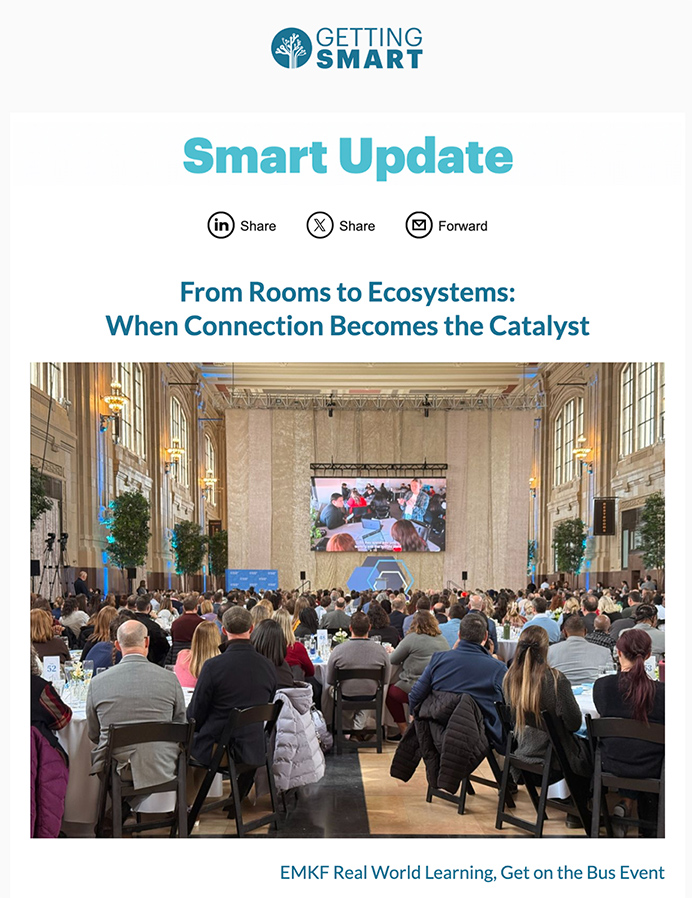
Some gatherings change not just in size, but in meaning. What started as a small, intentional space to celebrate partners has grown into a moment that reflects how an entire ecosystem has matured. Each year, the room fills with more leaders, more relationships, and more shared language about what learning can look like when people are genuinely connected. It is less about an event on the calendar and more about what it represents: an education community that knows each other, trusts each other, and keeps showing up.
That kind of connection did not happen by accident. Through efforts like Get on the Bus, hosted by the Ewing Marion Kauffman Foundation, networking for education leaders has shifted from transactional to relational. Students lead. Stories anchor the work. Conversations happen across tables, sectors, and roles. System leaders, intermediaries, industry partners, and civic organizations are not passing business cards. They are building shared understanding and social capital that lasts long after the room clears.
This week’s newsletter carries that same energy. You will find examples of learning that travels beyond buildings, leadership conversations grounded in real tensions, and models that reflect what becomes possible when ecosystems are aligned. When people feel connected to one another and to a common purpose, the work gets clearer, stronger, and more human. That sense of belonging is not just powerful. It is foundational to what comes next.
As we enter 2026, the Getting Smart team is diving deep into the convergence of human potential and technological opportunity. Our annual Town Hall isn’t just a forecast—it’s a roadmap for the year ahead. We will explore how human-centered AI is reshaping pedagogy, the power of participation, and the new realities of educational leadership. Join us as we define the new dispositions for future-ready educators and discover how to build meaningful, personalized pathways for every student.
What if the biggest change in education isn’t a new app… but the end of the university monopoly on credibility?
Jensen Huang has framed AI as a platform shift—an industrial revolution that turns intelligence into infrastructure. And when intelligence becomes cheap, personal, and always available, education stops being a place you go… and becomes a system that follows you. The question isn’t whether universities will disappear. The question is whether the old model—high cost, slow updates, one-size-fits-all—can survive a world where every student can have a private tutor, a lab partner, and a curriculum designer on demand.
This video explores what AI has in store for education—and why traditional universities may need to reinvent themselves fast.
In this video you’ll discover:
How AI tutors could deliver personalized learning at scale
Why credentials may shift from “degrees” to proof-of-skill portfolios
What happens when the “middle” of studying becomes automated
How universities could evolve: research hubs, networks, and high-trust credentialing
The risks: cheating, dependency, bias, and widening inequality
The 3 skills that become priceless when information is everywhere: judgment, curiosity, and responsibility
From DSC:
There appears to be another, similar video, but with a different date and length of the video. So I’m including this other recording as well here:
What if universities don’t “disappear”… but lose their monopoly on learning, credentials, and opportunity?
AI is turning education into something radically different: personal, instant, adaptive, and always available. When every student can have a 24/7 tutor, a writing coach, a coding partner, and a study plan designed specifically for them, the old model—one professor, one curriculum, one pace for everyone—starts to look outdated. And the biggest disruption isn’t the classroom. It’s the credential. Because in an AI world, proof of skill can become more valuable than a piece of paper.
This video explores the end of universities as we know them: what AI is bringing, what will break, what will survive, and what replaces the traditional path.
In this video you’ll discover:
Why AI tutoring could outperform one-size-fits-all lectures
How “degrees” may shift into skill proof: portfolios, projects, and verified competency
What happens when the “middle” of studying becomes automated
How universities may evolve: research hubs, networks, high-trust credentialing
The dark side: cheating, dependency, inequality, and biased evaluation
The new advantage: judgment, creativity, and responsibility in a world of instant answers
There were 15% fewer entry-level and internship job postings in 2025 than the year before, according to Handshake, a job-search platform popular with college students; meanwhile, applications per posting rose 26%.
How much AI is to blame for the fragile entry-level job market is unclear. Several research studies show AI is hitting young college-educated workers disproportionately, but broader economic forces are part of the story, too.
As Christine Y. Cruzvergara, Handshake’s chief education strategy officer, told me, AI isn’t “taking” jobs so much as employers are “choosing” to replace parts of jobs with automation rather than redesign roles around workers. “They’re replacing people instead of enabling their workforce,” she said.
Today’s graduates are stuck in an in-between moment. Many started college before AI mattered and graduated into a labor market reshaped almost overnight, where entry-level roles are disappearing faster than students can adapt.
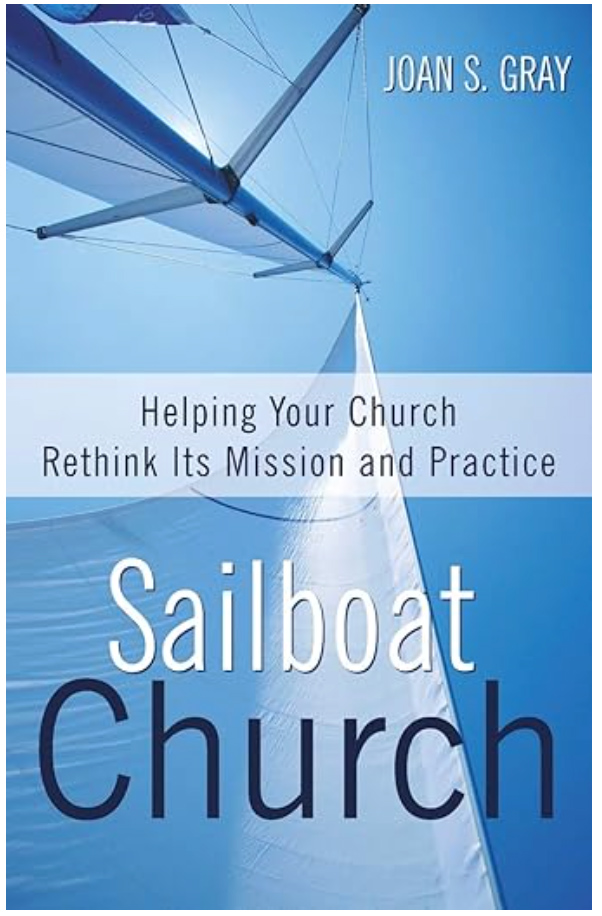
Gray does an incredible job packing a lot of material into a very concise book. In it, she describes the difference between a rowboat church (which relies on human efforts) and a sailboat church (which relies upon the LORD to guide it, resource it, and empower it). She asserts that the main purpose of a sailboat is to leave the dock and set out on the waters of life to achieve what the LORD guides us to by His Holy Spirit. And prayer is a key element of this book and this process.
It’s that time again ~ the annual round-up of tech tools we think are worth a look this year. This year I really feel like there’s something for everyone: history teachers, math and science teachers, people who run makerspaces, teachers interested in music or podcasting, writing teachers, special ed teachers, and anyone whose course content could be made clearer through graphic organizers.
Also somewhat relevant here, see:
Edtech Show & Tell January 2026 — from techlearning.com by Diana Restifo and Ray Bendici New edtech products that have caught our attention this month
Best Sites & Apps for K-12 Education Games — from techlearning.com by Diana Restifo Game-based learning is a great way to integrate technology into the classroom while engaging kids with real learning.
Two-thirds of employers say most new hires are not fully prepared for their roles, citing “experience,” not technical skill, as the greatest shortfall. At the same time, 61% of companies have raised their experience requirements.
As a result, many so-called entry-level roles now demand two to five years of prior work experience. The first rung of the career ladder has been pulled even farther out of reach for new job seekers. A portfolio—or full-spectrum—model of work-based learning is one promising way to rebuild that rung.
Experience has become what Deloitte calls “the new currency of employability.” But the places where young people once earned that currency are disappearing.
How Your Learners *Actually* Learn with AI— from drphilippahardman.substack.com by Dr. Philippa Hardman What 37.5 million AI chats show us about how learners use AI at the end of 2025 — and what this means for how we design & deliver learning experiences in 2026
Last week, Microsoft released a similar analysis of a whopping 37.5 millionCopilot conversations. These conversation took place on the platform from January to September 2025, providing us with a window into if and how AI use in general — and AI use among learners specifically – has evolved in 2025.
Microsoft’s mass behavioural data gives us a detailed, global glimpse into what learners are actually doing across devices, times of day and contexts. The picture that emerges is pretty clear and largely consistent with what OpenAI’s told us back in the summer:
AI isn’t functioning primarily as an “answers machine”: the majority of us use AI as a tool to personalise and differentiate generic learning experiences and – ultimately – to augment human learning.
Let’s dive in!
Learners don’t “decide” to use AI anymore. They assume it’s there, like search, like spellcheck, like calculators. The question has shifted from “should I use this?” to “how do I use this effectively?”
So where do you start? There are many agentic tools and platforms for AI tasks on the market, and the most effective approach is to focus on practical, high-impact workflows. So here, I’ll look at some of the most compelling use cases, as well as provide an overview of the tools that can help you quickly deliver tangible wins.
…
Some of the strongest opportunities in HR include:
Workforce management, administering job satisfaction surveys, monitoring and tracking performance targets, scheduling interventions, and managing staff benefits, medical leave, and holiday entitlement.
Recruitment screening, automatically generating and posting job descriptions, filtering candidates, ranking applicants against defined criteria, identifying the strongest matches, and scheduling interviews.
Employee onboarding, issuing new hires with contracts and paperwork, guiding them to onboarding and training resources, tracking compliance and completion rates, answering routine enquiries, and escalating complex cases to human HR specialists.
Training and development, identifying skills gaps, providing self-service access to upskilling and reskilling opportunities, creating personalized learning pathways aligned with roles and career goals, and tracking progress toward completion.
Here’s what’s shaped the AI-education landscape in the last month:
The AI Speed Trap is [still] here: AI adoption in L&D is basically won (87%)—but it’s being used to ship faster, not learn better (84% prioritising speed), scaling “more of the same” at pace.
AI tutors risk a “pedagogy of passivity”: emerging evidence suggests tutoring bots can reduce cognitive friction and pull learners down the ICAP spectrum—away from interactive/constructive learning toward efficient consumption.
Singapore + India are building what the West lacks: they’re treating AI as national learning infrastructure—for resilience (Singapore) and access + language inclusion (India)—while Western systems remain fragmented and reactive.
Agentic AI is the next pivot: early signs show a shift from AI as a content engine to AI as a learning partner—with UConn using agents to remove barriers so learners can participate more fully in shared learning.
Moodle’s AI stance sends two big signals: the traditional learning ecosystem in fragmenting, and the concept of “user sovereignty” over by AI is emerging.
For Cogniti to be taken seriously, it needs to be woven into the structure of your unit and its delivery, both in class and on Canvas, rather than left on the side. This article shares practical strategies for implementing Cogniti in your teaching so that students:
understand the context and purpose of the agent,
know how to interact with it effectively,
perceive its value as a learning tool over any other available AI chatbots, and
engage in reflection and feedback.
In this post, we discuss how to introduce and integrate Cogniti agents into the learning environment so students understand their context, interact effectively, and see their value as customised learning companions.
In this post, we share four strategies to help introduce and integrate Cogniti in your teaching so that students understand their context, interact effectively, and see their value as customised learning companions.
Collection: Teaching with Custom AI Chatbots — from teaching.virginia.edu; via Derek Bruff The default behaviors of popular AI chatbots don’t always align with our teaching goals. This collection explores approaches to designing AI chatbots for particular pedagogical purposes.