Celebrating International Day of Persons with Disabilities — from joshbersin.com by Josh Bersin

Today I want to celebrate the International Day of Persons with Disabilities, an important day that recognizes the needs of millions of people. My perspective, as a professional entering my later years, is that many of us are likely to have disabilities over time, so the more we understand the diversity of disabilities the better for everyone.

First, let me point out that this is a massive population. The US Department of Labor and Census estimates that 11-13% of the working age population has some form of disability (more on what that means below), yet only 5-6% of workers. This points out that the employment ratio (percent of people with jobs) is far lower. People with disabilities are one-third as likely to have a job, which is quite a disparity and loss of economic potential.

Second, people with disabilities suffer a 15% lower average wage.


Josh linked to the item below:


Celebrating International Day of persons with disabilities
International Day of Persons with Disabilities (IDPD) is a UN day that is celebrated every year on 3 December.

The day is about promoting the rights and well-being of persons with disabilities at every level of society and development, and to raise awareness of the situation of persons with disabilities in all aspects of political, social, economic, and cultural life. WHO joins the UN in observing this day each year, reinforcing the importance of securing the rights of people with disabilities, so they can participate fully, equally and effectively in society with others, and face no barriers in all aspects of their lives.

At its headquarters in Geneva, WHO organizes an annual IDPD event to educate the public, raise awareness, advocate for political will and resources, and celebrate WHO’s achievements. In 2022, the WHO launched the Global Report on health equity for persons with disabilities. This report sets forth the approaches and actions that countries can take to address the health inequities that persons with disabilities experience.


From DSC:
I just want to add that one of our daughters has some special needs. So Josh’s posting caught my eye. He’s right to point out these things. You and I will likely have a period of disability in our lives. It’s not just relevant for “other people.” (And by the way…in the learning world, practicing Universal Design for Learning (UDL) is good for everyone!)

People with disabilities face enormous challenges that neurotypical people never have to deal with. They face unfair wage situations and a lack of opportunities. Our family has experienced — and continues to experience — this firsthand.

So thanks Josh for your posting here.


AI’s Role in Online Learning > Take It or Leave It with Michelle Beavers, Leo Lo, and Sara McClellan — from intentionalteaching.buzzsprout.com by Derek Bruff

You’ll hear me briefly describe five recent op-eds on teaching and learning in higher ed. For each op-ed, I’ll ask each of our panelists if they “take it,” that is, generally agree with the main thesis of the essay, or “leave it.” This is an artificial binary that I’ve found to generate rich discussion of the issues at hand.


Could Your Next Side Hustle Be Training AI? — from builtin.com by Jeff Rumage
As automation continues to reshape the labor market, some white-collar professionals are cashing in by teaching AI models to do their jobs.

Summary: Artificial intelligence may be replacing jobs, but it’s also creating some new ones. Professionals in fields like medicine, law and engineering can earn big money training AI models, teaching them human skills and expertise that may one day make those same jobs obsolete.


DEEP DIVE: The AI user interface of the future = Voice — from theneurondaily.com by Grant Harvey
PLUS: Gemini 3.0 and Microsoft’s new voice features

Here’s the thing: voice is finally good enough to replace typing now. And I mean actually good enough, not “Siri, play Despacito” good enough.

To Paraphrase Andrej Karpathy’s famous quote, “the hottest new programming language is English”, in this case, the hottest new user interface is talking.

The Great Convergence: Why Voice Is Having Its Moment
Three massive shifts just collided to make voice interfaces inevitable.

    1. First, speech recognition stopped being terrible. …
    2. Second, our devices got ears everywhere. …
    3. Third, and most importantly: LLMs made voice assistants smart enough to be worth talking to. …

Introducing group chats in ChatGPT — from openai.com
Collaborate with others, and ChatGPT, in the same conversation.

Update on November 20, 2025: Early feedback from the pilot has been positive, so we’re expanding group chats to all logged-in users on ChatGPT Free, Go, Plus and Pro plans globally over the coming days. We will continue refining the experience as more people start using it.

Today, we’re beginning to pilot a new experience in a few regions that makes it easy for people to collaborate with each other—and with ChatGPT—in the same conversation. With group chats, you can bring friends, family, or coworkers into a shared space to plan, make decisions, or work through ideas together.

Whether you’re organizing a group dinner or drafting an outline with coworkers, ChatGPT can help. Group chats are separate from your private conversations, and your personal ChatGPT memory is never shared with anyone in the chat.


I analyzed 180M jobs to see what jobs AI is actually replacing today — from bloomberry.com by Henley Wing Chiu; via Kim Isenberg

I analyzed nearly 180 million global job postings from January 2023 to October 2025, using data from Revealera, a provider of jobs data. While I acknowledge not all job postings result in a hire, and some are ‘ghost jobs’, since I was comparing the relative growth in job titles, this didn’t seem like a big issue to me.

I simply wanted to know which specific job titles declined or grew the most in 2025, compared to 2024. Because those were likely to be ones that AI is impacting the most.

Key Sections


Also from Kim Isenberg, see:


Gen AI Is Going Mainstream: Here’s What’s Coming Next — from joshbersin.com by Josh Bersin

I just completed nearly 60,000 miles of travel across Europe, Asia, and the Middle East meeting with hundred of companies to discuss their AI strategies. While every company’s maturity is different, one thing is clear: AI as a business tool has arrived: it’s real and the use-cases are growing.

A new survey by Wharton shows that 46% of business leaders use Gen AI daily and 80% use it weekly. And among these users, 72% are measuring ROI and 74% report a positive return. HR, by the way, is the #3 department in use cases, only slightly behind IT and Finance.

What are companies getting out of all this? Productivity. The #1 use case, by far, is what we call “stage 1” usage – individual productivity. 

.


From DSC:
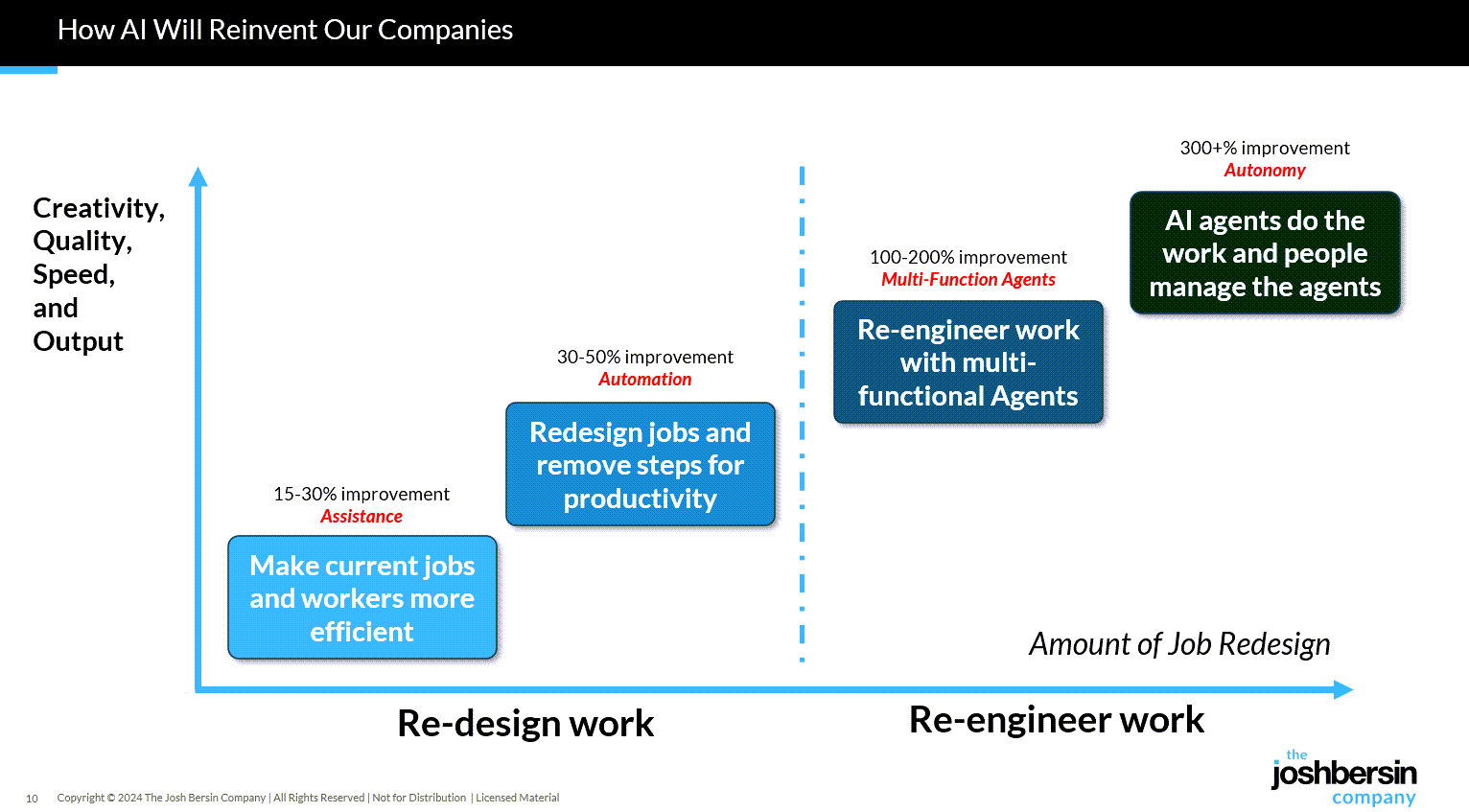
Josh writes: “Many of our large clients are now implementing AI-native learning systems and seeing 30-40% reduction in staff with vast improvements in workforce enablement.

While I get the appeal (and ROI) from management’s and shareholders’ perspective, this represents a growing concern for employment and people’s ability to earn a living. 

And while I highly respect Josh and his work through the years, I disagree that we’re over the problems with AI and how people are using it: 

Two years ago the NYT was trying to frighten us with stories of AI acting as a romance partner. Well those stories are over, and thanks to a $Trillion (literally) of capital investment in infrastructure, engineering, and power plants, this stuff is reasonably safe.

Those stories are just beginning…they’re not close to being over. 


“… imagine a world where there’s no separation between learning and assessment…” — from aiedusimplified.substack.com by Lance Eaton, Ph.D. and Tawnya Means
An interview with Tawnya Means

So let’s imagine a world where there’s no separation between learning and assessment: it’s ongoing. There’s always assessment, always learning, and they’re tied together. Then we can ask: what is the role of the human in that world? What is it that AI can’t do?

Imagine something like that in higher ed. There could be tutoring or skill-based work happening outside of class, and then relationship-based work happening inside of class, whether online, in person, or some hybrid mix.

The aspects of learning that don’t require relational context could be handled by AI, while the human parts remain intact. For example, I teach strategy and strategic management. I teach people how to talk with one another about the operation and function of a business. I can help students learn to be open to new ideas, recognize when someone pushes back out of fear of losing power, or draw from my own experience in leading a business and making future-oriented decisions.

But the technical parts such as the frameworks like SWOT analysis, the mechanics of comparing alternative viewpoints in a boardroom—those could be managed through simulations or reports that receive immediate feedback from AI. The relational aspects, the human mentoring, would still happen with me as their instructor.

Part 2 of their interview is here:


How Coworking Spaces Are Becoming The Learning Ecosystems Of The Future — from hrfuture.net

What if your workspace helped you level up your career? Coworking spaces are becoming learning hubs where skills grow, ideas connect, and real-world education fits seamlessly into the workday.

Continuous learning has become a cornerstone of professional longevity, and flexible workspaces already encourage it through workshops, talks, and mentoring. Their true potential, however, may lie in becoming centers of industry-focused education that help professionals stay adaptable in a rapidly changing world of work.
.


.

What if forward-thinking workspaces and coworking centers became hubs of lifelong learning, integrating job-relevant training with accessible, real-world education?

For coworking operators, this raises important questions: Which types of learning thrive best in these environments, and how much do the design and layout of a space influence how people learn?

By exploring these questions and combining innovative programs with cutting-edge technology aligned to the future workforce, could coworking spaces ultimately become the classrooms of tomorrow?


Breaking News: Law Firm’s AI Pilot Lets New Lawyers Step Away from Billable Hours — from jdjournal.com

In a groundbreaking move that may redefine how law firms integrate technology training into daily practice, Ropes & Gray LLP has introduced a new pilot program allowing its first-year associates to dedicate a significant portion of their work hours to artificial intelligence (AI) learning—without the pressure of billing those hours to clients.

The initiative, called “TrAIlblazers,” marks one of the first formal attempts by a major law firm to give attorneys credit toward their billable-hour requirements for time spent exploring and developing AI skills. The firm hopes the move will both prepare young lawyers for a rapidly evolving profession and signal a new era of flexibility in how law firms evaluate performance.


A New AI Career Ladder — from ssir.org (Stanford Social Innovation Review) by Bruno V. Manno; via Matt Tower
The changing nature of jobs means workers need new education and training infrastructure to match.

AI has cannibalized the routine, low-risk work tasks that used to teach newcomers how to operate in complex organizations. Without those task rungs, the climb up the opportunity ladder into better employment options becomes steeper—and for many, impossible. This is not a temporary glitch. AI is reorganizing work, reshaping what knowledge and skills matter, and redefining how people are expected to acquire them.

The consequences ripple from individual career starts to the broader American promise of economic and social mobility, which includes both financial wealth and social wealth that comes from the networks and relationships we build. Yet the same technology that complicates the first job can help us reinvent how experience is earned, validated, and scaled. If we use AI to widen—not narrow—access to education, training, and proof of knowledge and skill, we can build a stronger career ladder to the middle class and beyond. A key part of doing this is a redesign of education, training, and hiring infrastructure.

What’s needed is a redesigned model that treats work as a primary venue for learning, validates capability with evidence, and helps people keep climbing after their first job. Here are ten design principles for a reinvented education and training infrastructure for the AI era.

  1. Create hybrid institutions that erase boundaries. …
  2. Make work-based learning the default, not the exception. …
  3. Create skill adjacencies to speed transitions. …
  4. Place performance-based hiring at the core. 
  5. Ongoing supports and post-placement mobility. 
  6. Portable, machine-readable credentials with proof attached. 
  7. …plus several more…
 

Net tuition rises at colleges, but costs are far below their peaks — from highereddive.com by Ben Unglesbee
The prices students and their families paid after aid at four-year public colleges and private nonprofits ticked up in 2025-26, per College Board estimates.

Dive Brief:

  • The average tuition and fees paid by students and their families after aid rose slightly for the 2025-26 academic year but remain well below historic peaks, according to the latest higher education pricing study from the College Board.
  • At public four-year colleges, net tuition and fees for first-time, full-time students increased just 1.3% to $2,300 from last year, when adjusted for inflation, according to the College Board’s estimates. That figure is down 48.3% from the peak in 2012-2013.
  • At private nonprofits, net tuition and fees for first-time, full-time students rose 3.7% annually to $16,910 in the 2025-26 year, when adjusted for inflation. By comparison, that’s down 14.6% from the peak for private colleges in 2006-07.

Class of 2025 says they see the effects of a tough job market — from hrdive.com by Kathryn Moody
Young workers have been particularly exposed to the changes brought by artificial intelligence tools, some research has indicated.

The Class of 2025 faced a particularly tough job market, searching for jobs earlier, submitting more applications — averaging 10 applications to the Class of 2024’s six — and receiving fewer offers on average, a National Association of Colleges and Employers study said in a recent report, in partnership with Indeed.

Graduates were more likely to accept those offers, however, even amid uncertainty; 86.7% of those offered a job had accepted in 2025, compared to 81.2% of 2024 graduates.

“Compared to earlier classes, they were more likely to say they were unsure about their plans, and more were planning to enter the military, suggesting they were unsure about private-sector employment,” NACE said in an Oct. 30 announcement regarding the report.


An addendum from DSC:
While we’re talking the workplace, careers, jobs, and such involving higher education, also see:

Careers in Educational Development with Leslie Cramblet Alvarez and Chris Hakala — from intentionalteaching.buzzsprout.com by Derek Bruff

On the show today I talk with Leslie Cramblet Alvarez and Chris Hakala, authors of the new book Understanding Educational Developers: Tales from the Center from Routledge Press. The book blends scholarship and personal narratives to explore the career trajectories of the professionals who work at CTLs (Centers for Teaching & Learning). How do academics move into these careers? And what can these careers look like over time?

Leslie Cramblet Alvarez is assistant vice provost and director of the Office of Teaching and Learning at the University of Denver. Chris Hakala is director for the Center for Excellence in Teaching, Learning, and Scholarship and professor of psychology at Springfield College.

I wanted to talk with Chris and Leslie about what they discovered while writing their book. I also wanted to know what advice they had for navigating educational development careers here in the U.S. in 2025, with higher education under attack from the federal government, a looming demographic cliff affecting enrollment and tuition, and a budget situation that for more institutions is not rosy. Leslie and Chris offer advice for faculty considering a move into a faculty development role, as well as for those of us current working at CTLs trying to plan our careers.


KPMG wants junior consultants to ditch the grunt work and hand it over to teams of AI agents — from businessinsider.com by Polly Thompson

The Big Four consulting and accounting firm is training its junior consultants to manage teams of AI agents — digital assistants capable of completing tasks without human input.

“We want juniors to become managers of agents,” Niale Cleobury, KPMG’s global AI workforce lead, told Business Insider in an interview.

KPMG plans to give new consulting recruits access to a catalog of AI agents capable of creating presentation slides, analyzing data, and conducting in-depth research, Cleobury said.

The goal is for these agents to perform much of the analytical and administrative work once assigned to junior consultants, allowing them to become more involved in strategic decisions.


From DSC:
For a junior staff member to provide quality assurance in working with agents, an employee must know what they’re talking about in the first place. They must have expertise and relevant knowledge. Otherwise, how will they spot the hallucinations?

So the question is, how can businesses build such expertise in junior staff members while they are delegating things to an army of agents? This question applies to the next posting below as well. Having agents report to you is all well and good — IF you know when the agents are producing helpful/accurate information and when they got things all wrong.


This Is the Next Vital Job Skill in the AI Economy — from builtin.com by Saurabh Sharma
The future of tech work belongs to AI managers.

Summary: A fundamental shift is making knowledge workers “AI managers.” The most valuable employees will direct intelligent AI agents, which requires new competencies: delegation, quality assurance and workflow orchestration across multiple agents. Companies must bridge the training gap to enable this move from simple software use to strategic collaboration with intelligent, yet imperfect, systems.

The shift is happening subtly, but it’s happening. Workers are learning to prompt agents, navigate AI capabilities, understand failure modes and hand off complex tasks to AI. And if they haven’t started yet, they probably will: A new study from IDC and Salesforce found that 72 percent of CEOs think most employees will have an AI agent reporting to them within five years. This isn’t about using a new kind of software tool — it’s about directing intelligent systems that can reason, search, analyze and create.

Soon, the most valuable employees won’t just know how to use AI; they’ll know how to manage it. And that requires a fundamentally different skill set than anything we’ve taught in the workplace before.


AI agents failed 97% of freelance tasks; here’s why… — from theneurondaily.com by Grant Harvey

AI Agents Can’t Actually Do Your Job (Yet)—New Benchmark Reveals The Gap

DEEP DIVE: AI can make you faster at your job, but can only do 2-3% of jobs by itself.

The hype: AI agents will automate entire workflows! Replace freelancers! Handle complex tasks end-to-end!

The reality: a measly 2-3% completion rate.

See, Scale AI and CAIS just released the Remote Labor Index (paper), a benchmark where AI agents attempted real freelance tasks. The best-performing model earned just $1,810 out of $143,991 in available work, and yes, finishing only 2-3% of jobs.


From DSC:
One of my sisters shared this piece with me. She is very concerned about our society’s use of technology — whether it relates to our youth’s use of social media or the relentless pressure to be first in all things AI. As she was a teacher (at the middle school level) for 37 years, I greatly appreciate her viewpoints. She keeps me grounded in some of the negatives of technology. It’s important for us to listen to each other.


The new legal intelligence — from jordanfurlong.substack.com by Jordan Furlong
We’ve built machines that can reason like lawyers. Artificial legal intelligence is becoming scalable, portable and accessible in ways lawyers are not. We need to think hard about the implications.

Much of the legal tech world is still talking about Clio CEO Jack Newton’s keynote at last week’s ClioCon, where he announced two major new features: the “Intelligent Legal Work Platform,” which combines legal research, drafting and workflow into a single legal workspace; and “Clio for Enterprise,” a suite of legal work offerings aimed at BigLaw.

Both these features build on Clio’s out-of-nowhere $1B acquisition of vLex (and its legally grounded LLM Vincent) back in June.

A new source of legal intelligence has entered the legal sector.

Legal intelligence, once confined uniquely to lawyers, is now available from machines. That’s going to transform the legal sector.


Where the real action is: enterprise AI’s quiet revolution in legal tech and beyond — from canadianlawyermag.com by Tim Wilbur
Harvey, Clio, and Cohere signal that organizational solutions will lead the next wave of change

The public conversation about artificial intelligence is dominated by the spectacular and the controversial: deepfake videos, AI-induced psychosis, and the privacy risks posed by consumer-facing chatbots like ChatGPT. But while these stories grab headlines, a quieter – and arguably more transformative – revolution is underway in enterprise software. In legal technology, in particular, AI is rapidly reshaping how law firms and legal departments operate and compete. This shift is just one example of how enterprise AI, not just consumer AI, is where real action is happening.

Both Harvey and Clio illustrate a crucial point: the future of legal tech is not about disruption for its own sake, but partnership and integration. Harvey’s collaborations with LexisNexis and others are about creating a cohesive experience for law firms, not rendering them obsolete. As Pereira put it, “We don’t see it so much as disruption. Law firms actually already do this… We see it as ‘how do we help you build infrastructure that supercharges this?’”

The rapid evolution in legal tech is just one example of a broader trend: the real action in AI is happening in enterprise software, not just in consumer-facing products. While ChatGPT and Google’s Gemini dominate the headlines, companies like Cohere are quietly transforming how organizations across industries leverage AI.

Also from canadianlawyermag.com, see:

The AI company’s plan to open an office in Toronto isn’t just about expanding territory – it’s a strategic push to tap into top technical talent and capture a market known for legal innovation.


Unseeable prompt injections in screenshots: more vulnerabilities in Comet and other AI browsers — from brave.com by Artem Chaikin and Shivan Kaul Sahib

Building on our previous disclosure of the Perplexity Comet vulnerability, we’ve continued our security research across the agentic browser landscape. What we’ve found confirms our initial concerns: indirect prompt injection is not an isolated issue, but a systemic challenge facing the entire category of AI-powered browsers. This post examines additional attack vectors we’ve identified and tested across different implementations.

As we’ve written before, AI-powered browsers that can take actions on your behalf are powerful yet extremely risky. If you’re signed into sensitive accounts like your bank or your email provider in your browser, simplysummarizing a Reddit postcould result in an attacker being able to steal money or your private data.

The above item was mentioned by Grant Harvey out at The Neuron in the following posting:


Robin AI’s Big Bet on Legal Tech Meets Market Reality — from lawfuel.com

Robin’s Legal Tech Backfire
Robin AI, the poster child for the “AI meets law” revolution, is learning the hard way that venture capital fairy dust doesn’t guarantee happily-ever-after. The London-based legal tech firm, once proudly waving its genAI-plus-human-experts flag, is now cutting staff after growth dreams collided with the brick wall of economic reality.

The company confirmed that redundancies are under way following a failed major funding push. Earlier promises of explosive revenue have fizzled. Despite around $50 million in venture cash over the past two years, Robin’s 2025 numbers have fallen short of investor expectations. The team that once ballooned to 200 is now shrinking.

The field is now swarming with contenders: CLM platforms stuffing genAI into every feature, corporate legal teams bypassing vendors entirely by prodding ChatGPT directly, and new entrants like Harvey and Legora guzzling capital to bulldoze into the market. Even Workday is muscling in.

Meanwhile, ALSPs and AI-powered pseudo-law firms like Crosby and Eudia are eating market share like it’s free pizza. The number of inhouse teams actually buying these tools at scale is still frustratingly small. And investors don’t have much patience for slow burns anymore.


Why Being ‘Rude’ to AI Could Win Your Next Case or Deal — from thebrainyacts.beehiiv.com by Josh Kubicki

TL;DR: AI no longer rewards politeness—new research shows direct, assertive prompts yield better, more detailed responses. Learn why this shift matters for legal precision, test real-world examples (polite vs. blunt), and set up custom instructions in OpenAI (plus tips for other models) to make your AI a concise analytical tool, not a chatty one. Actionable steps inside to upgrade your workflow immediately.


Is An Internship In College More Important Than The Degree Itself? — from forbes.com by Brandon Busteed

While confidence in higher education has eroded and more Americans are questioning the importance of a degree, the demand for internships among college students is skyrocketing and the odds of getting an internship at a major company are now lower than getting into the Ivy League. This begs the question: are we at a point where an internship is as valuable – or perhaps more so – than a degree itself?

While concerns about degree ROI were on the rise, the value of internships and other work-integrated learning opportunities was becoming increasingly apparent. New research and analysis have shown us how valuable it is for a student to have an internship during college: it doubles the odds they have a good job waiting for them upon graduation and doubles their odds of being engaged in their work over their lifetime. Although there are some variations in those outcomes by choice of college or academic major, those variations pale in comparison to the impact of having an internship. In short, a collegiate internship experience is a more important indicator of these outcomes than alma mater or major.


Where are tomorrow’s teachers? Education degrees drop over 2 decades. — from k12dive.com by Anna Merod
Declines came in both bachelor’s and master’s degrees awarded between 2003-04 and 2022-23, an AACTE analysis of federal data shows.

The number of education degrees awarded in the U.S. steadily decreased in the nearly two decades between 2003-04 and 2022-23, according to a new analysis of federal data by the American Association of Colleges for Teacher Education.

Bachelor’s degrees in education dipped from 109,622 annually to 90,710 while master’s degrees declined from 162,632 to 143,669 in that time span, AACTE said in its report on data from the U.S. Department of Education.

 
© 2025 | Daniel Christian