15 Quick (and Mighty) Retrieval Practices — from edutopia.org by Daniel Leonard From concept maps to flash cards to Pictionary, these activities help students reflect on—and remember—what they’ve learned.
But to genuinely commit information to long-term memory, there’s no replacement for active retrieval—the effortful practice of recalling information from memory, unaided by external sources like notes or the textbook. “Studying this way is mentally difficult,” Willingham acknowledged, “but it’s really, really good for memory.”
…
From low-stakes quizzes to review games to flash cards, there are a variety of effective retrieval practices that teachers can implement in class or recommend that students try at home. Drawing from a wide range of research, we compiled this list of 15 actionable retrieval practices.
When Zach Groshell zoomed in as a guest on a longstanding British education podcast last March, a co-host began the interview by telling listeners he was “very well-known over in the U.S.”
Groshell, a former Seattle-area fourth-grade teacher, had to laugh: “Nobody knows me here in the U.S.,” he said in an interview.
But in Britain, lots of teachers know his name. An in-demand speaker at education conferences, he flies to London “as frequently as I can” to discuss Just Tell Them, his 2024 book on explicit instruction. Over the past year, Groshell has appeared virtually about once a month and has made two personal appearances at events across England.
The reason? A discipline known as cognitive science. Born in the U.S., it relies on decades of research on how kids learn to guide teachers in the classroom, and is at the root of several effective reforms, including the Science of Reading.
We need a coherent approach grounded in understanding how the technology works, where it is going and what it will be used for.
From DSC: I almost feel like Meghan should right the words “this week” or “this month” after the above sentence. Whew! Things are moving fast.
For example, we’re now starting to see more agents hitting the scene — software that can DO things. But that can open up a can of worms too.
Students know the ground has shifted — and that the world outside the university expects them to shift with it. A.I. will be part of their lives regardless of whether we approve. Few issues expose the campus cultural gap as starkly as this one.ce
From DSC: Universities and colleges have little choice but to integrate AI into their programs and offerings. There’s enough pressure on institutions of traditional higher education to prove their worth/value. Students and their families want solid ROI’s. Students know that they are going to need AI-related skills (see the link immediately below for example), or they are going to be left out of the competitive job search process.
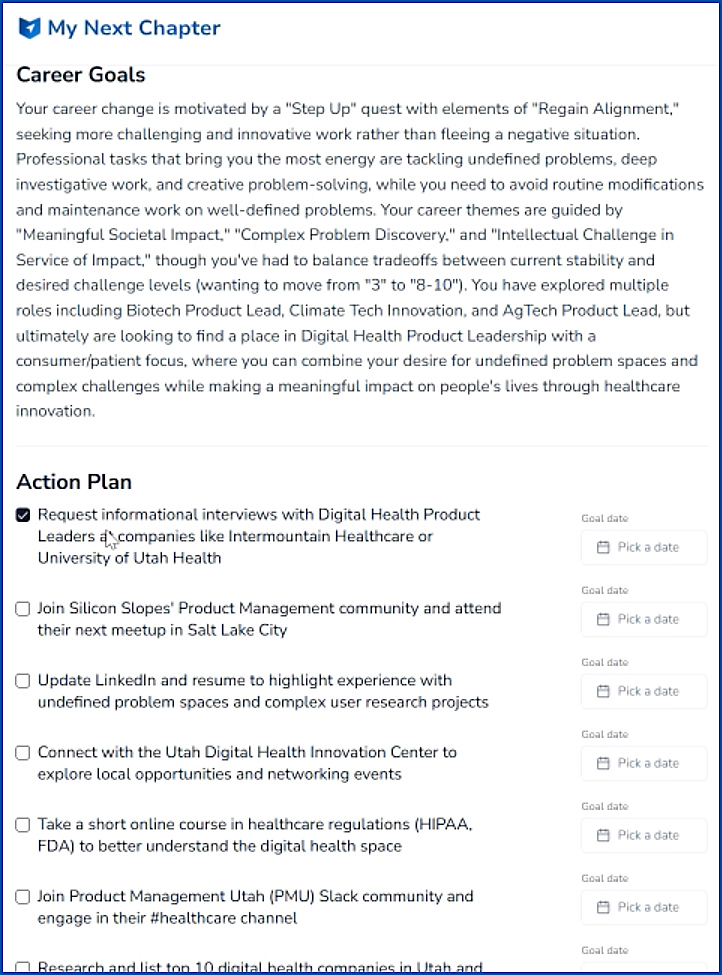
From DSC: In looking atMyNextChapter.ai— THIS TYPE OF FUNCTIONALITY of an AI-based chatbot talking to you re: good fits for a future job — is the kind of thing that could work well in this type of vision/learning platform. The AI asks you relevant career-oriented questions, comes up with some potential job fits, and then gives you resources about how to gain those skills, who to talk with, organizations to join, next steps to get your foot in the door somewhere, etc.
The next gen learning platform would provide links to online-based courses, blogs, peoples’ names on LinkedIn, courses from L&D organizations or from institutions of higher education or from other entities/places to obtain those skills (similar to the ” Action Plan” below from MyNextChapter.ai).
Teach business students to write like executives— from timeshighereducation.com by José Ignacio Sordo Galarza Many business students struggle to communicate with impact. Teach them to pitch ideas on a single page to build clarity, confidence and work-ready communication skills
Many undergraduate business students transition into the workforce equipped with communication habits that, while effective in academic settings, prove ineffective in professional environments. At university, students are trained to write for professors, not executives. This becomes problematic in the workplace where lengthy reports and academic jargon often obscure rather than clarify intent. Employers seek ideas they can absorb in seconds. This is where the one-pager – a single-page, high-impact document that helps students develop clarity of thought, concise expression and strategic communication – proves effective.
Also from Times Higher Education, see:
Is the dissertation dead? If so, what are the alternatives? — from timeshighereducation.com by Rushana Khusainova, Sarah Sholl, & Patrick Harte Dissertation alternatives, such as capstone projects and applied group-based projects, could better prepare graduates for their future careers. Discover what these might look like
The traditional dissertation, a longstanding pillar of higher education, is facing increasing scrutiny. Concerns about its relevance to contemporary career paths, limitations in fostering practical skills and the changing nature of knowledge production in the GenAI age have fuelled discussions about its continued efficacy. So, is the dissertation dead?
The dissertation is facing a number of challenges. It can be perceived as having little relevance to career aspirations in increasingly competitive job markets. According to The Future of Jobs Report 2025 by the World Economic Forum, employers demand and indeed prioritise skills such as collaborative problem-solving in diverse and complex contexts, which a dissertation might not demonstrate.
In Episode 5 of The Neuron Podcast, Corey Noles and Grant Harvey tackle the education crisis head-on. We explore the viral UCLA “CheatGPT” controversy, MIT’s concerning brain study, and innovative solutions like Alpha School’s 2-hour learning model. Plus, we break down OpenAI’s new $10M teacher training initiative and share practical tips for using AI to enhance learning rather than shortcut it. Whether you’re a student, teacher, or parent, you’ll leave with actionable insights on the future of education.
For today’s chief learning officer, the days of just rolling out compliance training are long gone. In 2025, learning and development leaders are architects of innovation, crafting ecosystems that are agile, automated and AI-infused. This quarter’s Tech Check invites us to pause, assess and get strategic about where tech is taking us. Because the goal isn’t more tools—it’s smarter, more human learning systems that scale with the business.
Sections include:
The state of AI in L&D: Hype vs. reality
AI in design: From static content to dynamic experiences
AI in development: Redefining production workflows
NEW YORK – The AFT, alongside the United Federation of Teachers and lead partner Microsoft Corp., founding partner OpenAI, and Anthropic, announced the launch of the National Academy for AI Instruction today. The groundbreaking $23 million education initiative will provide access to free AI training and curriculum for all 1.8 million members of the AFT, starting with K-12 educators. It will be based at a state-of-the-art bricks-and-mortar Manhattan facility designed to transform how artificial intelligence is taught and integrated into classrooms across the United States.
The academy will help address the gap in structured, accessible AI training and provide a national model for AI-integrated curriculum and teaching that puts educators in the driver’s seat.
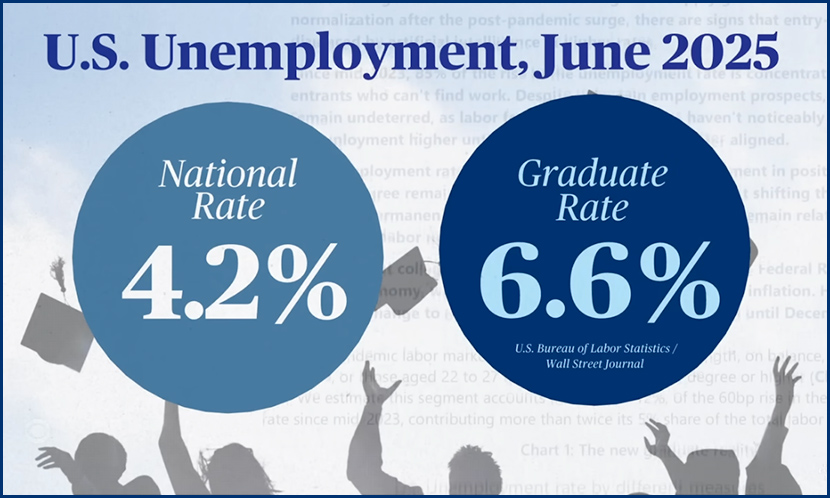
In an era when the college-going rate of high school graduates has dropped from an all-time high of 70 percent in 2016 to roughly 62 percent now, AI seems to be heightening the anxieties about the value of college.
According to the survey, two-thirds of parents say AI is impacting their view of the value of college. Thirty-seven percent of parents indicate they are now scrutinizing college’s “career-placement outcomes”; 36 percent say they are looking at a college’s “AI-skills curriculum,” while 35 percent respond that a “human-skills emphasis” is important to them.
This echoes what I increasingly hear from college leadership: Parents and students demand to see a difference between what they are getting from a college and what they could be “learning from AI.”
Culture matters here. Organizations that foster psychological safety—where experimentation is welcomed and mistakes are treated as learning—are making the most progress. When leaders model curiosity, share what they’re trying, and invite open dialogue, teams follow suit. Small tests become shared wins. Shared wins build momentum.
Career development must be part of this equation. As roles evolve, people will need pathways forward. Some will shift into new specialties. Others may leave familiar roles for entirely new ones. Making space for that evolution—through upskilling, mobility, and mentorship—shows your people that you’re not just investing in AI, you’re investing in them.
And above all, people need transparency. Teams don’t expect perfection. But they do need clarity. They need to understand what’s changing, why it matters, and how they’ll be supported through it. That kind of trust-building communication is the foundation for any successful change.
These shifts may play out differently across sectors—but the core leadership questions will likely be similar.
AI marks a turning point—not just for technology, but for how we prepare our people to lead through disruption and shape the future of learning.
Is graduate employability a core university priority? — from timeshighereducation.com by Katherine Emms and Andrea Laczik Universities, once judged primarily on the quality of their academic outcomes, are now also expected to prepare students for the workplace. Here’s how higher education is adapting to changing pressures
A clear, deliberate shift in priorities is under way. Embedding employability is central to an Edge Foundation report, carried out in collaboration with UCL’s Institute of Education, looking at how English universities are responding. In placing employability at the centre of their strategies – not just for professional courses but across all disciplines – the two universities that were analysed in this research show how they aim to prepare students for the labour market overall. Although the employability strategy is initialled by the universities’ senior leaders, the research showed that realising this employability strategy must be understood and executed by staff at all levels across departments. The complexity of offering insights into industry pathways and building relevant skills involves curricula development, student-centred teaching, careers support, partnership work and employer engagement.
Every student can benefit from an entrepreneurial mindset — from timeshighereducation.com by Nicolas Klotz To develop the next generation of entrepreneurs, universities need to nurture the right mindset in students of all disciplines. Follow these tips to embed entrepreneurial education
This shift demands a radical rethink of how we approach entrepreneurial mindset in higher education. Not as a specialism for a niche group of business students but as a core competency that every student, in every discipline, can benefit from.
At my university, we’ve spent the past several years re-engineering how we embed entrepreneurship into daily student life and learning.
What we’ve learned could help other institutions, especially smaller or resource-constrained ones, adapt to this new landscape.
The first step is recognising that entrepreneurship is not only about launching start-ups for profit. It’s about nurturing a mindset that values initiative, problem-solving, resilience and creative risk-taking. Employers increasingly want these traits, whether the student is applying for a traditional job or proposing their own venture.
Build foundations for university-industry partnerships in 90 days— from timeshighereducation.com by Raul Villamarin Rodriguez and Hemachandran K Graduate employability could be transformed through systematic integration of industry partnerships. This practical guide offers a framework for change in Indian universities
The most effective transformation strategy for Indian universities lies in systematic industry integration that moves beyond superficial partnerships and towards deep curriculum collaboration. Rather than hoping market alignment will occur naturally, institutions must reverse-engineer academic programmes from verified industry needs.
Our six-month implementation at Woxsen University demonstrates this framework’s practical effectiveness, achieving more than 130 industry partnerships, 100 per cent faculty participation in transformation training, and 75 per cent of students receiving industry-validated credentials with significantly improved employment outcomes.
How Do You Teach Computer Science in the A.I. Era? — from nytimes.com by Steve Lohr; with thanks to Ryan Craig for this resource Universities across the country are scrambling to understand the implications of generative A.I.’s transformation of technology.
The future of computer science education, Dr. Maher said, is likely to focus less on coding and more on computational thinking and A.I. literacy. Computational thinking involves breaking down problems into smaller tasks, developing step-by-step solutions and using data to reach evidence-based conclusions.
A.I. literacy is an understanding — at varying depths for students at different levels — of how A.I. works, how to use it responsibly and how it is affecting society. Nurturing informed skepticism, she said, should be a goal.
At Carnegie Mellon, as faculty members prepare for their gathering, Dr. Cortina said his own view was that the coursework should include instruction in the traditional basics of computing and A.I. principles, followed by plenty of hands-on experience designing software using the new tools.
“We think that’s where it’s going,” he said. “But do we need a more profound change in the curriculum?”
The unexpected benefits of academic blogging | THE Campus Learn, Share, Connect
DC: I wish more faculty and staff members would blog and share their knowledge with the public. I greatly appreciate those staff and faculty members that DO blog! https://t.co/CHfHbxICcL
Get yourself unstuck: overthinking is boring and perfectionism is a trap — from timeshighereducation.com by David Thompson The work looks flawless, the student seems fine. But underneath, perfectionism is doing damage. David Thompson unpacks what educators can do to help high-performing students navigate the pressure to succeed and move from stuck to started
That’s why I encourage imperfection, messiness and play and build these ideas into how I teach.
…
These moments don’t come from big breakthroughs. They come from removing pressure and replacing it with permission.