Thomson Reuters CEO: Legal Profession Faces “Biggest Disruption in Its History”from AI  — from lawnext.com by Bob Ambrogi

Thomson Reuters President and CEO Steve Hasker believes the legal profession is experiencing “the biggest disruption … in its history” due to generative and agentic artificial intelligence, fundamentally rewriting how legal work products are created for the first time in more than 300 years.

Speaking to legal technology reporters during ILTACON, the International Legal Technology Association’s annual conference, Hasker outlined his company’s ambitious goal to become “the most innovative company” in the legal tech sector while navigating what he described as unprecedented technological change affecting a profession that has remained largely unchanged since its origins in London tea houses centuries ago.


Legal tech hackathon challenges students to rethink access to justice — from the Centre for Innovation and Entrepreneurship, Auckland Law School
In a 24-hour sprint, student teams designed innovative tools to make legal and social support more accessible.

The winning team comprised of students of computer science, law, psychology and physics. They developed a privacy-first legal assistant powered by AI that helps people understand their legal rights without needing to navigate dense legal language. 


Teaching How To ‘Think Like a Lawyer’ Revisited — from abovethelaw.com by Stephen Embry
GenAI gives the concept of training law students to think like a lawyer a whole new meaning.

Law Schools
These insights have particular urgency for legal education. Indeed, most of Cowen’s criticisms and suggested changes need to be front and center for law school leaders. It’s naïve to think that law student and lawyers aren’t going to use GenAI tools in virtually every aspect of their professional and personal lives. Rather than avoiding the subject or worse yet trying to stop use of these tools, law schools should make GenAI tools a fundamental part of research, writing and drafting training.

They need to focus not on memorization but on the critical thinking skills beginning lawyers used to get in the on-the-job training guild type system. As I discussed, that training came from repetitive and often tedious work that developed experienced lawyers who could recognize patterns and solutions based on the exposure to similar situations. But much of that repetitive and tedious work may go away in a GenAI world.

The Role of Adjunct Professors
But to do this, law schools need to better partner with actual practicing lawyers who can serve as adjunct professors. Law schools need to do away with the notion that adjuncts are second-class teachers.


It’s a New Dawn In Legal Tech: From Woodstock to ILTACON (And Beyond) — from lawnext.com by Bob Ambrogi

As someone who has covered legal tech for 30 years, I cannot remember there ever being a time such as this, when the energy and excitement are raging, driven by generative AI and a new era of innovation and new ideas of the possible.

But this year was different. Wandering the exhibit hall, getting product briefings from vendors, talking with attendees, it was impossible to ignore the fundamental shift happening in legal technology. Gen AI isn’t just creating new products – it is spawning entirely new categories of products that truly are reshaping how legal work gets done.

Agentic AI is the buzzword of 2025 and agentic systems were everywhere at ILTACON, promising to streamline workflows across all areas of legal practice. But, perhaps more importantly, these tools are also beginning to address the business side of running a law practice – from client intake and billing to marketing and practice management. The scope of transformation is now beginning to extend beyond the practice of law into the business of law.

Largely missing from this gathering were solo practitioners, small firm lawyers, legal aid organizations, and access-to-justice advocates – the very people who stand to benefit most from the democratizing potential of AI.

However, now more than ever, the innovations we are seeing in legal tech have the power to level the playing field, to give smaller practitioners access to tools and capabilities that were once prohibitively expensive. If these technologies remain priced for and marketed primarily to Big Law, we will have succeeded only in widening the justice gap rather than closing it.


How AI is Transforming Deposition Review: A LegalTech Q&A — from jdsupra.com

Thanks to breakthroughs in artificial intelligence – particularly in semantic search, multimodal models, and natural language processing – new legaltech solutions are emerging to streamline and accelerate deposition review. What once took hours or days of manual analysis now can be accomplished in minutes, with greater accuracy and efficiency than possible with manual review.


From Skepticism to Trust: A Playbook for AI Change Management in Law Firms — from jdsupra.com by Scott Cohen

Historically, lawyers have been slow adopters of emerging technologies, and with good reason. Legal work is high stakes, deeply rooted in precedent, and built on individual judgment. AI, especially the new generation of agentic AI (systems that not only generate output but initiate tasks, make decisions, and operate semi-autonomously), represents a fundamental shift in how legal work gets done. This shift naturally leads to caution as it challenges long-held assumptions about lawyer workflows and several aspects of their role in the legal process.

The path forward is not to push harder or faster, but smarter. Firms need to take a structured approach that builds trust through transparency, context, training, and measurement of success. This article provides a five-part playbook for law firm leaders navigating AI change management, especially in environments where skepticism is high and reputational risk is even higher.


ILTACON 2025: The vendor briefings – Agents, ecosystems and the next stage of maturity — from legaltechnology.com by Caroline Hill

This year’s ILTACON in Washington was heavy on AI, but the conversation with vendors has shifted. Legal IT Insider’s briefings weren’t about potential use cases or speculative roadmaps. Instead, they focused on how AI is now being embedded into the tools lawyers use every day — and, crucially, how those tools are starting to talk to each other.

Taken together, they point to an inflection point, where agentic workflows, data integration, and open ecosystems define the agenda. But it’s important amidst the latest buzzwords to remember that agents are only as good as the tools they have to work with, and AI only as good as its underlying data. Also, as we talk about autonomous AI, end users are still struggling with cloud implementations and infrastructure challenges, and need vendors to be business partners that help them to make progress at speed.

Harvey’s roadmap is all about expanding its surface area — connecting to systems like iManage, LexisNexis, and more recently publishing giant Wolters Kluwer — so that a lawyer can issue a single query and get synthesised, contextualised answers directly within their workflow. Weinberg said: “What we’re trying to do is get all of the surface area of all of the context that a lawyer needs to complete a task and we’re expanding the product surface so you can enter a search, search all resources, and apply that to the document automatically.” 

The common thread: no one is talking about AI in isolation anymore. It’s about orchestration — pulling together multiple data sources into a workflow that actually reflects how lawyers practice. 


5 Pitfalls Of Delaying Automation In High-Volume Litigation And Claims — from jdsupra.com

Why You Can’t Afford to Wait to Adopt AI Tools that have Plaintiffs Moving Faster than Ever
Just as photocopiers shifted law firm operations in the early 1970s and cloud computing transformed legal document management in the early 2000s, AI automation tools are altering the current legal landscape—enabling litigation teams to instantly structure unstructured data, zero in on key arguments in seconds, and save hundreds (if not thousands) of hours of manual work.


Your Firm’s AI Policy Probably Sucks: Why Law Firms Need Education, Not Rules — from jdsupra.com

The Floor, Not the Ceiling
Smart firms need to flip their entire approach. Instead of dictating which AI tools lawyers must use, leadership should set a floor for acceptable use and then get out of the way.

The floor is simple: no free versions for client work. Free tools are free because users are the product. Client data becomes training data. Confidentiality gets compromised. The firm loses any ability to audit or control how information flows. This isn’t about control; it’s about professional responsibility.

But setting the floor is only the first step. Firms must provide paid, enterprise versions of AI tools that lawyers actually want to use. Not some expensive legal tech platform that promises AI features but delivers complicated workflows. Real AI tools. The same ones lawyers are already using secretly, but with enterprise security, data protection, and proper access controls.

Education must be practical and continuous. Single training sessions don’t work. AI tools evolve weekly. New capabilities emerge constantly. Lawyers need ongoing support to experiment, learn, and share discoveries. This means regular workshops, internal forums for sharing prompts and techniques, and recognition for innovative uses.

The education investment pays off immediately. Lawyers who understand AI use it more effectively. They catch its mistakes. They know when to verify outputs. They develop specialized prompts for legal work. They become force multipliers, not just for themselves but for their entire teams.
 

“It’s hard to fathom what the impact of 10 million people in student loan default will have on college-going attitudes.” — from linkedin.com by Brandon Busteed

The rates of student loan non payment between April and June climbed sharply, so that 12.9 percent of debt is now subject to “serious delinquency,” according to new data released by the Federal Reserve Bank of New York.

Federal Reserve Bank of New York’s Center for Microeconomic Data released its Quarterly Report on Household Debt and Credit on Wednesday, which found the number of student loans transitioning into serious delinquency, or 90 days past due, rose “sharply” in the second quarter of 2025.

Newsweek.com


What next for EDI? Protecting equality of opportunity in HE — from timeshighereducation.com by Laura Duckett
As equity, diversity and inclusion practices face mounting political and cultural challenges, this guide includes strategies from academics around the world on preserving fair access and opportunity for all

As many in this guide explain, hostility to efforts to create fairer, inclusive and diverse institutions of higher education runs a lot deeper than the latest US presidential agenda and it cannot be ignored and rejected as a momentary political spike. Yet the continued need for EDI (or DEI as it is called in America) work to address historic and systemic injustice is clear from the data. In the US, Black, Hispanic, Latino, Native American and Pacific Islander people are under-represented in university student and staff populations. Students from these groups also have worse academic outcomes.

In the UK, only 1 per cent of professors are Black, women remain under-represented on the higher rungs of the academic ladder and the attainment gap between students from minoritised backgrounds and their white counterparts remains stubbornly evident across the higher education sector.

While not all EDI work has proved successful, significant progress has been made on widening participation in higher education and building more inclusive universities in which students and academics can thrive.

This guide shares lessons from academics on navigating increasingly choppy waters relating to EDI, addressing misconceptions about the work and its core ambitions, strategies for allyship, anti-racism and inclusion and how to champion EDI through your teaching and institutional culture.


Back to School in the AI Era: Why Students Are Rewriting Your Lesson Plan — from linkedin.com by Hailey Wilson

As a new academic year begins, many instructors, trainers, and program leaders are bracing for familiar challenges—keeping learners engaged, making complex material accessible, and preparing students for real-world application.

But there’s a quiet shift happening in classrooms and online courses everywhere.

This fall, it’s not the syllabus that’s guiding the learning experience—it’s the conversation between the learner and an AI tool.


From bootcamp to bust: How AI is upending the software development industry — from reuters.com by Anna Tong; via Paul Fain
Coding bootcamps have been a mainstay in Silicon Valley for more than a decade. Now, as AI eliminates the kind of entry-level roles for which they trained people, they’re disappearing.

Coding bootcamps have been a Silicon Valley mainstay for over a decade, offering an important pathway for non-traditional candidates to get six-figure engineering jobs. But coding bootcamp operators, students and investors tell Reuters that this path is rapidly disappearing, thanks in large part to AI.

“Coding bootcamps were already on their way out, but AI has been the nail in the coffin,” said Allison Baum Gates, a general partner at venture capital fund SemperVirens, who was an early employee at bootcamp pioneer General Assembly.

Gates said bootcamps were already in decline due to market saturation, evolving employer demand and market forces like growth in international hiring.


Here are my favorite back-to-school activities to strengthen learning — from retrievalpractice.org by Pooja K. Agarwal, Ph.D.

Welcome back to school! For most of us (myself included), the whirlwind of lesson prep, meetings, professional development—and of course, teaching—is here. Keep reading for my favorite back-to-school activities to engage students with retrieval practice during the first week of class.

It may (or may not) surprise you to know that my first day of class is full of retrieval practice. Even if you haven’t introduced content yet, use retrieval practice the first day or week of class. Here’s how, with quick activities you can adapt for K–12 students, higher ed courses, and all content areas:


How to Teach a Good First Day of Class — by James Lang; via Dr. Pooja Agarwal’s posting above

What you can expect to find here:

  • I’ll start, as we academics so love to do, with a little bit of theory — specifically, four core principles that can help shape your planning for the first day of your course.
  • Next, I’ll cover the logistics of a successful first day, including managing the space and technology as well as getting to know your students.
  • To show you how to put the principles and the logistics into practice, I will provide examples of what a good set of first-day activities might look like in four disciplines.
  • I’ll finish with some suggestions for how to support the good work you have done on the first day with some follow-up activities.

7 Pieces of Advice for New Teachers — from edutopia.org by Brienne May
Focus on relationships with students and colleagues to make a good start to the year—and remember to ask for what you need.

Too often, teacher preparation programs are rich in theory but light on practical guidance. After working hard through my undergraduate classes, completing student teaching, and spending countless hours laminating and cutting, I still found myself on the first day of school, standing in front of a room full of expectant faces with eager eyes, and realized I had no idea what to do next. I didn’t know what to say to students in that moment, let alone how to survive the following 180 days. Twelve years later, I have collected a trove of advice I wish I could have shared with that fresh-faced teacher.


The Transient Information Effect: Why Great Explanations Don’t Always Stick — from scienceoflearning.substack.com by Nidhi Sachdeva and Jim Hewitt
In this post, Dr. John Sweller describes how the Transient Information Effect can overload student working memory and what teachers can do about it.

Highlights:

  • The Transient Information Effect happens when important information disappears before learners can process and remember it.
  • Dr. John Sweller, who first studied the Transient Information Effect, answers our questions about this overlooked learning challenge.
  • Turning transient information into something students can revisit (like writing key steps on the board) can help explanations stick.

41 Elementary Classroom Jobs to Build Shared Responsibility and Community — from edutopia.org by Donna Paul
Classroom jobs help students feel seen, trusted, and excited to contribute to their classroom community.

Each fall, one of the first routines I introduce is our classroom job board. It’s more than a list of tasks—it helps students feel that they belong and have real roles in our shared space. Over the years, I’ve expanded beyond classic jobs like Line Leader and Pencil Sharpener to include creative roles with quirky titles that engage and resonate with students.

Here are the jobs that have helped my students feel seen, trusted, and excited to contribute.


Guiding Students to Overcome Learned Helplessness — from edutopia.org by Michelle Singh
New teachers can create an environment where students feel supported and understand that mistakes are part of the learning process.


Creating a Kid-Led Hall of Fame for Books — from edutopia.org by Eric Hall
Allowing elementary students to nominate and vote for their favorite books of the year can create a culture of celebration in the classroom.

When I started teaching, I remembered that conversation with my elementary school librarian. I thought, “Why should adults have all the fun?” I wanted my students to experience the excitement of recognizing books they thought were the best. And just like that, the Hallbery Awards were born and continued twice a year for over 15 years. (Why Hallbery? Because my last name is Hall.)


Understanding Diagnostic, Formative, and Summative Assessments — from edmentum.com

Today, we’re taking a look at the three primary forms of assessments—diagnostic, formative, and summative—with the goal of not only differentiating between them but also better understanding the purpose and potential power of each.

At their core, each of the three primary assessment types serves a distinct purpose. Diagnostic assessments are used before instruction to help identify where students are in their comprehension of academic content. Formative assessments are used while content is being taught to understand what students are picking up, to guide their learning, and to help teachers determine what to focus on moving forward. Summative assessments are used after instruction to evaluate the outcomes of student learning: what, or how much, they ultimately learned.


How one state revamped high school to reflect reality: Not everyone goes to college — from hechingerreport.org by Kavitha Cardoza
Indiana’s initial plan for revised graduation requirements was criticized for prioritizing workforce skills over academic preparedness. The state has tried to find a balance between the two

This story is part of Hechinger’s ongoing coverage about rethinking high school. Read about high school apprenticeships in Indiana, a new diploma in Alabama that trades chemistry for carpentry, and “career education for all” in Kentucky.

The “New Indiana Diploma” — which was signed into law in April and goes into effect for all incoming first-year students this academic year — gives students the option to earn different “seals” in addition to a basic diploma, depending on whether they plan to attend college, go straight to work or serve in the military. Jenner describes it as an effort to tailor the diploma to students’ interests, expose students to careers and recognize different forms of student achievement.


How Teachers in This District Pushed to Have Students Spend Less Time Testing — from edweek.org by Elizabeth Heubeck

Students in one Arizona district will take fewer standardized tests this school year, the result of an educator-led push to devote less time to testing.

The Tucson Education Association, backed by the school board and several parents, reached an agreement with the Tucson Unified school system in May to reduce the number of district-mandated standardized assessments students take annually starting in the 2025-26 academic year.

Just 25 percent of educators agreed that state-mandated tests provide useful information for the teachers in their school, according to a 2023 EdWeek Research Center survey of teachers, principals, and district leaders. 


30 Ways to Bring Calm to a Noisy High School Classroom — from edutopia.org by Anne Noyes Saini
From ‘finding the lull’ to the magic of a dramatic whisper, these teacher-tested strategies quickly get high school students focused and back on track.


Approaching Experiential Learning as a Continuum — from edutopia.org by Bill Manchester
Teachers can consider 12 characteristics of experiential learning to make lessons more or less active for students.


Bringing the best of AI to college students for free — from blog.google by Sundar Pichai

Millions of college students around the world are getting ready to start classes. To help make the school year even better, we’re making our most advanced AI tools available to them for free, including our new Guided Learning mode. We’re also providing $1 billion to support AI education and job training programs and research in the U.S. This includes making our AI and career training free for every college student in America through our AI for Education Accelerator — over 100 colleges and universities have already signed up.

Guided Learning: from answers to understanding
AI can broaden knowledge and expand access to it in powerful ways, helping anyone, anywhere learn anything in the way that works best for them. It’s not about just getting an answer, but deepening understanding and building critical thinking skills along the way. That opportunity is why we built Guided Learning, a new mode in Gemini that acts as a learning companion guiding you with questions and step-by-step support instead of just giving you the answer. We worked closely with students, educators, researchers and learning experts to make sure it’s helpful for understanding new concepts and is backed by learning science.


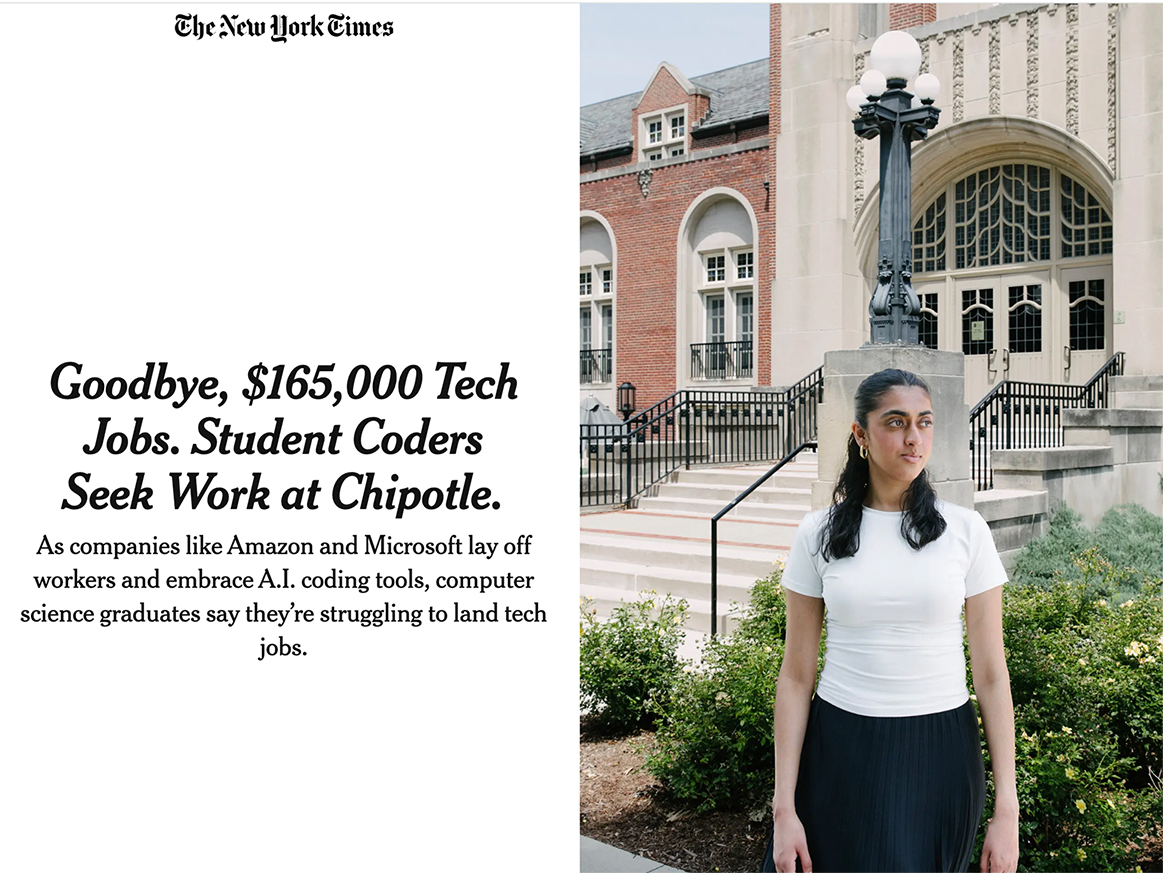
Goodbye, $165,000 Tech Jobs. Student Coders Seek Work at Chipotle. — from nytimes.com by Natasha Singer [this is a gifted NY article]

“The rhetoric was, if you just learned to code, work hard and get a computer science degree, you can get six figures for your starting salary,” Ms. Mishra, now 21, recalls hearing as she grew up in San Ramon, Calif.

Those golden industry promises helped spur Ms. Mishra to code her first website in elementary school, take advanced computing in high school and major in computer science in college. But after a year of hunting for tech jobs and internships, Ms. Mishra graduated from Purdue University in May without an offer.

“I just graduated with a computer science degree, and the only company that has called me for an interview is Chipotle,” Ms. Mishra said in a get-ready-with-me TikTok video this summer that has since racked up more than 147,000 views.

But now, the spread of A.I. programming tools, which can quickly generate thousands of lines of computer code — combined with layoffs at companies like Amazon, Intel, Meta and Microsoft — is dimming prospects in a field that tech leaders promoted for years as a golden career ticket. The turnabout is derailing the employment dreams of many new computing grads and sending them scrambling for other work.


BREAKING: Google introduces Guided Learning — from aieducation.substack.com by Claire Zau
Some thoughts on what could make Google’s AI tutor stand out

Another major AI lab just launched “education mode.”

Google introduced Guided Learning in Gemini, transforming it into a personalized learning companion designed to help you move from quick answers to real understanding.

Instead of immediately spitting out solutions, it:

  • Asks probing, open-ended questions
  • Walks learners through step-by-step reasoning
  • Adapts explanations to the learner’s level
  • Uses visuals, videos, diagrams, and quizzes to reinforce concepts

This Socratic style tutor rollout follows closely behind similar announcements like OpenAI’s Study Mode (last week) and Anthropic’s Claude for Education (April 2025).


How Sci-Fi Taught Me to Embrace AI in My Classroom — from edsurge.com by Dan Clark

I’m not too naive to understand that, no matter how we present it, some students will always be tempted by “the dark side” of AI. What I also believe is that the future of AI in education is not decided. It will be decided by how we, as educators, embrace or demonize it in our classrooms.

My argument is that setting guidelines and talking to our students honestly about the pitfalls and amazing benefits that AI offers us as researchers and learners will define it for the coming generations.

Can AI be the next calculator? Something that, yes, changes the way we teach and learn, but not necessarily for the worse? If we want it to be, yes.

How it is used, and more importantly, how AI is perceived by our students, can be influenced by educators. We have to first learn how AI can be used as a force for good. If we continue to let the dominant voice be that AI is the Terminator of education and critical thinking, then that will be the fate we have made for ourselves.


AI Tools for Strategy and Research – GT #32 — from goodtools.substack.com by Robin Good
Getting expert advice, how to do deep research with AI, prompt strategy, comparing different AIs side-by-side, creating mini-apps and an AI Agent that can critically analyze any social media channel

In this issue, discover AI tools for:

  • Getting Expert Advice
  • Doing Deep Research with AI
  • Improving Your AI Prompt Strategy
  • Comparing Results from Different AIs
  • Creating an AI Agent for Social Media Analysis
  • Summarizing YouTube Videos
  • Creating Mini-Apps with AI
  • Tasting an Award-Winning AI Short Film

GPT-Building, Agentic Workflow Design & Intelligent Content Curation — from drphilippahardman.substack.com by Dr. Philippa Hardman
What 3 recent job ads reveal about the changing nature of Instructional Design

In this week’s blog post, I’ll share my take on how the instructional design role is evolving and discuss what this means for our day-to-day work and the key skills it requires.

With this in mind, I’ve been keeping a close eye on open instructional design roles and, in the last 3 months, have noticed the emergence of a new flavour of instructional designer: the so-called “Generative AI Instructional Designer.”

Let’s deep dive into three explicitly AI-focused instructional design positions that have popped up in the last quarter. Each one illuminates a different aspect of how the role is changing—and together, they paint a picture of where our profession is likely heading.

Designers who evolve into prompt engineers, agent builders, and strategic AI advisors will capture the new premium. Those who cling to traditional tool-centric roles may find themselves increasingly sidelined—or automated out of relevance.


Google to Spend $1B on AI Training in Higher Ed — from insidehighered.com by Katherine Knott

Google’s parent company announced Wednesday (8/6/25) that it’s planning to spend $1 billion over the next three years to help colleges teach and train students about artificial intelligence.

Google is joining other AI companies, including OpenAI and Anthropic, in investing in AI training in higher education. All three companies have rolled out new tools aimed at supporting “deeper learning” among students and made their AI platforms available to certain students for free.


5 Predictions for How AI Will Impact Community Colleges — from pistis4edu.substack.com by Feng Hou

Based on current technology capabilities, adoption patterns, and the mission of community colleges, here are five well-supported predictions for AI’s impact in the coming years.

  1. Universal AI Tutor Access
  2. AI as Active Teacher
  3. Personalized Learning Pathways
  4. Interactive Multimodal Learning
  5. Value-Centric Education in an AI-Abundant World


1 in 2 graduates believe their college major didn’t prepare them for today’s market — from hrdive.com by Carolyn Crist
Respondents said they felt unprepared in numerous ways, especially finding a job after graduation and navigating student debt and personal finances.

As today’s college graduates struggle to start a steady career, 1 in 2 Americans say their college major didn’t prepare them for the job market, according to a June 18 report from Preply.

Beyond that, 1 in 6 Americans who went to college said they regret it. When thinking about their college experience, college graduates said their top regrets included taking out student loans, not networking more and not doing internships.

College graduates said they felt unprepared in numerous ways, especially finding a job after graduation and navigating student debt and personal finances. 

From DSC:
The Career Placement Office at Northwestern University did not help build my skills to get a job, at all. I had no clue what I was doing. I had no idea what networking was even about, nor the power of it, and why it would be useful throughout my career. They provided conference rooms for interviews to occur…and that was about it, at least in my experience. In terms of my education, I didn’t get any real-world experience (such as apprenticeships, internships, capstone courses, etc.), nor did I pick up many practical or technical skills. 


Driving Culture Change in Higher Education — from jeffselingo.com by Jeff Selingo

The call for transformation in higher education has never been louder, yet the path forward remains unclear for many institutions. Leaders often struggle with the “how” of meaningful change. This five-part playbook by higher education author and strategist Jeff Selingo as well as other experts draws on proven methodologies to provide clear, actionable guidance from mapping current institutional culture to sustaining long-term momentum.


Employers’ emphasis on skilled trades lost on Gen Z: Harris poll — from facilitiesdive.com
Young workers don’t realize going into the trades can offer good pay more quickly than pursuing a college-based career, the report says.

A mismatch exists between the importance employers are putting on skilled trades and how the generation that’s newly joining the workforce views those jobs, a Harris poll finds.

Gen Z, the oldest members of which are 28, is the age cohort least focused on skilled trades, in part because they’re misinformed about the jobs, says the report based on 2,200 respondents to survey questions posted online in June.

“Only 38% of Gen Z says skilled trades offer the best job opportunities today” and “only 36% strongly agree skilled trades offer a faster and more affordable path to a good career,” the report says.


One-size-fits-all learning is about to become completely obsolete. — from linkedin.com by Allie Miller


AI in the University: From Generative Assistant to Autonomous Agent This Fall — from insidehighered.com by
This fall we are moving into the agentic generation of artificial intelligence.

“Where generative AI creates, agentic AI acts.” That’s how my trusted assistant, Gemini 2.5 Pro deep research, describes the difference.

Agents, unlike generative tools, create and perform multistep goals with minimal human supervision. The essential difference is found in its proactive nature. Rather than waiting for a specific, step-by-step command, agentic systems take a high-level objective and independently create and execute a plan to achieve that goal. This triggers a continuous, iterative workflow that is much like a cognitive loop. The typical agentic process involves six key steps, as described by Nvidia:


AI in Education Podcast — from aipodcast.education by Dan Bowen and Ray Fleming


The State of AI in Education 2025 Key Findings from a National Survey — from Carnegie Learning

Our 2025 national survey of over 650 respondents across 49 states and Puerto Rico reveals both encouraging trends and important challenges. While AI adoption and optimism are growing, concerns about cheating, privacy, and the need for training persist.

Despite these challenges, I’m inspired by the resilience and adaptability of educators. You are the true game-changers in your students’ growth, and we’re honored to support this vital work.

This report reflects both where we are today and where we’re headed with AI. More importantly, it reflects your experiences, insights, and leadership in shaping the future of education.


Instructure and OpenAI Announce Global Partnership to Embed AI Learning Experiences within Canvas — from instructure.com

This groundbreaking collaboration represents a transformative step forward in education technology and will begin with, but is not limited to, an effort between Instructure and OpenAI to enhance the Canvas experience by embedding OpenAI’s next-generation AI technology into the platform.

IgniteAI announced earlier today, establishes Instructure’s future-ready, open ecosystem with agentic support as the AI landscape continues to evolve. This partnership with OpenAI exemplifies this bold vision for AI in education. Instructure’s strategic approach to AI emphasizes the enhancement of connections within an educational ecosystem comprising over 1,100 edtech partners and leading LLM providers.

“We’re committed to delivering next-generation LMS technologies designed with an open ecosystem that empowers educators and learners to adapt and thrive in a rapidly changing world,” said Steve Daly, CEO of Instructure. “This collaboration with OpenAI showcases our ambitious vision: creating a future-ready ecosystem that fosters meaningful learning and achievement at every stage of education. This is a significant step forward for the education community as we continuously amplify the learning experience and improve student outcomes.”


Faculty Latest Targets of Big Tech’s AI-ification of Higher Ed — from insidehighered.com by Kathryn Palmer
A new partnership between OpenAI and Instructure will embed generative AI in Canvas. It may make grading easier, but faculty are skeptical it will enhance teaching and learning.

The two companies, which have not disclosed the value of the deal, are also working together to embed large language models into Canvas through a feature called IgniteAI. It will work with an institution’s existing enterprise subscription to LLMs such as Anthropic’s Claude or OpenAI’s ChatGPT, allowing instructors to create custom LLM-enabled assignments. They’ll be able to tell the model how to interact with students—and even evaluate those interactions—and what it should look for to assess student learning. According to Instructure, any student information submitted through Canvas will remain private and won’t be shared with OpenAI.

Faculty Unsurprised, Skeptical
Few faculty were surprised by the Canvas-OpenAI partnership announcement, though many are reserving judgment until they see how the first year of using it works in practice.


Partnerships to make higher education work for the workforce — from timeshighereducation.com by Brooke Wilson
Fostering long-term industry partners can enhance student outcomes and prepare them for the workplace of the future. Here’s how to get the best out of them

As the pace of change accelerates across all industries, higher education institutions face increasing pressure to ensure their graduates are prepared for the workplace demands of today – and tomorrow. Cultivating meaningful partnerships with industry is no longer optional; it’s necessary.

From curriculum co-design to experiential learning, universities can collaborate with businesses and industries in several ways to enhance student outcomes and strengthen regional economies.


The keys to strong university–non-profit partnerships — from timeshighereducation.com by Mariana Leyva, Martha Sáenz, and Itzel Eguiluz
Collaborative projects between universities and non-profits nurture empathy and allow students to make a real-world impact. Here, three educators share their tips for building meaningful partnerships that benefit students and communities alike

Collaborative projects between universities and non-profits nurture empathy and allow students to make a real-world impact. Here, three educators share their tips for building meaningful partnerships that benefit students and communities alike.


AI and Higher Ed: An Impending Collapse — from insidehighered.com by Robert Niebuhr; via George Siemens; I also think George’s excerpt (see below) gets right to the point.
Universities’ rush to embrace AI will lead to an untenable outcome, Robert Niebuhr writes.

Herein lies the trap. If students learn how to use AI to complete assignments and faculty use AI to design courses, assignments, and grade student work, then what is the value of higher education? How long until people dismiss the degree as an absurdly overpriced piece of paper? How long until that trickles down and influences our economic and cultural output? Simply put, can we afford a scenario where students pretend to learn and we pretend to teach them?


This next report doesn’t look too good for traditional institutions of higher education either:


No Country for Young Grads — from burningglassinstitute.org

For the first time in modern history, a bachelor’s degree is no longer a reliable path to professional employment. Recent graduates face rising unemployment and widespread underemployment as structural—not cyclical—forces reshape entry?level work. This new report identifies four interlocking drivers: an AI?powered “Expertise Upheaval” eliminating many junior tasks, a post?pandemic shift to lean staffing and risk?averse hiring, AI acting as an accelerant to these changes, and a growing graduate glut. As a result, young degree holders are uniquely seeing their prospects deteriorate – even as the rest of the economy remain robust. Read the full report to explore the data behind these trends.

The above article was via Brandon Busteed on LinkedIn:


BREAKING: OpenAI Releases Study Mode — from aieducation.substack.com by Claire Zau
What’s New, What Works, and What’s Still Missing

What is Study Mode?
Study Mode is OpenAI’s take on a smarter study partner – a version of the ChatGPT experience designed to guide users through problems with Socratic prompts, scaffolded reasoning, and adaptive feedback (instead of just handing over the answer).

Built with input from learning scientists, pedagogy experts, and educators, it was also shaped by direct feedback from college students. While Study Mode is designed with college students in mind, it’s meant for anyone who wants a more learning-focused, hands-on experience across a wide range of subjects and skill levels.

Who can access it? And how?
Starting July 29, Study Mode is available to users on Free, Plus, Pro, and Team plans. It will roll out to ChatGPT Edu users in the coming weeks.


ChatGPT became your tutor — from theneurondaily.com by Grant Harvey
PLUS: NotebookLM has video now & GPT 4o-level AI runs on laptop

Here’s how it works: instead of asking “What’s 2+2?” and getting “4,” study mode asks questions like “What do you think happens when you add these numbers?” and “Can you walk me through your thinking?” It’s like having a patient tutor who won’t let you off the hook that easily.

The key features include:

  • Socratic questioning: It guides you with hints and follow-up questions rather than direct answers.
  • Scaffolded responses: Information broken into digestible chunks that build on each other.
  • Personalized support: Adjusts difficulty based on your skill level and previous conversations.
  • Knowledge checks: Built-in quizzes and feedback to make sure concepts actually stick.
  • Toggle flexibility: Switch study mode on and off mid-conversation depending on your goals.

Try study mode yourself by selecting “Study and learn” from tools in ChatGPT and asking a question.


Introducing study mode — from openai.com
A new way to learn in ChatGPT that offers step by step guidance instead of quick answers.

[On 7/29/25, we introduced] study mode in ChatGPT—a learning experience that helps you work through problems step by step instead of just getting an answer. Starting today, it’s available to logged in users on Free, Plus, Pro, Team, with availability in ChatGPT Edu coming in the next few weeks.

ChatGPT is becoming one of the most widely used learning tools in the world. Students turn to it to work through challenging homework problems, prepare for exams, and explore new concepts. But its use in education has also raised an important question: how do we ensure it is used to support real learning, and doesn’t just offer solutions without helping students make sense of them?

We’ve built study mode to help answer this question. When students engage with study mode, they’re met with guiding questions that calibrate responses to their objective and skill level to help them build deeper understanding. Study mode is designed to be engaging and interactive, and to help students learn something—not just finish something.


Osgoode’s new simulation-based learning tool aims to merge ethical and practical legal skills — from canadianlawyermag.com by Tim Wilbur
The designer speaks about his vision for redefining legal education through an innovative platform

The disconnection between legal education and the real world starkly contrasted with what he expected law school to be. “I thought rather naively…this would be a really interesting experience…linked to lawyers and what lawyers are doing in society…Far from it. It was solidly academic, so uninteresting, and I thought it’s got to be better than this.”

These frustrations inspired his work on simulation-based education, which seeks to produce “client-ready” lawyers and professionals who reflect deeply on their future roles. Maharg recently worked as a consultant with Osgoode Professional Development at Osgoode Hall Law School to design a platform that eschews many of the assumptions about legal education to deliver practical skills with real-world scenarios.

Osgoode’s SIMPLE platform – short for “simulated professional learning environment” – integrates case management systems and simulation engines to immerse students in practical scenarios.

“It’s actually to get them thinking hard about what they do when they act as lawyers and what they will do when they become lawyers…putting it into values and an ethical framework, as well as making it highly intensively practical,” Maharg says.


And speaking of legal training, also see:

AI in law firms should be a training tool, not a threat, for young lawyers — from canadianlawyermag.com by Tim Wilbur
Tech should free associates for deeper learning, not remove them from the process

AI is rapidly transforming legal practice. Today, tools handle document review and legal research at a pace unimaginable just a few years ago. As recent Canadian Lawyer reporting shows, legal AI adoption is outpacing expectations, especially among in-house teams, and is fundamentally reshaping how legal services are delivered.

Crucially, though, AI should not replace associates. Instead, it should relieve them of repetitive tasks and allow them to focus on developing judgment, client management, and strategic thinking. As I’ve previously discussed regarding the risks of banning AI in court, the future of law depends on blending technological fluency with the human skills clients value most.


Also, the following relates to legaltech as well:

Agentic AI in Legaltech: Proceed with Supervision! — from directory.lawnext.com by Ken Crutchfield
Semi-Autonomous agents can transform work if leaders maintain oversight

The term autonomous agents should raise some concern. I believe semi-autonomous agents is a better term. Do we really want fully autonomous agents that learn and interact independently, to find ways to accomplish tasks?

We live in a world full of cybersecurity risks. Bad actors will think of ways to use agents. Even well-intentioned systems could mishandle a task without proper guardrails.

Legal professionals will want to thoughtfully equip their agent technology with controlled access to the right services. Agents must be supervised, and training must be required for those using or benefiting from agents. Legal professionals will also want to expand the scope of AI Governance to include the oversight of agents.

Agentic AI will require supervision. Human review of Generative AI output is essential. Stating the obvious may be necessary, especially with agents. Controls, human review, and human monitoring must be part of the design and the requirements for any project. Leadership should not leave this to the IT department alone.


What borrowers should know about student loan changes in the One Big Beautiful Bill — from npr.org by Cory Turner

If you’re a federal student loan borrower or about to become one, your head may be spinning.

On July 4, when President Trump signed the One Big Beautiful Bill Act into law, he also greenlit a history-making overhaul of the federal student loan system — one that will affect the lives of many, if not most, of the United States’ nearly 43 million student loan borrowers.

And boy is it a lot to unpack, with new, tighter borrowing limits and dramatically reduced repayment options, to name just a few of the sweeping changes.

Under the One Big Beautiful Bill Act, borrowers in SAVE will have to change plans by July 1, 2028, when SAVE will be officially shut down. If they wait, though they currently can’t be required to make payments, they will see their loans explode with interest.

 
© 2025 | Daniel Christian