2025 EDUCAUSE Teaching and Learning Workforce in Higher Education — from library.educause.edu

This report is the first in a series that examines three distinct workforce domains in higher education in 2025 (teaching and learning, cybersecurity and privacy, and IT leadership) to determine the priorities and challenges facing the profession. The findings in this report, taken from a survey of teaching and learning professionals in higher education, highlight their perspectives on a range of topics:

  • Flexible work arrangements
  • Integration of technologies
  • Workload and staffing
  • Job satisfaction and transition/succession planning
  • Mental health and well-being
  • Culture of belonging
  • Professional development


Personal Finance for Students? Teachers Could Use It, Too — from edweek.org by Elizabeth Heubeck

More states are mandating personal finance courses for high schoolers, but what if their teachers aren’t confident managing money themselves?

But as momentum grows around students’ financial education, a key issue is often overlooked: Many teachers don’t feel confident in their own financial knowledge.

It’s not a problem unique to teachers. Experts report that many U.S. adults lack financial literacy, which, until very recently, was rarely required as a high school graduation requirement. Few teachers study it in college, despite recent surveys of K-12 educators indicating a strong interest in the subject. And once in the classroom, teachers rarely take time to learn subjects that would benefit their own lives, like personal finance, says Yanely Espinal, a financial educator and former classroom teacher.

It’s very rare that you see a teacher pause and consider their own needs, asking themselves things like, ‘How can I set myself up financially? Am I on track?,’”


From DSC:
If you are working in K-12 or in higher education, don’t rely on the contributions that your organization makes to your 403(b) or your 401k plans (the type of plan depends upon your organization’s for-profit or non-profit/tax-exempt status). You should be investing wisely. Those 6-10% contributions won’t cut it these days, even after working 30+ years at a place that contributes that kind of funds to your retirement accounts. You need to invest aggressively if you are going to retire at age 65 (or even younger).

I worked in the corporate world for half of my career and I’m glad that I did. It helped me understand more about personal finance and investing. It helped me get started building a nest egg. But it was really aggressive investments in a couple of key companies that helped me the most. I’m not here to specify which companies to invest in. I’m just saying that if you are relying on 6%-10% contributions to meet your retirement-related needs, you may end up with far less than you’ll need to retire.

I’m glad that they are teaching personal finance these days in K-12. I hope they add some basic legal knowledge to the curricula as well.


AI agents arrive in US classrooms — from zdnet.com by Radhika Rajkumar
Kira AI’s personalized learning platform is currently being implemented in Tennessee schools. How will it change education?

AI for education is a new but rapidly expanding field. Can it support student outcomes and help teachers avoid burnout?

On Wednesday, AI education company Kira launched a “fully AI-native learning platform” for K-12 education, complete with agents to assist teachers with repetitive tasks. The platform hosts assignments, analyzes progress data, offers administrative assistance, helps build lesson plans and quizzes, and more.

“Unlike traditional tools that merely layer AI onto existing platforms, Kira integrates artificial intelligence directly into every educational workflow — from lesson planning and instruction to grading, intervention, and reporting,” the release explains. “This enables schools to improve student outcomes, streamline operations, and provide personalized support at scale.”

Also relevant/see:

Coursera Founder Andrew Ng’s New Venture Brings A.I. to K–12 Classrooms — from observer.com by Victor Dey
Andrew Ng’s Kira Learning uses A.I. agents to transform K–12 education with tools for teachers, students and administrators.

“Teachers today are overloaded with repetitive tasks. A.I. agents can change that, and free up their time to give more personalized help to students,” Ng said in a statement.

Kira was co-founded by Andrea Pasinetti and Jagriti Agrawal, both longtime collaborators of Ng. The platform embeds A.I. directly into lesson planning, instruction, grading and reporting. Teachers can instantly generate standards-aligned lesson plans, monitor student progress in real time and receive automated intervention strategies when a student falls behind.

Students, in turn, receive on-demand tutoring tailored to their learning styles. A.I. agents adapt to each student’s pace and mastery level, while grading is automated with instant feedback—giving educators time to focus on teaching.


‘Using GenAI is easier than asking my supervisor for support’ — from timeshighereducation.com
Doctoral researchers are turning to generative AI to assist in their research. How are they using it, and how can supervisors and candidates have frank discussions about using it responsibly?

Generative AI is increasingly the proverbial elephant in the supervisory room. As supervisors, you may be concerned about whether your doctoral researchers are using GenAI. It can be a tricky topic to broach, especially when you may not feel confident in understanding the technology yourself.

While the potential impact of GenAI use among undergraduate and postgraduate taught students, especially, is well discussed (and it is increasingly accepted that students and staff need to become “AI literate”), doctoral researchers often slip through the cracks in institutional guidance and policymaking.


AI as a Thought Partner in Higher Education — from er.educause.edu by Brian Basgen

When used thoughtfully and transparently, generative artificial intelligence can augment creativity and challenge assumptions, making it an excellent tool for exploring and developing ideas.

The glaring contrast between the perceived ubiquity of GenAI and its actual use also reveals fundamental challenges associated with the practical application of these tools. This article explores two key questions about GenAI to address common misconceptions and encourage broader adoption and more effective use of these tools in higher education.


AI for Automation or Augmentation of L&D? — from drphilippahardman.substack.com by Dr. Philippa Hardman
An audio summary of my Learning Technologies talk

Like many of you, I spent the first part of this week at Learning Technologies in London, where I was lucky enough to present a session on the current state of AI and L&D.

In this week’s blog post, I summarise what I covered and share an audio summary of my paper for you to check out.


Bridging the AI Trust Gap — from chronicle.com by Ian Wilhelm, Derek Bruff, Gemma Garcia, and Lee Rainie

In a 2024 Chronicle survey, 86 percent of administrators agreed with the statement: “Generative artificial intelligence tools offer an opportunity for higher education to improve how it educates, operates, and conducts research.” In contrast, just 55 percent of faculty agreed, showing the stark divisions between faculty and administrative perspectives on adopting AI.

Among many faculty members, a prevalent distrust of AI persists — and for valid reasons. How will it impact in-class instruction? What does the popularity of generative AI tools portend for the development of critical thinking skills for Gen-Z students? How can institutions, at the administrative level, develop policies to safeguard against students using these technologies as tools for cheating?

Given this increasing ‘trust gap,’ how can faculty and administrators work together to preserve academic integrity as AI seeps into all areas of academia, from research to the classroom?

Join us for “Bridging the AI Trust Gap,” an extended, 75-minute Virtual Forum exploring the trust gap on campus about AI, the contours of the differences, and what should be done about it.


How to Use AI and Universal Design to Empower Diverse Thinkers with Susan Tanner — from legaltalknetwork.com by Zack Glaser, Stephanie Everett, and Susan Tanner

What if the key to better legal work isn’t just smarter tools but more inclusive ones? Susan Tanner, Associate Professor at the University of Louisville Brandeis School of Law, joins Zack Glaser to explore how AI and universal design can improve legal education and law firm operations. Susan shares how tools like generative AI can support neurodiverse thinkers, enhance client communication, and reduce anxiety for students and professionals alike. They also discuss the importance of inclusive design in legal tech and how law firms can better support their teams by embracing different ways of thinking to build a more accessible, future-ready practice. The conversation emphasizes the need for educators and legal professionals to adapt to the evolving landscape of AI, ensuring that they leverage its capabilities to better serve their clients and students.


Maximizing Microsoft Copilot in Your Legal Practice — from legaltalknetwork.com by Tom Mighell, Dennis Kennedy, and Ben Schorr

Copilot is a powerful tool for lawyers, but are you making the most of it within your Microsoft apps? Tom Mighell is flying solo at ABA TECHSHOW 2025 and welcomes Microsoft’s own Ben Schorr to the podcast. Ben shares expert insights into how lawyers can implement Copilot’s AI-assistance to work smarter, not harder. From drafting documents to analyzing spreadsheets to streamlining communication, Copilot can handle the tedious tasks so you can focus on what really matters. Ben shares numerous use-cases and capabilities for attorneys and later gives a sneak peek at Copilot’s coming enhancements.


Higher Ed Institutions Rely Less on OPMs While Increasingly Hiring Fee-For-Service Models — from iblnews.org

market report from Validated Insights released this month notes that fewer colleges and universities hire external online program management (OPM) companies to develop their courses.

For 2024, higher education institutions launched only 81 new partnerships with OPMs —  a drop of 42% and the lowest number since 2016.

The report showed that institutions increasingly pay OPMs a fee-for-service instead of following a revenue-sharing model with big service bundles and profit splits.

Experts say revenue-sharing models, which critics denounce as predatory arrangements, incentivize service providers to use aggressive recruiting tactics to increase enrollments and maximize tuition revenue.

According to the report, fee-for-service has become the dominant business model for OPMs.


6 Online Edtech Professional Learning Communities & Resources for Teachers — from techlearning.com by Stephanie Smith Budhai, Ph.D.
These resources can help provide training, best practices, and advice, for using digital tools such as Canva, Curipod, Kahoot!, and more

While school-led professional development can be helpful, there are online professional learning communities on various edtech websites that can be leveraged. Also, some of these community spaces offer the chance to monetize your work.

Here is a summary of six online edtech professional learning spaces.


Undergraduate Degree Earners for Academic Year 2023-24 — from nscresearchcenter.org; via Ryan Craig

The number of learners earning certificates continued its record-breaking growth, reaching a new 10-year high for the third consecutive year. Both first-time certificate earners (+12.6%, +41,500) and those with a prior award returning to earn a certificate (+8.0%, +11,500) saw significant increases.

In contrast, both bachelor’s degree and associate degree earners declined for the third consecutive year. Fewer students earned an associate degree this year than in any of the last ten years, and bachelor’s degree earners declined to their lowest level since 2015-16. As a result of ongoing certificate growth and associate and bachelor’s decline, the proportion of first-time completers who earn a certificate has risen from about 1 in 9 (11.3%) in 2014-15 to about 1 in 7 (15.4%) in 2023-24.

The 2023-24 academic year marks the first time that certificate completers aged 24 and younger outnumbered those 25 and older. Certificate completers 18-20 years old grew by 19,400 (17.8%) and those under 18 (likely dual enrolled high school students) grew by 7,100 (27.2%) in 2023-24.


What are colleges’ legal options when threatened with federal funding cuts? — from highereddive.com/ by Lilah Burke
Higher education experts said colleges could work together or lean on their associations if they take up a legal fight against the Trump administration.

Understand your allies
In fact, colleges may struggle to fight the administration on their own.

“I don’t think that institutions should necessarily fight it by themselves,” said Jeffrey Sun, a higher education and law professor at the University of Louisville. “I don’t think they’ll win.”

What will have more power is several institutions, or even many, working together to fight the attacks on higher education.

“I don’t think we have an option unless we work in collective action,” Sun said.


Harvard University won’t yield to Trump administration’s demands— from highereddive.com by Natalie Schwartz
Alan Garber, the Ivy League institution’s president, said the university wouldn’t forfeit its “independence or its constitutional rights.”

Harvard University President Alan Garber said Monday that officials there would not yield to the Trump administration’s litany of demands to maintain access to federal funding, arguing the federal government had overstepped its authority by issuing the ultimatum. 

“The University will not surrender its independence or relinquish its constitutional rights,” Garber wrote in a community message

The move tees up a battle between the Ivy League institution and the Trump administration, which threatened the university with the loss of $9 billion in federal funding over what it claimed was a failure to protect Jewish students from antisemitism.


Harvard Professors Sue the Trump Administration While Other Universities Are Targeted — from iblnews.org

Two groups representing Harvard University professors (the American Association of University Professors and the Harvard faculty chapter) filed a lawsuit against the Trump Administration on Friday, saying that the threat to cut billions in federal funding for the institution violates free speech and other First Amendment rights.

The Trump Administration announced two weeks ago that it reviewed about $9 billion in federal funding that Harvard receives and would send a list of demands to unfreeze the money.

In a statement, Andrew Manuel Crespo, a law professor at Harvard and general counsel of the AAUP-Harvard Faculty Chapter, said the “Trump administration’s policies are a pretext to chill universities and their faculties from engaging in speech, teaching, and research that don’t align with President Trump’s views.”


OPINION: For our republic to survive, education leaders must remain firm in the face of authoritarianism — from hechingerreport.org by Jason E. Glass
We face direct threats to the values around access, opportunity and truth our schools are meant to uphold

Across the country, education leaders are being forced to make some tough decisions — to choose between defending core values, such as equity and historical truth, or yielding to political coercion in hopes of avoiding conflict. There is no strategy that does not involve conflict and trade-offs. Every education leader operates in their own political context with unique legal and cultural constraints.

But make no mistake: Inaction is not neutral. Even the decision to do nothing is a choice, one that has consequences.


Northwestern to self-fund federally threatened research — from highereddive.com by Laura Spitalniak
Leaders at the well-known institution said the support would sustain “vital research” until they had a “better understanding of the funding landscape.”

Northwestern University will pull from its coffers to continue funding “vital research” that has been threatened by the Trump administration, the private institution announced Thursday.


Trump is bullying, blackmailing and threatening colleges, and they are just beginning to fight back — from hechingerreport.org by Liz Willen
After Harvard rejected the president’s demands, more university leaders have started to speak out — but many say a bigger response is needed

Many hope it is the beginning of a new resistance in higher education. “Harvard’s move gives others permission to come out on the ice a little,” McGuire said. “This is an answer to the tepid and vacillating presidents who said they don’t want to draw attention to themselves.”

Harvard paved the way for other institutions to stand up to the administration’s demands, Ted Mitchell, president of the American Council on Education, noted in an interview with NPR this week.

Stanford University President Jonathan Levin immediately backed Harvard, noting that “the way to bring about constructive change is not by destroying the nation’s capacity for scientific research, or through the government taking command of a private institution.”

“I tell them, you will never regret doing what is right, but if you allow yourself to be co-opted, you will have regret that you caved to a dictator who doesn’t care about you or your institution.”


4 ways community colleges can boost workforce development — from highereddive.com by Natalie Schwartz
Higher education leaders at this week’s ASU+GSV Summit gave advice for how two-year institutions can boost the economic mobility of their students.

SAN DIEGO — How can community colleges deliver economic mobility to their students?

College leaders at this week’s ASU+GSV Summit, an annual education and technology conference, got a glimpse into that answer as they heard how community colleges are building support from business and industry and strengthening workforce development.

These types of initiatives may be helping to boost public perception of the value of community colleges vs. four-year institutions.


A new kind of high school diploma trades chemistry for carpentry — from hechingerreport.org by Ariel Gilreath
Starting this fall, Alabama high school students can choose to take state-approved career and technical education courses in place of upper level math and science, such as Algebra 2 or chemistry.

Alabama state law previously required students to take at least four years each of English, math, science and social studies to graduate from high school. The state is now calling that track the “Option A” diploma. The new “Option B” workforce diploma allows students to replace two math and two science classes with a sequence of three CTE courses of their choosing. The CTE courses do not have to be related to math or science, but they do have to be in the same career cluster. Already, more than 70 percent of Alabama high school students take at least one CTE class, according to the state’s Office of Career and Technical Education/Workforce Development.

***

BIRMINGHAM, Ala. — In a corner of Huffman High School, the sounds of popping nail guns and whirring table saws fill the architecture and construction classroom.

Down the hall, culinary students chop and saute in the school’s commercial kitchen, and in another room, cosmetology students snip mannequin hair to prepare for the state’s natural hair stylist license.

Starting this fall, Alabama high school students can choose to take these classes — or any other state-approved career and technical education courses — in place of upper level math and science, such as Algebra 2 or chemistry.

From DSC:
This is excellent. Provide more choice. Engage all kinds of students with all kinds of interests, gifts, and abilities. Make learning fun and enjoyable and practical for students. The setup in this article mentions that “many universities, including the state’s flagship University of Alabama, require at least three math credits for admission. The workforce diploma would make it more difficult for students on that track to get into those colleges.” But perhaps college is not where these students want to go. Or perhaps the colleges and universities across our land should offer some additional pathways into them as well as new sorts of curricula and programs.


The following resource was from Roberto Ferraro:

Micromanagement — from psychsafety.com by Jade Garratt

Psychological Safety and Micromanagement
Those who have followed our work at Psych Safety for a while will know that we believe exploring not just what to do – the behaviours and practices that support psychological safety – but also what to avoid can be hugely valuable. Understanding the behaviours that damage psychological safety, what not to do, and even what not to say can help us build better workplaces.

There are many behaviours that damage psychological safety, and one that almost always comes up in our workshops when discussing cultures of fear is micromanagement. So we thought it was time we explored micromanagement in more detail, considering how and why it damages psychological safety and what we can do instead.

Micromanagement is a particular approach to leadership where a manager exhibits overly controlling behaviours or an excessive and inappropriate focus on minor details. They might scrutinise their team’s work closely, insist on checking work, refrain from delegating, and limit the autonomy people need to do their jobs well. It can also manifest as an authoritarian leadership style, where decision-making is centralised (back to themselves) and employees have little say in their work.


From DSC:
I was fortunate to not have a manager who was a micromanager until my very last boss/supervisor of my career. But it was that particular manager who made me call it quits and leave the track. She demeaned me in front of others, and was extremely directive and controlling. She wanted constant check-ins and progress reports. And I could go on and on here. 

But suffice it to say that after having worked for several decades, that kind of manager was not what I was looking for. And you wouldn’t be either. By the way…my previous boss — at the same place — and I achieved a great deal in a very short time. She taught me a lot and was a great administrator, designer, professor, mentor, and friend. But that boss was moved to a different role as upper management/leadership changed. Then the micromanagement began after I reported to a different supervisor.

Anyway, don’t be a micromanager. If you are a recent graduate or are coming up on your graduation from college, learn that lesson now. No one likes to work for a micromanager. No one. It can make your employees’ lives miserable and do damage to their mental health, their enjoyment (or lack thereof) of work, and several other things that this article mentions. Instead, respect your employees. Trust your employees. Let them do their thing. See what they might need, then help meet those needs. Then get out of their way.


.

2025 EDUCAUSE Students and Technology Report: Shaping the Future of Higher Education Through Technology, Flexibility, and Well-Being — from library.educause.edu

The student experience in higher education is continually evolving, influenced by technological advancements, shifting student needs and expectations, evolving workforce demands, and broadening sociocultural forces. In this year’s report, we examine six critical aspects of student experiences in higher education, providing insights into how institutions can adapt to meet student needs and enhance their learning experience and preparation for the workforce:

  • Satisfaction with Technology-Related Services and Supports
  • Modality Preferences
  • Hybrid Learning Experiences
  • Generative AI in the Classroom
  • Workforce Preparation
  • Accessibility and Mental Health

DSC: Shame on higher ed for not preparing students for the workplace (see below). You’re doing your students wrong…again. Not only do you continue to heap a load of debt on their backs, but you’re also continuing to not get them ready for the workplace. So don’t be surprised if eventually you’re replaced by a variety of alternatives that students will flock towards.
.


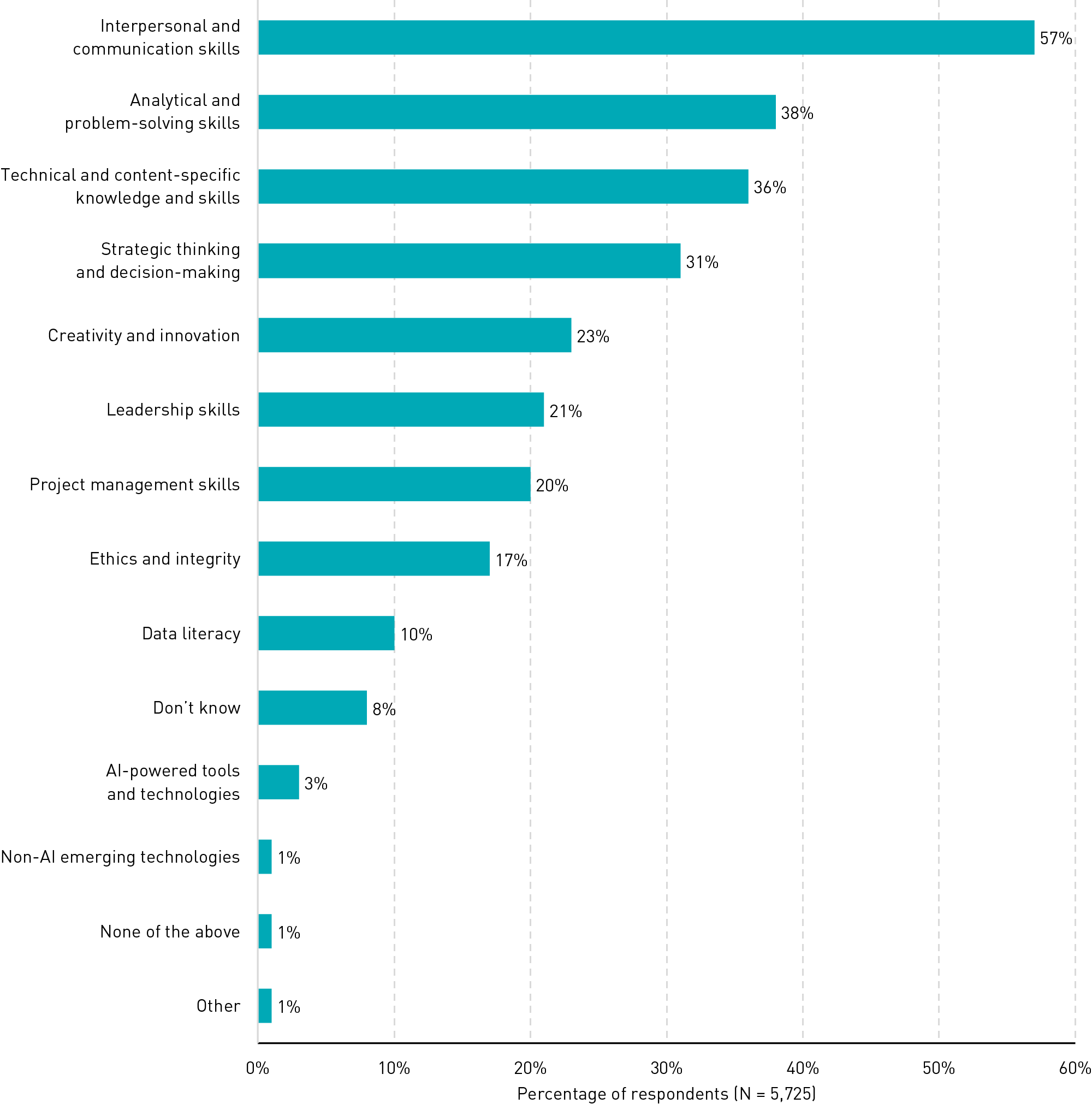
DSC: And students don’t have a clue as to what awaits them in the workplace — they see AI-powered tools and technologies at an incredibly low score of only 3%. Yeh, right. You’ll find out. Here’s but one example from one discipline/field of work –> Thomson Reuters Survey: Over 95% of Legal Professionals Expect Gen AI to Become Central to Workflow Within Five Years

.

Figure 15. Competency Areas Expected to Be Important for Career


From DSC:
After seeing Sam’s posting below, I can’t help but wonder:

  • How might the memory of an AI over time impact the ability to offer much more personalized learning?
  • How will that kind of memory positively impact a person’s learning-related profile?
  • Which learning-related agents get called upon?
  • Which learning-related preferences does a person have while learning about something new?
  • Which methods have worked best in the past for that individual? Which methods didn’t work so well with him or her?


Reflections on “Are You Ready for the AI University? Everything is about to change.” [Latham]

.
Are You Ready for the AI University? Everything is about to change. — from chronicle.com by Scott Latham

Over the course of the next 10 years, AI-powered institutions will rise in the rankings. US News & World Report will factor a college’s AI capabilities into its calculations. Accrediting agencies will assess the degree of AI integration into pedagogy, research, and student life. Corporations will want to partner with universities that have demonstrated AI prowess. In short, we will see the emergence of the AI haves and have-nots.

What’s happening in higher education today has a name: creative destruction. The economist Joseph Schumpeter coined the term in 1942 to describe how innovation can transform industries. That typically happens when an industry has both a dysfunctional cost structure and a declining value proposition. Both are true of higher education.

Out of the gate, professors will work with technologists to get AI up to speed on specific disciplines and pedagogy. For example, AI could be “fed” course material on Greek history or finance and then, guided by human professors as they sort through the material, help AI understand the structure of the discipline, and then develop lectures, videos, supporting documentation, and assessments.

In the near future, if a student misses class, they will be able watch a recording that an AI bot captured. Or the AI bot will find a similar lecture from another professor at another accredited university. If you need tutoring, an AI bot will be ready to help any time, day or night. Similarly, if you are going on a trip and wish to take an exam on the plane, a student will be able to log on and complete the AI-designed and administered exam. Students will no longer be bound by a rigid class schedule. Instead, they will set the schedule that works for them.

Early and mid-career professors who hope to survive will need to adapt and learn how to work with AI. They will need to immerse themselves in research on AI and pedagogy and understand its effect on the classroom. 

From DSC:
I had a very difficult time deciding which excerpts to include. There were so many more excerpts for us to think about with this solid article. While I don’t agree with several things in it, EVERY professor, president, dean, and administrator working within higher education today needs to read this article and seriously consider what Scott Latham is saying.

Change is already here, but according to Scott, we haven’t seen anything yet. I agree with him and, as a futurist, one has to consider the potential scenarios that Scott lays out for AI’s creative destruction of what higher education may look like. Scott asserts that some significant and upcoming impacts will be experienced by faculty members, doctoral students, and graduate/teaching assistants (and Teaching & Learning Centers and IT Departments, I would add). But he doesn’t stop there. He brings in presidents, deans, and other members of the leadership teams out there.

There are a few places where Scott and I differ.

  • The foremost one is the importance of the human element — i.e., the human faculty member and students’ learning preferences. I think many (most?) students and lifelong learners will want to learn from a human being. IBM abandoned their 5-year, $100M ed push last year and one of the key conclusions was that people want to learn from — and with — other people:

To be sure, AI can do sophisticated things such as generating quizzes from a class reading and editing student writing. But the idea that a machine or a chatbot can actually teach as a human can, he said, represents “a profound misunderstanding of what AI is actually capable of.” 

Nitta, who still holds deep respect for the Watson lab, admits, “We missed something important. At the heart of education, at the heart of any learning, is engagement. And that’s kind of the Holy Grail.”

— Satya Nitta, a longtime computer researcher at
IBM’s Watson
Research Center in Yorktown Heights, NY
.

By the way, it isn’t easy for me to write this. As I wanted AI and other related technologies to be able to do just what IBM was hoping that it would be able to do.

  • Also, I would use the term learning preferences where Scott uses the term learning styles.

Scott also mentions:

“In addition, faculty members will need to become technologists as much as scholars. They will need to train AI in how to help them build lectures, assessments, and fine-tune their classroom materials. Further training will be needed when AI first delivers a course.”

It has been my experience from working with faculty members for over 20 years that not all faculty members want to become technologists. They may not have the time, interest, and/or aptitude to become one (and vice versa for technologists who likely won’t become faculty members).

That all said, Scott relays many things that I have reflected upon and relayed for years now via this Learning Ecosystems blog and also via The Learning from the Living [AI-Based Class] Room vision — the use of AI to offer personalized and job-relevant learning, the rising costs of higher education, the development of new learning-related offerings and credentials at far less expensive prices, the need to provide new business models and emerging technologies that are devoted more to lifelong learning, plus several other things.

So this article is definitely worth your time to read, especially if you are working in higher education or are considering a career therein!


Addendum later on 4/10/25:

U-M’s Ross School of Business, Google Public Sector launch virtual teaching assistant pilot program — from news.umich.edu by Jeff Karoub; via Paul Fain

Google Public Sector and the University of Michigan’s Ross School of Business have launched an advanced Virtual Teaching Assistant pilot program aimed at improving personalized learning and enlightening educators on artificial intelligence in the classroom.

The AI technology, aided by Google’s Gemini chatbot, provides students with all-hours access to support and self-directed learning. The Virtual TA represents the next generation of educational chatbots, serving as a sophisticated AI learning assistant that instructors can use to modify their specific lessons and teaching styles.

The Virtual TA facilitates self-paced learning for students, provides on-demand explanations of complex course concepts, guides them through problem-solving, and acts as a practice partner. It’s designed to foster critical thinking by never giving away answers, ensuring students actively work toward solutions.


The 2025 AI Index Report — from Stanford University’s Human-Centered Artificial Intelligence Lab (hai.stanford.edu); item via The Neuron

Top Takeaways

  1. AI performance on demanding benchmarks continues to improve.
  2. AI is increasingly embedded in everyday life.
  3. Business is all in on AI, fueling record investment and usage, as research continues to show strong productivity impacts.
  4. The U.S. still leads in producing top AI models—but China is closing the performance gap.
  5. The responsible AI ecosystem evolves—unevenly.
  6. Global AI optimism is rising—but deep regional divides remain.
  7. …and several more

Also see:

The Neuron’s take on this:

So, what should you do? You really need to start trying out these AI tools. They’re getting cheaper and better, and they can genuinely help save time or make work easier—ignoring them is like ignoring smartphones ten years ago.

Just keep two big things in mind:

  1. Making the next super-smart AI costs a crazy amount of money and uses tons of power (seriously, they’re buying nuclear plants and pushing coal again!).
  2. Companies are still figuring out how to make AI perfectly safe and fair—cause it still makes mistakes.

So, use the tools, find what helps you, but don’t trust them completely.

We’re building this plane mid-flight, and Stanford’s report card is just another confirmation that we desperately need better safety checks before we hit major turbulence.


Addendum on 4/16:


Is collaboration the key to digital accessibility? — from timeshighereducation.com by Sal Jarvis and George Rhodes
Digital accessibility is ethically important, and a legal requirement, but it’s also a lot of work. Here’s how universities can collaborate and pool their expertise to make higher education accessible for all

How easy do you find it to navigate your way around your university’s virtual estate – its websites, virtual learning environment and other digital aspects? If the answer is “not very”, we suspect you may not be alone. And for those of us who might access it differently – without a mouse, for example, or through a screen reader or keyboard emulator – the challenge is multiplied. Digital accessibility is the wide-ranging work to make these challenges a thing of the past for everyone. It is a legal requirement and a moral imperative.

Make Things Accessible is the outcome of a collaboration, initially between the University of Westminster and UCL, but now incorporating many other universities. It is a community of practice, a website and an archive of resources. It aims to make things accessible for all.

 
© 2025 | Daniel Christian