


.
.
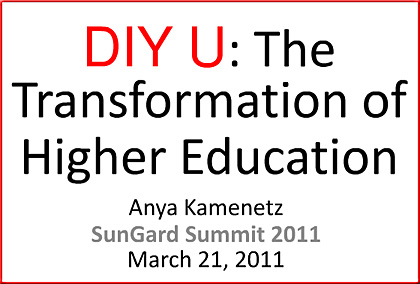
From DSC:
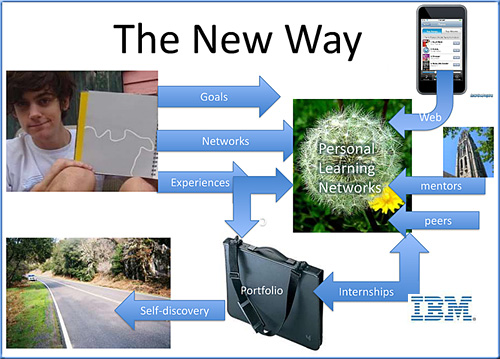
For those of us in more traditional institutions of higher education, if this is where things are heading — or even if pieces of Anya’s presentation come to fruition — what is our response? Strategy?
.
.
From DSC:
For those of us in more traditional institutions of higher education, if this is where things are heading — or even if pieces of Anya’s presentation come to fruition — what is our response? Strategy?

Abstract
A perfect storm has been building within higher education. Numerous, powerful forces have been converging that either already are or soon will be impacting the way higher education is offered and experienced. This paper focuses on one of those forces – the increasing price tag of obtaining a degree within higher education. It will seek to show that what goes up…must come down. Some less expensive alternatives are already here today; but the most significant changes and market “corrections” appear to be right around the corner. That is, higher education is a bubble about to burst.
Traditional instructional methods versus intelligent tutoring systems — from4u-all.com
From DSC:
I’m not crazy about the VS. part here…this post isn’t mean to stir competitive juices or put some folks out there on the defensive. Rather, I thought it had some interesting, understandable things to say about intelligent tutoring systems and what benefits they might provide.
A potential solution to this problem is the use of novel software known as “Intelligent Tutoring Systems” (ITS), with built-in artificial intelligence. These systems, which adapt themselves to the current knowledge stage of the learner and support different learning strategies on an individual basis, could be integrated with the Web for effective training and tutoring.
Intelligent tutoring systems (ITSs) are software programs that give support to the learning activity. These systems can be used in the conventional educational process, distant learning courses as well corporate training, either under the form of CDROMs or as applications that deliver knowledge over the Internet. They present new ways for education, which can change the role of the human tutor or teacher, and enhance it.
They present educational materials in a flexible and personalized way that is similar to one-to-one tutoring. In particular, ITSs have the ability to provide learners with tailored instructions and feedback. The basic underlying idea of ITSs is to realise that each student is unique.
They use simulations and other highly interactive learning environments that require people to apply their knowledge and skills. These active, situated learning environments help them retain and apply knowledge and skills more effectively in operational settings.
An intelligent tutoring system personalizes the instruction based on the background and the progress of each individual student. In this way, the learner is able to receive immediate feedback on his performance. Today, prototype and operational ITS systems provide practice-based instruction to support corporate training, high school and college education, military training etc.
The goal of intelligent tutoring systems is to provide the benefits of one-on-one instruction automatically and cost effectively. Intelligent tutoring systems enable participants to practice their skills by carrying out tasks within highly interactive learning environments…
The world changed, colleges missed it — from edreformer.com by Tom Vander Ark
A bunch of colleges are going out of business, only they don’t know it. They pretend that trimming costs and jacking tuition is a solution. They haven’t come to terms with a world where anyone can learn anything almost anywhere for free or cheap. Art Levine, Woodrow Wilson National Fellowship Foundation, sees three major change forces: new competition, a convergence of knowledge producers, and changing demographics.
…
To Art’s list of three big change forces, add shrinking government support, the press for more accountability, and emerging technology…the next few decades will be marked by a lumpy move to competency-based learning…instant information and the ability to learn anything anywhere.
…
The shift to personal digital learning is on. Some colleges get that. Others will seek bailouts until they go out of business. Working adults are getting smart on their own terms.
.
From DSC:
Time will tell if Tom’s assertions are too harsh here, but personally, I think he’s right.
I have it that:

Specifically, I have it that we should be experimenting with:
.
.
New Business Models for Higher Education — from David Collis, Yale University [via Educause]
Collis assesses the new higher education marketplace, replete with distance learning courses offered online. He reviews the business models of dozens of for-profit Internet based firms entering the higher education market, compares their strategies with those of traditional colleges and universities, and projects the effects of the new entrants on established institutions. Collis concludes that the new firms will move more quickly along a technology-enabled learning trajectory, which in the end will put them at a distinct advantage when they move from their most common point of entry — the corporate market — into the traditional higher education realm.
Traditional schools grow online — from boston.com by D.C. Denison
Students lured by cachet of brick-and-mortar schools’ reputations
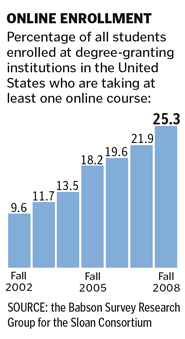
The best-known online players include the University of Phoenix, Walden, and Capella University, with the for-profit Phoenix’s current enrollment of 476,500 students making it the biggest university in North America.
But the brick-and-mortar competition is catching up, from the likes of Northeastern University, Lesley University, and Boston University, while smaller institutions, such as Southern New Hampshire University, in Manchester, are promoting online programs, too.
“It’s hard to think of a college that’s not building its online capability,’’ said Carol Aslanian, a senior vice president of market research at EducationDynamics LLC, a marketing firm that specializes in higher education.
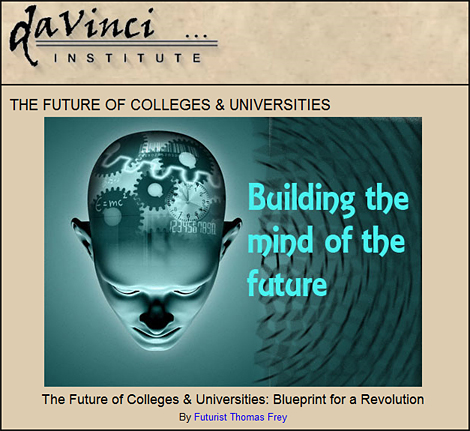
From Spring 2010
…
From DSC:
Most certainly, not everything that Thomas Frey says will take place…but I’ll bet you he’s right on a number of accounts. Whether he’s right or not, the potential scenarios he brings up ought to give us pause to reflect on ways to respond to these situations…on ways to spot and take advantage of the various opportunities that arise (which will only happen to those organizations who are alert and looking for them).
“Stanley Ikenberry, interim president of the University of Illinois, on how students, families and the university all could save money and, at the same time, maintain the quality and integrity of his institution. Ikenberry said a shorter college career, an “accelerated program” that could be in place by fall 2011, would raise revenue for the school while cutting tuition and letting students enter the work force sooner. The president said a combination of distance learning or online courses, placement tests for college credit, high school participation in some programs and, especially, use of summer school could shorten a student’s stay at one of the three campuses.”
From DSC:
I’m not sure what I think about all of the possibilities, but clearly, the environment is pressing us for change. The status quo is no longer an option.
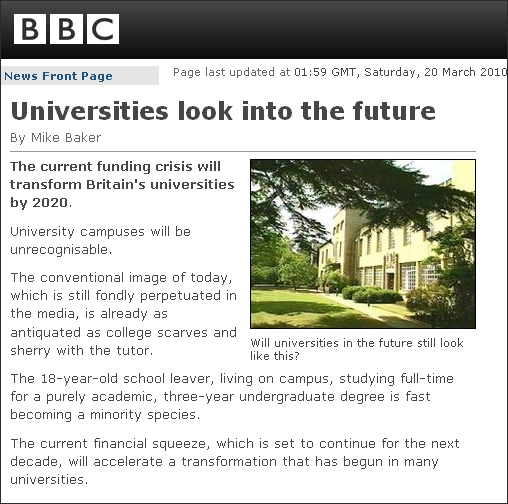
Quotes below — with emphasis from DSC
Already more than one in three students studies part-time and one in six is from overseas.
There will be more mature students, more studying part-time, more living in their own or their parents’ homes, and many more studying online.”
There will be more tailor-made vocational courses, operated in partnership with individual companies and employers.
There will be more “pick-and-mix” degrees, with students accumulating course credits at different universities, even across different countries, and with gaps for employment in between.
Students will increasingly become “consumers” as we reach the tipping-point where their contribution to the cost of the degree is greater than that made by the government.
Private providers will take over an increasing share of the university market.
The all-round university will increasingly lose out to more specialised institutions.
Finally, universities will become more global.
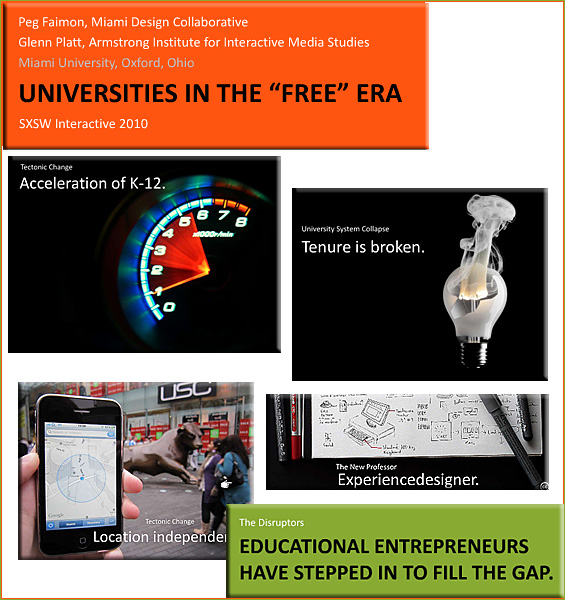
From:
http://www.slideshare.net/glenn.platt/universities-in-the-free-era-sxsw-2010-presentation
Also see:
Links for SXSW 2010 Presentatation: Universities in the “Free” Era
Glenn Platt, Armstrong Institute for Interactive Media Studies
Peg Faimon, Miami Design Collaborative — Miami University
Other food for thought: