“OpenAI’s Atlas: the End of Online Learning—or Just the Beginning?” [Hardman] + other items re: AI in our LE’s

OpenAI’s Atlas: the End of Online Learning—or Just the Beginning? — from drphilippahardman.substack.com by Dr. Philippa Hardman

My take is this: in all of the anxiety lies a crucial and long-overdue opportunity to deliver better learning experiences. Precisely because Atlas perceives the same context in the same moment as you, it can transform learning into a process aligned with core neuro-scientific principles—including active retrieval, guided attention, adaptive feedback and context-dependent memory formation.

Perhaps in Atlas we have a browser that for the first time isn’t just a portal to information, but one which can become a co-participant in active cognitive engagement—enabling iterative practice, reflective thinking, and real-time scaffolding as you move through challenges and ideas online.

With this in mind, I put together 10 use cases for Atlas for you to try for yourself.

6. Retrieval Practice
What:
Pulling information from memory drives retention better than re-reading.
Why: Practice testing delivers medium-to-large effects (Adesope et al., 2017).
Try: Open a document with your previous notes. Ask Atlas for a mixed activity set: “Quiz me on the Krebs cycle—give me a near-miss, high-stretch MCQ, then a fill-in-the-blank, then ask me to explain it to a teen.”
Atlas uses its browser memory to generate targeted questions from your actual study materials, supporting spaced, varied retrieval.


From DSC:
A quick comment. I appreciate these ideas and approaches from Katarzyna and Rita. I do think that someone is going to want to be sure that the AI models/platforms/tools are given up-to-date information and updated instructions — i.e., any new procedures, steps to take, etc. Perhaps I’m missing the boat here, but an internal AI platform is going to need to have access to up-to-date information and instructions.


There is no God Tier video model — from downes.ca by Stephen Downes

From DSC:
Stephen has some solid reflections and asks some excellent questions in this posting, including:

The question is: how do we optimize an AI to support learning? Will one model be enough? Or do we need different models for different learners in different scenarios?


A More Human University: The Role of AI in Learning — from er.educause.edu by Robert Placido
Far from heralding the collapse of higher education, artificial intelligence offers a transformative opportunity to scale meaningful, individualized learning experiences across diverse classrooms.

The narrative surrounding artificial intelligence (AI) in higher education is often grim. We hear dire predictions of an “impending collapse,” fueled by fears of rampant cheating, the erosion of critical thinking, and the obsolescence of the human educator.Footnote1 This dystopian view, however, is a failure of imagination. It mistakes the death rattle of an outdated pedagogical model for the death of learning itself. The truth is far more hopeful: AI is not an asteroid coming for higher education. It is a catalyst that can finally empower us to solve our oldest, most intractable problem: the inability to scale deep, engaged, and truly personalized learning.


Claude for Life Sciences — from anthropic.com

Increasing the rate of scientific progress is a core part of Anthropic’s public benefit mission.

We are focused on building the tools to allow researchers to make new discoveries – and eventually, to allow AI models to make these discoveries autonomously.

Until recently, scientists typically used Claude for individual tasks, like writing code for statistical analysis or summarizing papers. Pharmaceutical companies and others in industry also use it for tasks across the rest of their business, like sales, to fund new research. Now, our goal is to make Claude capable of supporting the entire process, from early discovery through to translation and commercialization.

To do this, we’re rolling out several improvements that aim to make Claude a better partner for those who work in the life sciences, including researchers, clinical coordinators, and regulatory affairs managers.


AI as an access tool for neurodiverse and international staff — from timeshighereducation.com by Vanessa Mar-Molinero
Used transparently and ethically, GenAI can level the playing field and lower the cognitive load of repetitive tasks for admin staff, student support and teachers

Where AI helps without cutting academic corners
When framed as accessibility and quality enhancement, AI can support staff to complete standard tasks with less friction. However, while it supports clarity, consistency and inclusion, generative AI (GenAI) does not replace disciplinary expertise, ethical judgement or the teacher–student relationship. These are ways it can be put to effective use:

  • Drafting and tone calibration:
  • Language scaffolding:
  • Structure and templates: ..
  • Summarise and prioritise:
  • Accessibility by default:
  • Idea generation for pedagogy:
  • Translation and cultural mediation:

Beyond learning design: supporting pedagogical innovation in response to AI — from timeshighereducation.com by Charlotte von Essen
To avoid an unwinnable game of catch-up with technology, universities must rethink pedagogical improvement that goes beyond scaling online learning


The Sleep of Liberal Arts Produces AI — from aiedusimplified.substack.com by Lance Eaton, Ph.D.
A keynote at the AI and the Liberal Arts Symposium Conference

This past weekend, I had the honor to be the keynote speaker at a really fantstistic conferece, AI and the Liberal Arts Symposium at Connecticut College. I had shared a bit about this before with my interview with Lori Looney. It was an incredible conference, thoughtfully composed with a lot of things to chew on and think about.

It was also an entirely brand new talk in a slightly different context from many of my other talks and workshops. It was something I had to build entirely from the ground up. It reminded me in some ways of last year’s “What If GenAI Is a Nothingburger”.

It was a real challenge and one I’ve been working on and off for months, trying to figure out the right balance. It’s a work I feel proud of because of the balancing act I try to navigate. So, as always, it’s here for others to read and engage with. And, of course, here is the slide deck as well (with CC license).


The above posting on LinkedIn then links to this document


Designing Microsoft 365 Copilot to empower educators, students, and staff — from microsoft.com by Deirdre Quarnstrom

While over 80% of respondents in the 2025 AI in Education Report have already used AI for school, we believe there are significant opportunities to design AI that can better serve each of their needs and broaden access to the latest innovation.1

That’s why today [10/15/25], we’re announcing AI-powered experiences built for teaching and learning at no additional cost, new integrations in Microsoft 365 apps and Learning Management Systems, and an academic offering for Microsoft 365 Copilot.

Introducing AI-powered teaching and learning
Empowering educators with Teach

We’re introducing Teach to help streamline class prep and adapt AI to support educators’ teaching expertise with intuitive and customizable features. In one place, educators can easily access AI-powered teaching tools to create lesson plans, draft materials like quizzes and rubrics, and quickly make modifications to language, reading level, length, difficulty, alignment to relevant standards, and more.


10 Tips from Smart Teaching Stronger Learning — from Pooja K. Agarwal, Ph.D.

Per Dr. Pooja Agarwal:

Combining two strategies—spacing and retrieval practice—is key to success in learning, says Shana Carpenter.


On a somewhat related note (i.e., for Instructional Designers, teachers, faculty members, T&L staff members), also see:


“A new L&D operating system for the AI Era?” [Hardman] + other items re: AI in our learning ecosystems

From 70/20/10 to 90/10 — from drphilippahardman.substack.com by Dr Philippa Hardman
A new L&D operating system for the AI Era?

This week I want to share a hypothesis I’m increasingly convinced of: that we are entering an age of the 90/10 model of L&D.

90/10 is a model where roughly 90% of “training” is delivered by AI coaches as daily performance support, and 10% of training is dedicated to developing complex and critical skills via high-touch, human-led learning experiences.

Proponents of 90/10 argue that the model isn’t about learning less, but about learning smarter by defining all jobs to be done as one of the following:

  • Delegate (the dead skills): Tasks that can be offloaded to AI.
  • Co-Create (the 90%): Tasks which well-defined AI agents can augment and help humans to perform optimally.
  • Facilitate (the 10%): Tasks which require high-touch, human-led learning to develop.

So if AI at work is now both real and material, the natural question for L&D is: how do we design for it? The short answer is to stop treating learning as an event and start treating it as a system.


My daughter’s generation expects to learn with AI, not pretend it doesn’t exist, because they know employers expect AI fluency and because AI will be ever-present in their adult lives.

— Jenny Maxell

The above quote was taken from this posting.


Unlocking Young Minds: How Gamified AI Learning Tools Inspire Fun, Personalized, and Powerful Education for Children in 2025 — from techgenyz.com by Sreyashi Bhattacharya

Table of Contents

Highlight

  • Gamified AI Learning Tools personalize education by adapting the difficulty and content to each child’s pace, fostering confidence and mastery.
  • Engaging & Fun: Gamified elements like quests, badges, and stories keep children motivated and enthusiastic.
  • Safe & Inclusive: Attention to equity, privacy, and cultural context ensures responsible and accessible learning.

How to test GenAI’s impact on learning — from timeshighereducation.com by Thibault Schrepel
Rather than speculate on GenAI’s promise or peril, Thibault Schrepel suggests simple teaching experiments to uncover its actual effects

Generative AI in higher education is a source of both fear and hype. Some predict the end of memory, others a revolution in personalised learning. My two-year classroom experiment points to a more modest reality: Artificial intelligence (AI) changes some skills, leaves others untouched and forces us to rethink the balance.

This indicates that the way forward is to test, not speculate. My results may not match yours, and that is precisely the point. Here are simple activities any teacher can use to see what AI really does in their own classroom.

4. Turn AI into a Socratic partner
Instead of being the sole interrogator, let AI play the role of tutor, client or judge. Have students use AI to question them, simulate cross-examination or push back on weak arguments. New “study modes” now built into several foundation models make this kind of tutoring easy to set up. Professors with more technical skills can go further, design their own GPTs or fine-tuned models trained on course content and let students interact directly with them. The point is the practice it creates. Students learn that questioning a machine is part of learning to think like a professional.


Assessment tasks that support human skills — from timeshighereducation.com by Amir Ghapanchi and Afrooz Purarjomandlangrudi
Assignments that focus on exploration, analysis and authenticity offer a road map for university assessment that incorporates AI while retaining its rigour and human elements

Rethinking traditional formats

1. From essay to exploration 
When ChatGPT can generate competent academic essays in seconds, the traditional format’s dominance looks less secure as an assessment task. The future lies in moving from essays as knowledge reproduction to assessments that emphasise exploration and curation. Instead of asking students to write about a topic, challenge them to use artificial intelligence to explore multiple perspectives, compare outputs and critically evaluate what emerges.

Example: A management student asks an AI tool to generate several risk plans, then critiques the AI’s assumptions and identifies missing risks.


What your students are thinking about artificial intelligence — from timeshighereducation.com by Florencia Moore and Agostina Arbia
GenAI has been quickly adopted by students, but the consequences of using it as a shortcut could be grave. A study into how students think about and use GenAI offers insights into how teaching might adapt

However, when asked how AI negatively impacts their academic development, 29 per cent noted a “weakening or deterioration of intellectual abilities due to AI overuse”. The main concern cited was the loss of “mental exercise” and soft skills such as writing, creativity and reasoning.

The boundary between the human and the artificial does not seem so easy to draw, but as the poet Antonio Machado once said: “Traveller, there is no path; the path is made by walking.”


Jelly Beans for Grapes: How AI Can Erode Students’ Creativity — from edsurge.com by Thomas David Moore

There is nothing new about students trying to get one over on their teachers — there are probably cuneiform tablets about it — but when students use AI to generate what Shannon Vallor, philosopher of technology at the University of Edinburgh, calls a “truth-shaped word collage,” they are not only gaslighting the people trying to teach them, they are gaslighting themselves. In the words of Tulane professor Stan Oklobdzija, asking a computer to write an essay for you is the equivalent of “going to the gym and having robots lift the weights for you.”


Deloitte will make Claude available to 470,000 people across its global network — from anthropic.com

As part of the collaboration, Deloitte will establish a Claude Center of Excellence with trained specialists who will develop implementation frameworks, share leading practices across deployments, and provide ongoing technical support to create the systems needed to move AI pilots to production at scale. The collaboration represents Anthropic’s largest enterprise AI deployment to date, available to more than 470,000 Deloitte people.

Deloitte and Anthropic are co-creating a formal certification program to train and certify 15,000 of its professionals on Claude. These practitioners will help support Claude implementations across Deloitte’s network and Deloitte’s internal AI transformation efforts.


How AI Agents are finally delivering on the promise of Everboarding: driving retention when it counts most — from premierconstructionnews.com

Everboarding flips this model. Rather than ending after orientation, everboarding provides ongoing, role-specific training and support throughout the employee journey. It adapts to evolving responsibilities, reinforces standards, and helps workers grow into new roles. For high-turnover, high-pressure environments like retail, it’s a practical solution to a persistent challenge.

AI agents will be instrumental in the success of everboarding initiatives; they can provide a much more tailored training and development process for each individual employee, keeping track of which training modules may need to be completed, or where staff members need or want to develop further. This personalisation helps staff to feel not only more satisfied with their current role, but also guides them on the right path to progress in their individual careers.

Digital frontline apps are also ideal for everboarding. They offer bite-sized training that staff can complete anytime, whether during quiet moments on shift or in real time on the job, all accessible from their mobile devices.


TeachLM: insights from a new LLM fine-tuned for teaching & learning — from drphilippahardman.substack.com by Dr Philippa Hardman
Six key takeaways, including what the research tells us about how well AI performs as an instructional designer

As I and many others have pointed out in recent months, LLMs are great assistants but very ineffective teachers. Despite the rise of “educational LLMs” with specialised modes (e.g. Anthropic’s Learning Mode, OpenAI’s Study Mode, Google’s Guided Learning) AI typically eliminates the productive struggle, open exploration and natural dialogue that are fundamental to learning.

This week, Polygence, in collaboration with Stanford University researcher Prof Dora Demszky. published a first-of-its-kind research on a new model — TeachLM — built to address this gap.

In this week’s blog post, I deep dive what the research found and share the six key findings — including reflections on how well TeachLM performs on instructional design.


The Dangers of using AI to Grade — from marcwatkins.substack.com by Marc Watkins
Nobody Learns, Nobody Gains

AI as an assessment tool represents an existential threat to education because no matter how you try and establish guardrails or best practices around how it is employed, using the technology in place of an educator ultimately cedes human judgment to a machine-based process. It also devalues the entire enterprise of education and creates a situation where the only way universities can add value to education is by further eliminating costly human labor.

For me, the purpose of higher education is about human development, critical thinking, and the transformative experience of having your ideas taken seriously by another human being. That’s not something we should be in a rush to outsource to a machine.


From EdTech to TechEd: The next chapter in learning’s evolution — from linkedin.com by Lev Gonick

A day in the life: The next 25 years
A learner wakes up. Their AI-powered learning coach welcomes them, drawing their attention to their progress and helping them structure their approach to the day.  A notification reminds them of an upcoming interview and suggests reflections to add to their learning portfolio.

Rather than a static gradebook, their portfolio is a dynamic, living record, curated by the student, validated by mentors in both industry and education, and enriched through co-creation with maturing modes of AI. It tells a story through essays, code, music, prototypes, journal reflections, and team collaborations. These artifacts are not “submitted”, they are published, shared, and linked to verifiable learning outcomes.

And when it’s time to move, to a new institution, a new job, or a new goal, their data goes with them, immutable, portable, verifiable, and meaningful.

From DSC:
And I would add to that last solid sentence that the learner/student/employee will be able to control who can access this information. Anyway, some solid reflections here from Lev.


AI Could Surpass Schools for Academic Learning in 5-10 Years — from downes.ca with commentary from Stephen Downes

I know a lot of readers will disagree with this, and the timeline feels aggressive (the future always arrives more slowly than pundits expect) but I think the overall premise is sound: “The concept of a tipping point in education – where AI surpasses traditional schools as the dominant learning medium – is increasingly plausible based on current trends, technological advancements, and expert analyses.”


The world’s first AI cabinet member — from therundown.ai by Zach Mink, Rowan Cheung, Shubham Sharma, Joey Liu & Jennifer Mossalgue

The Rundown: In this tutorial, you will learn how to combine NotebookLM with ChatGPT to master any subject faster, turning dense PDFs into interactive study materials with summaries, quizzes, and video explanations.

Step-by-step:

  1. Go to notebooklm.google.com, click the “+” button, and upload your PDF study material (works best with textbooks or technical documents)
  2. Choose your output mode: Summary for a quick overview, Mind Map for visual connections, or Video Overview for a podcast-style explainer with visuals
  3. Generate a Study Guide under Reports — get Q&A sets, short-answer questions, essay prompts, and glossaries of key terms automatically
  4. Take your PDF to ChatGPT and prompt: “Read this chapter by chapter and highlight confusing parts” or “Quiz me on the most important concepts”
  5. Combine both tools: Use NotebookLM for quick context and interactive guides, then ChatGPT to clarify tricky parts and go deeperPro Tip: If your source is in EPUB or audiobook, convert it to PDF before uploading. Both NotebookLM and ChatGPT handle PDFs best.

Claude can now create and edit files — from anthropic.com

Claude can now create and edit Excel spreadsheets, documents, PowerPoint slide decks, and PDFs directly in Claude.ai and the desktop app. This transforms how you work with Claude—instead of only receiving text responses or in-app artifacts, you can describe what you need, upload relevant data, and get ready-to-use files in return.

Also see:

  • Microsoft to lessen reliance on OpenAI by buying AI from rival Anthropic — from techcrunch.com byRebecca Bellan
    Microsoft will pay to use Anthropic’s AI in Office 365 apps, The Information reports, citing two sources. The move means that Anthropic’s tech will help power new features in Word, Excel, Outlook, and PowerPoint alongside OpenAI’s, marking the end of Microsoft’s previous reliance solely on the ChatGPT maker for its productivity suite. Microsoft’s move to diversify its AI partnerships comes amid a growing rift with OpenAI, which has pursued its own infrastructure projects as well as a potential LinkedIn competitor.

Ep. 11 AGI and the Future of Higher Ed: Talking with Ray Schroeder

In this episode of Unfixed, we talk with Ray Schroeder—Senior Fellow at UPCEA and Professor Emeritus at the University of Illinois Springfield—about Artificial General Intelligence (AGI) and what it means for the future of higher education. While most of academia is still grappling with ChatGPT and basic AI tools, Schroeder is thinking ahead to AI agents, human displacement, and AGI’s existential implications for teaching, learning, and the university itself. We explore why AGI is so controversial, what institutions should be doing now to prepare, and how we can respond responsibly—even while we’re already overwhelmed.


Best AI Tools for Instructional Designers — from blog.cathy-moore.com by Cathy Moore

Data from the State of AI and Instructional Design Report revealed that 95.3% of the instructional designers interviewed use AI in their daily work [1]. And over 85% of this AI use occurs during the design and development process.

These figures showcase the immense impact AI is already having on the instructional design world.

If you’re an L&D professional still on the fence about adding AI to your workflow or an AI convert looking for the next best tools, keep reading.

This guide breaks down 5 of the top AI tools for instructional designers in 2025, so you can streamline your development processes and build better training faster.

But before we dive into the tools of the trade, let’s address the elephant in the room:


3 Human Skills That Make You Irreplaceable in an AI World — from gettingsmart.com/ by Tom Vander Ark and Mason Pashia

Key Points

  • Update learner profiles to emphasize curiosity, curation, and connectivity, ensuring students develop irreplaceable human skills.
  • Integrate real-world learning experiences and mastery-based assessments to foster agency, purpose, and motivation in students.
 

Miro and GenAI as drivers of online student engagement — from timeshighereducation.com by Jaime Eduardo Moncada Garibay
A set of practical strategies for transforming passive online student participation into visible, measurable and purposeful engagement through the use of Miro, enhanced by GenAI

To address this challenge, I shifted my focus from requesting participation to designing it. This strategic change led me to integrate Miro, a visual digital workspace, into my classes. Miro enables real-time visualisation and co-creation of ideas, whether individually or in teams.

The transition from passive attendance to active engagement in online classes requires deliberate instructional design. Tools such as Miro, enhanced by GenAI, enable educators to create structured, visually rich learning environments in which participation is both expected and documented.

While technology provides templates, frames, timers and voting features, its real pedagogical value emerges through intentional facilitation, where the educator’s role shifts from delivering content to orchestrating collaborative, purposeful learning experiences.


Benchmarking Online Education with Bruce Etter and Julie Uranis — from buzzsprout.com by Derek Bruff

Here are some that stood out to me:

  • In the past, it was typical for faculty to teach online courses as an “overload” of some kind, but BOnES data show that 92% of online programs feature courses taught as part of faculty member’s standard teaching responsibilities. Online teaching has become one of multiple modalities in which faculty teach regularly.
  • Three-quarters of chief online officers surveyed said they plan to have a great market share of online enrollments in the future, but only 23% said their current marketing is better than their competitors. The rising tide of online enrollments won’t lift all boats–some institutions will fare better than others.
  • Staffing at online education units is growing, with the median staff size increasing from 15 last year to 20 this year. Julie pointed out that successful online education requires investment of resources. You might need as many buildings as onsite education does, but you need people and you need technology.


The 2025 Changing Landscape of Online Education (CHLOE) 10 Report — from qualitymatters.org; emphasis below from DSC

Notable findings from the 73-page report include: 

  • Online Interest Surges Across Student Populations: 
  • Institutional Preparedness Falters Amid Rising Demand: Despite accelerating demand, institutional readiness has stagnated—or regressed—in key areas.
  • The Online Education Marketplace Is Increasingly Competitive: …
  • Alternative Credentials Take Center Stage: …
  • AI Integration Lacks Strategic Coordination: …

Just 28% of faculty are considered fully prepared for online course design, and 45% for teaching. Alarmingly, only 28% of institutions report having fully developed academic continuity plans for future emergency pivots to online.


Also relevant, see:


Great Expectations, Fragile Foundations — from onedtech.philhillaa.com by Glenda Morgan
Lessons about growth from the CHLOE & BOnES reports

Cultural resistance remains strong. Many [Chief Online Learning Officers] COLOs say faculty and deans still believe in-person learning is “just better,” creating headwinds even for modest online growth. As one respondent at a four-year institution with a large online presence put it:

Supportive departments [that] see the value in online may have very different levels of responsiveness compared to academic departments [that] are begrudgingly online. There is definitely a growing belief that students “should” be on-ground and are only choosing online because it’s easy/ convenient. Never mind the very real and growing population of nontraditional learners who can only take online classes, and the very real and growing population of traditional-aged learners who prefer online classes; many faculty/deans take a paternalistic, “we know what’s best” approach.


Ultimately, what we need is not just more ambition but better ambition. Ambition rooted in a realistic understanding of institutional capacity, a shared strategic vision, investments in policy and infrastructure, and a culture that supports online learning as a core part of the academic mission, not an auxiliary one. It’s time we talked about what it really takes to grow online learning , and where ambition needs to be matched by structure.

From DSC:
Yup. Culture is at the breakfast table again…boy, those strategies taste good.

I’d like to take some of this report — like the graphic below — and share it with former faculty members and members of a couple of my past job families’ leadership. They strongly didn’t agree with us when we tried to advocate for the development of online-based learning/programs at our organizations…but we were right. We were right all along. And we were LEADING all along. No doubt about it — even if the leadership at the time said that we weren’t leading.

The cultures of those organizations hurt us at the time. But our cultivating work eventually led to the development of online programs — unfortunately, after our groups were disbanded, they had to outsource those programs to OPMs.


Arizona State University — with its dramatic growth in online-based enrollments.


BREAKING: Google introduces Guided Learning — from aieducation.substack.com by Claire Zau
Some thoughts on what could make Google’s AI tutor stand out

Another major AI lab just launched “education mode.”

Google introduced Guided Learning in Gemini, transforming it into a personalized learning companion designed to help you move from quick answers to real understanding.

Instead of immediately spitting out solutions, it:

  • Asks probing, open-ended questions
  • Walks learners through step-by-step reasoning
  • Adapts explanations to the learner’s level
  • Uses visuals, videos, diagrams, and quizzes to reinforce concepts

This Socratic style tutor rollout follows closely behind similar announcements like OpenAI’s Study Mode (last week) and Anthropic’s Claude for Education (April 2025).


How Sci-Fi Taught Me to Embrace AI in My Classroom — from edsurge.com by Dan Clark

I’m not too naive to understand that, no matter how we present it, some students will always be tempted by “the dark side” of AI. What I also believe is that the future of AI in education is not decided. It will be decided by how we, as educators, embrace or demonize it in our classrooms.

My argument is that setting guidelines and talking to our students honestly about the pitfalls and amazing benefits that AI offers us as researchers and learners will define it for the coming generations.

Can AI be the next calculator? Something that, yes, changes the way we teach and learn, but not necessarily for the worse? If we want it to be, yes.

How it is used, and more importantly, how AI is perceived by our students, can be influenced by educators. We have to first learn how AI can be used as a force for good. If we continue to let the dominant voice be that AI is the Terminator of education and critical thinking, then that will be the fate we have made for ourselves.


AI Tools for Strategy and Research – GT #32 — from goodtools.substack.com by Robin Good
Getting expert advice, how to do deep research with AI, prompt strategy, comparing different AIs side-by-side, creating mini-apps and an AI Agent that can critically analyze any social media channel

In this issue, discover AI tools for:

  • Getting Expert Advice
  • Doing Deep Research with AI
  • Improving Your AI Prompt Strategy
  • Comparing Results from Different AIs
  • Creating an AI Agent for Social Media Analysis
  • Summarizing YouTube Videos
  • Creating Mini-Apps with AI
  • Tasting an Award-Winning AI Short Film

GPT-Building, Agentic Workflow Design & Intelligent Content Curation — from drphilippahardman.substack.com by Dr. Philippa Hardman
What 3 recent job ads reveal about the changing nature of Instructional Design

In this week’s blog post, I’ll share my take on how the instructional design role is evolving and discuss what this means for our day-to-day work and the key skills it requires.

With this in mind, I’ve been keeping a close eye on open instructional design roles and, in the last 3 months, have noticed the emergence of a new flavour of instructional designer: the so-called “Generative AI Instructional Designer.”

Let’s deep dive into three explicitly AI-focused instructional design positions that have popped up in the last quarter. Each one illuminates a different aspect of how the role is changing—and together, they paint a picture of where our profession is likely heading.

Designers who evolve into prompt engineers, agent builders, and strategic AI advisors will capture the new premium. Those who cling to traditional tool-centric roles may find themselves increasingly sidelined—or automated out of relevance.


Google to Spend $1B on AI Training in Higher Ed — from insidehighered.com by Katherine Knott

Google’s parent company announced Wednesday (8/6/25) that it’s planning to spend $1 billion over the next three years to help colleges teach and train students about artificial intelligence.

Google is joining other AI companies, including OpenAI and Anthropic, in investing in AI training in higher education. All three companies have rolled out new tools aimed at supporting “deeper learning” among students and made their AI platforms available to certain students for free.


5 Predictions for How AI Will Impact Community Colleges — from pistis4edu.substack.com by Feng Hou

Based on current technology capabilities, adoption patterns, and the mission of community colleges, here are five well-supported predictions for AI’s impact in the coming years.

  1. Universal AI Tutor Access
  2. AI as Active Teacher
  3. Personalized Learning Pathways
  4. Interactive Multimodal Learning
  5. Value-Centric Education in an AI-Abundant World


From DSC:
In looking at
 
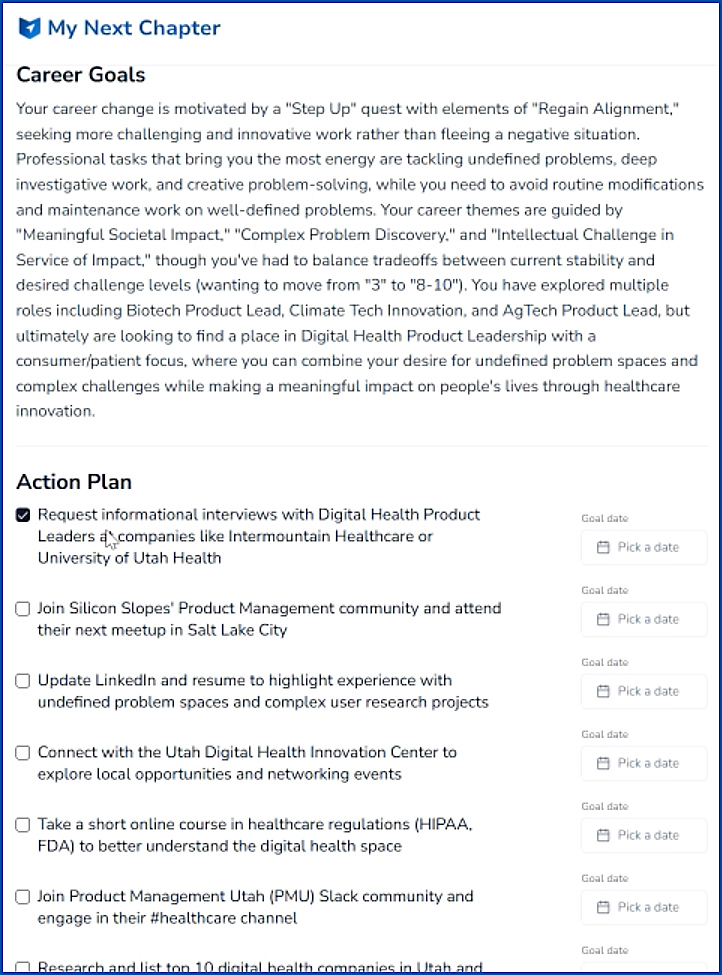
MyNextChapter.ai — THIS TYPE OF FUNCTIONALITY of an AI-based chatbot talking to you re: good fits for a future job — is the kind of thing that could work well in this type of vision/learning platform. The AI asks you relevant career-oriented questions, comes up with some potential job fits, and then gives you resources about how to gain those skills, who to talk with, organizations to join, next steps to get your foot in the door somewhere, etc.

The next gen learning platform would provide links to online-based courses, blogs, peoples’ names on LinkedIn, courses from L&D organizations or from institutions of higher education or from other entities/places to obtain those skills (similar to the ” Action Plan” below from MyNextChapter.ai).


“Using AI Right Now: A Quick Guide” [Molnick] + other items re: AI in our learning ecosystems

Thoughts on thinking — from dcurt.is by Dustin Curtis

Intellectual rigor comes from the journey: the dead ends, the uncertainty, and the internal debate. Skip that, and you might still get the insight–but you’ll have lost the infrastructure for meaningful understanding. Learning by reading LLM output is cheap. Real exercise for your mind comes from building the output yourself.

The irony is that I now know more than I ever would have before AI. But I feel slightly dumber. A bit more dull. LLMs give me finished thoughts, polished and convincing, but none of the intellectual growth that comes from developing them myself. 


Using AI Right Now: A Quick Guide — from oneusefulthing.org by Ethan Mollick
Which AIs to use, and how to use them

Every few months I put together a guide on which AI system to use. Since I last wrote my guide, however, there has been a subtle but important shift in how the major AI products work. Increasingly, it isn’t about the best model, it is about the best overall system for most people. The good news is that picking an AI is easier than ever and you have three excellent choices. The challenge is that these systems are getting really complex to understand. I am going to try and help a bit with both.

First, the easy stuff.

Which AI to Use
For most people who want to use AI seriously, you should pick one of three systems: Claude from Anthropic, Google’s Gemini, and OpenAI’s ChatGPT.

Also see:


Student Voice, Socratic AI, and the Art of Weaving a Quote — from elmartinsen.substack.com by Eric Lars Martinsen
How a custom bot helps students turn source quotes into personal insight—and share it with others

This summer, I tried something new in my fully online, asynchronous college writing course. These classes have no Zoom sessions. No in-person check-ins. Just students, Canvas, and a lot of thoughtful design behind the scenes.

One activity I created was called QuoteWeaver—a PlayLab bot that helps students do more than just insert a quote into their writing.

Try it here

It’s a structured, reflective activity that mimics something closer to an in-person 1:1 conference or a small group quote workshop—but in an asynchronous format, available anytime. In other words, it’s using AI not to speed students up, but to slow them down.

The bot begins with a single quote that the student has found through their own research. From there, it acts like a patient writing coach, asking open-ended, Socratic questions such as:

What made this quote stand out to you?
How would you explain it in your own words?
What assumptions or values does the author seem to hold?
How does this quote deepen your understanding of your topic?
It doesn’t move on too quickly. In fact, it often rephrases and repeats, nudging the student to go a layer deeper.


The Disappearance of the Unclear Question — from jeppestricker.substack.com Jeppe Klitgaard Stricker
New Piece for UNESCO Education Futures

On [6/13/25], UNESCO published a piece I co-authored with Victoria Livingstone at Johns Hopkins University Press. It’s called The Disappearance of the Unclear Question, and it’s part of the ongoing UNESCO Education Futures series – an initiative I appreciate for its thoughtfulness and depth on questions of generative AI and the future of learning.

Our piece raises a small but important red flag. Generative AI is changing how students approach academic questions, and one unexpected side effect is that unclear questions – for centuries a trademark of deep thinking – may be beginning to disappear. Not because they lack value, but because they don’t always work well with generative AI. Quietly and unintentionally, students (and teachers) may find themselves gradually avoiding them altogether.

Of course, that would be a mistake.

We’re not arguing against using generative AI in education. Quite the opposite. But we do propose that higher education needs a two-phase mindset when working with this technology: one that recognizes what AI is good at, and one that insists on preserving the ambiguity and friction that learning actually requires to be successful.


Leveraging GenAI to Transform a Traditional Instructional Video into Engaging Short Video Lectures — from er.educause.edu by Hua Zheng

By leveraging generative artificial intelligence to convert lengthy instructional videos into micro-lectures, educators can enhance efficiency while delivering more engaging and personalized learning experiences.


This AI Model Never Stops Learning — from link.wired.com by Will Knight

Researchers at Massachusetts Institute of Technology (MIT) have now devised a way for LLMs to keep improving by tweaking their own parameters in response to useful new information.

The work is a step toward building artificial intelligence models that learn continually—a long-standing goal of the field and something that will be crucial if machines are to ever more faithfully mimic human intelligence. In the meantime, it could give us chatbots and other AI tools that are better able to incorporate new information including a user’s interests and preferences.

The MIT scheme, called Self Adapting Language Models (SEAL), involves having an LLM learn to generate its own synthetic training data and update procedure based on the input it receives.


Edu-Snippets — from scienceoflearning.substack.com by Nidhi Sachdeva and Jim Hewitt
Why knowledge matters in the age of AI; What happens to learners’ neural activity with prolonged use of LLMs for writing

Highlights:

  • Offloading knowledge to Artificial Intelligence (AI) weakens memory, disrupts memory formation, and erodes the deep thinking our brains need to learn.
  • Prolonged use of ChatGPT in writing lowers neural engagement, impairs memory recall, and accumulates cognitive debt that isn’t easily reversed.
 

Mary Meeker AI Trends Report: Mind-Boggling Numbers Paint AI’s Massive Growth Picture — from ndtvprofit.com
Numbers that prove AI as a tech is unlike any other the world has ever seen.

Here are some incredibly powerful numbers from Mary Meeker’s AI Trends report, which showcase how artificial intelligence as a tech is unlike any other the world has ever seen.

  • AI took only three years to reach 50% user adoption in the US; mobile internet took six years, desktop internet took 12 years, while PCs took 20 years.
  • ChatGPT reached 800 million users in 17 months and 100 million in only two months, vis-à-vis Netflix’s 100 million (10 years), Instagram (2.5 years) and TikTok (nine months).
  • ChatGPT hit 365 billion annual searches in two years (2024) vs. Google’s 11 years (2009)—ChatGPT 5.5x faster than Google.

Above via Mary Meeker’s AI Trend-Analysis — from getsuperintel.com by Kim “Chubby” Isenberg
How AI’s rapid rise, efficiency race, and talent shifts are reshaping the future.

The TLDR
Mary Meeker’s new AI trends report highlights an explosive rise in global AI usage, surging model efficiency, and mounting pressure on infrastructure and talent. The shift is clear: AI is no longer experimental—it’s becoming foundational, and those who optimize for speed, scale, and specialization will lead the next wave of innovation.


Also see Meeker’s actual report at:

Trends – Artificial Intelligence — from bondcap.com by Mary Meeker / Jay Simons / Daegwon Chae / Alexander Krey


The Rundown: Meta aims to release tools that eliminate humans from the advertising process by 2026, according to a report from the WSJ — developing an AI that can create ads for Facebook and Instagram using just a product image and budget.

The details:

  • Companies would submit product images and budgets, letting AI craft the text and visuals, select target audiences, and manage campaign placement.
  • The system will be able to create personalized ads that can adapt in real-time, like a car spot featuring mountains vs. an urban street based on user location.
  • The push would target smaller companies lacking dedicated marketing staff, promising professional-grade advertising without agency fees or skillset.
  • Advertising is a core part of Mark Zuckerberg’s AI strategy and already accounts for 97% of Meta’s annual revenue.

Why it matters: We’re already seeing AI transform advertising through image, video, and text, but Zuck’s vision takes the process entirely out of human hands. With so much marketing flowing through FB and IG, a successful system would be a major disruptor — particularly for small brands that just want results without the hassle.


“The AI-enhanced learning ecosystem” [Jennings] + other items re: AI in our learning ecosystems

The AI-enhanced learning ecosystem: A case study in collaborative innovation — from chieflearningofficer.com by Kevin Jennings
How artificial intelligence can serve as a tool and collaborative partner in reimagining content development and management.

Learning and development professionals face unprecedented challenges in today’s rapidly evolving business landscape. According to LinkedIn’s 2025 Workplace Learning Report, 67 percent of L&D professionals report being “maxed out” on capacity, while 66 percent have experienced budget reductions in the past year.

Despite these constraints, 87 percent agree their organizations need to develop employees faster to keep pace with business demands. These statistics paint a clear picture of the pressure L&D teams face: do more, with less, faster.

This article explores how one L&D leader’s strategic partnership with artificial intelligence transformed these persistent challenges into opportunities, creating a responsive learning ecosystem that addresses the modern demands of rapid product evolution and diverse audience needs. With 71 percent of L&D professionals now identifying AI as a high or very high priority for their learning strategy, this case study demonstrates how AI can serve not merely as a tool but as a collaborative partner in reimagining content development and management.
.


How we use GenAI and AR to improve students’ design skills — from timeshighereducation.com by Antonio Juarez, Lesly Pliego and Jordi Rábago who are professors of architecture at Monterrey Institute of Technology in Mexico; Tomas Pachajoa is a professor of architecture at the El Bosque University in Colombia; & Carlos Hinrichsen and Marietta Castro are educators at San Sebastián University in Chile.
Guidance on using generative AI and augmented reality to enhance student creativity, spatial awareness and interdisciplinary collaboration

Blend traditional skills development with AI use
For subjects that require students to develop drawing and modelling skills, have students create initial design sketches or models manually to ensure they practise these skills. Then, introduce GenAI tools such as Midjourney, Leonardo AI and ChatGPT to help students explore new ideas based on their original concepts. Using AI at this stage broadens their creative horizons and introduces innovative perspectives, which are crucial in a rapidly evolving creative industry.

Provide step-by-step tutorials, including both written guides and video demonstrations, to illustrate how initial sketches can be effectively translated into AI-generated concepts. Offer example prompts to demonstrate diverse design possibilities and help students build confidence using GenAI.

Integrating generative AI and AR consistently enhanced student engagement, creativity and spatial understanding on our course. 


How Texas is Preparing Higher Education for AI — from the74million.org by Kate McGee
TX colleges are thinking about how to prepare students for a changing workforce and an already overburdened faculty for new challenges in classrooms.

“It doesn’t matter if you enter the health industry, banking, oil and gas, or national security enterprises like we have here in San Antonio,” Eighmy told The Texas Tribune. “Everybody’s asking for competency around AI.”

It’s one of the reasons the public university, which serves 34,000 students, announced earlier this year that it is creating a new college dedicated to AI, cyber security, computing and data science. The new college, which is still in the planning phase, would be one of the first of its kind in the country. UTSA wants to launch the new college by fall 2025.

But many state higher education leaders are thinking beyond that. As AI becomes a part of everyday life in new, unpredictable ways, universities across Texas and the country are also starting to consider how to ensure faculty are keeping up with the new technology and students are ready to use it when they enter the workforce.


In the Room Where It Happens: Generative AI Policy Creation in Higher Education — from er.educause.edu by Esther Brandon, Lance Eaton, Dana Gavin, and Allison Papini

To develop a robust policy for generative artificial intelligence use in higher education, institutional leaders must first create “a room” where diverse perspectives are welcome and included in the process.


Q&A: Artificial Intelligence in Education and What Lies Ahead — from usnews.com by Sarah Wood
Research indicates that AI is becoming an essential skill to learn for students to succeed in the workplace.

Q: How do you expect to see AI embraced more in the future in college and the workplace?
I do believe it’s going to become a permanent fixture for multiple reasons. I think the national security imperative associated with AI as a result of competing against other nations is going to drive a lot of energy and support for AI education. We also see shifts across every field and discipline regarding the usage of AI beyond college. We see this in a broad array of fields, including health care and the field of law. I think it’s here to stay and I think that means we’re going to see AI literacy being taught at most colleges and universities, and more faculty leveraging AI to help improve the quality of their instruction. I feel like we’re just at the beginning of a transition. In fact, I often describe our current moment as the ‘Ask Jeeves’ phase of the growth of AI. There’s a lot of change still ahead of us. AI, for better or worse, it’s here to stay.


AI-Generated Podcasts Outperform Textbooks in Landmark Education Study — form linkedin.com by David Borish

A new study from Drexel University and Google has demonstrated that AI-generated educational podcasts can significantly enhance both student engagement and learning outcomes compared to traditional textbooks. The research, involving 180 college students across the United States, represents one of the first systematic investigations into how artificial intelligence can transform educational content delivery in real-time.


What can we do about generative AI in our teaching?  — from linkedin.com by Kristina Peterson

So what can we do?

  • Interrogate the Process: We can ask ourselves if we I built in enough checkpoints. Steps that can’t be faked. Things like quick writes, question floods, in-person feedback, revision logs.
  • Reframe AI: We can let students use AI as a partner. We can show them how to prompt better, revise harder, and build from it rather than submit it. Show them the difference between using a tool and being used by one.
  • Design Assignments for Curiosity, Not Compliance: Even the best of our assignments need to adapt. Mine needs more checkpoints, more reflective questions along the way, more explanation of why my students made the choices they did.

Teachers Are Not OK — from 404media.co by Jason Koebler

The response from teachers and university professors was overwhelming. In my entire career, I’ve rarely gotten so many email responses to a single article, and I have never gotten so many thoughtful and comprehensive responses.

One thing is clear: teachers are not OK.

In addition, universities are contracting with companies like Microsoft, Adobe, and Google for digital services, and those companies are constantly pushing their AI tools. So a student might hear “don’t use generative AI” from a prof but then log on to the university’s Microsoft suite, which then suggests using Copilot to sum up readings or help draft writing. It’s inconsistent and confusing.

I am sick to my stomach as I write this because I’ve spent 20 years developing a pedagogy that’s about wrestling with big ideas through writing and discussion, and that whole project has been evaporated by for-profit corporations who built their systems on stolen work. It’s demoralizing.


Also relevant/see:


Report: 93% of Students Believe Gen AI Training Belongs in Degree Programs — from campustechnology.com by Rhea Kelly

The vast majority of today’s college students — 93% — believe generative AI training should be included in degree programs, according to a recent Coursera report. What’s more, 86% of students consider gen AI the most crucial technical skill for career preparation, prioritizing it above in-demand skills such as data strategy and software development. And 94% agree that microcredentials help build the essential skills they need to achieve career success.

For its Microcredentials Impact Report 2025, Coursera surveyed more than 1,200 learners and 1,000 employers around the globe to better understand the demand for microcredentials and their impact on workforce readiness and hiring trends.


1 in 4 employers say they’ll eliminate degree requirements by year’s end — from hrdive.com by Carolyn Crist
Companies that recently removed degree requirements reported a surge in applications, a more diverse applicant pool and the ability to offer lower salaries.

A quarter of employers surveyed said they will remove bachelor’s degree requirements for some roles by the end of 2025, according to a May 20 report from Resume Templates.

In addition, 7 in 10 hiring managers said their company looks at relevant experience over a bachelor’s degree while making hiring decisions.

In the survey of 1,000 hiring managers, 84% of companies that recently removed degree requirements said it has been a successful move. Companies without degree requirements also reported a surge in applications, a more diverse applicant pool and the ability to offer lower salaries.


Why AI literacy is now a core competency in education — from weforum.org by Tanya Milberg

  • Education systems must go beyond digital literacy and embrace AI literacy as a core educational priority.
  • A new AI Literacy Framework (AILit) aims to empower learners to navigate an AI-integrated world with confidence and purpose.
  • Here’s what you need to know about the AILit Framework – and how to get involved in making it a success.

Also from Allison Salisbury, see:

 
© 2025 | Daniel Christian